
Sign up to save your podcasts
Or



Based on Podcast App listening data
In this conversation, Becky Pallone and Michael Hart discuss how their phonemic awareness instruction has evolved over time. They emphasize the importance of blending and segmenting as key skills in phonemic awareness and highlight the benefits of incorporating letters in phonemic awareness instruction. They will also provide practical tips for you!
Takeaways
Resources
Looking for more literacy support and resources? Explore all of our podcast episodes, free listening guides, and classroom tools at literacypodcast.com.
Interested in bringing Melissa & Lori Love Literacy to your school or event? Email us at [email protected].
Melissa and Lori just returned from the Plain Talk About Literacy & Learning Conference in New Orleans and they will share their takeaways with YOU! Attendees called in while at the conference to share aha moments and key takeaways. You won't want to miss this one!
2024 Plain Talk Conference Presenters
Podcast Episodes We Mentioned
Looking for more literacy support and resources? Explore all of our podcast episodes, free listening guides, and classroom tools at literacypodcast.com.
Interested in bringing Melissa & Lori Love Literacy to your school or event? Email us at [email protected].
Matt Burns discusses the importance of phonemic awareness in reading instruction. Phonemic awareness is an outcome of skilled reading, not a precursor, and it has a reciprocal relationship with reading. Matt also emphasizes the need to focus on decoding skills in second, third, and fourth grade, rather than solely on phonemic awareness. Matt provides practical takeaways for teachers and recommends additional resources for learning about phonemic awareness.
Takeaways
Resources
Looking for more literacy support and resources? Explore all of our podcast episodes, free listening guides, and classroom tools at literacypodcast.com.
Interested in bringing Melissa & Lori Love Literacy to your school or event? Email us at [email protected].
Shayne Piasta discusses best practices for teaching alphabet knowledge. She tells us what the research suggests about teaching letter names and sounds, why teaching a letter of the week may not be the most effective approach, and an order to teach letters. The best part? She shares concrete ideas and strategies for classroom practice.
Takeaways
Resources
Looking for more literacy support and resources? Explore all of our podcast episodes, free listening guides, and classroom tools at literacypodcast.com.
Interested in bringing Melissa & Lori Love Literacy to your school or event? Email us at [email protected].
Summary
In this episode, the hosts discuss the RAND Model, a heuristic for thinking about reading comprehension. The model was developed in the late 1990s by the RAND Corporation in response to a need for more research on comprehension. The model considers three main components: the reader, the text, and the purpose or activity of reading. It emphasizes the active role of the reader in constructing meaning from the text and highlights the importance of text complexity, coherence, genre, and the context in which reading takes place. The hosts also explore the challenges of measuring reading comprehension and suggest a curriculum-based assessment approach.
Takeaways
Resources
Looking for more literacy support and resources? Explore all of our podcast episodes, free listening guides, and classroom tools at literacypodcast.com.
Interested in bringing Melissa & Lori Love Literacy to your school or event? Email us at [email protected].
Summary
In this episode, Hugh Catts discusses two popular reading models: the Simple View of Reading and Scarborough's Reading Rope. The Simple View of Reading highlights the importance of word recognition and language comprehension in reading comprehension. It emphasizes that if a child struggles in one area, it will affect their overall reading comprehension. Scarborough's Reading Rope provides a more detailed breakdown of the components involved in reading, including background knowledge, vocabulary, language structures, verbal reasoning, strategies, and literacy knowledge. Both models help educators understand the complexity of reading and the interaction between different components.
Takeaways
Resources
Looking for more literacy support and resources? Explore all of our podcast episodes, free listening guides, and classroom tools at literacypodcast.com.
Interested in bringing Melissa & Lori Love Literacy to your school or event? Email us at [email protected].
Summary
In this episode, the hosts discuss the five pillars from the National Reading Panel and their history. They explore the confusion that can arise from viewing these pillars as a model of how reading works. The role of fluency and the importance of differentiating instruction for the five pillars are also discussed. The conversation concludes with a reevaluation of the five pillars and a key takeaway to look beyond them. The next episodes will cover three other reading models.
Takeaways
Resources
Looking for more literacy support and resources? Explore all of our podcast episodes, free listening guides, and classroom tools at literacypodcast.com.
Interested in bringing Melissa & Lori Love Literacy to your school or event? Email us at [email protected].
FROM MARCH 10, 2023
Today we’ll be talking to a team of authors about a recent article they published on small group instruction, titled Maximizing Small-Group Reading Instruction. We ask and answer important questions about small group instructional time: What is the appeal of small group reading instruction? Why has it been popular? What does the research say? What do we need to know about effective small-group reading instruction? What are some best practices?
Resources
Looking for more literacy support and resources? Explore all of our podcast episodes, free listening guides, and classroom tools at literacypodcast.com.
Interested in bringing Melissa & Lori Love Literacy to your school or event? Email us at [email protected].
Why shouldn’t we level students?
Professor and researcher Kristin Conradi-Smith from episode 143 says, “We lack research for differentiation by text levels.There's simply no support for it.” Teaching with a leveled reading, sometimes known as guided reading, approach isn’t the most effective way to teach or learn to read.
Instead, we can
Resources
Looking for more literacy support and resources? Explore all of our podcast episodes, free listening guides, and classroom tools at literacypodcast.com.
Interested in bringing Melissa & Lori Love Literacy to your school or event? Email us at [email protected].
FROM FEBRUARY 24, 2023
In today’s episode, we discuss the structure and content of the literacy block. How can we teach using structured literacy in small groups? Kinder teacher Casey Jergens and author Natalie Wexler join us to connect theory and practice. Casey previously taught using a guided (leveled) reading approach with lots of small group time. In recent years, he’s switched to focus on Tier 1 instruction aligned to structured literacy, which supports access for all students.
Resources
Looking for more literacy support and resources? Explore all of our podcast episodes, free listening guides, and classroom tools at literacypodcast.com.
Interested in bringing Melissa & Lori Love Literacy to your school or event? Email us at [email protected].
From the publisher's feed
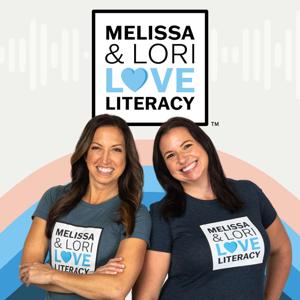
Melissa & Lori Love Literacy® is a science of reading podcast for teachers who want to understand how reading really works and what that means for classroom instruction.
Each month,…
Ranked by our users in the last 21 days
57 Listeners
640 Listeners
49 Listeners
206 Listeners
205 Listeners
132 Listeners
61 Listeners
7,716 Listeners
82 Listeners

25 Listeners

50 Listeners
176 Listeners
44 Listeners
41 Listeners

54 Listeners