
Sign up to save your podcasts
Or



Based on Podcast App listening data
What is a read aloud?
It is very common to see early childhood and elementary school teachers reading aloud to their students. But what exactly is happening during this time?
In episode 170, we talk with author and professor, Molly Ness about read alouds. We share her definition along with what to look for in a read aloud and the benefits of read alouds for all learners!
Check out Molly's book: Read Alouds for All Learners
Looking for more literacy support and resources? Explore all of our podcast episodes, free listening guides, and classroom tools at literacypodcast.com.
Interested in bringing Melissa & Lori Love Literacy to your school or event? Email us at [email protected].
From July 30, 2021
To connect with a practitioner lens, Duke (alongside Ward & Pearson) also penned The Science of Reading Comprehension Instruction. They ask the question: What have decades of research told us about the nature of comprehension and how to develop students’ comprehension in schools? Listen to find out!
Looking for more literacy support and resources? Explore all of our podcast episodes, free listening guides, and classroom tools at literacypodcast.com.
Interested in bringing Melissa & Lori Love Literacy to your school or event? Email us at [email protected].
What is dysgraphia?
The American Speech-Language-Hearing Association defines dysgraphia as referring to difficulty with either language or spelling-based aspects of writing. Dysgraphia impairs letter writing by hand, which can affect spelling, learning to spell words, the speed of writing, reading word recognition, comprehension, and writing processes and products.
Resources
Looking for more literacy support and resources? Explore all of our podcast episodes, free listening guides, and classroom tools at literacypodcast.com.
Interested in bringing Melissa & Lori Love Literacy to your school or event? Email us at [email protected].
Today talk to researcher Tiffany Hogan about language comprehension. We’ll start with the Simple View of Reading, exploring the relationship between phonics and language comprehension. Then we’ll discuss knowledge as the result of systematic and explicit language comprehension instruction and share approaches that work in the classroom - like read-alouds and discourse.
Tiffany P. Hogan, PhD, is a Professor in the Department of Communication Sciences and Disorders at MGH Institute of Health Professions in Boston, Director of the Speech and Language (SAiL) Literacy Lab and the center for translational research, implementation science, and dissemination for equity in CSD, (cTIDE), Research Associate at Harvard University, and inaugural research affiliate for the Boston University Center for Anti-Racist Research.
Resources Mentioned in this Episode
Looking for more literacy support and resources? Explore all of our podcast episodes, free listening guides, and classroom tools at literacypodcast.com.
Interested in bringing Melissa & Lori Love Literacy to your school or event? Email us at [email protected].
What is Developmental Language Disorder, or DLD?
Developmental Language Disorder is a brain-based neurodevelopmental diversity - such as autism or dyslexia or dysgraphia. Students with DLD are six times more likely to have reading difficulties. DLD is a brain variation that makes it difficult to learn language from the environment.
Resources
Looking for more literacy support and resources? Explore all of our podcast episodes, free listening guides, and classroom tools at literacypodcast.com.
Interested in bringing Melissa & Lori Love Literacy to your school or event? Email us at [email protected].
From October 7, 2022
In this episode, we talk with former balanced literacy teacher and parent, Missy Purcell. She authored a blog post titled Dear Balanced Literacy Teacher.
Missy writes, “According to Nancy Young’s ladder of reading, roughly 10-15% of kids can figure out reading out with this type of instruction, but my child, who would later be diagnosed with dyslexia, would never be able to become a proficient reader with any version of balanced literacy. He, according to Young, like 85% of students, benefit from or need systematic explicit instruction that follows a scope and sequence with fidelity to become proficient readers and writers.”
We want to normalize the idea that most kids CAN learn how to read with structured literacy instruction.
Resources
Looking for more literacy support and resources? Explore all of our podcast episodes, free listening guides, and classroom tools at literacypodcast.com.
Interested in bringing Melissa & Lori Love Literacy to your school or event? Email us at [email protected].
Nadine Gaab, Associate Professor of Education at the Harvard Graduate School of Education, joins us on the podcast to talk about how brains learn to read. Reading development starts in utero because the fundamental milestones for learning to read are sounds and language processing. Brain research shows us the brain of children learning to read is different in struggling readers. Dr. Gaab debunks dyslexia myths and connects the importance of early screening and intervention for dyslexia.
Resources
Connect with us!
Visit our website to subscribe to our weekly newsletter.
Helping teachers learn about science of reading, knowledge building, and high quality curriculum.
Looking for more literacy support and resources? Explore all of our podcast episodes, free listening guides, and classroom tools at literacypodcast.com.
Interested in bringing Melissa & Lori Love Literacy to your school or event? Email us at [email protected].
From September 30, 2022
Dr. J. Richard Gentry, Dyslexia Expert and the “Guru of Spelling,” joins us on the podcast today to discuss dyslexia. Dyslexia is a specific learning disability, neurobiological in origin. It’s the #1 reading disability that manifests itself in a continuum. People with dyslexia have difficulty in accurate fluent reading, spelling, and decoding abilities. Dr. Gentry shares his personal story of overcoming dyslexia, how dyslexia affects people, and how teachers can help students with dyslexia in the classroom.
Looking for more literacy support and resources? Explore all of our podcast episodes, free listening guides, and classroom tools at literacypodcast.com.
Interested in bringing Melissa & Lori Love Literacy to your school or event? Email us at [email protected].
Ever wondered why reading isn't as natural as speech? Carolyn Strom, an accomplished early literacy expert, reveals that unlike speech, reading doesn't come naturally. In fact, it requires well-structured, explicit instruction which we'll discuss in this episode.
The importance of a structured approach to teaching reading cannot be understated. We'll be taking a deep look at the role of decodable texts, progress monitoring, phonemic awareness activities, and the necessity of a proper scope and sequence. And for those who believe that word memorization is the ultimate key to learning to read, prepare to have that myth debunked. Carolyn introduces the concept of mapping – associating the visual form of a word with its sounds and meaning, a vital aspect in learning to read.
As we delve further into the episode, we look into how critical practice and spoken language are in the reading process. Discover how word games can transform skill drills into an engaging and exciting experience for kids. We also have valuable insights for those working with bilingual or multilingual learners, as we discuss the significance of building spoken language and conceptual knowledge, which play a major role in comprehension. Finally, we'll discuss creating a conducive environment for students to learn and provide resources for further exploration. Join us for this captivating and educational journey into the world of early literacy.
Resources
Looking for more literacy support and resources? Explore all of our podcast episodes, free listening guides, and classroom tools at literacypodcast.com.
Interested in bringing Melissa & Lori Love Literacy to your school or event? Email us at [email protected].
Resources
Looking for more literacy support and resources? Explore all of our podcast episodes, free listening guides, and classroom tools at literacypodcast.com.
Interested in bringing Melissa & Lori Love Literacy to your school or event? Email us at [email protected].
From the publisher's feed
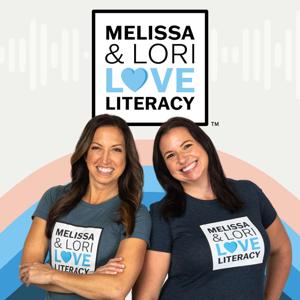
Melissa & Lori Love Literacy® is a science of reading podcast for teachers who want to understand how reading really works and what that means for classroom instruction.
Each month,…
Ranked by our users in the last 21 days
57 Listeners
640 Listeners
49 Listeners
206 Listeners
205 Listeners
132 Listeners
61 Listeners
7,716 Listeners
82 Listeners

25 Listeners
50 Listeners
176 Listeners
44 Listeners
41 Listeners

54 Listeners