
Sign up to save your podcasts
Or

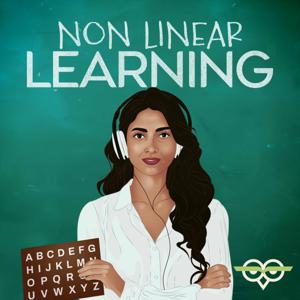


You've talked to 10 therapists. Tried 20 strategies. And your child still goes from calm to crisis in 30 seconds - for reasons no-one understands.
Understanding a body requires that we understand the sensory information coming in. And Dr. Dana Johnson - OT, PhD, and founder of the Spellers Center - tells us that there are not 5 but 8 senses.
Dana joins Non Linear Learning for the 3rd time to talk about interoception: the eighth sense, the one almost nobody gets taught, and the one that might explain what's been happening in front of you all along.
Listen along to learn:
Why your child's meltdown appears so sudden
Why self-injury can be the body trying to feel itself, not defiance
Why "tell me how you feel" is an impossible question for someone who's never reliably felt anything to name
Why professionals push back on all of this — and what actually shifts a paradigm
🔗 Dana's YouTube: The Autism Plus Apraxia Doctor
🔗 Dana's Substack
Did you know - you can now have Dr. Vaish Sarathy's teaching and personalized training in your pocket - Sign up for the Non Linear Learning Personalized Coach at www.studio.com/vaish
We talk a lot about what our students can't do. But something that educators have found over the years is that there is a scatter to the skills we see in our students.
The wildly uneven profile that we see could actually be a blessing.
Mark Talaga, counselor, speaker, and founder of the Center for Identity Potential, joins the podcast to talk about asynchronous development in gifted and twice-exceptional learners.
And here's what hit me: we're working the same problem from opposite ends. Where there is a sharp strength, there is often a significant deficit, but the opposite is true as well!
This conversation got under my skin in the best way. Tune in to this episode to learn:
You can find Mark Talaga's podcast, Hopelessly Gifted, on Apple Podcasts and Spotify, or visit centerforidentitypotential.com.
The IEP meeting is supposed to be about your child. Have you noticed that it often feels like it's about everyone else's comfort?
Dr. Diana Fannon spent 24 years inside public school systems as a bilingual school psychologist and director of special education. She now works with families. And in this podcast, she shares with us a few red and green flags of special education.
🎙️ Tune in to this episode to learn: 👇
Why "inclusive" school districts still often segregate kids with disabilities - and the one red flag that tells you immediately
The difference between a goal written for your child vs. a goal written for the teacher's comfort
Where in the IEP you can actually write instructions for the teacher not just the student
Why Universal Design for Learning saves teacher time instead of adding to it
etc.
The "system" unfortunately was not built to find your child's intelligence. That's our job. Follow for more!
Find Dr. Fannon at disabilityedpros.com and on Instagram @disabilityedpros.
What if your autistic / non-speaking learner's most overwhelming traits e.g.,
sensory sensitivity,
pattern obsession,
emotional upheavals
are the exact same features that make their brain extraordinary?
Dr. Andrew Hill is a cognitive neuroscientist, founder of Peak Brain Institute, and author of Gifted and Tortured. He has spent decades mapping real human brains and has worked with CEOs, athletes and people with disabilities.
In this episode, we talk about what the neuroscience of dysregulation actually looks like, why standard IQ tests are built to miss your child, and what parents of non-speaking and autistic learners can do right now to support regulation and reveal the intelligence that's already there.
What we cover:
Why gifted brains and dysregulated brains are often the same brain — and what that means for your child
Brain mapping (quantitative EEG): what it measures, what it reveals, and how to access it affordably
Why IQ tests fail non-speaking autistic learners and kids with Down syndrome — and the three physiological factors that actually predict intelligence
Neurofeedback for autistic and non-speaking kids: how it works and why it requires almost no active participation
The single most important thing you can do for your child's regulation (hint: it starts the night before)
and more…
Resources mentioned:
Get Dr. Hill's Book here: giftedandtortured.com
Peak Brain Institute (brain mapping + neurofeedback): peakbraininstitute.com
Work with Vaish:
Non Linear Education — teaching, courses, and support for parents of autistic and non-speaking learners:Non Linear Education
RPM lessons and consultation: drvaishsarathy.com/rpm
Do support groups actually help, or do they reinforce the very mindset that keeps parents stuck?
In this episode, I sit down with Sara Intonato to unpack this difficult question.
Both of us (and probably you) have lived the same reality:
Hypervigilance,
burnout,
the constant demand of raising a non-speaking child.
When we went looking for help, what we found in traditional support spaces was not growth or even help.
Unfortunately we found:
cycles of venting without direction
low expectations presented as acceptance
and a normalization of hopelessness
This is a hard but beautiful conversation, that digs deep and lets us find out what really helps.
We talk about:
A simple 1-minute regulation tool you can use in crisis
The HALT framework (Hungry, Angry/Anxious, Lonely, Tired)
How to think about self-care when even 5 minutes feels impossible
Sara introduces a different model: community with leadership, structure, and high expectations.
Effort is great, but our kids need our regulated presence more!
If you've ever felt unsupported in "support" spaces, listen to this episode now.
Links:
Find more about Sara here.
Sara's free podcast mini-series
Autism Changemakers
Dr. Vaish Sarathy: Get on the waitlist for Non Linear Education here.
Dr. Vaish Sarathy speaks with Dr. Kendall Stewart (former surgeon turned functional medicine + genomics clinician) about the biochemistry of learning: how inflammation, metabolic factors, neurotransmitter balance, and genetics can influence regulation, sensory stability, and why some kids respond to interventions while others don't.
What we cover:
Why progress can look like "good days/bad days" when inflammation fluctuates
Nutrigenomics vs exome sequencing vs pharmacogenetics (and why personalization matters)
A parent-friendly clinical framework: inflammation → autophagy/insulin tendencies → neurotrophic factors → glutamate/GABA → methylation
Sensory stability (vestibular/visual) and why eye contact can reduce listening for some learners
Microbiome basics: inflammation load, butyrate, absorption/biofilms
Resources
Dr. Kendall Stewart: www.drkendalstewart.com
Non Linear Education (NLE): https://www.drvaishsarathy.com/nonlineareducation
Medical disclaimer (important):
This episode is for educational purposes only and does not provide medical advice, diagnosis, or treatment. Always consult your qualified clinician for medical decisions—especially for children and complex conditions.
From the publisher's feed
39,030 Listeners
13,496 Listeners
2,018 Listeners

111,863 Listeners
203 Listeners

8,328 Listeners

334 Listeners

1,876 Listeners

57,608 Listeners

15,891 Listeners

1,424 Listeners
10 Listeners
8,805 Listeners
15 Listeners