
Sign up to save your podcasts
Or

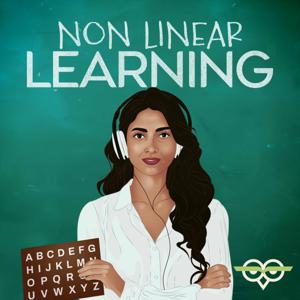


In this episode of Non Linear Learning, Dr. Vaish Sarathy speaks with Dr. Robin Harwick, founder of The Pearl Remote Democratic High School, a groundbreaking online school designed for teens who don't fit into traditional education especially autistic, ADHD, and otherwise neurodivergent learners.
Together, we explore:
Why compliance-based systems harm learning (and why they persist)
How democratic education gives back autonomy, voice, and safety
What it actually looks like to co-create curriculum with neurodivergent students
How to spot when your child's IEP is a red flag, not a lifeline
Why some students with PDA or ODD thrive when given real choice
Whether you're homeschooling, advocating at an IEP meeting, or simply wondering if there's any alternative to the status quo—this episode will expand your thinking and offer a glimpse into what education could be.
🔗 Learn more about The Pearl:
https://thepearlhighschool.org
🧠 Join the limited time free workshop offered by Dr Vaish Sarathy "What if your Autistic child could learn Anything?"
https://www.drvaishsarathy.com/learningskills
🎧 Like the show?
Leave a rating or review and share this episode with someone who's tired of the compliance trap.
In this edition of Non Linear Learning, Dr. Vaish Sarathy and co-host Searmi Park unpack the buzz around "productive failure"and flip it on its head for neurodivergent learners.
Inspired by Manu Kapur's work and his recent conversation on 10% Happier, Vaish and Searmi explore when failure can deepen learning, when it harms, and why the word we're actually looking for is exploration, not failure at least for this audience.
In this episodeProductive failure what we think it means
Why we don't "design failure" for autistic students
Parents as the ones who "fail productively"
Real-life stories
A challenge for listeners
Exploration > evaluation. Our learners already face constant performance tests; they don't need "engineered" failure.
Hold the bar high, detach from outcomes. You can keep rigor and still protect nervous systems.
Make the "failure" yours. Parents and educators can iterate on the environment, task, and supports instead of labeling the child.
Build a web, not a bridge. Let detours teach the terrain.
Book: Productive Failure: Unlocking Deeper Learning Through the Science of Failing by Manu Kapur
Podcast that sparked this convo: 10% Happier with Dan Harris "Let's Normalize Failure (The Right Kind) | Manu Kapur." (Spotify)
Pick one stretch experience your child "can't do"—museum hour, library time, a short concert, a new trail, and scaffold it respectfully (sensory-wise, regulation-wise). Debrief afterwards: What worked? What needs one tweak? What surprised you?
About your hosts
Dr. Vaish Sarathy — TEDx speaker, PhD educator, creator of Non Linear Education, and mom to a non-speaking autistic poet with Down syndrome.
Searmi Park — Concertmaster, Eugene Symphony; founder of Autism Mustang Alliance; mom to a non-speaking autistic young adult.
💌 Get the free guide: Turn ON your child's learning switch
🎓 Join the Non Linear Education waitlist
⭐ If this episode helped, please leave a 5-star review—and if it didn't… maybe skip the review this time 😉
In this episode of Nonlinear Learning, we challenge the conventional path parents often take when preparing children with disabilities for higher education.
We discuss why focusing solely on life skills, physical independence, and basic academics can leave students unprepared for the real demands of college.
Instead, I outline the true foundation that fosters genuine readiness for higher education and guess what - there is a key factor there - MOTIVATION. How do we build that? Tune in to learn more.
You'll discover:
Why physical independence, while valuable, doesn't guarantee college readiness.
How fluent academic communication—whether through speech, AAC, or spelling-based systems—unlocks learning potential.
and more...
Links & Resources:
Join the waitlist for the Nonlinear Education
Learn more about Dr. Vaish Sarathy
Is your child's speech meaningful?
In this unfiltered episode of Non Linear Learning, co-hosts Dr. Vaish Sarathy and Searmi Park talk about the difference between speech and language, and why that may be everything in educating our kids with disabilities.
Here's what they talk about:
Why scripting and echolalia aren't proof of limited cognition
The danger of over-labeling learners as "gestalt processors"
How presumed competence starts where speech ends
Why academics—not behavior—is the best way to detect intention
This is the episode for you if you've ever wondered:
Is my child's speech meaningful?
How do I know if they understand but can't express it?
What should I do when I don't know what's motor, comprehension, or behavior?
👉 If this episode made you think or gave you hope, please leave a review so others can find us. It makes all the difference.
Does your child echo everything you say—but struggle to express their own thoughts?
In this episode of Non Linear Learning, Dr. Vaish Sarathy tackles one of the most misunderstood differences in developmental education: the gap between speech and language—and why recognizing this difference can completely shift how you teach your autistic child.
You'll learn:
How speech apraxia and motor planning issues can mask true intelligence
Why "presuming competence" often means "presuming apraxia"
A powerful mindset shift that could change everything for your child's learning journey
Free Resource Download your free guide to Non Linear Learning: www.drvaishsarathy.com/nonlinearlearning
Do :) Leave a Review If this episode gave you a new perspective, help us reach more parents and educators by leaving a review wherever you listen.
In this deeply honest episode, I talk with Syed Abbas—global meditation teacher, disability advocate, and father—about how a life-altering diagnosis of muscular dystrophy pushed him into the world of breathwork, mindfulness, and inner transformation.
We talk about:
His journey from depression and chronic medication use to mental clarity and peace
What it's like to live with a progressive disability—and find pride and power in it
The science and simplicity of breathwork
Why caregivers, especially parents of children with disabilities, are stuck in constant fight-or-flight—and what they can actually do about it
How just a few deep breaths can shift your nervous system, your energy, and your life
🔗 Resources Mentioned:
Learn Sudarshan Kriya (SKY Breath Meditation)
Sahaj Samadhi Meditation course info: Sahaj Samadhi
🧪 Studies & Science Behind Breathwork and Pranayama
Breath-based meditation can reduce anxiety and enhance well-being: Streeter, C.C., et al. (2020). Effects of Yoga on the Autonomic Nervous System, Gamma-aminobutyric-acid, and Allostasis in Epilepsy, Depression, and Post-traumatic Stress Disorder. Frontiers in Psychiatry, 11: 782. Read the full study on PubMed Central
Pranayama improves cardio-respiratory efficiency and endurance in healthy young adults: Satheesh, R., & Bindu, C.B. (2020). Pranayama improves cardio-respiratory efficiency and physical endurance in young healthy volunteers. International Journal of Research in Medical Sciences, 8(7), 2421–2425. Read the full article on MSJOnline.org
Pranayama and aerobic exercise enhance heart rate variability and VO₂ max in sedentary middle-aged men: Hariprasad, R., Prabhu, N., & Karishma, S. (2024). Effect of Aerobic Exercise and Pranayama on Heart Rate Variability and Maximal Oxygen Consumption in Sedentary Middle Aged Males. International Journal of Current Medical and Applied Sciences, 42(2), 20–25. Read the full article on IJCMAA
From the publisher's feed
39,030 Listeners
13,496 Listeners
2,018 Listeners

111,863 Listeners
203 Listeners

8,328 Listeners

334 Listeners

1,876 Listeners

57,608 Listeners

15,891 Listeners

1,424 Listeners
10 Listeners
8,805 Listeners
15 Listeners