
Sign up to save your podcasts
Or



Based on Podcast App listening data
Iceland is known for geothermal beauty, fishing and as the birthplace of Bjork. It also made international headlines in 2008 thanks to a banking crisis that tipped the country into recession and reverberated around Europe. Now, Iceland is back in the headlines after the leak of the so-called Panama Papers unveiled offshore accounts held by Iceland's prime minister and sparked mass protests that eventually unseated him. While the island nation is one of the few countries that sent bankers to prison after the financial crisis, discontent remains rife among its small population, underscored by the rise of the anti-establishment Pirate Party. Joining us to discuss all things Icelandic are Edward Robinson and Omar Valdimarsson, authors of Welcome to Iceland, Where Bad Bankers Go to Prison from the latest edition of Bloomberg Markets magazine.
See omnystudio.com/listener for privacy information.
A high-flying hedge fund manager lost everything back in 2007 after an accounting scandal prompted investors to pull money from his $12 billion fund. Almost a decade later, Dan Zwirn has been cleared of all wrongdoing by U.S. securities regulators and is busy rebuilding his investment empire, specializing in lending to companies that don't usually have access to traditional bank financing. Zwirn's new fund, Arena Investors LP, is one of a crop of so-called shadow banks seeking to plug a financing gap exacerbated by the financial crisis and new regulation. Max Abelson of Bloomberg News co-hosts this week's episode, in which we talk the pros and cons of non-bank financial intermediation.
See omnystudio.com/listener for privacy information.
Short-selling, the practice of betting against stocks by agreeing to sell equities that you don't own, has been in the headlines recently. The share price of Valeant Pharmaceuticals International Inc. has fallen nearly 90 percent from its peak since being targeted by prominent short-sellers including Citron Research's Andrew Left and Bronte Capital's John Hempton, while some other types of short-sellers have been given the Hollywood treatment with the release of the film version of Michael Lewis's The Big Short.This week, Tracy joins forces with Bloomberg Markets Reporter Luke Kawa, to take a look at the fraught life of the American short-seller. We speak with Marc Cohodes, managing general partner at Copper River Management LLC, well-known short-seller and part-time chicken farmer. Known for his high-profile campaign against Overstock.com, Cohodes highlights the less glamorous side of short-selling including protracted legal battles and sifting through trash cans for clues to a company's sales volume. He also speaks about the social benefits provided by short sellers, the fine line they must walk during public battles, and why Canadians can't stand when someone bets against a domestic company.
See omnystudio.com/listener for privacy information.
For years, the image of a stock market trader was synonymous with images of Testosterone-fueled traders wheeling and dealing on the floor of big exchanges. But change has swept stock markets in recent years, diminishing their role in everyday trading. Now, the vast majority of stock trades take place through computerized systems, giving rise to huge debate over the dangers and benefits of high-frequency and automated trading. This week, Pimm Fox, co-anchor of Taking Stock on Bloomberg Radio, joins Odd Lots co-host Tracy Alloway to speak with Keith Bliss, senior vice president at Cuttone & Co. and one of a dwindling number of floor traders left at the New York Stock Exchange. We visit a bygone era when 5,000 traders swaggered through the crowded floors of the NYSE -- unafraid to prank their bosses, or indeed, even the president of the United States.
See omnystudio.com/listener for privacy information.
Asset purchases! Currency devaluations! Low interest rates! Negative interest rates! And... more? The world's central banks have unleashed a torrent of unconventional monetary policy since the 2008 financial crisis, hoping to heal economic wounds and revive markets' animal spirits. Rescuing us from another Great Depression is no longer seen as sufficient. Seven years on, doubts are starting to build about the ability of central banks to continually boost economic growth. Talk of central banks "running out of ammunition" reached a crescendo earlier this year and coincided with a dramatic market sell-off. More economists are saying fiscal policy needs to play a greater role, while the European Central Bank last week demonstrated it may still have some bullets left in its armory. We sit down this week with Mohamed El-Erian, BloombergView columnist and chief economic adviser at Allianz SE, as well as Dan Moss, executive editor of global economics for Bloomberg News, to discuss the limits of central banks.
See omnystudio.com/listener for privacy information.
In 1987, investors watched in horror as the Dow Jones Industrial Average plunged 22 percent in an event that became known as "Black Monday." Months later, the U.S. Securities and Exchange Commission published an 840-page report into the incident; in it was buried a seed that would eventually sprout into the $3 trillion market for exchange-traded funds. Eric Balchunas, ETF analyst for Bloomberg, has the story of the stock exchange executives who seized upon an idea to create what is now one of the world's most pervasive financial products - and the investors who passed them up.
See omnystudio.com/listener for privacy information.
In late 2008, as markets tanked thanks the the global financial crisis, two massive Ponzi schemes unraveled. One was the $17.5 billion fraud engineered by Bernie Madoff. The other was the smaller but no less interesting one run by R. Allen Stanford, a flamboyant Texan who lived in the small Caribbean island of Antigua and operated a bevy of companies under the Stanford brand. Best known for his involvement in the sport of cricket, Stanford soon found himself under a much less flattering spotlight -- all thanks to the work of one independent financial analyst, Alex Dalmady. This is the story of how Dalmady did a favor for a friend and then ended up uncovering a $7 billion investment fraud. Seven years after Dalmady's work set in motion the events that culminated in Stanford's downfall, we discuss the research note that spawned an international investigation and whether we can expect more such schemes to emerge in the wake of recent market upheaval.
See omnystudio.com/listener for privacy information.
Everybody knows by now that a handful of hedge funders made a fortune by betting against housing before the market crashed back in 2008. But, people who bought at the bottom, when everyone else was panicking, also did extremely well. In the latest episode of Odd Lots we speak with Bloomberg Alastair Marsh, who discovered two traders who won big time by buying the most toxic assets in the world during the depths of the panic in early 2009.
See omnystudio.com/listener for privacy information.
In theory, anyone with an internet connection can became an expert on just about anything from just about anywhere. In the latest edition of Odd Lots, we speak with Lorcan Roche Kelly, a cattle farmer, and former explosives engineer in rural Ireland who decided in the early days of the euro crisis to figure out what the heck was going on with his nation's banks. Lorcan tells the story of how he went from a farm in Sixmilebridge, Ireland to advising hedge funds on what sovereign bonds they should buy, and ultimately to Bloomberg. He also breaks down why once again, people are getting nervous about the Eurozone financial system.
See omnystudio.com/listener for privacy information.
On today’s episode, we’re taking the “dismal” out of the dismal science by interviewing Yoram Bauman, who bills himself as the world’s only stand-up economist. Join us for a Laffer curve-a-minute romp through the humor of homo economicus. Along the way, we find the upside in the economic assumption that all human beings are selfish jerks and learn what classes would be included in the University of Comedy curriculum. We also take a look at some of the funniest economics papers of all time, including a satirical work that sparked a minor squabble among economists by trying to determine who's the better singer in the band AC/DC, plus the age-old classic: Japan’s Phillips Curve Looks Like Japan. In addition, Yoram conducts the first ever stand-up routine performed over cell phone to an audience of five business journalists.
See omnystudio.com/listener for privacy information.
From the publisher's feed
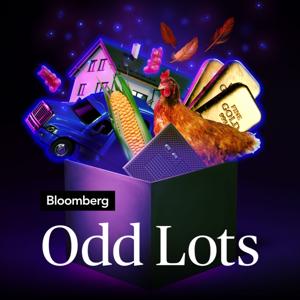
Bloomberg's Joe Weisenthal and Tracy Alloway explore the most interesting topics in finance, markets and economics. Join the conversation every Monday, Thursday, and Friday
Ranked by our users in the last 21 days

964 Listeners

408 Listeners

1,190 Listeners

2,167 Listeners

432 Listeners

349 Listeners

2,321 Listeners

969 Listeners
970 Listeners

794 Listeners

193 Listeners
287 Listeners

2,269 Listeners
30 Listeners

550 Listeners

434 Listeners
4 Listeners
154 Listeners

58 Listeners

233 Listeners

229 Listeners

63 Listeners

71 Listeners
82 Listeners

447 Listeners

243 Listeners

19 Listeners
12 Listeners
7 Listeners
2 Listeners

150 Listeners
114 Listeners