
Sign up to save your podcasts
Or



Based on Podcast App listening data
Episode 13: Everyone dreams of being able to win almost every time when gambling. Of course, whether it's blackjack, horse betting, poker or the stock market, it's really hard to consistently win. But one professor, armed with advanced mathematical knowledge and computers, was able to beat the system while gambling on the obscure sport of Jai Alai. In this week's Odd Lots podcast, Steven Skiena, who teaches computer science at Stony Brook University in New York, tells the story of how he made 500 percent on his money in six months by gambling on Jai Alai. Skiena also explains how his approach applies to much bigger arenas, including algorithmic trading on the stock market.
See omnystudio.com/listener for privacy information.
On this episode, co-host Tracy Alloway is joined by Bloomberg Markets reporter Luke Kawa for a journey back in time. As the global elite mingle at the World Economic Forum's annual meeting in Davos, Switzerland, we look back at a WEF gathering five years ago. Back then, the mood was buoyant -- markets had recovered from the 2008 financial crisis and the euro-zone debt crisis had yet to fully unfold. But Barrie Wilkinson, a partner at Oliver Wyman Ltd., wasn't feeling so jubilant. As bankers, regulators, and politicians congratulated themselves for a job well done, he was warning of a brewing crisis that would start with a crash in commodities prices in 2015. Now, parts of his 27-page report seem eerily prescient.
See omnystudio.com/listener for privacy information.
When the world lost David Bowie this month, it lost one of modern music's undisputed geniuses. Less well-known is Bowie's contribution to the financial world. In this episode of Odd Lots, hosts Tracy Alloway and Joe Weisenthal speak with David Pullman, the banker who worked with Bowie to develop "Bowie Bonds," which paid investors on the cash flow from the artist's song royalties. This episode covers how these bonds came to be, their lasting\u0010impact on financial markets and what it was like to work with David Bowie.\u0010\u0010Speaking of financial history, in this episode we also talk about the Beige Book, a monthly publication from the Federal Reserve that gives an anecdotal look at the U.S. economy. Joining us are Bloomberg News editor Paul Cox (arguably the father of the Beige Book) and Fed reporter Matt Boesler.
See omnystudio.com/listener for privacy information.
This week, we're taking on one of the most fragile commodities markets around. No, it's not oil (though we do get to that later in the program), it's the market for bananas. Dangerously reliant on a single, boring breed of the tropical fruit, banana growers now face a rampant disease that threatens one of the world's biggest food supplies. We talk to Dan Koeppel, author of "Banana: The Fate of the Fruit That Changed the World," about the development of a monoculture-based banana market and the pitfalls of having a single breed monopolizing the local supermarket. Speaking of monopolies, we then take a swift detour from the banana republics of yesteryear to visit the oil-drenched Middle East of today, where Saudi Arabia is considering an initial public offering of its massive state-owned oil company
See omnystudio.com/listener for privacy information.
(Bloomberg) -- It’s a new year and a new episode of Odd Lots. Co-hosts Joe Weisenthal and Tracy Alloway have re-stoked our proverbial holiday fire, refilled our wine glasses and are ready to continue our conversation with a newly relaxed group of Bloomberg News reporters and editors. This time we’re looking ahead to 2016, making predictions for key markets and finance events during the next 12 months. Hear how sentiment could affect stocks, why the Federal Reserve is about to become even more important and exactly what trouble might be in store for perma-bears. Featuring: Matt Boesler, Ed Hammond, Matt Levine, Dan Moss and Chris Nagi.
See omnystudio.com/listener for privacy information.
(Bloomberg) -- Gather ‘round the Odd Lots fire. Co-hosts Joe Weisenthal and Tracy Alloway have assembled a collection of Bloomberg News reporters and editors to spread holiday cheer by sharing their favorite market stories and happenings of 2015. We discuss the stock market sell-off of Aug. 24, the fall of Silk Road, drama in the pharmaceuticals industry, how we all survived the first U.S. interest rate increase in almost a decade, China’s movie-goers, and the many, many people worried about bond market liquidity. Featuring: Max Abelson, Matt Boesler, Ed Hammond, Matt Levine, Dan Moss, and Chris Nagi.
See omnystudio.com/listener for privacy information.
The film “The Big Short” has sparked lots of attention about the origins of the financial crisis and the people who saw it coming. While lot of attention is being paid to a few men who made a fortune on the housing collapse, this week Tracy and Joe talk to the editor of the blog “Calculated Risk” about Doris Dungey, an early blogger and whistleblower who tried to warn the world about brewing problems in the mortgage market. Between 2006 and 2008, Dungey, who wrote under the pseudonym “Tanta,” became an influential must-read for her prescient, good-humored writing and analysis.
See omnystudio.com/listener for privacy information.
This week we're thinking about what it means to be a trader in today's electronified markets and contrast it with trading in the era of horse and buggies. That's right, we're going back in time to talk mule trading and the story of the legendary Ray Lum, who spent years buying and selling livestock all over the U.S. in the early 1900s. William R. Ferris, history professor at the University of North Carolina and author of Mule Trader: Ray Lum's Tales of Horses, Mules, and Men, tells us about Lum's adventures in the South, including the purchase and transportation by train of 80,000 mules from South Dakota to New Orleans. He explains why the "trader is the poet of capitalism," how the term "day trader" can be traced to stable storage trades and why some things—like boozy dinners between brokers and their clients—never seem to change. It's arbitrage of the animal sort, with storage trades thrown in to boot.Along the way, we ask whether traders provide a social service and explore the trade-off between modern efficient markets and the bygone era of 100 percent mark-ups on (mule) trades.
See omnystudio.com/listener for privacy information.
(Bloomberg) -- What better way to prepare for what may be the first U.S. rate hike in almost a decade than to tour 6,000 years of interest-rate history? This week, Joe and Tracy speak with NYU Stern finance professor Richard Sylla, co-author of A History of U.S. Interest Rates. We start in Babylonia, where Hammurabi codified the relationship between debtors and creditors, and end with zero percent interest rates in the U.S. in the 21st century. Along the way, we journey to the Roman city that pledged its public colonnades as collateral, learn why medieval French princes had such terrible credit histories and figure out why today's negative interest rates in parts of Europe really are a historical oddity. In other words, Odd Lots read a 700-page book on interest rates so you don't have to. (No, really, you should read it. It's a great book).
See omnystudio.com/listener for privacy information.
(Bloomberg) -- Hedge-fund manager Kyle Bass has a plan that could cut the high cost of prescription drugs in the U.S. -- and make himself a lot of money. The strategy: Take short positions in a number of pharmaceutical companies while also trying to overturn their drug patents in court. Joining hosts Tracy Alloway and Joe Weisenthal to discuss Bass's unusual tactic is Guan Yang, an occasional Bloomberg View contributor who has researched the odd intersection of Wall Street and patent law.
See omnystudio.com/listener for privacy information.
From the publisher's feed
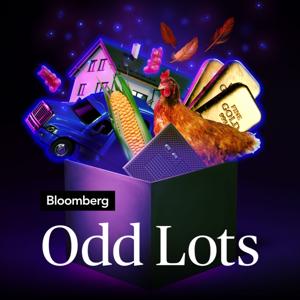
Bloomberg's Joe Weisenthal and Tracy Alloway explore the most interesting topics in finance, markets and economics. Join the conversation every Monday, Thursday, and Friday
Ranked by our users in the last 21 days

964 Listeners

408 Listeners

1,190 Listeners

2,167 Listeners

432 Listeners

349 Listeners

2,321 Listeners

969 Listeners
970 Listeners

794 Listeners

193 Listeners
287 Listeners

2,269 Listeners
30 Listeners

550 Listeners

434 Listeners

4 Listeners
154 Listeners

58 Listeners

233 Listeners

229 Listeners

63 Listeners

71 Listeners
82 Listeners

447 Listeners

243 Listeners

19 Listeners

12 Listeners

7 Listeners
2 Listeners

150 Listeners

114 Listeners