
Sign up to save your podcasts
Or



Based on Podcast App listening data
McKay delves into the transformative power of being an "illuminator" in a world often focused on the "spotlight." By choosing to see the "need" rather than just the "devastation," we find our true calling and the opportunity to create a lasting impact.
Our host uses Drew Brees’s "wrong turn" in New Orleans to show that interruptions are often revelations, and shares stories of a baby-holding teacher and a community pizza shop that highlight how goodness is contagious. He goes on to challenge us all to bring light to our homes and workplaces by listening deeply and offering hope rather than demanding attention. Ending with a sobering survival story, McKay urges us to live so our "auras" shine bright when needed most.
Main Themes:
Top 10 Quotes:
"Wrong turns are not just simply interruptions; sometimes they’re revelations."
"Light is most noticeable precisely where it is darkest."
"Listening long enough to discover what someone actually needs... may be one of the most underrated forms of light."
"Real light doesn’t need an audience."
"A candle doesn’t become weaker because it lights another candle. The first flame remains, but now there are two."
"I want to live my life so my aura, when it leaves, is very bright."
Show Links:
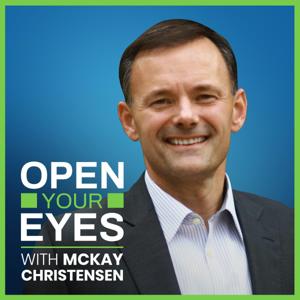
Open Your Eyes with McKay Christensen
McKay explores the profound impact of perspective on our daily struggles and long-term goals as he makes the case that deciding to "enjoy the ride" is the essential shift needed to turn average days into extraordinary ones. By looking at the creative hurdles behind the film Gravity and the real-life endurance of elite athletes, he illustrates how a mindset of abundance and gratitude allows us to navigate life’s "gravity" without being crushed by it.
McKay draws a powerful parallel between an astronaut’s survival and our own pursuits, urging listeners to jettison the "junk" of fear and doubt that creates a drag on our momentum. He shares the story of a realtor named Lee, whose seventeen-year odyssey to conquer the Oceans Seven and the world’s highest peaks proves that while we cannot control the weather or our circumstances, we can control our gratitude for the opportunity. Through the five most important decisions we must make and the simple wisdom of a schoolgirl’s "seven wonders," this episode invites us to stop living for tomorrow and start "dancing" in the life we have today.
Main Themes:
Top 10 Quotes:
"If you decide to go back to Earth, then you gotta get on with it, sit back, and enjoy the ride."
"Too often we get stressed or anxious at our goals rather than enjoying the things we learn along the way."
"Abundance is really your ability to see more in your life - more options, more choices, more resources."
"Do not follow where the path may lead. Go instead where there is no path and leave a trail."
"When you enjoy the ride, you don’t blame as much."
"Good people give you happiness. Bad people give you experience. Worst people give you a lesson. Best people give you memories."
"Your life right now may not be the party you had hoped for, but while you’re here, you might as well dance."
Show Links:
Open Your Eyes with McKay Christensen
You probably know one of the greatest Japanese proverbs of all time that teaches us about the power of resilience - ‘Fall down seven times, rise eight.’
In this week’s episode, McKay talks about the importance of dusting yourself off after a crisis and getting back up. He kicks off the episode by telling us a powerful story about Florence Rogers and how a seemingly normal day turned out to be an enormous test of her resilience. Just like Rocky Balboa, she decided to keep moving forward after life hit her hard. Next, McKay shares a few other compelling examples of keeping faith during a crisis and rising from the ashes every single time. There’s so much wisdom to unpack from this episode, as McKay shares the most effective tips for surviving tough times and picking yourself back up after you’re down. So if you want to build resilience and learn to endure life’s hardships, make sure you tune into this week’s episode to hear what McKay has to say.
The Finer Details of This Episode:
Quotes:
“When you're knocked down, you're left with two choices - stay there or get up. And people asked me, ‘How did you overcome the loss?’ My answer - I got up. No matter what life throws at you, you get up. Even if you need help, you get up.”
“Even though it may seem like it's too hard to get up, try again, I promise you can. It is worth one more try.”
“It ain't about how hard you hit. It's about how hard you can get hit and keep moving forward, how much you can take and keep moving forward.”
“Mistakes or a fall or a pause or a failing doesn't need to define you. You are able to mount up with wings of eagles and rise to the person you can and should become.”
“There's great power in a new paradigm.”
“I promise, the moment you reach out to the right person for help, you will begin to see a way out of your situation.”
Links:
McKay Christensen Homepage
Too often in life, we get to thinking that we are less than capable of doing what we set out to do. But the truth is: we are better than we think. So, how do you find the best within you?
In this week’s episode, McKay shares some valuable tips for finding the best within you and discovering your own potential. He talks about the dangers of making excuses, why it’s important to take calculated risks in life, and how to rise to your true self. As he nicely puts it, you are way better than you think, even though you might not see it at the moment. However, you’re not alone in this; most people get so caught up in the chaos of everyday life that they miss the beauty of it all. That’s precisely why it is so important for you to tune in today, and learn how you, too, can turn things around and find the best within you.
The Finer Details of This Episode:
Quotes:
“Because people are so busy and focused on their day, they miss the beauty and rarity of the moment.”
“In life, there are so many things around us that are, in fact, better than we think. People are better than we think. Circumstances, our life, kids, job, our own potential, often are much better than we think. ”
“You are better than you think.”
“Over time, it becomes more of a habit to talk than to walk.”
“Most of us have ideas or dreams of what we'd love to do. And we make an assessment and the impossibility of the thing takes over. And soon we place the idea on the shelf hoping that someday we can dust it off, open it up and dream a bit more.”
“To find the best in us, we must risk a bit of ourselves - our pride, our time, our effort. It's the risk that teaches us to value the outcome.”
“It's in the risk of it that we learn to bring out the best in us.”
Links:
McKay Christensen Homepage
In this episode of Open Your Eyes, McKay delves into the theme of taking control of one's life and reaching one's potential, and he does this through the lens of the Boston Marathon. The stories of some Marathon runners, as discussed by McKay, offer insight and encouragement to do the hard things in order to achieve success. The rigorous process of qualifying for the marathon, the dedication and hard work required to be considered as a participant, the emotions and experiences of race day, and the camaraderie and support of the spectators and fellow runners are all explored. Our host also shares the power of determination and perseverance, and introduces listeners to the "Scream Tunnel" - a powerful reminder of the impact that support and encouragement can have in an individual's journey towards their goals.
During the episode, McKay also recounts the remarkable story of Katherine Switzer, and emphasizes the importance of proving our abilities and the price we must pay to truly run the race of life. As you listen in today, you will gain insight into how to take your life back and do the things necessary to grow your business and achieve success - including losing things such as idle time and the willingness to procrastinate so that you can gain energy, satisfaction, and a sense of being remarkable. Inspirational and motivational, today’s episode answers that most crucial of questions: Isn’t it time to do the hard things necessary to take your life back?
The Finer Details of This Episode:
Quotes:
"500,000 spectators line the route and gather at the finish line to cheer on a brother, a sister, a friend, or to just watch runners reaching their goals."
"Race day is an experience all by itself."
"One magical place on the course is called ‘Scream Tunnel.’"
"Isn't it time to take your life back, do the hard things when it's time?”
"And soon you'll be in the habit and your life, yourself, your self worth, will return."
"It also means you may gain a few things - energy, satisfaction, and a sense of you being remarkable."
"She trained and worked and finally ran a marathon plus an extra 5 miles to prove to her coach that she could run the distance."
"And in Katherine's case, she proved her ability in training by herself with no one watching.”
"The other runners were happy to see her and supportive of her.”
Links:
https://www.mckaychristensen.org/
Delving into the transformative power of internal resolve, McKay argues that what we carry in our hearts determines our success far more than external conditions or resources. By examining historical turning points and personal anecdotes, he illustrates how acting with conviction before proof exists is the key to overcoming fear and achieving the impossible.
McKay uses the "Trenton moment" of George Washington’s icy Delaware crossing to show how a single act of resolve can shift the momentum of an entire revolution. He explains the "law of diminishing intent," warning that delay erodes confidence while action, much like regenerative braking in a hybrid car, actually recharges our faith through resistance. Through the lenses of Peter’s walk on water and Jim Morris’ mid-life Major League debut, we see that potential is limitless when we remove distractions and commit to our choices. Ultimately, this episode serves as a call to stop reacting to past setbacks and start feeding a vision of who we are becoming through consistent, heart-led effort.
Main Themes:
Top 10 Quotes:
"What you resolve in your heart will have more impact on what you’re doing than just about anything else."
"The longer we delay doing something, the less likely it is that we will do it."
"Faith is a sales job. Each day we are selling to ourselves the thing in which we are placing our faith."
"Pushing through fear is less frightening than living with the underlying fear that comes out of helplessness."
"Feed your faith and your doubts will starve to death."
"Faith is to believe what you do not see; the reward of faith is to see what you have believed."
"It is against resistance that faith grows."
"Courage doesn’t always roar. Sometimes courage is a quiet voice at the end of the day saying, 'I will try again tomorrow better.'"
Show Links:
Open Your Eyes with McKay Christensen
The "belief window" - the invisible lenses that shape how we interpret every life event - comes under McKay’s learned scrutiny today as he explains that, while we assume we see objective reality, our brains actually construct our experiences based on past conditioning. He then demonstrates that questioning these default settings moves us from being constrained by old perspectives to being empowered by new ones.
Referencing the Northern Thailand cave rescue and the Mann Gulch fire, McKay shows how mental models can save us or become blind spots. He highlights NVIDIA’s AI vision and Boyan Slat’s Ocean Cleanup to illustrate how "future glasses" overcome skepticism. Through Daryl Davis’s conversations and behavioral science, we learn that transformation begins with perception, not just behavior. Throughout this episode, McKay encourages us all to stop reacting to the world through the lenses of your past and start constructing a new reality through the vision of who we are becoming.
Main Themes:
Top 10 Quotes:
"Your brain isn’t simply observing reality, it’s actively constructing your experience of reality."
"The world begins to look like the glasses that you’re wearing."
"Our greatest strengths quietly become our greatest blind spots."
"When you view a problem from the future, it loses some of its emotional grip."
"Today’s glasses constantly ask, 'How do I feel?' Five-year glasses ask, 'Who am I becoming?'"
"People wearing future glasses are willing to change strategies without abandoning the goal."
"To construct a new reality or way of living, we have to first put on a new view."
Show Links:
Open Your Eyes with McKay Christensen
McKay demonstrates that life's greatest victories are achieved through steady, everyday efforts rather than sudden breakthroughs through his exploration of the "go the distance" mindset. While our world celebrates quick finishes, real resilience is forged in the quiet, ongoing dedication that persists long after the initial excitement fades.
Alongside his friend Austin's adaptation to a paralyzing injury, McKay shares stories of deep perseverance. He explores Stallone's true vision for Rocky and W.P. Kinsella's pursuit of redemption in Shoeless Joe. He then traces Katalin Karikó's long mRNA research and José Hernández's twelve attempts to join NASA. These examples, including Jessica Long's Paralympic path, show that success lies in the quiet, daily struggle.
Main Themes:
Top 10 Quotes:
"Real life is not built around breakthroughs; it is built around continuation."
"Real wins in life happen to those who stay the course, who go the distance."
"Often, the greatest victory is becoming the kind of person who can stay in the arena long enough to get there."
"The greatest rewards in life often come only after we continue beyond the point where quitting would have been reasonable, when we go the distance."
"The question is never whether discouragement will arrive; it is rather what will happen after it arrives."
"We don't know when the breakthrough will arrive... What we do know is that continuing creates possibilities that quitting never can."
Show Links:
Open Your Eyes with McKay Christensen
McKay explores the "because I choose to" mindset - the principle that circumstances don't dictate our reality or outcomes. Throughout the episode he demonstrates that, while life often burdens us with the heavy weight of "I have to," freedom and success emerge when we recognize our inherent agency to choose our response.
In addition to highlighting Ashleigh Barty's intentional return to tennis and contrasting it with her earlier burnout, our host goes on to share such stories as Desmond Doss's battlefield convictions and Holocaust survivor Eddie Jaku's choice to be "The Happiest Man on Earth." From Arunima Sinha's Everest climb to McKay's lesson at a prison gate, this episode shows how embracing reality changes destiny, urging us to use choice to build an extraordinary life.
Main Themes:
Top 10 Quotes:
"Most of us do have a choice. And when we remember that we can choose and do choose, our approach is different. It's more healthy."
"The human mind has the ability to assign meaning to experience, and that meaning directly influences our behavior and long-term outcomes."
"The circumstance itself doesn't determine the meaning, but the response does."
"Suffering is not only caused by what happens, but also by what we do with it."
"Happiness does not fall from the sky. It's in your hands. It comes from a choice inside you."
"Small choices accumulate into identity through repetition."
"The shift from 'I have to' to 'I choose to' is therefore not semantic. It's internal strength."
"To live from this perspective is to recognize that while circumstances may be given, our level of participation is chosen."
Show Links:
Open Your Eyes with McKay Christensen
The transformative power of the "gentle slope," the principle that our lives are not defined by singular, dramatic events, but by the accumulation of tiny, consistent choices comes under McKay’s scrutiny today. Acknowledging that the world often waits for a "lightning strike" of inspiration, our host explains that true change happens through the quiet persistence of daily habits.
Analyzing the history of the Grand Canyon, McKay contrasts a 1956 crash with the slow erosion that actually shaped its depths. He also shares stories of John Woolman’s anti-slavery persuasion and Jennie Flexner’s book-by-book literacy drive. From Edith Eger’s resilience to Barry Magee’s endurance, this episode shows how a one-degree shift changes your destiny. McKay provides a framework for "evolving instead of revolving," urging us to use small habits to build an extraordinary life.
Main Themes:
Top 10 Quotes:
"Extraordinary results are often the product of ordinary actions repeated consistently over time."
"The river never set out to carve a canyon a mile deep; it simply kept moving in the same direction."
"The great things we achieve, or the erosion in our actions and character, are not arrived at in a moment. Rather, it is a gentle slope."
"Our lives are shaped by small choices... like a river carving a canyon, the effects are almost invisible day by day, yet over years, they become impossible to ignore."
"Impact compounds."
"By small and simple things are great things brought to pass."
"You’ve got to evolve instead of revolve."
"Today's small choices become tomorrow's habits, and tomorrow's habits become next year's character, and character becomes destiny."
Show Links:
Open Your Eyes with McKay Christensen
From the publisher's feed
13,474 Listeners
5,650 Listeners
13,999 Listeners

1,709 Listeners
1,156 Listeners
1,796 Listeners

3,630 Listeners

907 Listeners

10,658 Listeners
990 Listeners
540 Listeners
1,552 Listeners

2,017 Listeners

57 Listeners

190 Listeners