
Sign up to save your podcasts
Or

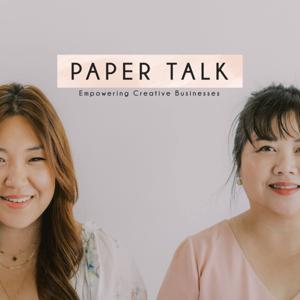


Listen to mixed-medium artist Ann Wood talk about her international exhibit and how she keeps herself inspired and challenged with her art.
Have you ever found yourself in a creative rut? Found yourself no longer joyful with your work, but simply slogging through? Maybe you’re having difficulty even imagining a different way to do things. Maybe you have a dream to chase, but the risks seem too big.
If that sounds familiar, we have the perfect inspiration for you!
In this episode of Paper Talk, we chatted with Ann Wood of Woodlucker studio. She is the amazing mixed-medium artist behind a plethora of hyperreal insects, feathers, vegetables, fruit, and flowers. These incredible creations have been featured in many publications including Martha Stewart Living, as well as NPR’s Cultivating Place podcast. Her dream to create a massive botanical wall led to her current exhibition at the Kunstmuseum Den Haag in the Netherlands.
Here’s what you’ll learn when you tune in:
Find the confidence to break boundaries and take risks with your art.
Get inspired by the depth and breadth of Ann’s experience, and how she actively molds her journey to keep her work challenging and interesting.
Let yourself dream of the endless possibilities our medium provides.
And finally, you’ll get a glimpse of the magic behind transporting, installing and putting together an international museum exhibit.
Our conversation also touched on the beauty of slowing down and connecting with nature. Ann spoke beautifully about noticing all of the amazing little details we get to dissect as botanical artists, and of the emotional meaning and memories individuals bring to flowers.
Listen now to get inspired and start dreaming of your next creative adventure. Ann summed up her inspiring optimism when she said this: “I think this is a movement of the paper art, especially the paper florals. This is a new movement. And it’s exciting to be part of, ‘What are the possibilities that are available for all of us to dream up in the next ten years?’”
Learn more about Ann by following her on social media:
INSTAGRAM: @woodlucker
WEBSITE: www.woodlucker.com
Listen to the world-renowned paper artist, Ceres Lau, about finding the confidence and perseverance to get your paper flowers featured in fine art spaces.
Does the idea of submitting your paper flowers to a gallery strike fear in your heart? Or maybe you’ve tried in the past with little success and have become disheartened. We have heard so many paper florists express apprehension about exhibiting their paper flowers as fine art. There’s a lot of unknowns: Where do you begin? How do you deal with rejection? Is your creation really worth it?
We’ve all felt those doubts. But what if we told you that we know the secret behind finding success as an exhibiting artist? The best news is, it’s totally something you can do.
In this Episode of Paper Talk, we chatted with Ceres Lau, a paper artist in Malaysia, whose incredible work has been exhibited around the world and extensively online. She literally cuts, carves, sculpts, and creates elegant works of art from paper. Needless to say, she understands the way a blank sheet of paper can make the heart sing with possibilities.
Listen to our conversation, and here’s what you’ll learn about:
Dealing with negative feedback, especially when it comes from loved ones—which it will!
Balancing art and making a living. It’s a difficult needle to thread, staying true to your artistic side and still being able to eat.
Staying true to the value of your artwork when people complain about the price tag.
Most importantly, persevering until you find the right opportunities. (Spoiler alert: this is the crucial bit.)
Ceres was a joy to talk with, and hearing her story about becoming a paper artist and the emotion and inspiration behind much of her work was captivating. We’re sure by the end of the episode you’ll be full of inspiration of your own, as well as the confidence and know-how you need to submit your paper flower art to exhibitions.
As Ceres said, “When you get one acceptance, it’s totally worth it.”
Read what Ceres has to say about her journey!
1. Introduce yourself to us! Who is Ceres Lau?
I am a paper artist who draws inspiration from nature as the source of her artistic expression. My fascination with paper stems from the possibilities found within it – beautiful, complicated forms arise from the transformation of this humble, almost-mundane material, a process limited only by the breadth of creativity.
I cut, carve, sculpt, create works of art out of paper. I do not paint on it, but rather I learn to focus on the material itself, and try to uncover the hidden beauty of paper without any interference.
I was born in Kuching, Sarawak, the eastern part of Malaysia. It is a small city where we would often joke that everyone knows everyone (that shows just how small it is, it applies most of the time!). It is situated on an island which is also known as Borneo, a place famous for having one of the richest cultures and rainforests in the world, which also explains why my work is often inspired by that of nature.
I graduated in graphic design, and before that, I was actually studying in the science stream, going into the medical field would have been the initial goal but I was not doing well at it, most importantly, my heart was elsewhere. I was secretly an art nerd.
Graphic design is the only course available that is closest to the arts at that time, in this small town. I took it up not knowing what lies ahead of me and thus, begins the life-changing journey, getting to where I am now.
2. Were you a creative when you werea child?
Thinking back, I have always been drawing, on any surface, I can find, for as long as I can remember. My ultimate childhood dream was actually to become a comic artist!
3. What is the art community like in Malaysia? Growing up, was there any opportunity to live as an artist?
The art community here is flourishing. There are more and more opportunities coming up for the arts in recent years. Paper art, however, is still not quite known here in Malaysia, and people are confused when they see what I do. It is not a norm, which is also one of the reasons why the art community here is, until this day, still remains foreign to me.
Instead of craving for a change of environment and situation, throughout the years I learnt to depend on myself rather than on ‘things’ and situations. I learnt to make use of limited resources, embrace what’s available in front of me, and at the same time, also seek opportunities away from my comfort zone.
I have kept close with a very small circle of artists in Malaysia, to which each of them specialise in different mediums. They are invaluable to me but something was still missing.
At some point, I turned to Instagram and found myself a wonderful community of paper artists who have had similar experiences. It can be intimidating at times, however more than that, it has been extremely comforting knowing that there are a group of artists and people who support you, unconditionally. I soon realised that finding the right community really helps to better oneself, it really has so much to do with that.
Then I was introduced to a paper art organisation by chance and got offered to be a part of it. The organization helped me find my voice and confidence in what I do. I was able to meet and connect with like-minded artists, not only that I get to have conversations on the medium we shared, but also exchange experiences, knowledge, and honest criticisms.
More opportunities became available to me, in ways that I could never think of if I have not stepped forward. Finding this has had a major impact on my life and growth as an artist. Having a community that supports one another, no matter how small of an amount or far in the distance, truly makes a difference.
4. You talk a bit about using what limited resources you have. Is that why you chose paper as your medium?
I was thoroughly amused by this medium. You can transform it anyhow you want and the possibilities are endless. I am until this day, still fascinated by the versatility of this everyday object that we tend to take granted for. I see it as a beautiful medium on its own, even more so when it’s being explored and experimented with.
It's been roughly 8 years of using this medium, on and off. Funny enough, looking back there were subtle hints here and there that it was the right one for me.
The first memory I had with paper, was when I was still in elementary school. I remember it so well, cutting strips of paper and coiling them together, I made a not-so-practical bookmark and gave it to my friends. I didn’t know that it was known as quilling back then.
When I started college, I began using paper again for my assignments. It was not encouraged because I was majoring in graphic design and doing hands-on work was not a ‘thing’. Paper as an art form was far less known than it is today. I stopped after that, focusing on digital works instead.
During my final year in college, I manage to transfer to a university in London. I stepped out for the first time in my life, and through one of the downfalls, I rediscovered paper with the help and advice of my then lecturer. From then onwards, I responded to all assignments given throughout the year using only paper.
Upon returning to Malaysia after my studies, where paper art is not known at all, coming from a small city it was even harder, I gave in to peer pressure and did not engage with paper for a year or two. I was given small opportunities and slowly started to pick it up again while managing 3 different jobs at a time, working my way through without a solid aim. Just 3 years ago, I decided to dedicate myself fully to this paper world and have not regretted my choice since.
5. You explained that you "focus on the material itself, and try to uncover the hidden beauty of paper without any interference." How do you do this? What tools and supplies do you use to create your masterpieces?
It really depends on what kind of work I am doing! I use tools that I find comfortable using, both unconventional and conventional ones. While I have proper tools to suit and function in a certain way, different kinds of craft knives, I also have several curvy wooden massaging tools, which I use in some of my work! I vividly remember using a toothpick to curl the paper strips, too.
But the tools I absolutely must have and can't live without would be surgery scalpel and bone folder. These two are the ones I juggle back and forth with.
I use archival-quality papers and adhesives. I often use G.F Smith Colorplan papers for my work, mix and match with other brands such as Daler Rowney, Arches, Takeo, and many more. Sometimes I use unbranded papers in my work (I have a collection of them from my trips!) if the colour and texture appeal to me.
6. Let's talk about the evolution of your artwork. You've created so many different series of artwork that are distinctively different from each other. Where do you find your inspiration?
I am constantly trying to explore different dynamics, however human relationships, and nature is both my inspiration.
When I just started doing paper art, I like many others, was completely lost at some point, because like you mentioned, I have a variety of works that is contrastingly different.
I used to stress about it so much. Everyone works differently, often I would admire artists who seem to know what they want and has a very unique sense of style of their own.
Along the way, I realised that while it is important to have a style, it is also not essential. Eventually, I started letting go of how I perceive things, and from there onwards, I started not to bother so much about having a specific style. I realised that it is actually okay to have a few different approaches as long as I am able to express what I want, get my feelings across and build a connection with the audience. I believe that, being able to capture a moment, a feeling and emotion, is also a form of art and something I hold close to.
7. There are many artists who work with paper. What do you think makes your artwork unique from other paper artists?
Tough question, I truly have no idea!
However, through the words of my artist friends and lovely followers, I was told that my art has a raw approach and feel to it.
I have always found it hard to express myself, and it is through what I do and make, that helps me put my feelings out there. Every piece of work has a story behind it, they not only serve as a reminder but also a memory to me, capturing my feelings and the very moment in life. And it is perhaps through this way, that I get to connect to an audience that I never thought I could.
8. What do you remember about your first art exhibition?
I had one of my first collaborative art exhibitions in my hometown, 6 years ago. I created a piece of art through quilling, very much different from what I do this day. It was sort of, as an amateur debut? It was memorable because it was held in a rundown space. The art piece I spent 3 to 4 weeks in full swing to make, was priced at an amount that did not reflect all the hard work put into it at all.
I was told that it was extremely expensive, with people telling me that they should rob the bank if they were to buy my work. I had mixed feelings, happy but overwhelmed, completely clueless on what to do, or which direction I am heading towards. I had no plans, no expectations, no ambitions nor goals.
But through that one small exhibition, I have learnt a great deal and found a way to do what I love. To be very honest, I never knew I could take part in exhibitions until I was offered the chance to, it never occurs to me that I can do this and that there are other ways of doing something.
On a side note, I didn't manage to sell anything during the exhibit, while others sold their pieces. However years after the event, I sold that particular piece for 5 times the price back then!
9. Where can your paper art be currently seen? When's your next exhibition?
Unfortunately, for now, it’s mainly on my social media. There has been a huge change of plans after what is happening to the world right now. While it is saddening that things have to be cancelled or postponed until further notice, it is inevitable but I learnt to be thankful and appreciative of my situation, finding gratitude in the slightest thing.
I took time off from preparing for exhibitions and chose to focus on my well-being instead. It can be challenging at times like this, however, it is also important to know that in the midst of chaos, strength means something different to all of us, too.
10. How do you decide which art exhibit and/or art gallery to submit your work or opportunities to seize?
An artist friend once said to me, that I should keep creating, go out there and grab hold of any chances offered to me, regardless of what is being put on the plate. I held onto that advice since then. I think I was really lucky to be approached by curators and organisers of art exhibits back then, from my early years when I was still struggling and trying to find a balance in this art world. Those experiences helped shape me; my ideals, my visions, and what I want to do in my life.
After all these years, I manage to narrow down the chances given to me but I have too, seek out new opportunities by sending in my work, submitting applications, and such every now and then. It is not something I can explain in detail, but simply know what you want and grab on every chance provided which feels right to you, it differs from one another and will definitely give you an invaluable experience one way or another.
As for the process, the artwork, of course, is the most important component. High-quality shots of the artwork(s) are necessary. A strong and concise statement of the art piece is just as important. Providing a CV outlining your past exhibits, experiences and achievements are also crucial. Depending on the requirements (every gallery and exhibition submission differs) you may be required to pay a small fee to be considered, put together a proposal of the exhibition, and/or all of the above.
You might get considered or shortlisted, but that does not solidify your chances. Following the rules, as simple as naming the files correctly, in a certain format and size, getting all the fundamentals done properly also plays a huge part.
There is a high probability of getting rejected and ending up with disappointments, even until this day I still face rejections despite all the experiences I had. It is completely normal and I hope one does not dwell on it too much, simply push yourself and repeat the process until you get it!
11. What advice would you have for an aspiring paper artist?
I don’t think that I am in the position to give any professional advice, because like everyone else, I still have so much to learn about.
One of the things I’d always tell myself is, do not let anyone tell you how things should be done, yet take as many criticisms and advices as you can. Listen and try, but stay true to your core identity at the same time. Do not be afraid of failing, take it as a notion to learn about yourself, failures contribute to your successes and it will go a long way.
Be loose, be you. Sometimes you don’t shine the most when you show your truest self or have your work reflect who you are as a person, but you will definitely attract the right crowd for you.
12. What are your favourite flowers to play with?
Wildflowers. It holds such a profound meaning to me personally. When I look at it, it makes me reflect on the events in my life.
Sometimes people call wildflowers weeds and are always described as plants growing out of places that do not fit in, often not being celebrated by many. However, for me, they represented more. They may seem out of place, but they are free-spirited, diverse and fascinating, intricate yet bold. As uninvited as they may be, these darlings mysteriously add a unique touch, complementing the surroundings. They aren’t controlled, they exist for their own sake and that is why it is amazing.
I see it as a reminder to oneself. Allow yourself to grow in places that people thought you never would, or could. Know that it is okay to stray away from the carefully curated garden beds, know that you are blooming in your own way even on the sideway, or the open fields. You are uniquely you, beautifully free and strong, just like a wildflower.
Learn about the exciting new projects you can participate in that will promote and grow the paper florist community, and help us all succeed in our new industry.
You want to connect with more clients. You want your amazing creations to be enjoyed. Spending time to promote your work is not what you imagined doing when you became a paper florist. Well, we’ve got your back. There is strength in numbers, and the paper florist community is about to get a whole lot stronger, together.
Paper florists are scattered all over the world, which is why you’re reading these words! You want to connect with others in our industry. That’s always been the heart and soul of Paper Talk and the Paper Florists Collective. This is why we are so excited about some big projects coming down the pipeline. These projects will include all paper florists who want to participate, and they will help us all to promote and grow our industry.
In this episode of Paper Talk, we delved into some of the specifics, but here is a brief intro:
Quynh has had a dream to create a gigantic paper flower installation for art gallery use for some time now, but we’re pushing for it to become reality. We want paper florists from all over to be involved and to use this as an opportunity to highlight the environmental impact we are having on the planet. As Jessie said, this will be the “intersection between beauty...and the ugliness of our consumption.”
We’ve been working on a Paper Florists Directory that will connect clients with paper florists all over the world. We envision this being used for special events, commercial events, print and digital media, and on and on.
There are so many other moving parts involved in these projects. Listen now to learn even more about our plans for free translated tutorials for the art installation, the amazing people helping to bring the directory to life, the timeline for these projects, and more.
As Quynh put it, “In 2021 the paper florist industry is going to make a stamp in the world.”
Learn from a marketing expert, Tonneli Gruetter, how to reach across industry lines to grow your paper floral business and gain exposure in print and digital publications.
Let’s face it: our paper floral industry is strong, but still has lots of room to grow. To get our work out there and to help our community flourish, we need to collaborate with other industries. Getting featured in the magazines or blogs of other groups is a fabulous way to grow your business. An obvious one is the fresh florist market. We can create pansies with long stems or an iris for a dried bouquet. The possibilities for collaborating with florists are endless!
You may wonder if a fresh floral magazine or blog will feature your paper flowers, and the answer is yes! On our latest episode of Paper Talk, Tonneli Gruetter— a marketing expert and writer at the Florists’ Review magazine—spoke eloquently about the amazing collaboration that can happen when we choose to look outside of our immediate industry and connect with others.
She would love to see our community’s work, either by submitting it on the Florists’ Review website or tagging/direct messaging them on Instagram @florists_review. “For us, it’s really about appreciating the floral form above all else. That’s what we’re all about, is celebrating flowers,” Tonneli told us.
So what is she looking for? What can you do to make sure your work gets featured? Tonneli gave this advice:
Follow trends. Know what’s happening in our paper floral world and the industries you’re trying to collaborate with. She gave our listeners the tip that big circles are always on trend with her followers. We all agreed that following industry leaders, like Hitomi Gilliam on YouTube, is a great way to learn and stay on top of trends.
Stay within the season. Wintertime calls for darker and moodier blooms. Summer is brighter and airier. This is fairly common sense, but a holly wreath is going to get a better reception in December than in July.
Keep trying. Tonneli might not have a place for your work right away. She might wait for that theme to be featured or on-trend. Or she might tell you that she likes what you’re doing and wants to see more in the future. That isn’t a no! That means that what you sent might not be a good fit, but that she sees potential in future collaboration.
Our conversation also dipped into many other fascinating topics. A big one was sustainability. Besides her work as a marketer and writer, Tonneli owns her own farm, Salty Acres, which produces flowers, preserves the agricultural heritage of her community, and offers classes to educate visitors on a wide variety of topics.
One of her passions is finding ways to reduce waste, like saving parts of flowers that would be headed to the compost heap, drying them, and using them as edible confetti for baking. Tonneli sees this focus on sustainability as something that will only continue to grow in popularity across industries. That’s great news for paper florists, as our craft can fill in gaps for florists dedicated to buying locally and sustainably. We can create peonies in the perfect color in January, which makes for happy clients and florists.
Listen now to hear even more as we chatted about upcoming trends, running workshops during Covid-19, and more.
Here are some questions we asked Tonneli about herself:
1. Introduce yourself to us!
My name is Tonneli Gruetter (tawn-ah-Lee), I am a 3rd generation farmer, military spouse, & marketing expert living on Whidbey Island Washington where I work from my flower farm, Salty Acres. I specialize in corporate social responsibility helping clients of all sizes to better embody their values through the authenticity of philanthropic action. Through my work at Florists Review Magazine, I have found an avenue to fuse my passion for flowers with business.
2. You have a long list of experiences, from being a brand specialist to a digital marketer to a farmer. Can you tell us a bit about these identities?
Like so many young people finding a fiscally sound path to becoming your dream full-time is not something easily realized all in one step. For me pursuing a serious career in brand marketing helped me gain the work-life balance to afford to start a farm, and on-the-job skills needed to thrive as a modern farmer. From the outside, it seems crazy to compare launching successful video game titles at mega conventions like e3 to running a flower farm but really all the same concepts are there: be authentic, find your base, make it fun.
3. Tell us about Wildflower Media, Florists Review, Canadian Florist, and SuperFloral.
Our publications are for floral enthusiasts of every stripe. Each of our magazines has a slightly different voice, today I am here to speak most about Florists Review which is our sort of all-encompassing world of beauty and an excellent resource for anyone looking to learn about techniques regarding composition, design, how to use supplies, etc.
We also chat quite a bit about the business of flowers and entrepreneurship. Canadian Florist is similar but celebrates the unique voice of Canadian florists, to some, it may come as a surprise but many of the world's top talent in the field of floristry is Canadian. Last but not least is SuperFloral, our publication for mass-market flowers & large-scale growers.
4. You're the Director of Marketing at Wildflower Media. Can you tell us what that role involves?
I am responsible for helping our advertisers launch new campaigns, keeping our social media streams representative of current trends, covering top floral events in real life. Personally, it has been my mission to see our community become a home for all flower lovers not just the traditional florist and I'm proud to say that's very much visible in our work today.
5. How are Florists Review, Canadian Florists, and SuperFloral which all began as print publications, adapting to the digital world?
Our magazine is celebrating its 123rd birthday this year, we have a proud heritage but are quite delightfully modern. Recently we made the switch to being a primarily free-to-subscribe online magazine, supported by special edition book-azines, video library on youtube, and Instagram community devoted to sharing the work of floral artists.
6. Since you are in print media, we have to ask: Are print publications still relevant given the trend to move to digital media?
There is something inherently magical about print. We've all been there when a friend sends a link of something you MUST read... yet you don't even open it, or perhaps it only gets a quick scan. When someone shares information via print it becomes something to take your time with a view more than once, it becomes a resource. That's exactly the direction we are going with our books & special edition book-azines.
7. It's a well-known fact that many florists/contributors want to be featured in one of your prestigious magazines.
There are many reasons to be featured, but I think even more than clout or prizes (tho who doesn't want to visit a flower farm in another country or receive luxurious roses for free?) is that we represent an extraordinarily supportive community. Our readers are an active part of that community but when you are featured it brings you to another level where you are able to tell your story and we're all here to cheer you on. When we feature a floral artist they get a lot of visibility, not just in our world of flowers but also in the realms adjacent to us such as weddings, events, and brand collaborations.
8. It would be such an honour to be featured in your magazine! So how do florists get featured in one of your magazines? What do you look for when determining who/what to feature?
We have a few different ways to become featured, and also a few different people on the job to ensure we stay fresh & inclusive. To be considered for our magazine we have an online portal on our website under the "contact us" page, as well as frequent design contests. As for our Instagram, that's really my world. I suggest creators reach out however feels right to them to either use DM, tagging @florists_review, or using #floristsreview... I also spend significant time visiting florists when I travel IRL & tracking emerging online floral trends.
9. Our listeners are mainly paper floral artists and entrepreneurs. Do you have any specific tips on how they could be featured in a prominent magazine/blog, like yours?
Absolutely! Above all else: collaborate. You can magnify your reach so much by collaborating with other creatives & tagging the brands or products included. There are many flowers I hold beloved as a grower myself such as poppies, but I nearly always dissuade customers from purchasing them for weddings due to their delicate nature... this is exactly the time I know I'd love to have a paper floral artist I could direct my customers to bring into our conversation.
I always tell creators to treat social media like real life but with fewer rules. If you interact with an account with a large following or strategic reach you wish you could be involved with, let them know. Don't be afraid to "slide into the DMs" with something you have an idea about if it's sincere. Worst case scenario is they ignore you... and most of the time {trust me} they won't.
10. Lastly - What are your favourite flowers to design with? What is your favourite flower?
I design mostly using Dahlias as they make up the lionshare of my farm but I love impractical flowers, silly, flowers, and flowers with TERRIBLE vase life. In the last year, I've had an obsession with an impossible to grow Australian native called the flannel flower. I also love Wisteria, bearded iris, & poppies. I'm trying my hand at a few new things like hothouse tuberose and heirloom chrysanthemums this year, we'll see how those adventures go.
Although South Korea did not formally implement a lockdown, South Koreans were encouraged to practice physical distancing and to wear masks in public spaces. Most of their economy is back to "normal" and we thought it would be interesting to speak to Jasmine Sing of Merremade about how she went about re-commencing her in-person workshops in South Korea, as it would be equally relevant in other countries once the physical distancing policies start to loosen up.
If you want to know more about Jasmine, be sure to check out Episode 15 where we first spoke to her about the paper flower industry in Asia.
First, let's learn a bit about Jasmine:
1. Tell us about yourself, Jasmine!
The Asian with big dreams, and the brain & hands behind Merremade. I am born and raised in Singapore but moved to South Korea 7 years ago. Still trying to learn & adjust to this not-so-new environment. Every day is an adventure and I have so much I want to achieve. I am usually a funny person. I like to think differently, act differently, and speak differently. I am also quite ambitious and dream too big at times :)
2. What products and services do you provide under the name Merremade?
Merremade is mainly based in South Korea and I conduct regular courses, one-day workshops and work on commissioned works from time to time. I also travel back to Singapore to teach and work on projects/collaborations. I’m looking forward to venturing into international projects too.
3. How has the Covid-19 lockdown affected your business?
I was in Singapore when Covid-19 hit Asia and the project I was working on was canceled. I flew back to Korea and the situation got worse. Everyone was in panic and very worried about what would happen. All my scheduled classes were postponed to much later date. And thankfully, I was able to resume my classes 2 months later (in May). During that 2 months, I was lucky to still have income from my online course. I spent that whole period working on things that I had procrastinated on and of course experimented with many new tools, materials, ideas that I had for the longest time.
4. How have you had to adapt your business in light of the Covid-19 lockdown?
Surprisingly, there was no lockdown in Korea at all. But people were advised to work from home and stay away from crowds. Everyone was going online for everything. So, in the earlier stage, I focused more on my online course and connecting with my followers and students. Is online platforms. When I was able to resume my offline classes, I followed the precautions and measures that were set for public meetings.
5. You recently began offering in-person workshops again. When did you decide it was an appropriate time? What challenges do/did you face?
Honestly, I wasn’t ready to have the classes any time soon. I was skeptical and worried even now. Students were waiting for me to resume classes and always checking on the dates. The drop in the number of Covid cases helped me decide to start my classes again. At that point in time, we were looking at less than 20 infected cases per day. It was progressing really well but we can’t let our guards down isn’t it?
I sanitise the entire room (yes, including the doorknobs and all my tools before and after workshops. I also prepare sanitisers and extra masks just in case. My classes are held in smaller groups (maximum 3pax) now and we practice social distancing. The biggest challenge is not knowing if anyone is carrying any virus including myself. We are all risking at this moment to have any face-to-face workshops. But these small measures, gives us peace of mind. Not just for myself, but also for all the participants in the same room.
6. Tell us about the International Crafts Design Association and its designation.
It is a private association registered and approved by the Korean government. The purpose of the association establishment is to promote the development of craftworks in Korea. Having a registered association, I’m able to issue official certificates to prove that the student has completed the full course and is capable of teaching what she/he has learned.
The course consists of general paper flower fundamentals, basic to intermediate skills. They will learn up to 10 different types of flowers and a few types of foliages. After which, they will take a written test and once they pass, they will receive the official certificate. They will then become certified Instructors under ICDA and be able to teach what learned from them.
7. What made you decide to implement certification of completion for your workshops?
In the beginning, I didn’t think issuing a certificate of completion was necessary. However, in Korea, having a certificate plays a big role if you want to teach. It is a kind of recognition and people acknowledge that you have gone through the whole training to become a certified instructor.
8. Is there anything else you'd like to share with us?
I may not be the best person to go to, but if you need any listening ear/advice, do drop me an email. I’m willing to share my experiences. We are in this together. Have faith and we can get through this together. Stay safe!
From the publisher's feed
38,702 Listeners

36,217 Listeners
2,509 Listeners
438 Listeners
346 Listeners
1,251 Listeners
1,094 Listeners