
Sign up to save your podcasts
Or

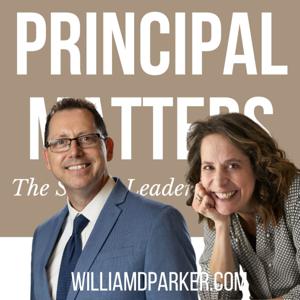
By Principal Matters: The School Leader's Podcast with William D. Parker


4.7
122122 ratings


The podcast currently has 915 episodes available.
The most played episodes among Podcast App listeners.
A Quick Note to Listeners: Before this week’s interview, Jen Schwanke and I take some time to answer a listener question. This week’s question is: What practical ways can I increase visibility even when I get trapped in my office so often? Listen in to hear our answer! Meet Patrick Erwin: Patrick M. Erwin is an educator, speaker, and leadership development specialist currently serving as Curriculum Director for Maxwell Leadership Foundation. With a background that blends music education, leadership, and school culture development, Patrick spent 17 years as the band director at Hillgrove High School, where he became known for building strong student leadership systems and positive team culture. He holds degrees from the University of Georgia, Auburn University, and Berry College. Patrick is the author of the new book I Love This Place, which explores how intentional leadership development can transform school culture. A nationally recognized presenter and leadership coach, Patrick continues to encourage educators through speaking, curriculum design, and practical strategies that help schools become places where both students and staff thrive. Amplifying School Culture Through Leadership: Patrick and I begin our conversation by exploring one of the central metaphors in Patrick’s new book, I Love This Place: the idea of constructive and destructive interference in music. Patrick explains how school teams either amplify one another or unintentionally cancel each other out depending on how aligned they are around vision, values, and expected behaviors. Just as musical harmony requires people playing together with intention, healthy school culture requires leaders who clearly communicate purpose and create alignment across teams. Leadership, Patrick argues, becomes more influential when others catch the vision and begin amplifying it alongside you. The Leadership Framework of HUSTLE: Patrick also shares the story behind the acronym HUSTLE, a leadership framework he developed while leading a large high school band program. Originally a reminder to move quickly and stay focused, HUSTLE eventually evolved into a practical leadership model centered on key character traits: humility, understanding, scholarship, trustworthiness, leadership attitude, and excellence. Patrick explains how those values became the foundation for developing student leaders who could influence culture, support one another, and help sustain a thriving organization far beyond what two directors alone could accomplish. Humility vs. Humiliation: One of the most powerful parts of the conversation centers on Patrick’s distinction between humility and humiliation. He explains that both words share the same root idea of being “grounded,” but humility is choosing to ground yourself honestly, while humiliation happens when the world grounds you instead. Patrick shares transparent stories from his early years as a teacher, including difficult moments where ego and pride created blind spots in his leadership. Those experiences ultimately helped him recognize that leadership is not about protecting personal reputation or legacy, but about serving others, learning continuously, and staying open to growth. Why Diversity Strengthens Teams: We also dive into Patrick’s reflections on diversity, inclusion, and team composition. Drawing from both research and his own classroom experience, he explains why diverse teams naturally create friction—but also produce stronger decisions, better creativity, and healthier outcomes over time. Patrick describes looking across his classroom and recognizing the incredible variety of personalities, experiences, and backgrounds represented within a single group of students. Rather than trying to erase differences, he argues that leaders must learn how to celebrate them, understand them, and help teams find common purpose while allowing different strengths to shine. Creating Rituals That Build Belonging: Patrick shares several practical strategies for building school culture, including one especially powerful ritual involving nuts, bolts, and paracord necklaces. At the end of each marching band season, students exchanged nuts and bolts with peers who had “helped them hold it together” throughout the year. The simple physical artifact became a lasting symbol of teamwork, support, and shared accomplishment. Patrick explains how attaching meaningful objects to emotional moments can help students remember that they belong to something bigger than themselves and that strong cultures are built through intentional connection and recognition. Building Places People Love: As the episode closes, Patrick reminds listeners that culture change takes time, often several years, but leadership development remains one of the most powerful drivers of long-term transformation. When schools intentionally invest in helping both adults and students grow as leaders, cultures become places where people feel connected, valued, and proud to belong. Eventually, students begin leaving campus and telling others, “I love this place.” And according to Patrick, that is when true culture change begins spreading into the broader community. Now It’s Your Turn: As you reflect on this conversation, consider these questions for your own leadership: Are your teams amplifying one another or unintentionally canceling one another out? How clearly have you communicated vision, values, and expectations within your organization? Are you choosing humility, or waiting for humiliation to teach the lesson instead? How are you helping diverse voices and strengths shine within your team? What rituals or traditions could help your students and staff feel more connected and valued? Where might you need to give someone permission to lead instead of trying to control every outcome? Learn more about I Love This Place and connect with Patrick at Patrick Erwin’s Website The post I Love This Place with Patrick Erwin – PMP520 appeared first on Principal Matters.

The school year is in full swing, and in addition to leaders I’ve been supporting in Grow Academies, Masterminds, and one-on-on coaching, I’ve also had the privilege of gathering with leaders in person. This week I wanted to share about an opportunity I had recently to join my friend Chris LeGrande, Executive Director of Oklahoma’s secondary principal and middle-level education associations (OASSP & OMLEA), as Principal Matters sponsored a dinner for principals from my area of the state. Several themes emerged from our time together. Here are three takeaways I thought may resonate with Principal Matters listeners and leaders: Belonging matters, not just for students, but for adults too. Beau Brannon, Union High School, Tulsa, Oklahoma, shared an amazing system he and his teachers have created to track every student to make sure he/she has a caring adult connected to their outcomes. Listen in as Jen and I talk about some of the takeaways he’s learned from that effort. PLCs, when done well, can be wonderful. When done without fidelity, they can become toxic. Timothy Ray, Assistant Superintendent, Catoosa Public Schools, Oklahoma, shared vulnerable lessons on how his leadership team has reorganized their own meetings around teaching and learning in order to dive deeper into the same tasks their helping teachers navigate. AI is still top of mind for many leaders who are trying to figure out how to protect against its misuse while also learning how to manage it as a tool, not an end in itself. Amy Sanders, Sapulpa Public Schools, Oklahoma, shared ways she and her teachers are tackling the hard questions of keeping students safe while also not being afraid of learning ways to utilize technology as an instrument in learning. As I like to say whenever I’m in a room with other leaders, “The smartest person in the room is the room.” Jen and I also discuss some upcoming leadership development opportunities for listeners. as well as give some shout-outs to the following: For Oklahoma leaders: Sign up for the OASSP/OMLEA Leadership & Learning Conference in Edmond, Oklahoma, October 28–29. Danny Steele and Phil Januszewski will be keynoting, along with other great leaders: https://www.ccosa.org/page/oasspomlea-leadership-and-learning-conference For all leaders: In September, I launched a virtual leadership series called Hats We Wear in partnership with First Educational Resources. We meet once a month. Even though we’ve already completed Session 1, it’s not too late to sign up for the remaining seven sessions. You’ll also receive the video from Session 1 so you can catch up in the meantime. Want to learn more about Hats We Wear – Virtual PD Series or sign up? Go here: https://resources.firsteducation-us.com/the-hats-we-wear-as-school-leaders-how-to-lead-serve-coach-and-communicate-with-confidence-full-year-series-landing-page Finally, Jen Schwanke will be at Louisiana’s principal’s association conference September 27-28, in Baton Rouge. If you’re there, make sure to tell her hello! Listen to the full episode to hear us reflect on these and other ideas that emerged in today’s Monday Matters! As always, thank you for doing what matters! ~ Will The post MONDAY MATTERS with Jen Schwanke and Will Parker – Learning From Other Leaders appeared first on Principal Matters.
Meet Robyn Hamasaki: Robyn Hamasaki is Managing Director of Leadership Development for the National Principals Association, supporting efforts to develop PreK–12 school leaders, National Honor Society advisers, and student councils. Previously, she served as a teacher, assistant principal, and PreK–8 principal and helped establish the Principal Leadership Institute with the Colorado Department of Education. She also served as a Colonel in the U.S. Army Reserve. Born and raised in Hawaii, Robyn brings a deep commitment to servant leadership, coaching, belonging, relationships, and developing others. The Realities of School Leadership: Robyn begins by discussing one of the persistent realities of school leadership: it can be lonely. Whether leading a rural school, serving without an assistant principal, or simply carrying responsibilities others may not fully understand, school leaders need meaningful connections with people who understand the work. Robyn emphasizes the importance of networks, coaching relationships, and communities where leaders can safely talk through challenges, exchange ideas, and learn from one another. Belonging: A central theme of the conversation is belonging. Robyn explains that belonging matters not only for students, but also for teachers and school leaders. When people feel seen, heard, and connected, they become more committed and confident. The progression can be summarized in this way: Belonging → Attachment → Commitment → Transformation Five Guiding Principles: The conversation also explores lessons Robyn has learned from decades of leadership across education and the military. She identifies five principles that continue to guide her: I can’t do it alone. It’s not about being right and making someone else wrong. Include and empower others in leadership. Lead by example. Trust your gut and the experience behind it. 2027 National Principals Conference: Robyn also previews the February 2027 National Principals Conference in Tampa, built around the theme “One Conference, One Community.” She shares how the conference is being designed as a PreK–12 gathering focused not simply on professional development, but on creating meaningful experiences, relationships, and memories for school leaders. Conference strands will address teaching and learning; belonging and well-being; systems leadership; community voice and shared responsibility; and innovation, technology, and AI. Closing Comments: As the conversation closes, Robyn offers a reminder to school leaders to cherish the experience of leadership. The work is difficult, but leaders have an extraordinary opportunity every day to influence students, teachers, families, and communities. She encourages leaders to notice and celebrate what’s going well, reach out when the work becomes difficult, build a community of support, and remember the power of something as simple as noticing another person and saying hello. Staying Connected: To connect with Robyn Hamasaki, you can shoot her an email at: [email protected]. If you would like to learn more about the 2027 National Principals Conference, you can visit https://www.principals.org/ or see the information below! National Principals Conference 2027: February 6–9, 2027 Tampa Convention Center | Tampa, Florida https://npc.principals.org/ Conference Registration & Rates: https://npc.principals.org/conference-rates-and-hotel/ The $699 early-bird registration rate is available through September 30, 2026. The post Creating Belonging, Experience, and Memories with Robyn Hamasaki – PMP519 appeared first on Principal Matters.
This week on Monday Matters, Jen Schwanke and Will Parker discuss helping teachers avoid burnout. They start out the conversation by going over the differences between fatigue and burnout. Next, they spend some time talking about the benefits of proactively addressing burnout. Then, Will and Jen address the ways that school leaders can be proactive about teacher burnout. School leaders do have some responsibility to provide teachers with the tools they need to avoid burnout. Some ways that leaders can address the risk of burnout with teachers: Auditing the invisible load Learning to protect focus over volume Normalizing boundaries These three practices are a great way for leaders to open the discussion about burnout with their teachers and minimize the risk of teacher burnout down the line. The tools discussed in this week’s episode are also great ways for leaders to proactively address their own burnout. Will and Jen remind listeners that this job is a gift, but even gifts can be handled in a way that leads to burnout. Give yourself grace as you navigate the highly emotional and impactful work you do! Now It’s Your Turn: Think about a time that you felt exhausted or lonely in your work. What did you do to resolve that? Listen to the full conversation for more takeaways! If you would like to read Jen Schwanke’s full post about burnout, you can find it here. As always, thank you for doing what matters! The post MONDAY MATTERS with Jen Schwanke and Will Parker – Helping Teachers Avoid Burnout appeared first on Principal Matters.
A Quick Note to Listeners: Before each week’s interview, Will Parker and Jen Schwanke take some time to answer a listener question. This week’s question is: If we know best practices for strong student outcomes, why are so many schools not implementing them? Listen in to hear their response! Meet Mara Tieken: Mara Casey Tieken is a professor of education at Bates College in Lewiston, Maine. Her research focuses on educational equity for rural students and communities, including rural college access, rural school closure, and rural racial justice. She is the author of Educated Out: How Rural Students Navigate Elite Colleges—and What it Costs Them (University of Chicago Press, 2025), which was a 2025 American Educational Studies Association Critics’ Choice Book Award winner, and Why Rural Schools Matter (University of North Carolina Press, 2014). She is currently working on two projects: one focused on school closures in rural Black communities, and another studying rural-serving college access organizations. An award-winning teacher, Mara also designed and maintains a web-based toolkit for rural communities fighting school closure. She began her career in education as a third-grade teacher in rural Tennessee. “We give rural students an awful choice: college or community. We need to help them think about it as navigating different worlds rather than choosing one or the other.” Mara Tieken In this week’s episode, Dr. Jen Schwanke leads the conversation with author and researcher Dr. Mara Tieken to explore the unique challenges and strengths of rural education. Drawing from her experience teaching in rural Tennessee, Mara discusses the invisible barriers that rural students face when navigating higher education and the cultural cost of leaving home. The “College vs. Community” Paradox: Rural students often feel they must choose between pursuing a degree and maintaining their community identity. Educators must help students see college not as a replacement for their roots, but as a path to navigate multiple worlds. Recognizing Rural Assets: Rural students bring immense practical skills—like problem-solving, development of systems, and establishing routines—that are often undervalued in traditional academic settings. High school leaders can help students frame these life experiences as professional and intellectual strengths. The Myth of “Schooling” vs. “Schools”: There is a critical distinction between the business of education (test scores, mandates, data) and the sanctuary of a school (relationships, safety, and community). Successful principals “clear the clutter” so that the human element of the school remains intact. The True Cost of School Closures: Research shows that closing rural schools rarely saves the money promised by policymakers, yet it can flatten a community’s social and economic hub. Listening to student voices during these transitions is vital for mitigating trauma and preserving community hope. Normalizing Help-Seeking: Many first-generation rural students feel isolated in elite environments because they aren’t aware that certain resources (like emergency funds or tutoring) are meant for everyone. Administrators can bridge this gap by coaching students on how to advocate for themselves before they leave high school. Staying Connected: If you would like to learn more about Dr. Mara Tieken, you can visit her Linked In profile. The post Why Rural Schools Matter with Dr. Mara Tieken – PMP518 appeared first on Principal Matters.
The podcast currently has 915 episodes available.
2,418 Listeners
1,258 Listeners
61 Listeners
59 Listeners
273 Listeners

437 Listeners
646 Listeners
210 Listeners

566 Listeners
59 Listeners
176 Listeners

82 Listeners
31 Listeners
56 Listeners
33 Listeners