
Sign up to save your podcasts
Or

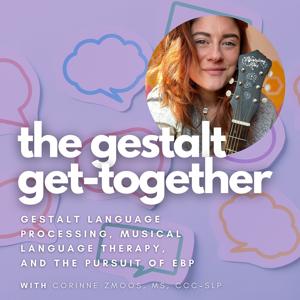

This episode of The Gestalt Get Together explores the origins and applications of the term "Gestalt" in psychodynamics, design, and language processing. Host Corinne Smoos delves into the historical roots of Gestalt theory, tracing its development from German psychodynamics in the late 1800s to its current relevance in speech therapy, particularly for Gestalt language processors (GLPs). The episode discusses key Gestalt principles such as similarity, proximity, closure, continuity, figure-ground, and Prägnanz, highlighting how these principles influence perception, learning, and communication. Corinne also examines how these concepts apply to speech therapy, particularly in working with neurodivergent children, and provides practical strategies for leveraging Gestalt principles in clinical practice.
Three Key Questions Students Will Learn:
Earn 0.1 ASHA CEU for this episode with Speech Therapy PD: https://www.speechtherapypd.com/course?name=So-What-is-a-Gestalt
About the host: Corinne Zmoos, M.S. CCC-SLP, is a musical speech-language pathologist in Baltimore, Maryland. Her private practice, Messy Happy Music Lab, specializes in neurodivergent language acquisition, musical language therapy, Gestalt Processing, and AAC. As a neurodivergent individual, Corinne deeply understands how music lights up the brains of nontraditional learners and facilitates progress rooted in joy rather than compliance. Corinne presents nationally and internationally her framework for music theory as a critical element and intervention consideration in Gestalt Language Processing. Corinne’s current areas of qualitative inquiry are auditory-motor rhythmic cueing, musical syntax as a vehicle for linguistic syntax, and timbre-experience matching.
 View all episodes
 By corinne zmoos, ms, ccc-slp
5
77 ratings
This episode of The Gestalt Get Together explores the origins and applications of the term "Gestalt" in psychodynamics, design, and language processing. Host Corinne Smoos delves into the historical roots of Gestalt theory, tracing its development from German psychodynamics in the late 1800s to its current relevance in speech therapy, particularly for Gestalt language processors (GLPs). The episode discusses key Gestalt principles such as similarity, proximity, closure, continuity, figure-ground, and Prägnanz, highlighting how these principles influence perception, learning, and communication. Corinne also examines how these concepts apply to speech therapy, particularly in working with neurodivergent children, and provides practical strategies for leveraging Gestalt principles in clinical practice.
Three Key Questions Students Will Learn:
Earn 0.1 ASHA CEU for this episode with Speech Therapy PD: https://www.speechtherapypd.com/course?name=So-What-is-a-Gestalt
About the host: Corinne Zmoos, M.S. CCC-SLP, is a musical speech-language pathologist in Baltimore, Maryland. Her private practice, Messy Happy Music Lab, specializes in neurodivergent language acquisition, musical language therapy, Gestalt Processing, and AAC. As a neurodivergent individual, Corinne deeply understands how music lights up the brains of nontraditional learners and facilitates progress rooted in joy rather than compliance. Corinne presents nationally and internationally her framework for music theory as a critical element and intervention consideration in Gestalt Language Processing. Corinne’s current areas of qualitative inquiry are auditory-motor rhythmic cueing, musical syntax as a vehicle for linguistic syntax, and timbre-experience matching.

38,856 Listeners
69,540 Listeners
214 Listeners
48 Listeners
27 Listeners
428 Listeners
6 Listeners
6 Listeners

19,524 Listeners
10 Listeners
12 Listeners
65 Listeners
4 Listeners

12,143 Listeners
7 Listeners
2 Listeners