
Sign up to save your podcasts
Or



Based on Podcast App listening data
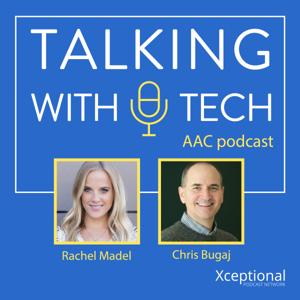
This week, Chris talks with Assistive Technology Specialist David Moehn about supporting general education and special education students more effectively with assistive technology (including AAC). They discuss how to train staff more effectively, supporting all students with text-to-speech and speech-to-text, the specific language system first approach, and the benefits of providing AAC and core language instruction to all students in a classroom.
Before the interview, Chris and Rachel answer a listener question: how can we make using AAC more spontaneous and expressive for a child who is accustomed to lots of hand-over-hand prompting? Chris and Rachel offer lots of helpful suggestions for making AAC more motivating, including: changing the appearance of the device, evaluating what the child is most excited about, modeling without expectation, using expected routines, and the benefits of targeting motivating sensory experiences.
Key ideas this week:
🔑 To tempt communication and reduce prompt dependence, combine an expectant pause with an expected routine, like “ready, set….” during a highly motivating activity.
🔑 Some technology supports, like Read & Write for Chrome, can be helpful for both general- and special-education students. For example, all students, not just students with dyslexia, can benefit from listening to their writing before submitting it.
🔑 When AAC and core language is more universally adopted in a district, consults go down over time because everyone is more accustomed to using the app. Many students also use language more expressively when modeling increases in the classroom.
🔑 Look at the time spent by specialists and support staff to train vs the cost of universal deployment of a tool like Read & Write - if teachers and staff are comfortable and do not need training, then less specialist involvement is required overall.
Help us develop new content and keep the podcast going strong! Support our podcast at patreon.com/talkingwithtech!
Visit talkingwithtech.org to access previous episodes, resources, and CEU credits that you can earn for listening to TWT episodes!
This week’s episode features Rachel’s interview with neuropsychologist Dr. Karen Wilson! Dr Wilson shares some of the treatment approaches and assistive technology tools she uses to support children and adults with ADHD, dyslexia, dysgraphia, and language-based learning disorders.
Before the interview, Chris and Rachel answer a reader’s question looking for more on the "Specific Language System First Approach" from the TWT episode with Erik Engar. Chris tells the story of how this term came to be used, revisits some of the reasoning behind this approach, and shares some resources for learning more about it!
Key ideas this week:
🔑 Classroom accommodations that can help children with ADHD include: private signals between a teacher and the student to refocus attention, breaking down instructions into smaller chunks to support working memory, and eliminating distractions with strategies like preferential seating.
🔑 Mindfulness helps with decreasing anxiety, increasing self-regulation, and and improving focus. Using a mindfulness app before beginning schoolwork can help people with ADHD increase focus and get ready to learn.
🔑 Listening to audiobooks (while following along with the printed text) can help children with dyslexia improve their reading comprehension, because they can spend more effort on comprehending the material and not use up all their energy simply decoding the words.
Links & Tools
AAC Spotlight Slides:
Bit.ly/aacspotlightcb
Mindfulness:
Headspace
Calm
Stop, Breathe, Think
Breathe like a Bear book
ADHD:
Revibe watch
Dyslexia:
NaturalReader
Kurzweil
Google Keep
Notability
Read&Write for Chrome
Co:Writer Universal
Snap & Read
Livescribe Smartpen
Top 6 digital scanner pens
Help us develop new content and keep the podcast going strong! Support our podcast at patreon.com/talkingwithtech!
Visit talkingwithtech.org to access previous episodes, resources, and CEU credits that you can earn for listening to TWT episodes!
In this episode of Teaching with Tech, Chris and Rachel explore the Picseepal, a low-tech AAC communication tool that protects and organizes low-tech communication boards! Chris and Rachel unbox the Picseepal, talk about how they would use it in therapy, and discuss the importance of Picseepal’s goal of donating 1 million Picseepals to those in need across the world. They also discuss why laminating communication boards is not ideal for protecting communication boards, including: 1) lamination may not last very long, 2) it creates a distraction for some AAC users, 3) recreating damaged boards takes time, and 4) dirty or crumpled lamination looks less professional than a Picseepal.
Links:
To see the video version of this episode, visit talkingwithtech.org/episodes/picseepal
Buy an Early Bird Picseepal at over 40% off (for a limited time) and support their global initiative at startsomegood.com/picseepal
Download Picseepal’s core communication board: bit.ly/picseepaldownload
Learn more about Picseepal: www.picseepal.com
This week, Kevin Williams and Lateef McLeod share about racism and ableism from their perspective as Black AAC users. Kevin Williams is a freelance web developer and the Chief Technical Officer of USSAC. Lateef is a PHD Candidate in the Anthropology and Social Change program at California Institute of Integral Studies, Vice President of ISSAC’s LEAD Committee, and published poet/author. In the interview, Kevin and Lateef discuss the importance of having difficult conversations about racism and ableism, the intersection of race and disability in their own life, and the importance of patience, especially from the police, when communicating with AAC users.
Before the interview, Chris and Rachel discuss the need for more options for AAC users to socialize with other AAC users online, especially during the pandemic.
Key Ideas this Week:
🔑 Have uncomfortable conversations about racism and ableism with people in your immediate circle of friends and family. People are more likely to listen to someone they care about and respect
🔑 Police should inspire compliance with their own behavior, including telling someone why they are being physically restrained, rather than simply demanding compliance. Police need to be the most patient with people with disabilities.
🔑 An AAC user’s personality is communicated by more than the software or voice on a device; it also comes from that person’s gestures, vocalizations, and body language.
Links:
Some of Lateef's books on Amazon
Lateef’s podcast “Black Disabled Men Talk”
Join USSAAC and ISAAC
ISAAC PWUAAC Chat page
Speak Up blog
Body Cam Footage of the Death of Rashad Brooks Warning: Video Contains Graphic Images
Where is Hope, The Art of Murder (the documentary)
This week, Rachel interviews Erik Raj, a Speech-Language Pathologist and app developer. about using apps to make language development more motivating and fun! Rachel and Erik discuss picture-manipulation apps to get students laughing, telling stories with the my story app, making passive screen time more active, teaching students to comment and not just request, integrating parents into therapy with the superherofx app, and more! Learn more about Erik at Erikxraj.com and on Instagram @erikxraj
For extra apps and hacks from Erik Raj and to enter to win Erik’s Your Face Learning apps, become a TWT Patron at patreon.com/talkingwithtech!
Before the interview, Rachel and Chris discuss their presentations on AAC in the Cloud: Chris’s presentation on robots and coding for core language, and Rachel’s presentation with Lauren Enders on attention-grabbing tools. They also share about some of the other interesting presentations from this year's AAC in the Cloud conference.
Visit talkingwithtech.org to access previous episodes, resources, and CEU credits that you can earn for listening to TWT episodes!
This week, Rachel interviews Chris Ellis of Audio Cardio, an app designed to help strengthen hearing. They discuss how the app uses threshold sound conditioning (TSC) and barely audible sound to stimulate the cells in the ear, and the results of research studies suggesting TSC can improve hearing thresholds.
TWT listeners can get a free 30 day trial of Audio Cardio by going to audiocardio.com and using the code AAC3XS
Before the interview, Chris and Rachel talk about intersection of hearing and AAC. Rachel shares about an AAC user who had recently received cochlear implants. This AAC user benefited from the visuals on the device and he rapidly improved his functional communication by using the device. Then, Chris shares about some of the issues regarding speaker volume he has solved with solutions like bluetooth speakers. Finally, Chris and Rachel discuss teaching AAC users how to change volume on their devices so they can be heard above the background noise.
Check out Picseepal, a low tech communication tool that is mobile, durable, and splash-proof, at picseepal.com and on Facebook at facebook.com/picseepal
Visit talkingwithtech.org to access previous episodes, resources, and CEU credits that you can earn for listening to TWT episodes!
This week, Rachel interviews Gemma White, an SLP who owns a private practice specializing in AAC and feeding support. Gemma and Rachel discuss a “growth mindset” and why mindset is important for everyone, including people with complex communication needs.
Before the interview, Rachel and Chris play a game where Rachel decides on which words she would use to communicate with fictional “veggie” creatures! Then, Rachel and Chris discuss resources for learning about state license reciprocity and how Chris teaches growth mindset to his kids.
Key ideas this week:
🔑 The idea behind a “growth mindset” is that a person’s personality, intelligence and abilities are not fixed. People grow, change, and develop when they make mistakes and decide on a path forward.
🔑 Promoting a growth mindset isn’t just being a cheerleader- it’s also about fostering an environment where people are brave enough to make mistakes, receive feedback on what was done correctly and incorrectly, and choose a path forward
🔑 We can promote growth mindset while also teaching core language and modeling. We can model things like “you tried, it’s hard, you can do it” to support the idea that learning is a process, they made an error, and we are going to move forward.
🔑 When giving corrective feedback, try to say “not yet” instead of “no”.
You can find out more about Gemma at gemmawhiteslp.com and on Instagram (@a.spoonful)
Check out Picseepal, a low tech communication tool that is mobile, durable, and splash-proof, at picseepal.com and on Facebook at facebook.com/picseepal
Research
Dweck, C. S. (2008). Mindset: The new psychology of success. Random House Digital, Inc..
Dweck, C. S. (2000). Self-theories: Their role in motivation, personality, and development. Psychology press.
Rhew, E., Piro, J. S., Goolkasian, P., & Cosentino, P. (2018). The effects of a growth mindset on self-efficacy and motivation. Cogent Education, 5(1), 1492337.
This week, Rachel and Chris interview Cara Walton (@thebuckeyeslp), the author of a recent change.org petition “Demands for ASHA to Increase Cultural Sensitivity.” Cara shares about her experience as a Black woman becoming a speech-language pathologist, what ASHA can do right now to increase cultural sensitivity, and ways that AAC can better support people of color.
Before the interview, Rachel and Chris talk about their previous attempt to discuss anti-racism and AAC on the podcast, how they responded to mistakes they made, and how that response has led to a better understanding of their own cultural “blindspots” and the importance of learning from our mistakes.
Key ideas this week:
🔑 There is a need for more diversity in the field of speech-language pathology - only 8% of SLPs self-identify as people of color, and only 3% identify as Black. We need to recruit more people of color to become SLPs and audiologists, and push graduate schools to have requirements to enroll a more diverse class.
🔑 Most AAC symbol sets typically default to white male icons being showcased in vocabulary templates and it requires a high level of customization to select and program racially diverse icons. Considering whether the symbols will represent the user can be an important factor when choosing a system for an AAC user. If software developers know racial diversity in symbol sets is a consideration when feature matching, we may see more diverse symbol options in AAC software.
🔑 There should be a mandatory diversity CEU requirement that is similar to the mandatory ethics CEU requirement, and there should be more CEUs on diversity and multicultural issues available on the ASHA Learning Pass.
We invite you to write your own goals for improving racial equity and share them with us at https://bit.ly/twtequityform.
Click here to sign the ASHA petition Cara started.
Resources:
This week, Rachel interviews Brittyn Coleman (https://www.autismdietitian.com), a pediatric dietitian who specializes in supporting children with autism and ADHD. She talks with Rachel about the difference between the different types of food reactions, when biomedical testing may be used to evaluate food sensitivity, the different reasons why some foods may be avoided by picky eaters, and more!
Before the interview, Chris and Rachel finish their game of AAC Bingo! Topics that they rate themselves on this week include if they “inspire not require”, if they are CEU “junkies”, if they use password managers, and how much they enjoy laminating!
Key ideas this week:
🔑 There are up to 30 different steps that may be necessary before we ask a picky eater to eat a new food (e.g., seeing, smelling, touching, tasting). Going straight to eating a new food may elicit a “fight or flight” response that reduces appetite even further.
🔑 There are different types of food reactions that can occur. Food allergies often involve anaphylactic reactions and typically can bee seen on the outside. Food sensitivities can take longer to show up and may only occur internally and manifest as cognitive and/or behavioral issues. Food intolerance is when there is a digestive enzyme that is missing and the body can’t break down a particular food.
🔑 Every person on the autism spectrum is unique and there is no one diet that works for everyone. Even if someone doesn’t benefit from one diet (e.g., gluten-free diet), it doesn’t mean they won’t benefit from a different approach.
Listeners can get $500 off Brittyn’s services by using the promo code talkingwithtech !
Brittani’s son Lucas is a 7 year old AAC user who has Joubert’s syndrome. Brittani shares about her journey with teaching Lucas to communicate and how it led to writing her book “Lucas the Lion Loves the Tiny Talker,” a social story about a lion who uses AAC. It teaches kids about AAC and even comes with its own light-tech AAC device, the Tiny Talker!
Before the interview, Chris plays the “Opposite Challenge” with Rachel, a game with a surprise ending! Next, Chris remembers the late, great Bruce Baker and talks about the impact Bruce made on his life. Rachel discusses starting new online therapy groups for kids that combine direct therapy activities and integrated parent training - learn more at rachelmadel.com/vitual. Chris and Rachel also talk about the need for a “telepractice” license that allows you to practice in multiple states at the same time.
Key ideas this week:
🔑 Joubert’ syndrome is a genetic condition causing the vermis of the cerebellum to be underformed, which causes global developmental delays in eye movement, speech, coordination, and balance.
🔑 Considering the size of a device is important when doing an AAC assessment. A very heavy device may not be a good fit for a small child to take around at home and school.
🔑 Talking with Tech has a new website! Visit talkingwithtech.org for access to all of our episodes and more!
Help us develop new content and keep the podcast going strong! Support our podcast at patreon.com/talkingwithtech!
From the publisher's feed
Ranked by our users in the last 21 days

21,780 Listeners

43,352 Listeners

12,187 Listeners

14,907 Listeners

69,495 Listeners

4,754 Listeners
427 Listeners

4,523 Listeners

3,461 Listeners

5,816 Listeners

12,705 Listeners

17,644 Listeners

10,652 Listeners

13,624 Listeners
3,426 Listeners