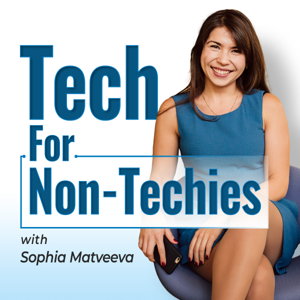
Tech for Non-Techies

Tech for Non-Techies

Download on the App Store

Tech for Non-Techies episodes

  • 313. Nvidia's most valuable asset is not on its balance sheet

    What is Nvidia actually worth?

    You could look at their factories, their hardware, their staff. But their most valuable assets — the patents, the processes, the institutional knowledge — don't appear anywhere on their balance sheet.

    And Nvidia is not an exception.

    Research from Stanford and Chicago Booth, covering 21,000 M&A transactions worth $15 trillion, shows that intangible assets now account for over half the total value of acquired companies.

    Customer data alone totals over $1.1 trillion!

    Here's what this means for you:

    the most valuable things your organisation owns are probably invisible too — and if you're not actively investing in them, they are quietly decaying.

    Listen to this episode to learn:

    • Why the standard ways of measuring company value are systematically misleading us
    • What the research actually shows — and why it should change how you think about your own organisation
    • Why intangible assets decay if you don't actively invest in them
    • What corporate leaders should be asking about their brand, customer data and institutional knowledge right now
    • Why founders who ignore intangible assets while building their product are making an expensive mistake

    This episode is for you if:

    • You are a corporate leader trying to make the case for investing in brand, data or customer insight
    • You are a founder who wants to build something that is genuinely hard to replicate
    • You want to understand where real value is created in the age of AI

    Book a free consulting session with Sophia: https://calendly.com/sophia-matveeva/sample-consulting-session-2026

    Read the full Chicago Booth Review article here: https://www.chicagobooth.edu/review/nvidias-most-valuable-asset-is-not-on-its-balance-sheet

    Timestamps
    • 00:00 – The hidden asset behind NVIDIA's valuation
    • 02:15 – Chicago Booth's research on intangible assets
    • 04:35 – Why 70% of companies are undervalued
    • 06:50 – NVIDIA's real moat: patents no one sees
    • 09:15 – Fixing your company's intangible assets
    • 11:35 – Free consulting session offer
    • 13:55 – Key takeaways for founders and investors

    Follow and Review:

    We'd love for you to follow us if you haven't yet. Click that purple '+' in the top right corner of your Apple Podcasts app. We'd love it even more if you could drop a review or 5-star rating over on Apple Podcasts. Simply select "Ratings and Reviews" and "Write a Review" then a quick line with your favorite part of the episode. It only takes a second and it helps spread the word about the podcast. Listen to our podcast on:

    • Apple
    • Spotify
    • YouTube
    • Audible
    • Pandora
    Transcript: https://www.techfornontechies.co/blog/313-nvidia-s-most-valuable-asset-is-not-on-its-balance-sheet
    16 min
  • 312. How competitive advantage changed in the age of AI

    If building products isn't your competitive advantage anymore, then what is?

    Listen to this episode to find out.

    AI means that everyone can now build (and everyone can copy).

    So to succeed today, you need something un-copyable.

    Listen to this episode to learn:

    • Why speed to build is now the entry ticket, not the prize
    • What genuinely cannot be copied with AI — and why that is where your real advantage lives
    • Real examples of companies that won not because of their technology, but because of what they had that nobody else could replicate
    • What this means if you are a founder with none of those assets yet
    • Why large organisations have the most uncopyable advantages — and why they are the slowest to use them

    This episode is for you if:

    • You are building a product and want to understand what will actually protect it
    • You are a corporate leader trying to figure out where your real innovation opportunity lies
    • You are a founder who needs to think beyond the product itself

    Book a free consulting session with Sophia: https://calendly.com/sophia-matveeva/new-meeting-1

    Timestamps:

    • 00:00 – Why AI has killed the old competitive advantage
    • 02:20 – Preview: lessons from Sophia's corporate AI workshop
    • 04:40 – The real threat AI poses to your business
    • 06:58 – Nike Run Club: how brand beats better tech
    • 09:19 – Bloomberg Terminal and Peloton: data and community as moats
    • 11:43 – 5 uncopyable assets every business needs
    • 14:01 – Why big companies innovate too slowly
    • 16:28 – How founders build brand and distribution from zero

    Follow and Review:

    We'd love for you to follow us if you haven't yet. Click that purple '+' in the top right corner of your Apple Podcasts app. We'd love it even more if you could drop a review or 5-star rating over on Apple Podcasts. Simply select "Ratings and Reviews" and "Write a Review" then a quick line with your favorite part of the episode. It only takes a second and it helps spread the word about the podcast. Listen to our podcast on:

    • Apple
    • Spotify
    • YouTube
    • Audible
    • Pandora

    Transcript: https://www.techfornontechies.co/blog/312-how-competitive-advantage-changed-in-the-age-of-AI

    18 min
  • 311. The one metric that tells you if you're really winning

    You can hit your financial goal and destroy your business.

    You can be surrounded by fans, but none of them become customers.

    This is demoralising, and it happens when you're measuring the wrong thing.

    In this episode, you'll learn one of the most important concepts in product management — the North Star metric — and how to apply it to your product, your venture and your career.

    This is the concept that tells you not just whether you hit a number, but whether you're actually winning.

    This episode is for you if:

    • You're building a product and want to make sure you're focused on the right thing
    • You have a big career goal and want a sharper way to track real progress
    • You keep hitting targets but feel like you're not actually getting anywhere

    Book a free consulting session with Sophia: https://calendly.com/sophia-matveeva/new-meeting-1

    Timestamps:

    • 0:00 – Why you may be measuring the wrong success metric
    • 00:30 – Podcast intro: Tech for Non-Technical Founders
    • 01:52 – Free consulting sessions
    • 03:20 – New course on product thinking and AI innovation
    • 04:40 – What is a North Star metric?
    • 06:36 – Revenue vs retention in a language learning app
    • 10:25 – Why retention is the real growth metric
    • 14:38 – How to apply North Star metrics to your career or venture
    • 16:00 – How Sophia Matveeva grew Tech for Non-Techies
    • 17:55 – External stages as a personal North Star metric
    • 19:50 – Set better goals for the second half of 2026
    • 20:47 – Free session reminder and episode close

    Follow and Review:

    We'd love for you to follow us if you haven't yet. Click that purple '+' in the top right corner of your Apple Podcasts app. We'd love it even more if you could drop a review or 5-star rating over on Apple Podcasts. Simply select "Ratings and Reviews" and "Write a Review" then a quick line with your favorite part of the episode. It only takes a second and it helps spread the word about the podcast. Listen to our podcast on:

    • Apple
    • Spotify
    • YouTube
    • Audible
    • Pandora

    Transcript: https://www.techfornontechies.co/blog/311-the-one-metric-that-tells-you-if-you-re-really-winning

    22 min
  • 310. Product thinking and personal brand: why you need both to win

    You can be invisible with brilliant ideas. Or you can be everywhere with nothing worth saying. Neither works.

    In the age of AI, the barrier to building things has collapsed. The tools exist. The access exists. Which means the differentiator is no longer whether you can build — it's whether you know what to build, and whether people trust you to build it.

    That's product thinking. And that's personal brand. And they are not two separate skills. They are two sides of the same thing.

    In this episode:

    • Why product thinking is no longer just for founders and product managers — and what it actually means to create something valuable
    • Why personal brand without substance gets you nowhere — and what substance actually looks like
    • Why the most ambitious professionals need both — and how to start building them deliberately
    • How my clients are combining both to get promoted, get published and get discovered by the right people

    This episode is for you if:

    • You have good ideas but the right people don't know it
    • You're visible in your industry but not sure you have the frameworks to back it up
    • You're a founder or senior leader who wants opportunities to come to you rather than chase them

    Book a free consulting session with Sophia: https://calendly.com/sophia-matveeva/new-meeting-1

    Timestamps:

    • 00:00 - Introduction: The invisible professional and the overexposed one
    • 02:20 - Free gift: A one-on-one consulting session with Sophia
    • 03:10 - The show's evolution: Product thinking meets personal branding
    • 06:58 - Why product thinking is now a non-negotiable career skill
    • 09:18 - You need to think of yourself as the product
    • 11:33 - How personal branding built a $300,000 government contract
    • 13:00 - Client story 1: A product manager going on international trips with the CEO
    • 15:20 - Client story 2: A consultant heading to the Harvard Business Review
    • 16:17 - Client story 3: A fintech founder building credibility ahead of fundraising
    • 18:27 - Why strategic personal branding is not LinkedIn likes and followers
    • 21:00 - Summary: Why product thinking + personal brand = unstoppable
    • 23:02 - Closing and how to book your free session

    Follow and Review:

    We'd love for you to follow us if you haven't yet. Click that purple '+' in the top right corner of your Apple Podcasts app. We'd love it even more if you could drop a review or 5-star rating over on Apple Podcasts. Simply select "Ratings and Reviews" and "Write a Review" then a quick line with your favorite part of the episode. It only takes a second and it helps spread the word about the podcast. Listen to our podcast on:

    • Apple
    • Spotify
    • YouTube
    • Audible
    • Pandora

    Transcript: https://www.techfornontechies.co/blog/310-product-thinking-and-personal-brand-why-you-need-both-to-win

    24 min
  • 309. What successful founders and senior executives have in common

    Most corporate leaders say they want innovation. What they actually reward is the opposite.

    And then one day — usually the moment someone gets promoted to the top — the rules change.

    Suddenly you need vision, ideas, creativity. Nobody told you that was coming. Nobody taught you how.

    Founders know this feeling from day one. The pressure to create something new, with limited resources, no roadmap, and no safety net.

    The skill that gets both of these people through that moment has a name. It's called product thinking. And if you haven't heard of it — you're almost certainly already doing it. You just don't know it yet.

    In this episode:

    • Why innovation was never everyone's job inside corporations — and what changes when you reach the top
    • What product thinking actually is and why it's now a non-negotiable skill
    • Why founders and senior executives are solving the same problem from different directions

    If this resonates and you want to bring this thinking into your organisation, book a call here https://calendly.com/sophia-matveeva/new-meeting

    Timestamps:

    • 00:00 - Introduction: The wall every ambitious person hits
    • 02:21 - Personal updates: Becoming a mother and entrepreneur
    • 04:40 - Why corporate leaders and investors are tuning in
    • 06:10 - The dirty secret: Senior leaders are suddenly asked to innovate with no training
    • 09:25 - Why founders are the ultimate product thinkers
    • 10:40 - What is product thinking and why it matters now
    • 13:00 - Teaching lawyers to think like product managers
    • 14:11 - Product thinking is what the CEO actually does
    • 16:31 - Who this show is really for and what you'll learn

    Free AI Mini-Workshop for Non-Technical Founders:

    Learn how to go from idea to a tested product using AI — in under 30 minutes.

    Get free access here: https://www.techfornontechies.co/aiclass Follow and Review:

    We'd love for you to follow us if you haven't yet. Click that purple '+' in the top right corner of your Apple Podcasts app. We'd love it even more if you could drop a review or 5-star rating over on Apple Podcasts. Simply select "Ratings and Reviews" and "Write a Review" then a quick line with your favorite part of the episode. It only takes a second and it helps spread the word about the podcast. Listen to our podcast on:

    • Apple
    • Spotify
    • YouTube
    • Audible
    • Pandora

    Transcript: https://www.techfornontechies.co/blog/309-what-successful-founders-and-senior-executives-have-in-common

    19 min
  • 308. How to innovate without blowing up your business — with Netflix's ex-CFO

    Your core business is doing well. Maybe it's doing really well. But you also know that if you don't innovate in the next 5-10 years, you'll be irrelevant.

    So you want to invest in the next thing. But how much? How do you do it without either recklessly spending or being so conservative that you never actually build anything?

    This is the innovator's dilemma. And it's not just a startup problem — it's a corporate problem.

    David Wells was the CFO at Netflix for nearly 15 years. He joined when they were a fledgling DVD-by-mail company with 400,000 customers. He didn't solve the innovation problem with reckless spending. He solved it with financial guardrails.

    Key takeaways:

    • Guardrails, not gates: Netflix didn't say "spend whatever you want." They set boundaries like maintaining operating margin growth and never going into consolidated net loss. This let them innovate aggressively within discipline.
    • You need three types of people: Financial modelers (business thinking), data scientists (insight), and technical teams (execution). Missing one type is why most innovation projects fail.
    • The CFO's real job: Not to hold the company back, but to ensure you can survive hard times. It's constant scenario planning between growth and sustainability.
    • Risk tolerance changes: Risk-taking gets harder the deeper you get into life (debt, family, obligations). There's a sweet spot for taking big bets.
    • Data matters more than coding: Non-technical people should understand data fundamentals and insight, not learn to code.

    Book a call with us if you want to grow your revenue or your margins with new innovative approaches: https://calendly.com/sophia-matveeva/new-meeting

    Timestamps:

    • 00:00 - Introduction: Balancing innovation and financial discipline at Netflix
    • 02:45 - Why David studied public policy alongside his MBA
    • 04:45 - Joining Netflix as a DVD-by-mail company in 2004
    • 07:03 - Choosing Netflix over consulting and the dot-com aftermath
    • 09:30 - Advice for people considering startup risk over a stable job
    • 11:49 - Why "tech" understanding matters even in finance roles
    • 14:12 - Data science vs software engineering: Which matters more?
    • 18:50 - Demystifying algorithms: They're not as scary as the name implies
    • 19:50 - The triumvirate: FP&A, data science, and engineering teams
    • 21:17 - How Netflix valued content deals using data
    • 23:42 - Building an anti-fraud team across 120 countries
    • 25:00 - The innovator's dilemma: How much should you spend on the next big thing?
    • 26:07 - Netflix's growth boundaries: Operating margin and no consolidated net loss
    • 28:33 - Applying the innovator's dilemma to traditional companies
    • 30:54 - Advice for bankers trying to break into fintech
    • 33:17 - Why founders want to see you use the product, not a PowerPoint deck

    Free AI Mini-Workshop for Non-Technical Founders:

    Learn how to go from idea to a tested product using AI — in under 30 minutes.

    Get free access here: https://www.techfornontechies.co/aiclass Follow and Review:

    We'd love for you to follow us if you haven't yet. Click that purple '+' in the top right corner of your Apple Podcasts app. We'd love it even more if you could drop a review or 5-star rating over on Apple Podcasts. Simply select "Ratings and Reviews" and "Write a Review" then a quick line with your favorite part of the episode. It only takes a second and it helps spread the word about the podcast. Listen to our podcast on:

    • Apple
    • Spotify
    • YouTube
    • Audible
    • Pandora

    Transcript: https://www.techfornontechies.co/blog/308-how-to-innovate-without-blowing-up-your-business-with-netflix-s-ex-cfo

    36 min
  • 307. How to lead a development team when you're not technical

    You're paying for developer time. But you can't evaluate the work yourself. So you're left wondering — are they actually building, or just going through the motions?

    Most founders figure this out the hard way. In this episode, we break down the framework that lets you lead technical teams without being technical — and why trying to implement it alone often fails.

    Key takeaways:

    • The invisible accountability trap: Why hours-driven management doesn't work (and why output-driven does).
    • The Monday morning meeting: The exact structure that keeps developers accountable without micromanaging.
    • Prioritization as a business skill: How to make tradeoffs — understanding that building feature X means NOT building feature Y.
    • Technical oversight: Why having a senior engineer validating your developers' work prevents expensive mistakes — and how we act as that advisor for you.

    The implementation gap

    Knowing this framework and actually implementing it with your team are two different things. Without someone technical validating your developers' estimates, you won't know if they're being realistic.

    Without someone who's done this before, you won't know how to troubleshoot when things go wrong.

    Lead your team with confidence

    If you want to set up this system properly — or fix it if you're already struggling — book a call with us.

    Our CTO will validate your developers' estimates. Sophia will help you run the meetings.

    We'll help you avoid the expensive mistakes along the way.

    Book a call: https://calendly.com/sophia-matveeva/new-meeting

    Timestamps:

    • 00:00 - Introduction: How to manage a technical team without being technical
    • 02:34 - Output-driven vs input-driven management
    • 04:51 - How to run your Monday morning developer meeting
    • 07:13 - Come with sketches and designs, not just words
    • 09:27 - Real example: The video feature trade-off
    • 11:50 - Why junior developers won't tell you about trade-offs
    • 13:30 - Building your prioritization framework
    • 14:11 - What is a sprint and how to use it
    • 17:30 - How to know if developer estimates are reasonable
    • 20:30 - Summary and closing

    Free AI Mini-Workshop for Non-Technical Founders:

    Learn how to go from idea to a tested product using AI — in under 30 minutes.

    Get free access here: https://www.techfornontechies.co/aiclass Follow and Review:

    We'd love for you to follow us if you haven't yet. Click that purple '+' in the top right corner of your Apple Podcasts app. We'd love it even more if you could drop a review or 5-star rating over on Apple Podcasts. Simply select "Ratings and Reviews" and "Write a Review" then a quick line with your favorite part of the episode. It only takes a second and it helps spread the word about the podcast. Listen to our podcast on:

    • Apple
    • Spotify
    • YouTube
    • Audible
    • Pandora

    Transcript: https://www.techfornontechies.co/blog/307-how-to-lead-a-development-team-when-you-are-not-technical

    24 min
  • 306. From prototype to product: the infrastructure trap non-technical leaders miss

    If you have a working product - well done. This truly is a major milestone.

    BUT maintaining commercial control of what you've created might be challenging.

    In this episode, we contrast two founders: Founder 1, who has a no-code prototype ready to scale, and Founder 2, who let an outside agency manage her hosting and was hit with a $4,000 bill just to try and claw back her own data. We break down why legal ownership on paper means nothing without operational control of your code and servers.

    Key takeaways:
    • The illusion of progress: Why a functioning app doesn't automatically mean you own a secure business asset.
    • Prevention vs. cure: How to use the prototype phase to lock down your infrastructure before hiring developers.
    • The $4,000 gate fee: The hidden financial liabilities of letting an external agency manage your cloud accounts.
    • The 3-point audit: Crucial steps to verify who controls your GitHub, cloud servers, and documentation.

    Secure your tech asset

    Don't wait for a surprise bill to find out who holds the keys to your technology.

    If you want an independent review of your prototype or current development setup, book a Technical Diagnostic with us. We don't sell development hours; we give you an unbiased evaluation of what you control, what needs fixing, and what it should realistically cost.

    Book a call to find out how this would work for your business: https://calendly.com/sophia-matveeva/new-meeting Timestamps:
    • 00:00 - Introduction: When you don't actually control your own tech
    • 04:00 - Founder 1: Built a working prototype, now what?
    • 06:00 - Why a technical diagnostic must come before hiring developers
    • 09:14 - Founder 2: Real product, real users, but a dangerous hidden problem
    • 11:37 - The $4,000 wake-up call: Legal ownership vs operational control
    • 14:01 - The GitHub analogy: Why admin passwords matter
    • 16:12 - Three things every non-technical founder must audit right now
    • 18:32 - When compliance laws kick in and why this becomes urgent
    • 20:52 - Closing and resources

    Free AI Mini-Workshop for Non-Technical Founders:

    Learn how to go from idea to a tested product using AI — in under 30 minutes.

    Get free access here: https://www.techfornontechies.co/aiclass Follow and Review:

    We'd love for you to follow us if you haven't yet. Click that purple '+' in the top right corner of your Apple Podcasts app. We'd love it even more if you could drop a review or 5-star rating over on Apple Podcasts. Simply select "Ratings and Reviews" and "Write a Review" then a quick line with your favorite part of the episode. It only takes a second and it helps spread the word about the podcast. Listen to our podcast on:

    • Apple
    • Spotify
    • YouTube
    • Audible
    • Pandora

    Transcript: https://www.techfornontechies.co/blog/306-from-prototype-to-product-the-infrastructure-trap-non-technical-leaders-miss

    22 min
  • 305. How to build a company you're proud of — with Eric Ries

    Most founders start with the best intentions.

    And then somewhere along the way — without noticing — the company they've built becomes something they're ashamed of.

    Not because they're bad people. But because nobody taught them how to prevent it.

    Eric Ries wrote The Lean Startup — the book that changed how Silicon Valley thinks about building companies.

    His new book, Incorruptible, tackles the question that comes next: how do you build a company that makes money without destroying the thing that made it worth building in the first place?

    In this episode, Sophia Matveeva speaks with Eric about the practical techniques any founder can use today — no revolution in how business works required.

    Listen to learn:

    • Why investors are not your bosses — and what happens when you treat them like they are
    • How the most successful mission-driven companies are structured so they cannot make money any other way except by achieving their mission
    • Why doing the right thing by your customers and employees is often the highest ROI decision you can make — just not on a short-term spreadsheet

    Eric also shares the story of a Texas grocery store that told customers to take their shopping home for free during an ice storm — and what that decision reveals about what it actually means to build with integrity.

    Resource mentioned in this episode: The Lean Startup by Eric Ries — covered on episode 111 Lessons from the Lean Start-Up by Eric Reis

    ---

    Ready to build your tech venture the right way?

    Book a call: https://calendly.com/sophia-matveeva/new-meeting

    Timestamps:

    • 00:00 - Introduction: The ice storm story - When HEB gave away groceries
    • 02:53 - How every founder starts with good intentions but ends up somewhere else
    • 05:05 - Mission-driven vs mission-hopeful: What actually counts
    • 08:18 - Costco's governance fortress and violating "best practices"
    • 10:55 - Long-term vs short-term: Maximizing human flourishing
    • 14:04 - Why business founders have a bad reputation
    • 17:41 - Investors are not your bosses - The fundamental mistake
    • 21:52 - The AI insurance startup hiding their nonprofit foundation
    • 25:08 - The HEB ice storm story: When doing right pays off
    • 28:45 - Closing and resources

    Free AI Mini-Workshop for Non-Technical Founders:

    Learn how to go from idea to a tested product using AI — in under 30 minutes.

    Get free access here: https://www.techfornontechies.co/aiclass

    Follow and Review:

    We'd love for you to follow us if you haven't yet. Click that purple '+' in the top right corner of your Apple Podcasts app. We'd love it even more if you could drop a review or 5-star rating over on Apple Podcasts. Simply select "Ratings and Reviews" and "Write a Review" then a quick line with your favorite part of the episode. It only takes a second and it helps spread the word about the podcast.

    Listen to our podcast on:
    • Apple
    • Spotify
    • YouTube
    • Audible
    • Pandora

    Transcript: https://www.techfornontechies.co/blog/305-how-to-build-a-company-you-re-proud-of-with-eric-ries

    33 min
  • 304. How one founder went from zero to 6 million users with no ad spend

    Can you build a B2C app to 6 million users with no advertising?

    Colin Hodge did it when he co-founded Bang with Friends — a dating app that went viral purely through word of mouth — because he understood the psychology of his users so precisely that they couldn't help but share it.

    In this episode, Sophia Matveeva speaks with Colin Hodge — entrepreneur, growth expert, and author who has scaled businesses to over 100 million users.

    He co-founded a viral dating app, served as Chief Growth Officer for 17Live, Asia's leading live-streaming app, and re-acquired his own startup after selling it, growing it into a top 5 US dating app.

    But this episode is not really about dating apps.

    It is about the one thing that separates products that grow from products that stagnate: understanding your users deeply enough to build something they cannot stop sharing.

    You'll learn:

    • The overnight pivot that took a failing startup to a million users in three months
    • Three practical techniques for getting inside the mind of your user, even if you are nothing like them
    • Why the best user interviews feel like anthropology rather than sales
    • Why critiquing your own product before user interviews makes you a dramatically better listener

    Timestamps:

    • 00:00 - Introduction: How Bang with Friends went from zero to 1 million users
    • 04:51 - How a bad date launched Colin's biggest business success
    • 08:48 - The pivot: From friends of friends to "Who has a crush on me?"
    • 11:07 - Reaching 1 million users in 3 months with zero ad spend
    • 14:36 - Lessons for boring businesses from a scandalous dating app
    • 18:35 - Three methods to understand users who aren't like you
    • 20:59 - Method 1: The method acting technique - Live your user's life
    • 22:50 - Method 2: Build detailed personas beyond demographics
    • 26:55 - Method 3: User research as an anthropologist, not a salesperson
    • 27:52 - How to suppress your founder instinct and actually listen

    Free AI Mini-Workshop for Non-Technical Founders:

    Learn how to go from idea to a tested product using AI — in under 30 minutes.

    Get free access here: techfornontechies.co/aiclass

    Follow and Review:

    We'd love for you to follow us if you haven't yet. Click that purple '+' in the top right corner of your Apple Podcasts app. We'd love it even more if you could drop a review or 5-star rating over on Apple Podcasts. Simply select "Ratings and Reviews" and "Write a Review" then a quick line with your favorite part of the episode. It only takes a second and it helps spread the word about the podcast.

    Listen to our podcast on:
    • Apple
    • Spotify
    • YouTube
    • Audible
    • Pandora

    Transcript: https://www.techfornontechies.co/blog/304-how-one-founder-went-from-zero-to-6-million-users-with-no-ad-spend

    32 min

About Tech for Non-Techies

From the publisher's feed

If you want to build new things and be known as the innovator in the room — this is your show.

More shows like Tech for Non-Techies

The Twenty Minute VC (20VC): Venture Capital | Startup Funding | The Pitch by Harry Stebbings

The Twenty Minute VC (20VC): Venture Capital | Startup Funding | The Pitch

541 Listeners

The McKinsey Podcast by McKinsey & Company

The McKinsey Podcast

388 Listeners

The Knowledge Project by Shane Parrish

The Knowledge Project

2,698 Listeners

The a16z Show by Andreessen Horowitz

The a16z Show

1,087 Listeners

Super Data Science: ML & AI Podcast with Jon Krohn by Jon Krohn

Super Data Science: ML & AI Podcast with Jon Krohn

305 Listeners

Founders by David Senra

Founders

2,208 Listeners

Masters of Scale by WaitWhat

Masters of Scale

3,979 Listeners

The Diary Of A CEO with Steven Bartlett by DOAC

The Diary Of A CEO with Steven Bartlett

8,527 Listeners

Inside the Strategy Room by McKinsey & Company

Inside the Strategy Room

175 Listeners

Coaching Real Leaders by Muriel Wilkins

Coaching Real Leaders

671 Listeners

Business Breakdowns by Colossus | Investing & Business Podcasts

Business Breakdowns

349 Listeners

ACQ2 by Acquired by Ben Gilbert and David Rosenthal

ACQ2 by Acquired

290 Listeners

Marketing Against The Grain by Hubspot Media

Marketing Against The Grain

358 Listeners

The AI Daily Brief: Artificial Intelligence News and Analysis by Nathaniel Whittemore

The AI Daily Brief: Artificial Intelligence News and Analysis

684 Listeners

HBR On Leadership by Harvard Business Review

HBR On Leadership

156 Listeners