
Sign up to save your podcasts
Or



Agile has helped spawn methodologies that address business processes and broader scopes than software, websites, or digital marketing. One of these is “design thinking,” which has its origins at IDEO, a design studio that does a lot of work in human-centred design and has completed a broad range of projects that involve user experience. The easiest way to describe design thinking is as a philosophy that approaches business challenges with a clean slate. Instead of improving upon something which currently exists, it starts with the question, “What is the problem we’re trying to solve?” and designs a solution from that. Design thinking is similar to agile in that input is sought beyond the primary team doing the work, and it requires an iterative process to achieve the best solution to the problem. What sets design thinking apart from agile is that it is even further from the waterfall methodology. Agile still assumes a particular end solution is a right approach. Design thinking does not make any such assumptions. The solution is designed around the user and not around a specific method, channel, or medium.
Agile has helped spawn methodologies that address business processes and broader scopes than software, websites, or digital marketing. One of these is “design thinking,” which has its origins at IDEO, a design studio that does a lot of work in human-centred design and has completed a broad range of projects that involve user experience.
The easiest way to describe design thinking is as a philosophy that approaches business challenges with a clean slate. Instead of improving upon something which currently exists, it starts with the question, “What is the problem we’re trying to solve?” and designs a solution from that.
Design thinking is similar to agile in that input is sought beyond the primary team doing the work, and it requires an iterative process to achieve the best solution to the problem.
What sets design thinking apart from agile is that it is even further from the waterfall methodology. Agile still assumes a particular end solution is a right approach. Design thinking does not make any such assumptions. The solution is designed around the user and not around a specific method, channel, or medium.
Hosted on Acast. See acast.com/privacy for more information.
Hosted on Acast. See acast.com/privacy for more information.
Hosted on Acast. See acast.com/privacy for more information.
I go through the Agile Brand Manifesto and talk about valuing continual improvement over maintaining status quo.
Hosted on Acast. See acast.com/privacy for more information.
From the publisher's feed
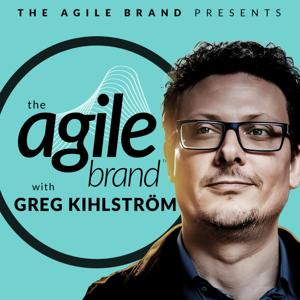
Marketing technology, AI, and customer experience, explained by the people building it. Three times a week, Greg Kihlström interviews CMOs, product leaders, and martech executives from platform…
Each episode runs 20–30 minutes: one guest, one specific problem, no filler. Recent conversations cover what changes when AI agents enter the discovery and purchase path, how to move past traditional A/B testing with reinforcement learning, closing the AI capability gap inside marketing teams, and where personalization stops paying off.
Who it's for: CMOs, VPs of marketing, martech and marketing operations leaders, and CX practitioners at enterprise brands and the platforms that serve them.
Greg Kihlström is an AI transformation advisor to leading brands, a martech futurist, a keynote speaker, and the author of over 25 books on marketing technology, including the Agile Brand Guide series. He has hosted The Agile Brand since 2019 — 900+ episodes, and highly rated across all podcast platforms.
New episodes drop at least three times a week. Follow the show so new episodes arrive automatically.
Hosted on Acast. See acast.com/privacy for more information.

21,049 Listeners
1,262 Listeners
308 Listeners

202 Listeners

9,568 Listeners

810 Listeners
15,412 Listeners
208 Listeners

616 Listeners
1,001 Listeners

36 Listeners

518 Listeners

404 Listeners