
Sign up to save your podcasts
Or



Based on Podcast App listening data
Monkey Cage 100!
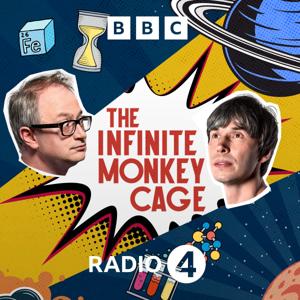
Brian Cox and Robin Ince celebrate the 100th episode of the hit science/comedy show, by inviting some very well known monkey cage alumni to join them. Brian Blessed, Eric Idle, Katy Brand, Dave Gorman and Andy Hamilton (to name a few) take to the stage to consider what has been learnt since Episode 1, back in November 2009. Joining them on stage, will be science royalty, including Alice Roberts, American Astrophysicist Neil De Grasse Tyson, Professor Sue Black and Prof Fay Dowker, to look at the big scientific discoveries that have happened in the time since Brian and Robin first hit the airwaves, from the Higgs Boson, to Gravitational Waves, to our understanding of how human evolved. What epic discoveries might be made over the course of the next 100 episodes?
For the first time, You can watch the 100th episode of The Infinite Monkey Cage, recorded live in the iconic BBC Radio Theatre, on BBC iPlayer for 30 days from Wednesday July 11th, and on the BBC Red Button at various times for 7 days from Monday 16th July.
Producer: Alexandra Feachem
Volcano!
Brian Cox and Robin Ince are joined by comedian Jo Brand and Volcano experts Professor Tamsin Mather and Professor Clive Oppenheimer. They look at the very latest technology that is used to predict the next big volcanic eruption, as well as the history and importance of volcanoes and volcanic activity on our planet.
Producer: Alexandra Feachem.
How Animals Behave
Brian Cox and Robin Ince are joined by comedian Rufus Hound, Zoologist and broadcaster Lucy Cooke and Professor Rory Wilson to discover how we learn about what animals are up to when we are not looking, and some of the hilarious mistakes we've made in the process of discovery. They'll be hearing about why the sex life of eels has remained so enigmatic, how the mystery of the wandering albatross has been solved, and why making underwear for frogs finally solved the riddle of how babies are made.
The Teenage Brain
Brian Cox and Robin Ince are joined by impressionist Rory Bremner, Professor of Cognitive Neuroscience at UCL Sarah-Jayne Blakemore and Professor of Zoology at Manchester University Matthew Cobb to look at the working of the teenage brain, and why teenagers are so, well, teenagery. Stomping off to your bedroom, being embarrassed by your parents, wanting to fit in with your peers and a love of risky behaviour are all well known traits associated with our teenage years, exasperating parents through the ages. But new research into dynamic changes going on in the brain during these key years has revealed that it's not just hormones that are responsible for these behaviours. Could a better understanding of what is going on during these formative years not only help teenagers themselves, but inform our education system and even help prevent many of the mental health problems that often begin during adolescence?
Antibiotics
Producer: Alexandra Feachem.
The Secret Life of Birds
Brian Cox and Robin Ince are joined by guests including Katy Brand, Steve Backshall and Professor Tim Birkhead to uncover the secret life of birds. They'll be looking at some of the extraordinary and cunning behaviour exhibited by many species of birds, both male and female, in an effort to attract a mate. They also get a special visit from Brann the Raven, who takes to the stage to demonstrate just how intelligent some species of birds can be.
When Two Stars Collide
Brian Cox and Robin Ince are joined on stage by comedian Dara O'Briain, Professor Sheila Rowan of Glasgow University and Professor Nils Andersson of Southampton University to look at last summer's spectacular discovery of gravitational waves from two colliding neutron stars. The observation of this huge cosmic event not only confirmed one of Einstein's great predictions, some 100 years ago, but also revealed the source of gold in our universe. Brian, Robin and guests look at how this momentous discovery brought together nearly 1/3 of the world's astronomers and astrophysicists as they raced to point their telescopes at the collision, but also confirmed the presence of gravitational waves, first predicted in Einstein's theory of general relativity back in 1915. They also discover why the source of our heavier elements such as gold and platinum has been so difficult to prove, until now.
The Infinite Monkey Cage book "How to Build A Universe (Part 1)" is out now and available to buy from all the usual places.
The Infinite Monkey Cage Christmas Special: The Science of Magic
The Infinite Monkeys bring their own brand of yule friendly science and comedy to the BBC Radio 4 Christmas schedule, and this year add an extra sprinkling of festive magic. Brian Cox and Robin Ince will be joined on stage by some very special guests to look at the science behind some of our best loved magic tricks and illusions. Actor, writer and illusionist Andy Nyman,actor and comedian Diane Morgan, Professor of Psychology and magician Richard Wiseman, and theologian and broadcaster Professor Francesca Stavrakopoulou will all be demonstrating how basic human psychology and evolution allow us to see and believe the seemingly impossible. They'll be exploring how some basic psychology can lead to some truly impressive deceptions, and ask how easy it is to trick the human mind, even a mind like Brian's. Prepare to be amazed.
Producer: Alexandra Feachem.
The Mind V The Brain.
It's one of the hardest problems in neuroscience. How do the chemical processes and electric signals produced by our brains result in the complex and varied experiences and sense of self that we might describe as our mind? Brian Cox and Robin Ince are joined on stage by comedian Katy Brand, and neuroscientists Professor Uta Frith and Professor Sophie Scott to ask whether the mind is simply a product of the biology of our brain, or is there more to it than that? Can you have a brain without a mind, and is the mind simply an unexpected consequence, an emergent property, of our highly evolved and sophisticated brain. They'll also be tackling the question of free will, and whether we really have any, and if you could in theory simulate a fully working brain, with all its signals and complexity, would a mind naturally emerge?
Producer: Alexandra Feachem.
Are we living in a simulation?
Elon Musk thinks we definitely could be, and it seems he is not alone. The idea that we might simply be products of an advanced post-human civilisation, that are simply running a simulation of our universe and everything it contains, has taken hold over the last few years. Brian Cox and Robin Ince are joined on stage by comedian Phill Jupitus, Philosopher Professor Nick Bostrom and Neuroscientist Professor Anil Seth to ask what the chances are that are living in some Matrix like, simulated world and more importantly, how would we ever know?
Producer: Alexandra Feachem.
From the publisher's feed
A witty, irreverent look at the world through scientists' eyes, guest hosted by Prof. Adam Rutherford and Jess Fostekew.
Ranked by our users in the last 21 days

7,586 Listeners

522 Listeners

873 Listeners

1,043 Listeners

287 Listeners

5,514 Listeners

2,103 Listeners
4,820 Listeners

490 Listeners

384 Listeners

407 Listeners

824 Listeners

238 Listeners

475 Listeners

347 Listeners

233 Listeners

309 Listeners

3,226 Listeners

110 Listeners

77 Listeners
78 Listeners

806 Listeners

518 Listeners

628 Listeners
186 Listeners

380 Listeners

233 Listeners

60 Listeners

73 Listeners
431 Listeners

72 Listeners