
Sign up to save your podcasts
Or



Based on Podcast App listening data
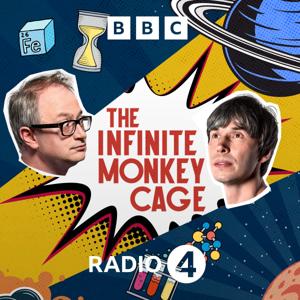
Will Insects Inherit the Earth?
Brian Cox and Robin Ince are joined on stage by comedian Dave Gorman, zoologist Tim Cockerill and forensic entomologist Amoret Whitaker. They'll be discovering the joy of creepy crawlies, why the flea is the ultimate master of Darwinian evolution, and whether those pesky cockroaches will really have the last laugh if we are unlucky enough to be wiped out by a nuclear explosion. They'll be discovering how and why insects have been by far the most successful group of organisms during the history of life on planet earth, and why we simply couldn't do without them.
Oxygen: a matter of life and death.
Brian Cox and Robin Ince are joined on stage by chemist Andrea Sella, science broadcaster and writer Gabrielle Walker and comedian Sara Pascoe to look at the life and death properties of oxygen. It's the molecule we simply can't live without, but as fate would have it, oxygen is also the molecule that eventually leads to our death. Hailed as an elixir of life, and foundation of the atmosphere, oxygen is the revolutionary element that quickens life and hastens death through its ferocious reactivity. It's the molecule our cells need, but is actually highly toxic to them, and is in the end what causes us to age. Brian and Robin get to grips with the chemistry of this contradictory molecule, and Andrea Sella tries not to cause too big an explosion by demonstrating oxygen's reactive nature using a digestive biscuit.
Producer: Alexandra Feachem.
Astronaut Special
Brian Cox and Robin Ince transport the cage to Trondheim Norway, host of this year's Starmus Festival, for an extraordinary gathering of astronauts. They are joined on stage by NASA astronauts Sandra Magnus and Terry Virts, ESA astronaut Claude Nicollier, and Apollo 16's Charlie Duke, one of the last people to have walked on the moon. They talk about their personal journeys to fulfill their long-held dreams, and literally reach for the stars. They hear from Charlie Duke about the extraordinary Apollo missions he was part of, including his role as Capsule Communicator for the very first moon landing, before taking his own first steps on the lunar surface as part of Apollo 16. They explore the different experience of astronauts from Charlie's era, and those who now become residents of space, spending months and months aboard the International Space Station, and the challenges each mission brings. And Claude Nicollier describes his epic spacewalk to repair the Hubble Telescope.
Producer: Alexandra Feachem.
"What Particles Remain to be Discovered?"
Brian Cox and Robin Ince return for a new series of the hugely popular, multi-award winning science/comedy show. Over the series a variety of scientists and comedy science enthusiasts will take to the stage to discuss everything from the glory of insects to whether free will is just an illusion. They'll be joined by the usual eclectic selection of guests over the series, including comedian Sara Pascoe, Dane Baptiste, Katy Brand and Eric Idle, as well as astronauts Sandra Magnus and Apollo astronaut and moon walker Charlie Duke, for a space traveller special.
The first show will see Python legend and Monkey Cage theme tune creator Eric Idle take to the stage alongside physicists Jonathan Butterworth and Catherine Heymans to ask "what particles remain to be discovered?" . They'll be looking at life beyond the Higgs Boson and asking whether a new, as yet undetected particle could answer arguably the greatest question in physics and finally uncover the mysterious unknown elements that make up the 95% of our Universe that are known as Dark Matter and Dark Energy.
Making the Invisible, Visible
Producer: Alexandra Feachem.
The Human Story: how we got here and why we survived.
Producer: Alexandra Feachem.
Oceans: what remains to be discovered?
Producer: Alexandra Feachem.
Science's Epic Fails
Brian Cox and Robin Ince are joined on stage by actor and comedian Rufus Hound, Professor Alice Roberts and Dr Adam Rutherford to discuss some of the great scientific failures, and mistakes made by some very well known scientists. They look at how some of the greatest scientific thinkers of all time, from Darwin to Einstein, got key elements of their own theories wrong, or in the case of others, followed a path of understanding that would later be completely disproved. They discuss why failure in science is no bad thing, and ask whether getting it wrong, is a fundamental part of the scientific method, and should in fact be applied to many other areas of life.
Producer: Alexandra Feachem.
How to beat the house and win at games.
The Science of Everyday Life
From the publisher's feed
A witty, irreverent look at the world through scientists' eyes, guest hosted by Prof. Adam Rutherford and Jess Fostekew.
Ranked by our users in the last 21 days

7,586 Listeners

522 Listeners

873 Listeners

1,043 Listeners

287 Listeners

5,514 Listeners

2,103 Listeners
4,820 Listeners

490 Listeners

384 Listeners

407 Listeners

824 Listeners

238 Listeners

475 Listeners

347 Listeners

233 Listeners

309 Listeners

3,226 Listeners

110 Listeners

77 Listeners
78 Listeners

806 Listeners

518 Listeners

628 Listeners

186 Listeners

380 Listeners

233 Listeners

60 Listeners

73 Listeners
431 Listeners

72 Listeners