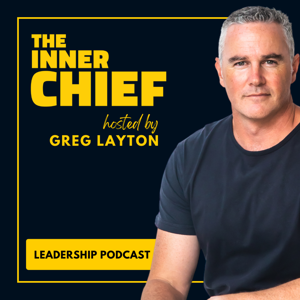
The Inner Chief

The Inner Chief

Download on the App Store

The Inner Chief episodes

  • 60. Authority Guru Steve Brossman on Making Sales Easy and Being an Enterprise of One

    In this episodes we hear from CEO and authority guru Steve Brossman on Making on Sales Easy and and Being and Enterprise of One.

    Steve is a former National Professional Track Champion and is the Author of two Amazon No.1 Best Sellers 'Stand Up, Stand Out or Stand Aside' and 'The Authority Client Attraction System".

    He has created several 6 and 7 figure businesses of his own, including inventing and marketing an environmental product selling 4 million units into 26 Countries.

    With over 20 years TV and video experience including hosting and producing his own TV Show on Ch 9 and appearing on TV in 5 Continents he is one of Australia's most experienced Video presenter trainers.

    Steve has spoken in 15 countries and trained over 32,000 Speakers, Coaches and Business Owners to Stand out in their market.

    Recognised as real influencers Pam and Steve were invited to a high-level mastermind with Richard Branson on his own Necker Island.

    With a desire to help professionals overcome their fear of selling Steve has created the Blueprint Conversion System. This breakthrough program is changing the way professionals market and sell their services.

    Questions I ask Steve:

    Why do people fear sales so much?

    How do people build authority within their organisation or as a small business?

    What is it like working Sir Richard Branson on Necker Island?

    What is the difference between an expert and someone with authority

    What is the biggest mistake people make in sales?

    What separates the top 1% of sales people from every other person?

    Key Points from Steve:

    • One of my mentors once said, "You're not in the job of your profession, your profession is marketing what you do."
    • An expert knows something, an authority is known for something.Now in corporate world, you could be an authority within the corporate world. What most people don't do is go and look at what their strengths are. Not only what their strengths are, but what that means to other people. I do work in the corporate world, and with individuals as well. I try and teach them to be their own what I call a personal enterprise. That they've got to run their own business within the corporate. They've got to be seen as a leader and authority to stand out in that business. That person is the go-to person for something.
    • Work out what is your own uniqueness, what you want to be known for. What are the outcomes that you deliver for the people in your own organisation, or for your clients and customers, if you're a business owner.
    • I love bringing sporting analogies, and you'll appreciate this one, is that once they're known for that, and they're delivering and exceeding the delivery, exceeding the values that they're providing for other people, they need to do it in two ways. They need to do it in their playing field, and that's with and for people that they're interacting on a daily basis. That's providing great service, and it's other people seeing that they're providing great service. So that's down on the playing field, but what they also should be looking at is the perception from the stands. The people that may or may not be interacting, but potentially are going to be responsible for, or actually reporting to those responsible for that person getting a promotion, or getting up the corporate ladder.
    • That's the thing, it's not the fear of selling. If you're selling yourself, if you're a professional, it's the fear of personal rejection.
    • The philosophy is sell the system, not yourself. When you take it away from selling yourself, and I get them to pictorialize their system in a way that it is a graphic blueprint. Because we absorb images, verbal is linear.
    • "This is the system. This is my blueprint for success for you." Then they start saying, "Well, this is the different ways that we could help. This is the different value that we could have." They're collecting value as they're going along, and at the end of it, the perceived value was greater than the investment. Does it make sense we implement this sooner rather than later? So it's a collaboration, people like collaborating. As you're going through, you're collaborating, you're working with that person. They're coming in with some ideas, so you're co-creating a solution. By the time you get to end of it, they've co-created the solution, so the objections are not there.
    • My definition of sales, and I heard it from a mentor many, many years ago, was professionally servicing other people's needs for a mutually beneficial gain.
    • The people that just jump in, and just solve a need, are going to be just solving those needs. They're just order takers, and they're going to make much less sales. So the real good salesmen, elite salespeople, really understand more than just what the problem is. What is that problem causing? What are the emotional effects that that problem is going to cause? How can we solve all of those? They're the elite sales people. They take the time to understand more than just what they need to sell.
    • The purpose is to take the viewer or the prospect along an emotional journey, where in the end, in their mind, they're making a logical decision to do whatever the next step is. If you've done it right, you've given them enough emotion. You've taken them on that emotional journey, but you still have enough facts in there, that in their mind they're making a logical decision. "I've got to do that. I've just got to have that," and that's what it's all about.
    • I love LinkedIn, so they can connect with me directly on LinkedIn. I make it very hard for people to find me on the web. It's stevebrossman.com. If they do actually want to email me personally, I do respond personally. It's even harder, [email protected].
    • One of the biggest things that most people don't know is the way Richard actually operates. He works in two hour shifts, and the way he works is he just gets paid to think. You access his brain, he has got two assistants beside him. They'll ask a question or outline something, and he will answer and go into that. They'll start reporting that while the other person asks a question, and he just gets paid to think. The other thing that's interesting about him, it's almost embarrassing. When he's talking to you, and particularly when you're just sitting there having breakfast one-on-one, you feel embarrassed, because you feel as if he's trying to pick your brain. You feel as if he's trying to learn from you, and he remembers. That's the big thing, is you learn to be present. That's why he is very successful. He is present, he listens, but all he does is he gets paid to think, not do.
    44 min
  • 59. Executing Your Life Vision

    In this episode we talk about executing your Life Vision as part 2. If you haven't listened to Episode 57 of building your Life Vision I'd recommend doing that first. There is an old saying, "Vision without execution is just a dream". And, chief, I've got a confession so make this was me. I was a dreamer with all sorts of grand ideas about who or what I'd become. I always had new ideas and goals that all seemed to flow from my creative mind. I was the line from poem "George Gray" by Edgar Lee Masters that I read in Ep 57 on building your life vision..."a boat longing for the sea and yet afraid." I was stuck in my own sheltered harbour. Not willing to do the hard work break the boundaries, to look inside myself at the things I liked about myself the least or the limiting beliefs I held and grow beyond them. It was only when I realised that all greatness requires challenge. It will requires a thousand steps one after the other to change my game. One must have a vision and one must execute. I've seen too many people with only one part of the pie. In Life Vision Part 1 we did some dreaming and created your life vision. Now we focus on execution. We take specific planned action towards our goals.

    14 min
  • 59. Executing Your Life Vision
    In this episode we talk about executing your Life Vision as part 2. If you haven’t listened to Episode 57 of building your Life Vision I’d recommend doing that first.  
    In Life Vision Part 1 we did some dreaming and created your life vision. Now we focus on execution. We take specific planned action towards our goals.
    14 min
  • 58. Marketing to Mums Guru Katrina McCarter on Being an Intrapreneur, Having More Confidence and Being The Architect of Your Life

    In this week's episode we meet Katrina McCarter the Founder and CEO of Marketing to Mums. She is a Marketing Strategist, Best-selling Author, Speaker and Advisor, who specialises in helping businesses sell more to world's most powerful consumer, Mums.

    An award-winning businesswoman and mother of three, Katrina founded an award winning online shopping website for mums called Bubbler.com.au which she grew to a community of 150,000.

    Katrina is the author of bestselling business book, Marketing to Mums, and is a regular contributor to business media.

    See more at www.chiefmaker.com.au/58

    QUESTIONS I ASK KATRINA

    1. What is the biggest mistake organisations make in marketing to mums?
    2. What are the steps people should follow if they're thinking about starting out on their own?
    3. How can people be more influential through their own work in large organisations?
    4. What is an intrapreneur and how can professionals be one?
    5. How have you planned the future of your life?
    6. How can people build more confidence in their work and in the early stages of starting their own business?
    7. What kind of structures should they put in place to be more effective?
    39 min
  • 57. Building Your Life Vision
    In this episode we build your own Life & Career Vision. "George Gray" I have studied many times The marble which was chiseled for me-- A boat with a furled sail at rest in a harbor. In truth it pictures not my destination But my life. For love was offered me and I shrank from its disillusionment; Sorrow knocked at my door, but I was afraid; Ambition called to me, but I dreaded the chances. Yet all the while I hungered for meaning in my life. And now I know that we must lift the sail And catch the winds of destiny Wherever they drive the boat. To put meaning in one's life may end in madness, But life without meaning is the torture Of restlessness and vague desire-- It is a boat longing for the sea and yet afraid. - Edgar Lee Masters, 1868 - 1950 To leave the harbour chief we must start with a destination. One that inspires us and drives us to personal greatness. In this episode we will talk through creating your own Life Vision. The very first time I did a vision board was in 2007. It was a transformative period of my life and I was reading self-help books by the dozen. They ALL said you need a vision. Without it you simply don't know what direction you're going. They said it's like when you decide you want to go away for a weekend and what you do first is imagine what the perfect weekend would be like you create a vision in your head. Then you go about finding the right region, accommodation and activities that'll help you achieve your vision. It all starts with vision. Without the vision you don't even leave your home in the first place.
    16 min
  • 57. Building Your Life Vision
    To leave the harbour chief we must start with a destination. One that inspires us and drives us to personal greatness. In this episode we will talk through creating your own Life Vision.
    16 min
  • 56. Mastery Of Money Guru Adam Carroll On Owners Mentality And Building A Bigger Life

    In this week's episode we meet Mastery of Money Guru Adam Carroll.

    Adam is an internationally recognized financial literacy expert, author and speaker. He is a two-time TED talk speaker, with one of his talks surpassing 2 million views. Adam is the founder and curator of www.MasteryOfMoney.com, and creator of the documentary film, Broke Busted & Disgusted.

    His passion is helping people build a bigger life, not a bigger lifestyle.

    See more at www.chiefmaker.com.au/56

    QUESTIONS I ASK ADAM

    What did you learn from your $10,000 experiment on your kids?

    How do we cultivate Owners Mentality in ourselves and our people?

    What is the biggest mindset shift you think we as individuals need to make?

    What do you mean by building a bigger life not a bigger lifestyle?

    KEY POINTS BY ADAM CARROLL

    • I think the biggest mistake is we wait. We wait for other people to recognise our greatness instead of claiming our greatness and helping other people see it.
    • I've always in my life held high intention but low attachment. I have really high intention that things are going to happen, but I'm not directly attached to the outcome always.
    • A good friend of mine one time told me he said when something is placed on your heart, that idea that burning desire, that thing that you absolutely must go do, your head will attempt to justify. It will say no Greg you can't do that, you're not old enough, wise enough, rich enough, famous enough, et cetera. But your heart will never justify. Your heart will always want what the heart wants because that's what God put in your heart for you to go do or the universe or whatever being you believe in. So, if there's something on your heart that continues to come up pursue it, go after it, it's there for a reason and that is your service freedom. If you have re-orient your life to go do it by all means go do it.
    • You said in chief maker be bold and make a difference. Bold is not just offering help but it's asking for help. Because when we don't ask for help we deny someone the ability to offer help or to give help
    • See yourself as the architect of your own life
    • If you're going to build a big life, you have to ask yourself really big questions. The questions that people would ask themselves were around, I don't know how to do this but if I did, what would I do first? Or they would say, I really want to live a vacation lifestyle, what would I need to do to live a vacation lifestyle? Then they let those questions simmer in their subconscious. You know as well as I do that your subconscious mind is the most powerful super computer ever designed. Its goal is to answer the question that are posed to it.
    • There are three things required for shared ownership and I think that's what you're talking about is shared ownership. Not just one person owns it but everybody owns it, right. The three things required for shared ownership are information, so telling people all the information necessary to be informed of decisions that are being made. So information, decision making, meaning how many people are involved in the decision of do we do this, do we not, do we spend this money do we not, do we invest this do we not. The last thing is consequences. If there is information and there's decision making and there are consequences understood then we have shared ownership.
    • Zig Ziglar says, money is not everything, it's not the most important thing, but it certainly ranks right up there with Oxygen on the got to have it scale
    • We will say and I have heard parents say I love my kids, I don't want them to struggle. So as a result I take care of everything for them, I buy them what they need, I pay for their meals. When we go to the store and they want a toy I pay for it. So, what we started doing was saying I love my kids and I want them to struggle. Because people who struggle financially especially when they're young and they make solid decisions with small amounts of money they become really successful adults who make solid decisions around large amounts of money. So that's the goal is we try and give our kids the ability to make mistakes around money at a very early age so we can correct and change their behaviour down the road.
    • The way I define love, I will greet each day with love in my heart. The whole idea was that love is the greatest weapon and the greatest shield because no one that I encounter when I use love can defend against it differently than lifestyle, is life for me is about financial freedom, it's about time freedom, it's about relationship freedom and it's about service freedom, those four things, money, time, relationships and service. If I have the freedom to do all those four things I have a real big life.
    • Behaviour is multi causal, it's multi functional and it's multi dimensional. So, we don't know why people behave the way they behave, nor can we assume to know because there are so many different things that can impact behaviour.
    50 min

About The Inner Chief

From the publisher's feed

The Inner Chief is a leadership podcast for managers and leaders who want to accelerate their career and build high performing teams. Every episode is dedicated to helping leaders rise above the pressure of work to establish a more meaningful career and life. Through a series of CEO interviews and minisodes, listeners are guided through practical leadership strategies, executive performance habits, career tips and business advice.

More shows like The Inner Chief

Property Investment Podcast Network by Momentum Media

Property Investment Podcast Network

14 Listeners

Mamamia Out Loud by Mamamia Podcasts

Mamamia Out Loud

565 Listeners

Politics Now by ABC Australia

Politics Now

87 Listeners

Investopoly by Stuart Wemyss & Campbell Wallace

Investopoly

13 Listeners

If You're Listening by ABC Australia

If You're Listening

309 Listeners

Equity Mates Investing Podcast by Equity Mates Media

Equity Mates Investing Podcast

72 Listeners

How I Work by Amantha Imber

How I Work

126 Listeners

The Morning Edition by The Age and Sydney Morning Herald

The Morning Edition

70 Listeners

No Bullsh!t Leadership by Martin G Moore

No Bullsh!t Leadership

126 Listeners

The Imperfects by The Imperfects

The Imperfects

395 Listeners

The Money Café with Alan Kohler by Intelligent Investor

The Money Café with Alan Kohler

50 Listeners

Straight Talk with Mark Bouris by Mentored.com.au

Straight Talk with Mark Bouris

326 Listeners

Chanticleer by Australian Financial Review

Chanticleer

23 Listeners

UNEMPLOYABLE by Unemployable Media

UNEMPLOYABLE

12 Listeners

Shaped by Trent Cotchin by Stitch Up

Shaped by Trent Cotchin

17 Listeners