
Sign up to save your podcasts
Or

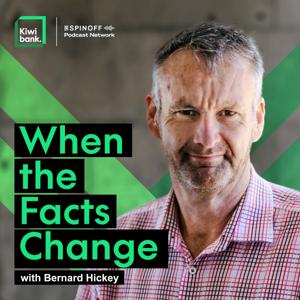


We’ve been hearing the phrase “social insurance” a lot since the government released the 2021 budget last week. It’s an idea designed to deal with unemployment we’re going to see a lot more of in the years to come, but it also brings up issues of inequality and fairness. Would introducing unemployment insurance just help embed a two-tier system in which the rich stay rich and the poor stay poor? To find out how it could work in practice, Bernard Hickey speaks to Kirk Hope from BusinessNZ and NZCTU president Richard Wagstaff.
Learn more about your ad choices. Visit megaphone.fm/adchoices
This week’s episode is coming to you from parliament, where Bernard Hickey has been up to his elbows in the budget just released by finance minister Grant Robertson. This year’s budget is a big one – it’s the first one after Covid, and with a parliamentary majority, a very popular prime minister at the helm, a strong economy and low public debt, it was a huge opportunity for the government to do some things… so what did they do? Bernard shares his impressions of Budget 2021, then speaks to Kate Prickett, director of the Roy McKenzie Centre for the Study of Families at Victoria University, and Hillmarè Schulze, chief economist at BERL, to see what they made of it.
Learn more about your ad choices. Visit megaphone.fm/adchoices
New Zealand has made international headlines in recent weeks for deciding to take the word “genocide” out of a parliamentary motion criticising China for its treatment of Uyghurs in the Xinjiang province. Basically, we were afraid it would hurt our trade relationship. In this episode, Bernard Hickey wants to change our minds on how New Zealand deals with China, and explain why we should follow Australia's lead and stop worrying so much about trade and start standing up for our views on human rights. To find out more, he talks to Natasha Hamilton-Hart from the department of management and international business at the University of Auckland business school, before Sam Roggeveen from the Lowy Institute offers an Australian perspective.
Learn more about your ad choices. Visit megaphone.fm/adchoices
The Spinoff business editor Michael Andrew is joined by Kiwibank sustainability lead Julia Jackson to talk about the evolving concept of sustainability, its growing influence on businesses and how New Zealanders can better integrate it into their lives.
Learn more about your ad choices. Visit megaphone.fm/adchoices
How does a government work out the best way to spend money to maximise not just GDP but the long-term health and happiness of its population? This is something our government is trying to do, or says it’s trying to do – but when it comes to the wellbeing side of the equation, is it doing a good enough job? In this episode, Bernard Hickey talks to Girol Karacaoglu, head of the school of government at Victoria University and one of the architects of the way New Zealand analyses happiness. He then talks to Susan St John, an economist at the University of Auckland’s business school who has an interesting take on what we should be spending our money on.
Learn more about your ad choices. Visit megaphone.fm/adchoices
Imagine if the value of your house doubled overnight. Could that actually happen? In this week’s episode, Bernard Hickey explains how it could – and how the Reserve Bank and government are doing things in the next couple of weeks to make sure it doesn’t. To find out more about how banks, lending and the housing market all operate, Bernard talks to Carmen Vicelich, CEO of Valocity Global. She knows exactly how banks decide who to lend to, when to lend to them and how much the property under the loan is worth. He then asks Kiwibank chief economist Jarrod Kerr what type of restrictions the Reserve Bank could apply in the coming weeks, and just how landlords are reacting to the government’s big changes announced last month. Spoiler alert: they’re not rushing for the exits.
Learn more about your ad choices. Visit megaphone.fm/adchoices
A new report on temporary migration in New Zealand suggests the current settings are letting down migrants and contributing to a low wage, low productivity and low wellbeing society. To find out more, in this episode Bernard talks to Julie Fry, the economist who wrote the report, and asks Anu Kaloti from the Migrant Workers’ Association about the scale of temporary migrant exploitation in New Zealand and what needs to change. Because right now, we’re not exactly living up to our image as a kind country.
Learn more about your ad choices. Visit megaphone.fm/adchoices
You may think the big decisions around housing affordability and climate change are being made in the Beehive, and that these are national policies. But in this week’s episode, Bernard suggests these issues are actually manifesting in a series of house-to-house and street-by-street fights at council level. To find out more, he speaks to Tamatha Paul from the Wellington City Council and Auckland city councillor Efeso Collins about how young renters and activists wanting higher density housing and more pedestrian and cycling friendly transport routes will have to fight the battle of their lives in next year’s local elections.
Learn more about your ad choices. Visit megaphone.fm/adchoices
For the last 12 years, Kiwibank has supported the Local Hero Award, acknowledging the people making a difference to New Zealand communities. In this bonus episode of When the Facts Change, The Spinoff’s business editor Michael Andrew talks with Shannon Te Huia, the 2021 Kiwibank Local Hero of the Year. Shannon established Pūniu River Care in 2015, a marae-based initiative designed to improve water quality and biodiversity by planting trees along the banks of the Pūniu river in the Waikato. He talks about where the idea came from, how he grew it into a viable project and what the award means to him and means for the project.
Learn more about your ad choices. Visit megaphone.fm/adchoices
This week we’re talking about global capitalism, and how it's in danger of destroying itself from the inside out. The concept is known as a “doom loop”: as the economy grows, those who own all the assets get more and more, those who don’t get poorer and poorer, and as a result growth slows as the machine grinds to a halt. And the key to stopping this doom loop lies in addressing inequality and productivity. To explore this idea and how it affects New Zealand, Bernard Hickey talks to the Productivity Commission's Ganesh Nana and Council of Trade Unions economist Craig Renney.
Learn more about your ad choices. Visit megaphone.fm/adchoices
From the publisher's feed

7,563 Listeners

5,525 Listeners

33 Listeners

16 Listeners

12 Listeners
12 Listeners

1 Listeners

6 Listeners

31 Listeners

14 Listeners
51 Listeners

161 Listeners

2 Listeners

2,828 Listeners

91 Listeners

0 Listeners

3,049 Listeners

5 Listeners

5 Listeners

5 Listeners

0 Listeners

0 Listeners