
Sign up to save your podcasts
Or

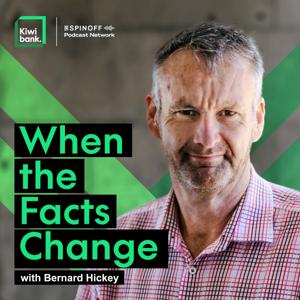


ESG (Environmental, Social, Governance) investing is a movement that has arisen over the last decade or so, where big fund managers invest only in companies with sustainable, socially responsible policies. It turns out this is often also the most profitable approach in the long run. One of the leading players in this movement has been the New Zealand Superannuation Fund, and its CEO Matt Whineray joins Bernard Hickey in this episode to talk about how the fund operates its ESG policy. Bernard also talks to Barry Coates, founder and CEO of individual ethical investment tool Mindful Money, about how to tell if a company is really as ethical as they say they are.
Learn more about your ad choices. Visit megaphone.fm/adchoices
In recognition of Te Wiki o Te Reo Māori and what the language means to the fabric of Aotearoa, The Spinoff’s commercial editorial director Simon Day speaks to Teahooterangi Pihama, head of Māori advisory, and Keita Te Ngoungou, Kiwibank Māori advisor. They’ve been given a mandate to steer the Kiwibank waka on it’s journey into te ao Māori, and talk about why te reo Māori is important for all New Zealanders, and how lifting the cultural competency at Kiwibank can improve outcomes for Māori staff and customers, support the growth of the Māori economy and raise the financial capabilities of Māori.
Learn more about your ad choices. Visit megaphone.fm/adchoices
Gordon Gekko’s “Greed is Good” era of shareholder-driven global capitalism is ending, but what and who will replace it? Bernard Hickey interviews renowned Chicago School economist, author and podcaster Luigi Zingales (Capitalisn't) about what went wrong with corporate capitalism and how it could be fixed.
Learn more about your ad choices. Visit megaphone.fm/adchoices
Businesses face a big task and some big decisions in the months ahead. They need to ensure as many staff as possible get vaccinated, without breaking the law or alienating their workforces. They’ll have to look at their own vaccination programmes, their own testing policies and their employment policies. Should they adopt a “no jab no job” policy? Can they? To discuss where these lines will be drawn and who should be doing that drawing – businesses or government – Bernard Hickey talks to BusinessNZ CEO Kirk Hope and Frances Hughes from Oceania Healthcare.
Learn more about your ad choices. Visit megaphone.fm/adchoices
When New Zealand’s second national level four lockdown was announced in August, it was a situation many New Zealand business owners were already familiar with and prepared for. The Spinoff’s commercial editorial director Simon Day speaks to Quentin Quin, chief customer officer – business banking at Kiwibank, about what businesses have learned from the last 18 months and how that’s changed their response to the most recent outbreak. Before joining Kiwibank, Quentin worked in a number of post conflict countries, emerging economies and unregulated unstable business environments, and he compares that experience to the economic uncertainty of Covid-19.
Learn more about your ad choices. Visit megaphone.fm/adchoices
Last year the government paid out $14 billion in wage subsidies to businesses as part of the Covid-19 response. This included a number of large companies who went on to deliver big annual profits and dividends to shareholders – and very few of those companies have repaid it. In this week’s episode, Bernard Hickey looks at the ethics of the wage subsidy scheme and asks: where is the accountability? And is the social license that was there for wage subsidies in March 2020 still there now? Guests: Professor Jilnaught Wong from the University of Auckland and Peter Vial of Chartered Accountants Australia New Zealand.
Learn more about your ad choices. Visit megaphone.fm/adchoices
How big do we want Aotearoa to be? How fast do we want it to grow, and where? And are we still a classless society, or are we becoming a country of owners and servants? In this episode, Bernard Hickey looks at the need for an actual population policy alongside new migration settings. To find out more he talks to demographers Paul Spoonley and Tahu Kukutai, the New Zealand Infrastructure Commission's Geoff Cooper and geographer Francis Collins.
Learn more about your ad choices. Visit megaphone.fm/adchoices
How is it that democracies can only make big, politically difficult changes when faced with an emergency? We did it last year with Covid-19 – so could we do it again with the climate emergency that is in our faces right now? New reports released this week all point to the fact we can’t really afford to wait any longer – we need to take some political and economic pain to reduce emissions, and do it fast. To explore the political economy issues of dealing with climate change as an emergency, Bernard talks to Stephen Mills from UMR, researcher Jess Berentson-Shaw and the 1point5 Project’s Paul Winton.
Learn more about your ad choices. Visit megaphone.fm/adchoices
What does the way we treat our migrant population say about who we are as a country? With around 200,000 people living and working in New Zealand on temporary visas, pressure is mounting on the government to make sweeping policy changes to address the limbo these migrants are being left in – an already Kafkaesque situation which has only been exacerbated by Covid. To look at how we ended up in this situation and what needs to be done to tackle the problems that have arisen as a result, Bernard talks to National’s immigration spokesperson Erica Stanford, The New Zealand Initiative's Eric Crampton and Dr Oliver Hartwich, along with immigration lawyer Alistair McClymont.
Learn more about your ad choices. Visit megaphone.fm/adchoices
Bernard Hickey goes on a journey to find out how New Zealand's fascinating public transport history can inform our future, meeting musician, historian and public transport advocate Anthonie Tonnon at Whanganui’s historic Durie Hill underground elevator. Built in 1919, the elevator was once part of an extensive and heavily used public transport network in the city – how were these networks built, why did they die off and what can they tell us about the future of public transport in this country? To find out more about the current state of public transport and what happens next, Bernard talks to transport minister Michael Wood.
Learn more about your ad choices. Visit megaphone.fm/adchoices
From the publisher's feed

7,563 Listeners

5,525 Listeners

33 Listeners
16 Listeners
12 Listeners
12 Listeners
1 Listeners

6 Listeners
31 Listeners
14 Listeners
51 Listeners
161 Listeners

2 Listeners

2,828 Listeners
91 Listeners

0 Listeners

3,049 Listeners

5 Listeners

5 Listeners

5 Listeners

0 Listeners

0 Listeners