
Sign up to save your podcasts
Or



Based on Podcast App listening data
S2 Ep 20. How a sea creature can help us see more of our universe. A lobster’s eyes have evolved to spot food and potential threats in murky conditions at the bottom of the ocean. Scientists have copied their structure to create a new X-ray telescope that can be used to see into the dark expanse of space.
S2 Ep 19. A tricky design challenge solved! All thanks to the scaly skin of the pangolin. Scales cover its body in an overlapping pattern, providing both flexibility and armour against attack. Architects copied this to create a glass roof for a famous British railway station, which meant the structure could fit into an oddly shaped location.
S2 Ep18. Snap! The trap-jaw ant’s amazing jaws can move faster than a speeding bullet, snapping shut at a top speed of 230km per hour. When the ant bites down, the force is so great that it launches the insect high into the air. Their powerful spring mechanism is being copied by scientists and may help move a new type of mini robot, which one day could be deployed in situations too dangerous for humans to enter – like fires or earthquake zones.
S2 Ep 17. A new synthetic test to create safe vaccines – based on the secrets of the horseshoe crab and its blue blood. Scientists hope this new technology could mean they no longer need to use the blood to test vaccines for harmful bacteria.
S2 Ep16. It’s a “living fossil”! This fish can resist piranha attacks and is inspiring a new body armour. The arapaima has been swimming the waters of the Amazon for millions of years. It’s also home to a famous predator, the fearsome piranha. The Arapaima has a secret weapon – it’s scales are both tough and flexible and they’ve caught the attention of scientists.
S2 Ep15. Learning from Lily the owl – could she help small aircraft cope with turbulence? Scientists hope what they’ve learnt about barn owls might help with the design of drones.
S2 Ep14. Will a ray save the day? It’s inspiring a way to prevent more pollution of our oceans. As sea water enters a manta ray’s large mouth, plankton are captured and other particles are thrown up by whirlpools. Systems are being developed to extract or capture microplastics from water.
S2 Ep13. Bye-bye bacteria! How an insect’s wings inspired materials that could keep surfaces free from bacterial infections. The wings of cicadas are covered with tiny spikes which burst the walls of bacteria and kill them. Replicating this remarkable design could lead to the development of antibacterial materials with potential for industrial and medical use.
S2 Ep12. We love cats (well, many people do)! Thanks to one feline friend, they help keep us safe. An inventor narrowly avoided a road accident thanks to the eyes of a cat. He developed reflective road studs and named them, fittingly, ‘cat’s eyes’, which help us drive safely at night.
S2 Ep11. Can the remarkable dexterity of octopus suckers help improve delicate surgery? The octopus uses its powerful arms to grip onto rocks, capture prey and walk around the sea floor. Suckers are found along the arms which are crucial for manipulating objects. The action of these suckers has inspired a device to transfer fragile sheets of thin tissue in surgical procedures.
Thanks for listening. Let us know what you think. #30Animals
Get in touch: www.bbcworldservice.com/30animals
From the publisher's feed
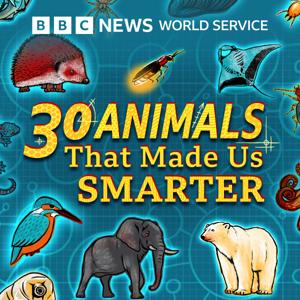
Amazing things humans have learnt from the animal kingdom. Inspiring, fascinating, bingeable.
Ranked by our users in the last 21 days

31,985 Listeners

7,611 Listeners

1,086 Listeners
878 Listeners

1,044 Listeners

5,481 Listeners
1,794 Listeners
1,825 Listeners

1,028 Listeners
1,905 Listeners
13,748 Listeners

1,136 Listeners

240 Listeners

111,874 Listeners
258 Listeners

914 Listeners

3,218 Listeners

1,004 Listeners
2,020 Listeners
15,626 Listeners

1,594 Listeners

2,831 Listeners
219 Listeners