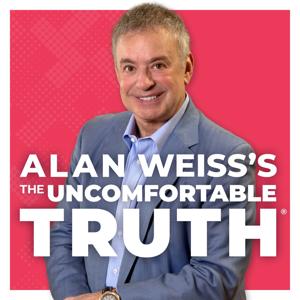
Alan Weiss's The Uncomfortable Truth®

Alan Weiss's The Uncomfortable Truth®

By Alan WeissSociety & Culture
Download on the App Store

Alan Weiss's The Uncomfortable Truth® episodes

  • A Conversation with Barry Banther
    We are in the midst of the largest transgenerational shift in wealth in the history of the country. Part of this are the maturing retirement funds created under the Reagan administration, and part is the succession of small business owners from founders to the second (or third) generations.
    Barry Banther has worked with hundreds of family businesses, from $50 million to $500 million in revenues. He creates strategies for continuity and succession, from family ownership to outright sales with proceeds going to the family. He distinguishes between family-owned and run businesses and family owned but not run businesses (run by professional executives employed for that reason).
    He's worked with some of the most well-known families in the country whom we can’t name here but whom you would recognize instantly, as well. He talks of the three major factors involved in positioning successful family businesses, and of the sometimes incredible factors overlooked (trusts, wills, successions plans, etc.). He points out the dangers in having a family member serve as a trustee.
    Barry has run his own business independent of this one, and works with his clients typically for several years in order to position them for success. He’s currently finishing work after 17 years with a company that was at $60 million and will now be sold for a quarter billion.
    Small businesses are the largest creators of net new jobs in the country. The smart and longest-lived ones listen to Barry Banther. Perhaps you should, too.
    30 min
  • Virtue Signaling
    Is an economically disadvantaged kid better off because of an insistence on how many black film editors, or baseball executives, or executive chefs receive awards?
    Is climate change really helped by expensive legislation that kills jobs and causes inefficiencies? (The prohibition of gas-powered anything.)
    Virtue signaling is the public expression of opinions or sentiments intended to demonstrate one’s good character or social conscience or the moral correctness of one’s position on a particular issue. It’s often expressed as being against something.
    Remember:
    Live and let live
    People who live in glass houses shouldn’t throw stones
    Do unto others as you would have them do unto you
    Do as I say not as I do (that didn’t work coming from my father)
    I don’t care whose picture is on a beer can. I don’t believe you’re a “better” person because you have a black lives matter sign on your lawn. I see too many people praying in church who won’t merge leaving the parking lot.
    Virtue signaling is the expression of a conspicuous, self-righteous moral viewpoint with the intent of communicating good character.
    Virtue signaling doesn’t actually require or prove that you’re doing or have done anything virtuous.
    In 2016, an NFL quarterback named Colin Kaepernick chose to sit rather than stand during the national anthem. This was his form of protesting against racial prejudice and inequality. Nike sales and stock shot up when they made him their spokesperson. But 7 years later Kaepernick still hasn’t been signed by any team and his age probably prohibits it at this point.
    In another example, when Apple stopped including chargers for its new iPhones they stated that it helped cut back on e-waste.
    However, as the authors point out, “Cynics argue that Apple is merely taking part in moral grandstanding and cutting costs while not passing the savings on to customers.”
    Some Sources:
    Virtue Signaling Examples
    By Dave Cornell (PhD) and Peer Reviewed by Chris Drew (PhD) / August 5, 2023 from HelpfulProfessor.com
    11 min
  • A Conversation with Jeff Herman
    Jeff has been representing me for over 30 years, and was responsible for acquiring publishers (McGraw-Hill, Wiley, Macmillan, AMACOM, et. al.) for my four best-sellers, including the 30-year, 6-edition Million Dollar Consulting.
    He is responsible for thousands of published works and hundreds of authors’ happiness. For example, he represented the famous Why Bad Things Happen to Good People.
    We talk of the takeover of publishing by large venture capital firms. We discuss why hard copy books have never disappeared or even greatly diminished, despite the false prophets of electronic dominance.
    Learn how to create a query letter and formal proposal to “sell” an agent to represent you, and why publishers are expecting the authors to market and sell enough books to pay for the entire initial press run (sad, but true, and publishers know next-to-nothing about marketing these days, and wouldn’t invest in it even if they did). Publishers once paid for advances, but now they want the “advance” from you in terms of initial sales.
    You can, of course, pay between $50,000 and substantial six-figure amounts to firms which will “guarantee” a best-seller position in the New York Times or Wall Street Journal, but it’s for a nanosecond. I know people who have done it. They don’t even deserve the nanosecond.
    Jeff talks about the distinctions of the power of reviews vs. testimonials, and what it takes to convince an agent to represent you.
    This is a fast and furious tour through modern publishing. You might want to fasten your seat belt. Most of my business and referrals have originated with my books.
    27 min
  • Proportionality
    I received a letter from someone who had subscribed to one of my newsletters for $250 annually. He was late, but I accepted him, and he demanded—not requested—that I send him all the issues he has missed.
    I did that and he complained that they weren’t always in the same format, although I think that was a matter of his equipment, not mine.
    Now he’s complained that he didn’t get the final (August) issue and went on to lecture me about responsibilities, living up to promises, what constitutes professional businesses, yada yada, yada—sanctimony on parade. And, of course, I had sent it, who knows why he didn’t get it.
    Ordinarily, I simply provide what’s requested, but I told this guy to buzz off, except with my New Jersey vocabulary. The vast probability with these things is that the problem is on the receiving end.
    But, more than that, we’re looking at:
    • A return of Covid
    • Wildfires around the world, including absolute carnage in Maui
    • A seemingly endless war in Ukraine
    • Poor public services (this guy is in Italy, and they’re bad)
    • Social justice demands
    • Polarized politics
    Now, I know that neither you nor I go through this litany every time we have a difficulty to rationalize that we’re overreacting. But there is a limit to overreacting. This was a single issue of an electronic monthly newsletter which is probably in his spam file and which was promptly replaced.
    So, I told him off and told him I wouldn’t accept any further subscriptions from him. Maybe it was petty, but he’s an ass. And that’s the uncomfortable truth.
    7 min
  • Censorship
    Elin Hilderbrand has a new book called Five Star Weekend. In my view, it’s awful, not at all up to her earlier work, predictable, with paper-thin characters and a dumb plot. You may disagree with me, most people do according to the reviews on Amazon. But I posted a very critical review. Amazon accepted it.
    However, after accepting it, someone clearly complained, because I received this obtuse communication today:
    I never mentioned “authenticity” (in a book??). I’m a veteran reviewer on Amazon. But I think someone from the publisher or author is muting negative reviews and Amazon is going along with it. This is the world we’re living in today, nonsensical responses from automated programs that distort and hide free speech. My critique was purely literary, noting the weaknesses in the book and the writing, nothing ad hominem. 
    When they start to remove dissenting points of view, where does that leave us?
    11 min
  • I'm Old Fashioned
    An “old fashioned” is a fabulous cocktail. The official origin of the drink is still heavily debated. While the Waldorf-Astoria in New York by way of the Pendennis Club, a private social club in Louisville, KY has been crested as the birthplace of the cocktail as we know it today, the publication of Modern American Drinks, by George Kappeler, in 1895 mentions the recipe for the Old Fashioned Whiskey Cocktail that Simonson describes as the evolutionary link between the whiskey cocktail and Old-Fashioned as we know it.
    I will admit to being “old fashioned.” I believe in courtesy and a balance of personal preference with societal conformance.
    Recently in Toppers, a world-class restaurant in Nantucket’s Wauwinet Inn, some people had on jackets (once a must) but most had on “resort casual,” shirts and slacks for men, summer dresses for women. One woman, dressed in that manner, came in with a man who had on shorts, a polo shirt, and flip-flops. You might say he was an individualist. Or you might say he was a slob. What did this nicely dressed woman think when he showed up that night?
    I hold open doors for people when I’m slightly ahead of them. I open the car door for women. If I’m wearing a hat I take it off in a restaurant or in a meeting or in the theater.
    I don’t “work my phone” at meals with others, nor do I tell stories loudly enough for people to hear me who are driving by.
    I’m adept at yawning without making a noise like an oncoming tornado, and I say God Bless You when someone sneezes. No one has accused me of violating the separation of church and state as yet.
    8 min
  • The Bridge
    In 1973, D. Keith Mano wrote his only science fiction book, The Bridge.
    It takes place in 2035, over 60 years since its original publication, but only 12 years from today.
    It is about radical environmentalism run amok with a “green” socialist government. 
    The government decides to give earth back to nature, after already protecting all animal and plant life, but the fact that we destroy microbes every time we breathe is the final straw.
    Cars have been eliminated, people return to the fields. The world is incapable of complex technology. Obesity is social standing. 
    There is resistance, but it is ineffective. Diseases must go untreated. Tumors are declared autonomous life forms, and protected. 
    Everyone must commit suicide, squads are deployed to kill those who don’t and then they will commit suicide, until the earth is free of all humans. 
    The hero, Priest, is determined not to die but to find his wife. He must cross the decayed and destroyed George Washington Bridge, hence, the book’s name.
    When I read the book, 50 years ago, six years out of undergraduate school, I felt it was dystopian fiction, imaginative but implausible. 
    Just yesterday I read of a scientist in a scholarly journal who discussed the “full life of plants, including their communications and emotions.” 
    Barry Goldwater was urgently warned in his presidential bid in 1964 NOT to say that extremism is sometimes justified. Yet he said, “Extremism in the defense of liberty is no vice.” He lost in a landslide to Lyndon B. Johnson.
    Exercise, religion, philanthropy, volunteerism, education, travel: You name it, anything that takes you to extremes is likely to be terrible for you, even if moderate amounts are positive for you. 
    I’m predicting that the inhumane harvesting of animals will be a major and divisive cause in the near future, and it deserves to be remedied. But ending the consumption of animals by law is well on the way over the slope. 
    Do you think you can’t be arrested for harming a tree or a bush? A woman just petitioned the Rhode Island legislature to make it a felony to use your fingers to pretend to point a fictitious gun at someone. 
    When everyone’s every grievance is a demand that the entire world observes and honors, otherwise there is oppression and resultant entitlement, we may just be heading for The Bridge. Good luck trying to cross it.

    10 min
  • Breathing Space
    When we see an empty ballroom, or stadium, or theater, we can see unlimited possibilities if we have any creative juices at all. We can stage performances, meetings, athletic events, entertainment, networking opportunities, and so forth.
    But then we think of our fictitious “business life” and “personal life” duality, and we bifurcate that huge space with a wall right down the middle, a line of demarcation with separate pursuits on each side.
    And then we create meetings, obligations, failure work, responsibilities, “bucket lists,” one-way streets, detours, “do not enter” zones, a great deal of noise, and misdirection. We become mice in a maze of our own creation, and that once huge, empty, high-potential space has become a tiny, oppressive place.
    The fact is, we have one “life,” period. Personally, I have no problem whatsoever taking a few phone calls at the beach on vacation, just as I have no problem taking a weekday afternoon and spending it at my pool. I can engage in one of my hobbies on a Thursday morning and write part of my next book or create a proposal on Saturday morning.
    I never feel “cheated” of time, nor that I’m “intruding” on some other portion of my life! If you have to go to Staples to pick up some office supplies, wouldn’t you also stop at the grocery to pick up some food for dinner? Or are those two separate trips, one for each “life”?!
    We can’t keep closing in on our “breathing space,” enclosing ourselves and reducing our huge space and opportunity to small warrens and corners.
    If we do, we’re going to run out of oxygen.
    11 min
  • Unsolicited Feedback
    Let me harshly deal here with people who provide you with feedback you didn’t ask for, don’t require, and can’t use. That applies to feedback which is too positive as well as too negative.
    We talk here about the trivialists, the hypocrites, the projectionists, and the general pains in the ass. Those who claim the only thing to do with feedback is to consider it are directing you toward the life of the ping pong balls or pickle balls being whacked back and forth.
    You’ll hear some of my standard replies when offered unsolicited feedback and why even my mother fell into my feedback hell.
    No one is erecting statues to critics in the park, even to replace those Columbus statues so ardently removed. We honor creators, not critics.
    Thus: Defend yourself against the time wasters and underminers and passive-aggressives who would, with a patina of supposed good intention, try to derail you. Our job is not to please everyone, not to be liked, but rather to help improve people and be respected. We do that through the honest and forthright delivery of good ideas and practices, not through tearing others down.
    Feedback can radically change others’ behavior, especially if they think you know more than they do. Be careful about intervening when you’re not asked. Telling someone they have lettuce in their incisors or toilet paper draped on their Pradas is, indeed, an act of good will. But telling them they shouldn’t be eating lettuce because they have an eating disorder or that their shoes are inappropriate is not helpful.
    Don’t believe everything you hear. In fact, try not even to hear everything.
    9 min
  • A Conversation with Seth Magaziner
    Seth Magaziner and I met when he ran for, and served as, Rhode Island State Treasurer for eight years. I asked that we make this conversation non-partisan, to which he agreed, and as always was gracious with his time and accessibility.
    We talk about his view of the three biggest issues he sees facing America: climate change, income and opportunity inequality, and the rise of non-democratic movements inside and outside of the country.
    He talks about the House of Representatives as the purest elected part of government, since Senators can be appointed by governors when the office falls vacant, and the President is actually placed in office by the Electoral College. (Originally and Constitutionally, Senators were appointed by state legislatures and there was no popular vote until the 17th Amendment in 1913.)
    The discussion covered Ukraine, a war that originally was to see Russia in Kiev in two weeks, and is now in its 500th+ day with Russia on the defensive. I asked what we learned about our own military preparedness.
    Seth is optimistic that polarization will be lessened, and wants to ensure that the debt ceiling is never again used as a bargaining chip by either party. He points out that there are many bipartisan discussions, agreements, and bills passed that don’t always make the media even now.
    He told me that he was surprised by “how nice people are in the House”! I surprised him by recommending Washington’s Café Milano, the restaurant where the food is supposed to be mediocre but the neutrality is top priority and power brokers from both parties enjoy meals together.
    I did tell him reservations are tough and he may have to call on Ms. Pelosi to get a table!
    27 min

About Alan Weiss's The Uncomfortable Truth®

From the publisher's feed

Alan Weiss's The Uncomfortable Truth® is a weekly broadcast from “The Rock Star of Consulting,” Alan Weiss, who holds forth with his best (and often most contrarian) ideas about society, culture,…

More shows like Alan Weiss's The Uncomfortable Truth®

The Tim Ferriss Show by Tim Ferriss: Bestselling Author, Human Guinea Pig

The Tim Ferriss Show

16,052 Listeners

The Knowledge Project by Shane Parrish

The Knowledge Project

2,699 Listeners

Making Sense with Sam Harris by Sam Harris

Making Sense with Sam Harris

26,243 Listeners

The Amy Porterfield Show by Amy Porterfield

The Amy Porterfield Show

4,585 Listeners

HBR IdeaCast by Harvard Business Review

HBR IdeaCast

143 Listeners

The StoryBrand Podcast by StoryBrand.com

The StoryBrand Podcast

1,932 Listeners

The Martell Method w/ Dan Martell by Dan Martell

The Martell Method w/ Dan Martell

578 Listeners

The Daily by The New York Times

The Daily

111,821 Listeners

The Cure for Chronic Pain with Nicole Sachs, LCSW by Nicole Sachs, LCSW

The Cure for Chronic Pain with Nicole Sachs, LCSW

2,511 Listeners

My First Million by Hubspot Media

My First Million

2,649 Listeners

At The Table with Patrick Lencioni by Patrick Lencioni

At The Table with Patrick Lencioni

1,126 Listeners

All-In with Chamath, Jason, Sacks & Friedberg by All-In Podcast, LLC

All-In with Chamath, Jason, Sacks & Friedberg

10,124 Listeners

The Ezra Klein Show by New York Times Opinion

The Ezra Klein Show

15,911 Listeners

Pulling The Thread with Elise Loehnen by Elise Loehnen

Pulling The Thread with Elise Loehnen

1,106 Listeners

The AI Daily Brief: Artificial Intelligence News and Analysis by Nathaniel Whittemore

The AI Daily Brief: Artificial Intelligence News and Analysis

674 Listeners