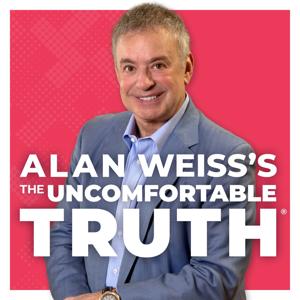
Alan Weiss's The Uncomfortable Truth®

Alan Weiss's The Uncomfortable Truth®

By Alan WeissSociety & Culture
Download on the App Store

Alan Weiss's The Uncomfortable Truth® episodes

  • A Conversation with Lee Duckworth & Larry Dooley
    It’s seldom that you can receive uncomplicated answers about the economy and the impact of these turbulent times. Ask five “experts” and you’ll get seven opinions.
    So I was overjoyed that Lee Duckworth and Larry Dooley from Capital Wealth Management were able to join me and respond to questions about unemployment, bank failures, the Fed’s actions, the TINA principle, and the TARA principle. (I hadn’t heard of these, either, but they make a lot of sense and you’ll see how they’re changing when you listen to the interview.)
    We chat about the primacy of cash for individuals and organizations in turbulent times, and what some bare minimums are to consider. I’ve always advised people entering professional services that they should have a minimum of six months of regular expenses in the bank when they launch their practice. Find out if I’m right or wrong.
    We discuss the very low unemployment we’re experiencing and the fact that there are two jobs for every person seeking one. We review consumer spending, especially in hospitality and travel.
    There are very original insights on the bank failures in California of a few weeks ago, and the need to check on whether deposits are actually insured or not. I raise the issue about the large withdrawals from Schwab and State Street, two main custodians, and receive a rather surprising answer.
    I have four degrees, but took only three credits in economics over that entire stretch of schooling. You’ll learn a great deal here listening to two pros in financial planning and asset management.
    29 min
  • Internecine Strife
    We are largely in conflict with ourselves. This is assured to be destructive to everyone.
    One person complains that their sixth grader saw the great art work, The David, complete with genitalia, of course, and the teacher is fired.
    A solitary coach praying on a football field after a game, win or lose, is voluntarily joined by some players and a few parents feel that this is a tectonic issue of church and state, despite the fact that athletes performing well and entertainers receiving awards regularly thank God in gesture and words.
    Politicians with opportunities in front of them are struggling to deny that they have ever said “defund the police” even though their statements have been captured on tape. We use the “woke” and grammatical horror “they” to refer to individuals, so that the listener doesn’t know if the reference is to one person or a group or a nation.
    Some doctors are actually endorsing physically-altering therapy for pre-teens and teenagers who claim they identify with the opposite gender. Yet many of these kids reverse such sentiments over short time frames. But you can’t reverse the surgery.
    Airlines and theaters actually have to make announcements that patrons should respect those who wear masks and those who choose not to, as if a professional wrestling or soccer riot were to break out. We’re teaching kids about how to identify their gender while the Chinese are teaching their kids the STEM disciplines.
    We insist on fighting ourselves where no one “wins” and progress doesn’t occur. Is there a cure for this illness?
    11 min
  • A Conversation with Suzanne Bates
    I’ve known Suzanne for about 20 years. She is the relatively rare example of the founder of a boutique firm who successfully built up its valuation, decided to sell, found the right time to sell, overcame the interruption of the pandemic, and closed with an international buyer.
    Her journey is a huge example of talent, success, and plain grit. Originating in the media business as a news anchor, she migrated to communications education and training, offering her coaching services and gradually built a company which obtained Fortune 500 clients. She describes, in this interview, the challenges encountered and overcome, often not so easily. (She started preparing to sell five years before the sale was actually consummated.)
    We talk about the impact today of remote learning, ChatGPT, and leadership in ambiguous times. While it may sound grandiose to say that AI will “change the world,” there are precedents, such as the Industrial Revolution, right down to the advent of the internet (which no one predicted). Should social media companies be treated as utilities and regulated (as is gas, electric, and water)? As you read this, I’ve recently been reinstated after being banished from Linkedin for reasons they won’t disclose!
    It's difficult to sell a business, no matter how successfully, and become someone’s “employee” once again. And it’s also difficult to decide who you are and what to do once that relationship also ends. Neither Suzanne nor I believe in “retirement.” 
    And neither should you.
    28 min
  • First Impressions
    Why is it that I trust the doctor when he simply says, “You look healthy, don’t worry, you’re not sick”?
    The first 90 seconds of your speech will determine how closely people pay attention to you. Not if they pay attention, but to what degree. It’s the difference between them taking notes and asking questions on the one hand, and checking their email under the table on the other.
    That applies to what you write, your conversations, and what you record, as well. We tend to immediately make conscious or unconscious notes about peoples’ attire, table manners, language, sense of humor, attitude, attention and focus, and emotions. Books are often judged by their covers.
    Haven’t you found that the plane’s cleanliness or lack thereof can affect your trip, or that the auto dealer’s service area gives you a lot more confidence when it’s spotless and uncluttered? What about the hotel lobby, and the doorman or desk agent?
    And certainly, when visiting a home, you take into account the grounds, the interior, the layout, the lighting, and so forth. I’m impressed that my gardener’s tools and equipment are clean and neatly stored in his trailer. Nothing is rusted or rattling around loose.
    No matter how much we may deny it, first impressions are lasting impressions. They can be overcome, of course. Or, they can overcome whatever follows.
    That choice is ours.
    11 min
  • A Conversation with Steven Gaffney
    Steven and I have known each other for over a decade. He’s an expert on a widely-studied field—teams—and a field not studied enough—honesty.
    In this conversation he explains about fear being the cause of a lack of honesty. He explains the novel notion that “It’s not what we say, but what we don't say.” Steven does believe that honesty is making a comeback, contrary to what many people may think. We talk about the government actually rewarding “whistleblowers” to come forward by offering seven- and even eight-figure payments, and the problems that creates when people make false accusations to try to get some of that money.
    We discuss the modern “guilty until proven innocent” reversal that seems to have taken hold of society and the media, as embodied by TSA: Prove to us that you’re not a terrorist.
    Steven doesn’t feel the pandemic dramatically changed teamwork but he does see a trend to get people back into the office because socialization is a huge part of effective teamwork, and you can’t do that remotely. He feels that “high achieving” teams is the right phrase, more so than “high performing” teams. And he doesn't see a difference in honesty or teamwork between the public and private sectors. Of course, we talk about politicians.
    He makes the case that you need to calculate time investment before taking on some lies that really aren’t harmful, or where people are so resistant to other views that they won’t listen anyway. 
    I asked him if he were self-conscious about his own truthfulness and he said, “Of course, and sometimes I do lie!”
    And, lastly, we do agree on the appropriate time to lie.
    28 min
  • Observations
    In dealing with a global community of thousands—and hundreds of thousands who have read my books—I’m able to keep my finger on the pulse of the profession and its clients. I’m sharing in this podcast some of the repetitive discussions and challenges that are extant internationally.
    For example, “remote” now rules. It’s often the default interaction, and often represents more value, not less. (A huge amount of time and money are saved.)
    However, leaders are not sure how to deal with combinations of remote, onsite, and hybrid employees. They are frustrated that they’re not getting their “40 hours” of productivity from them, when, in fact, even employees in the office physically are not providing 40 hours of productivity! This goes back to “Scientific Management” and Frederick Winslow Taylor in the early 20th Century, the first time-and-motion consultant. The problem is that he fudged his numbers and never factored in fatigue and boredom.
    Supply chains are changing, but they’re changing from global (do we really want to rely on China for chips or Russia for gas) to regional supply chains. Hence, the US, as an example, is building chip plants. And we see new alliances forming that once were almost unthinkable—Finland joining NATO, Japan and South Korea cooperating and the former settling WW II claims from the latter.
    The old retirement rules are artifacts. The French are crazily protesting an increase in the retirement age to 64 or 65 in the face of morbidity outpacing fertility and restrictions about immigration. The entire First World, including China, is facing severe labor shortages. (The US desperately needs pilots, yet the government mandates 65 as the retirement age. Government stupidity at its worst.)
    I’m 77, it’s a good thing they don’t have the power (yet) to mandate that I retire!
    15 min
  • A Conversation with Connie Dieken
    Connie is a former anchor on two major networks. She has moved from broadcasting to coaching, consulting, and speaking with remarkable ease. She’s created her own psychometric testing instrument, and has clients on six continents.
    I’ve had the pleasure of working with her for many years, and her innovation about, and intelligence in, leadership and executive presence is creating state-of-the art interventions.
    We talk about the relationship of charisma, presence, and leadership. She tells us about how she became engaged in places such as Kuwait and Dubai, dealing with inclusion and equity. 
    Connie raises the issue of those who think they’re influential but really are not. (My term is “legends in their own zip code”). We focus on the differences among manipulation and actual, long-term, mutually supportive influence. 
    I ask her about the effectiveness of leaders in remote and hybrid environments and about the changes necessary intergenerationally. When I asked about a leader who exemplifies her beliefs about superb presence and leadership, her choice is at once both surprising and unarguable.
    She cites a very suspect source for some of her success, but she does provide great advice for those who are, or aspire to be, leaders in any realm. 
    I know you’ll greatly enjoy this informal, insightful conversation with a master of her craft and a leading light in her profession.
    31 min
  • ChatGPT (or not)
    Well, is this a further step in the dehumanization of civilization, or a Jonestown Kool Aid romp, or another Y2K flop?
    When you put a variety of documents or fictional passages through the system, I find they are seldom improved and often seriously injured. In some cases, such as in instructions or directions, I think there is huge potential. But I examine in this podcast the downsides of people jumping on this latest “bandwagon” amid the pet rocks and hula hoops.
    Are we eager to “homogenize” writing? Or eager to duplicate with grammar what we’ve done with math, which only a few people seem to be able to do in their heads anymore. (I fall down laughing at people who can’t figure out a tip in a restaurant, so that the restaurants overcome this by suggesting percentages to tip and the amounts represented therein.)
    What does this mean for dissertations or term papers? What does it mean for book proposals or reviews?
    Are we going to live in a world of automated writing, automated math, autonomous cars, and synthetic food? Is that the kind of quality life to which we aspire? Hell, I won’t drive a sports car without a stick shift (or it ain’t a sports car).
    Believe it or not, the following is ChatGPT’s “improvement” on the final four lines above:
    As automation technology advances, it's becoming increasingly likely that we will see more and more examples of automated writing, automated math, autonomous cars, and synthetic food in our daily lives. While this may bring convenience and efficiency in some cases, it raises the question of whether this is the kind of quality of life we truly desire.
    There are certainly benefits to be had from the automation of certain tasks, but we must also consider the potential drawbacks. For example, while autonomous cars may make our commutes more pleasant and reduce the number of accidents caused by human error, they also raise concerns about job loss for drivers and the possibility of accidents caused by software glitches.
    Similarly, while synthetic food may offer a solution to food scarcity and reduce our environmental impact, it may also pose health risks and raise ethical concerns about the nature of what we're consuming.
    It's important to consider these issues carefully as we move towards a more automated world. While some people may prefer the convenience of automated technology, others may feel that the loss of human control and connection is a step in the wrong direction. Ultimately, it's up to us to decide what kind of world we want to live in, and whether the benefits of automation outweigh its costs.
    As for driving a sports car without a stick shift, personal preferences will always vary, but it's clear that the rise of automated technology is changing the way we interact with our cars, and it remains to be seen how this will impact our overall driving experience.
    Need I say more?

    12 min
  • A Conversation with Rebecca Hubbard
    I’ve been staying at the Lotte Palace Hotel in New York City since it was solely “The Palace” and run by the legendary Leona Helmsley. It’s ideally situated on Madison Avenue between 50th and 51st, right across from St. Patrick’s Cathedral, and in easy walking distance to all Broadway plays and only about 300 good restaurants.
    Becky Hubbard has been the general manager for a dozen years amidst her 20 in the hospitality industry.
    We speak here about staffing and sustaining a highly supportive and polite work force; of the rebound since Covid; of international tourism rebounding; and of a day that had her walking home around eight at night, while her daughter tracks her location on her cell phone.
    She presides over a 900+ room, elite hotel which she calls her “inn” and has just overseen a $140 million renovation. We talk here about her preference for dealing directly with guests and the importance of the “first see, last see” front door staff.
    We discuss the dramatic rise in hotel charges to guests (in Florida right now they are up as much as 64%) and how to overcome rising costs to the hotel. And we talk about the continuing need for innovation and adaption of technological solutions. (Even low-end hotels are offering keyless entry using smart phones and check in remotely.)
    26 min
  • Homelessness
    I recall walking out of a church in the twilight in San Diego and thinking it was horrible that store owners and residents had left their garbage on the sidewalks. As I came closer I realized these were homeless people who were being stepped over by pedestrians.
    There are almost 600,000 homeless people in the US according to 2022 statistics, and about 20 percent of them in California alone. They form communities for protection, but also suffer from crime, disease, addiction, and brutality. We have no cogent plan to deal with homelessness despite who is in political office.
    People buying homes in Los Angeles are often faced with the difficulty of finding one for a decent price with the reality that a few hundred yards away, beneath on overpass, are scores of homeless people, often violent and often ill.
    There are the mentally ill, who are protected from institutionalization by laws that actually place them in greater danger. There are the truly dispossessed, who have suffered from job loss, inflation, housing loss, serious illnesses, and so forth. And then there are the “professionally homeless” who want to make a point and simply lead a life which dares others to stop them.
    Perhaps we need the equivalent of a FEMA for the homeless?
    And a plethora or organizations raising funds to “help” the homeless are really simply helping themselves. They exploit the situation they don’t alleviate it and, in fact, they thrive on its continuance.
    This, of course, is a travesty in any country but especially in this, the wealthiest. We need stronger actions. There are no “rights” to homelessness, nor to accost others in the streets.
    And the real crime here is that we’re doing next to nothing about it.
    10 min

About Alan Weiss's The Uncomfortable Truth®

From the publisher's feed

Alan Weiss's The Uncomfortable Truth® is a weekly broadcast from “The Rock Star of Consulting,” Alan Weiss, who holds forth with his best (and often most contrarian) ideas about society, culture,…

More shows like Alan Weiss's The Uncomfortable Truth®

The Tim Ferriss Show by Tim Ferriss: Bestselling Author, Human Guinea Pig

The Tim Ferriss Show

16,052 Listeners

The Knowledge Project by Shane Parrish

The Knowledge Project

2,699 Listeners

Making Sense with Sam Harris by Sam Harris

Making Sense with Sam Harris

26,243 Listeners

The Amy Porterfield Show by Amy Porterfield

The Amy Porterfield Show

4,585 Listeners

HBR IdeaCast by Harvard Business Review

HBR IdeaCast

143 Listeners

The StoryBrand Podcast by StoryBrand.com

The StoryBrand Podcast

1,932 Listeners

The Martell Method w/ Dan Martell by Dan Martell

The Martell Method w/ Dan Martell

578 Listeners

The Daily by The New York Times

The Daily

111,821 Listeners

The Cure for Chronic Pain with Nicole Sachs, LCSW by Nicole Sachs, LCSW

The Cure for Chronic Pain with Nicole Sachs, LCSW

2,511 Listeners

My First Million by Hubspot Media

My First Million

2,649 Listeners

At The Table with Patrick Lencioni by Patrick Lencioni

At The Table with Patrick Lencioni

1,126 Listeners

All-In with Chamath, Jason, Sacks & Friedberg by All-In Podcast, LLC

All-In with Chamath, Jason, Sacks & Friedberg

10,124 Listeners

The Ezra Klein Show by New York Times Opinion

The Ezra Klein Show

15,911 Listeners

Pulling The Thread with Elise Loehnen by Elise Loehnen

Pulling The Thread with Elise Loehnen

1,106 Listeners

The AI Daily Brief: Artificial Intelligence News and Analysis by Nathaniel Whittemore

The AI Daily Brief: Artificial Intelligence News and Analysis

674 Listeners