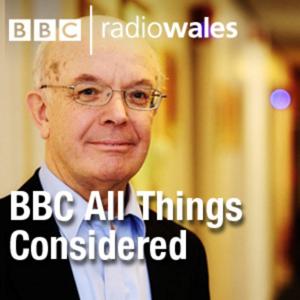
All Things Considered

All Things Considered

By BBC Radio WalesReligion & Spirituality
Download on the App Store

All Things Considered episodes

  • Art and Faith
    Jonathan Thomas goes on a journey around Wales to meet three contemporary artists; Karen Jones in Anglesey, Mark Cutliffe in Swansea and Lois Adams in Treforest, Pontypridd. He finds out how their faith informs and inspires their art.
    Mark Cutliffe finds his inspiration in the outdoors and works with willow and sand. Jonathan joins him and together they create a piece of sand art on Swansea Bay. Jonathan finds out about his past as a rock musician and his personal journey to faith. We hear about his work with community groups and his firm belief that anyone can be creative, they just need to make a start. Mark runs the Essence Creative Christian Festival held each summer in Swansea.
    Karen Jones is a painter and lives in Waenfawr near the Snowdonia National Park. We meet her on Treaddur Bay in Anglesey where she is collecting shells to inspire a new painting. She explains how her art is influenced by the Italian mathematician Fibonacci, and how painting has helped her cope with the loss of her brother.
    Jonathan meets 3D artist Lois Adams at Parc Arts in Treforest, Pontypridd. Here she is exhibiting a piece in a touring exhibition "Biblical Women: Equity." The collection aims to take a fresh look at how women are depicted in the Bible by focussing on the work of female artists. Lois explains her thought proving 3D art, and shares her understanding about the role of artists to serve the community around them.
    28 min
  • Britain's First Sheikh
    Azim Ahmed looks at the extraordinary life and work of the nineteenth century Liverpool solicitor William Abdullah Quilliam. Although brought up as a Wesleyan, Quilliam would convert to Islam after a visit to Morocco. He returned with indefatigable zeal to establish a mosque in Liverpool, and to create a British version of Islam, complete with hymns and a very distinctive version of the national anthem. Quilliam used the title of 'Sheikh al-Islam' of the British Isles, a title he claimed was conferred on him by the Sultan of Turkey. Azim talks to Professor Ron Geaves of Cardiff University, and to Yahya Birt, an Islamic community historian. In addition, Azim talks to writer and historian Christina Longden, whose Cardiff-born ancestor Robert Stanley went on to become one of Quilliam's most significant converts.
    This programme was first broadcast in January.
    28 min
  • Easter postcards from Jerusalem
    The final part of a series of programmes on BBC Radio Wales marking the 900th anniversary of St David’s international recognition. David’s spiritual authority is said to have come from his reputed visit to Jerusalem in the 6th century, the city which is the focus of the Easter narrative and would have been at the centre of David’s world.
    In the 21st century that city’s story is a complex and involved one: this programme does not seek to explain or explore those issues, but simply offers three Easter postcards from Jerusalem. These come from places connected with the events of Holy Week, which have been significant through the centuries. Their stories are told from the perspectives and through the voices of Christian visitors to and residents of a city which continues to inspire people from around the world.
    28 min
  • St David 900: 4 - Miracles
    St. David is said to have performed a number of miracles, from restoring the sight of a man who was blind to the famous occasion when a hill rose up beneath him so that the crowds could hear his preaching. As part of our series marking the 900th anniversary of St. David’s recognition as a saint, Roy Jenkins and guests discuss miracles today.
    The panel examine how we make sense of St. David’s miracles in a contemporary context, whether miracles do in fact still happen, and if they do occur, why do so many earnest prayers go unanswered?
    Roy Jenkins is joined by four guests; Julian Richards, who founded Cornerstone church with his wife Sarah more than thirty years ago and now heads up New Wine Cymru. Joshua Brown is a professor of psychology and neuroscience at Indiana University. His own experience of miraculous healing was recently featured in an article in the New York Times. He helped found the Global Medical Research Institute which investigates and publishes case studies of miraculous events. Gemma Simmonds is a sister of the Congregation of Jesus, a prolific writer who teaches at the Margaret Beaufort Institute of Theology in Cambridge. She is a regular visitor to Lourdes. Lastly Trystan Owain-Hughes, a Christian theologian and author of Finding Hope and Meaning in Suffering. He’s the Director of Ministry Development for the Church in Wales.
    28 min
  • St David 900: 2 - Faith, Language, Contemporary Identity
    Roy Jenkins discusses contemporary Welsh identity in Bangor with four guests: the Archbishop of Wales and Bishop of Bangor Andrew John; historian Elin Jones, author of the recent book History Grounded, documenting the history of Wales; political commentator Theo Davies-Lewis, a regular writer for The Spectator and contributor to both BBC Radio Cymru and BBC Radio Wales; and Menna Machreth, former chair of Cymdeithas yr Iaith Gymraeg (the Welsh Language Society) and currently project manager for the Welsh-medium playgroups Mudiad Meithrin.
    The panel discuss the relevance of St. David to contemporary society; when increasing numbers of people declare that they have no religion, what is the relevance of a saint’s day? What do the faith and works of a sixth-century monk mean for those who don’t share his beliefs? And in what sense can he be significant still to the faith, language and identity of a 21st century society?
    28 min
  • A Holy War?
    This week we’re marking the first anniversary of the full-scale invasion of Ukraine on 24th February 2022. Roy Jenkins explores some of the religious elements involved in this conflict. Many argue that Russia’s President Putin has been using religion to justify his so-called special military operation. The largest religious tradition in both Russia and Ukraine is the Orthodox Church with years of history stretching back to 988 AD. Officially there are 15 Orthodox churches worldwide, along with a dozen others whose status is said to be uncertain. It’s Patriarch Kirill who leads the Moscow Patriarchate. He’s spoken in support of Russia’s so-called special military operation; a stance which has led Pope Francis to refer to him as “Putin’s altar boy”. We hear about him and ask just how much religious liberty there is for worshippers in Russia.
    Meanwhile in Ukraine where there is considerable religious diversity, we hear about the friction between the pro-Moscow Orthodox and independent Orthodox Church of Ukraine. We also hear about the humanitarian and pastoral work in the country. We also ask - what of the future?
    Our guests:
    Dr Geraldine Fagan: Editor of the journal East-West Church Report and a practising member of the Orthodox Church. www.eastwestreport.org
    Dr Joshua Searle of Spurgeon’s College in London and a trustee of the Dnipro Hope Mission in Ukraine. www.dniprohopemission.org
    Jonathan Luxmoore is freelance journalist based in the UK and Poland specialising in religious news throughout Europe. He writes (among others) for the Church Times and The Tablet.
    Music:
    Extracts from the Vespers Op 37 by Sergei Rachmaninov.
    Extract from Prayer for Ukraine by Valentin Silvestrov.
    28 min
  • Canon Aled Edwards
    Roy welcomes back Canon Aled Edwards, an Anglican priest who’s spent more than half of his ministry among the politicians and officials of what’s now the Welsh Parliament, the Senedd. At the same time, he’s worked for large numbers of refugees and asylum seekers, fought against racism and other kinds of discrimination, and helped forge links between different religious communities. And he’s done so both as a Christian minister, and as a political anorak, who once spent a fortnight’s holiday in California campaigning for Barak Obama.
    At the end of March, Canon Aled Edwards will move on after 23 years with Cytûn, Churches Together in Wales, the last 17 as its chief executive – a fitting guest in this Week of Prayer for Christian Unity.
    28 min
  • Post-Christian Wales
    The recent release of Census statistics for religion suggests that the number of people with no religion now far exceeds the number of those purporting to be Christian. Roy Jenkins discusses the implication of these results with a panel including Dr Emma Whittick, chaplain of Trinity Saint Davids University of Wales at Lampeter and Carmarthen; George Craig, a retired civil servant and Methodist lay preacher; Kathy Riddick, Wales co-ordinator for Humanists UK; and Chris Street, who leads the Wales Leadership Forum, an organisation that aims to help church leaders to develop their mission.
    28 min
  • Magnificat - a song of hope, love and revolution
    As the Christmas festival continues, Roy Jenkins explores – with the help of a range of guests – the significance of one of the best known seasonal texts.
    The Magnificat is an outpouring of joy from Mary, on hearing the news from the Archangel Gabriel that she is to give birth to Jesus. The text, from St Luke’s Gospel, will have been heard in many churches during the past few weeks as part of the telling of the Christmas story.
    There have been countless musical settings down the centuries – ranging from single line Gregorian chant to more florid settings from JS Bach and Palestrina, and in the present day from composers such as John Tavener and Arvo Pärt. As the Magnificat has an important place in Roman Catholic and Anglican liturgy, there are numerous settings for singing in the daily round of Vespers and Choral Evensongs in our cathedrals and churches.
    On the face of it, the Magnificat or “Mary’s Song” as it’s sometime known, isn’t such good news for the mighty who will be unseated, and the rich who will be sent empty away. The German pastor and theologian Dietrich Bonhoeffer who was executed by the Nazis, described the Magnificat as “the most passionate, the wildest… the most revolutionary hymn ever sung.” But after a year during which we have seen the start of a war, a rise in the cost of living, a widening of the gap between rich and poor, continuing pestilence and the ravages of climate change, what hope can we glean from it for 2023?
    Our guests:
    The Rt Revd Mary Stallard, Assistant Bishop of Bangor.
    Andrew Wilson-Dickson, composer and Cardiff-based musician.
    Dr Emma Gibbins, Director of Music, St Woolos Cathedral, Newport.
    Revd Dr Craig Gardiner, Tutor at South Wales Baptist College and Cardiff University.
    Sean Stillman, Minister at Zac's Place, Swansea, and International President of God Squad.
    Revd Dr Jennie Hurd, Chair of Wales Synod Cymru of the Methodist Church.
    The programme includes extracts of settings of the Magnificat by Sir John Tavener, JS Bach, Charles Villiers Stanford, Richard Shephard, and Margaret Rizza.

    28 min
  • Nativities
    It’s the most wonderful time of year, with kids jingle-belling and tea towel clad shepherds, sulking kings and young inn keepers playing their part in Nativity plays in schools and churches. Costumes, songs, proud parents, and memories created, are all part of this advent tradition. It has a special place in hearts of many, and gives some a warm fuzzy feeling. But, where has this tradition come from? What does it really mean for children and families? And what of other kinds of representations popping up? As census data shows Christianity has fallen to lower than half the population, with an increase in those stating they have no religion, what is the future of this tradition?
    28 min

About All Things Considered

From the publisher's feed

Religious affairs programme, tackling the thornier issues of the day in a thought-provoking manner

Best of All Things Considered

Ranked by our users in the last 21 days

  1. Number 3: Logos Hope
    29 min

More shows like All Things Considered

Global News Podcast by BBC World Service

Global News Podcast

7,592 Listeners

From Our Own Correspondent by BBC Radio 4

From Our Own Correspondent

369 Listeners

More or Less by BBC Radio 4

More or Less

879 Listeners

Newshour by BBC World Service

Newshour

1,042 Listeners

In Our Time by BBC Radio 4

In Our Time

5,498 Listeners

The Documentary Podcast by BBC World Service

The Documentary Podcast

1,793 Listeners

Witness History by BBC World Service

Witness History

952 Listeners

6 Minute English by BBC Radio

6 Minute English

1,825 Listeners

Learning English Conversations by BBC Radio

Learning English Conversations

1,040 Listeners

Friday Night Comedy from BBC Radio 4 by BBC Radio 4

Friday Night Comedy from BBC Radio 4

2,089 Listeners

Comedy of the Week by BBC Radio 4

Comedy of the Week

486 Listeners

Desert Island Discs by BBC Radio 4

Desert Island Discs

2,009 Listeners

Great Lives by BBC Radio 4

Great Lives

487 Listeners

Profile by BBC Radio 4

Profile

110 Listeners

Last Word by BBC Radio 4

Last Word

45 Listeners

Ramblings by BBC Radio 4

Ramblings

166 Listeners

Moral Maze by BBC Radio 4

Moral Maze

62 Listeners

The Inquiry by BBC World Service

The Inquiry

727 Listeners

Start the Week by BBC Radio 4

Start the Week

160 Listeners

Sliced Bread by BBC Radio 4

Sliced Bread

136 Listeners

You're Dead to Me by BBC Radio 4

You're Dead to Me

3,213 Listeners

Americast by BBC News

Americast

718 Listeners

The Bomb by BBC World Service

The Bomb

1,006 Listeners

The Rest Is History by Goalhanger

The Rest Is History

15,589 Listeners