
Sign up to save your podcasts
Or


Most commercially available hormones are designed for population-level dosing - one-size-fits-all, and no room for personalization.
But hormones don't behave at the population level. Human bodies are uniquely shaped by metabolism, liver function, toxin exposure, and how each person absorbs and processes hormones.
And yet, the commercial market still tries to solve for all of that complexity with a limited set of fixed doses.
Take something as common as an estradiol patch. It only comes in a handful of options. So what happens if your body needs something in between?
That gap is where a lot of people get stuck. They're technically "on hormones," but they don't feel right, they don't respond the way they should, or they're dealing with side effects that don't make sense.
At the same time, we're seeing a new wave of messaging that says hormones are now "safe," and therefore easy to prescribe. But that creates a second problem. Because hormones aren't inherently safe or unsafe; they're precise.
And when you remove the precision, the testing, and the individualization, you don't get better outcomes. You just get more people on a one-size-fits-all approach that was never designed to fit them in the first place.
So the real question becomes: if standardized options fall short, what does it actually take to get hormones that actually match what your body needs?
In this episode, speaker, author, educator, and Anti-Aging and Precision Medicine expert, Dr. Pamela Smith, returns. Today, we're breaking down why compounding isn't an alternative approach; it's often the only way to truly match treatment to the patient.
Things You'll Learn In This Episode
Hormones don't follow averages Most medications are designed for population-level outcomes, but hormones are influenced by metabolism, weight, liver function, toxins, and more. What happens when we treat something highly individualized with standardized protocols?
Convenience is replacing clinical rigor From telehealth checklists to "no-testing" approaches, hormone therapy is becoming easier to access, but less precise. Are we improving care, or just scaling shortcuts?
Why "normal dosing" often fails patients Small changes like weight fluctuations or absorption differences can shift hormone needs significantly. If dosing isn't adjusted at a micro level, how many patients are being under- or over-treated without realizing it?
Hormones aren't the starting point; they're the amplifier When upstream issues like toxins, gut health, or metabolic dysfunction aren't addressed, hormone therapy often fails. Are we blaming hormones when the real issue is everything around them?
PS. If you enjoy the show, remember to leave a review on your favorite podcast app! Reviews help the podcast reach a wider audience and help more people.
Guest Bio
Pamela Smith, M.D., MPH, MS, is an internationally known speaker and author on the subject of Anti-Aging and Precision Medicine. She spent her first twenty years of practice as an emergency room physician with the Detroit Medical Center in a level 1 trauma center and then 28 years as an Anti-Aging/Functional Medicine specialist. She is a diplomat of the Board of the American Academy of Anti-Aging Physicians and is. Dr. Smith also holds a master's degree in public health and a master's degree in metabolic and nutritional medicine. She is in private practice and is the senior partner for The Center for Precision Medicine, with offices in Michigan and Florida. She has been featured on CNN, PBS, and many other television networks, has been interviewed in numerous consumer magazines, and has hosted two of her own radio shows. Dr. Smith was one of the featured physicians on the PBS series "The Embrace of Aging" as well as the online medical series "Awakening from Alzheimer's" and "Regain Your Brain". She is the author of fourteen best-selling books, including How to Prevent Breast Cancer- Before & After: A Guide to Taking Back Control of Your Life. To learn more about Dr. Smith and to get her books, visit https://mdpamelasmith.com/.
About Your Host
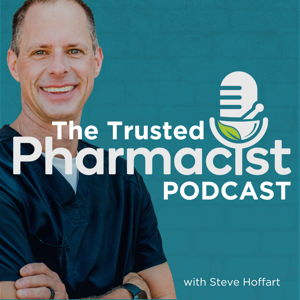
Steve Hoffart is an award-winning pharmacist, entrepreneur, speaker and podcaster. As the visionary founder of Magnolia Pharmacy, Steve saw a need for a more personal pharmacy that could make a bigger impact. Today, Steve and his team of experts deliver on that promise, working with patients and their physicians to solve medication problems and offer personalized solutions to achieve better health and wellness. As host of The Trusted Pharmacist podcast and through his combined reach of over 1M on social media, Steve shares actionable advice on nutrition, supplements, and wellness strategies while advocating for meaningful change in healthcare.
Stay Ahead with Steve the Pharmacist!
Loving the show? Want more insights into how your body works? Head over to TheTrustedPharmacist.com and sign up with your email! You'll get the latest episodes, plus exclusive health tips to help you take charge of your wellness. Don't miss out – join me today!
 View all episodes
 By Steve Hoffart

4.9
3030 ratings
Most commercially available hormones are designed for population-level dosing - one-size-fits-all, and no room for personalization.
But hormones don't behave at the population level. Human bodies are uniquely shaped by metabolism, liver function, toxin exposure, and how each person absorbs and processes hormones.
And yet, the commercial market still tries to solve for all of that complexity with a limited set of fixed doses.
Take something as common as an estradiol patch. It only comes in a handful of options. So what happens if your body needs something in between?
That gap is where a lot of people get stuck. They're technically "on hormones," but they don't feel right, they don't respond the way they should, or they're dealing with side effects that don't make sense.
At the same time, we're seeing a new wave of messaging that says hormones are now "safe," and therefore easy to prescribe. But that creates a second problem. Because hormones aren't inherently safe or unsafe; they're precise.
And when you remove the precision, the testing, and the individualization, you don't get better outcomes. You just get more people on a one-size-fits-all approach that was never designed to fit them in the first place.
So the real question becomes: if standardized options fall short, what does it actually take to get hormones that actually match what your body needs?
In this episode, speaker, author, educator, and Anti-Aging and Precision Medicine expert, Dr. Pamela Smith, returns. Today, we're breaking down why compounding isn't an alternative approach; it's often the only way to truly match treatment to the patient.
Things You'll Learn In This Episode
Hormones don't follow averages Most medications are designed for population-level outcomes, but hormones are influenced by metabolism, weight, liver function, toxins, and more. What happens when we treat something highly individualized with standardized protocols?
Convenience is replacing clinical rigor From telehealth checklists to "no-testing" approaches, hormone therapy is becoming easier to access, but less precise. Are we improving care, or just scaling shortcuts?
Why "normal dosing" often fails patients Small changes like weight fluctuations or absorption differences can shift hormone needs significantly. If dosing isn't adjusted at a micro level, how many patients are being under- or over-treated without realizing it?
Hormones aren't the starting point; they're the amplifier When upstream issues like toxins, gut health, or metabolic dysfunction aren't addressed, hormone therapy often fails. Are we blaming hormones when the real issue is everything around them?
PS. If you enjoy the show, remember to leave a review on your favorite podcast app! Reviews help the podcast reach a wider audience and help more people.
Guest Bio
Pamela Smith, M.D., MPH, MS, is an internationally known speaker and author on the subject of Anti-Aging and Precision Medicine. She spent her first twenty years of practice as an emergency room physician with the Detroit Medical Center in a level 1 trauma center and then 28 years as an Anti-Aging/Functional Medicine specialist. She is a diplomat of the Board of the American Academy of Anti-Aging Physicians and is. Dr. Smith also holds a master's degree in public health and a master's degree in metabolic and nutritional medicine. She is in private practice and is the senior partner for The Center for Precision Medicine, with offices in Michigan and Florida. She has been featured on CNN, PBS, and many other television networks, has been interviewed in numerous consumer magazines, and has hosted two of her own radio shows. Dr. Smith was one of the featured physicians on the PBS series "The Embrace of Aging" as well as the online medical series "Awakening from Alzheimer's" and "Regain Your Brain". She is the author of fourteen best-selling books, including How to Prevent Breast Cancer- Before & After: A Guide to Taking Back Control of Your Life. To learn more about Dr. Smith and to get her books, visit https://mdpamelasmith.com/.
About Your Host
Steve Hoffart is an award-winning pharmacist, entrepreneur, speaker and podcaster. As the visionary founder of Magnolia Pharmacy, Steve saw a need for a more personal pharmacy that could make a bigger impact. Today, Steve and his team of experts deliver on that promise, working with patients and their physicians to solve medication problems and offer personalized solutions to achieve better health and wellness. As host of The Trusted Pharmacist podcast and through his combined reach of over 1M on social media, Steve shares actionable advice on nutrition, supplements, and wellness strategies while advocating for meaningful change in healthcare.
Stay Ahead with Steve the Pharmacist!
Loving the show? Want more insights into how your body works? Head over to TheTrustedPharmacist.com and sign up with your email! You'll get the latest episodes, plus exclusive health tips to help you take charge of your wellness. Don't miss out – join me today!
7,205 Listeners

4,986 Listeners
12,147 Listeners
9,231 Listeners

7,995 Listeners

646 Listeners
336 Listeners
142 Listeners
1,130 Listeners
516 Listeners

29,207 Listeners

2,243 Listeners
1,196 Listeners
217 Listeners
3,097 Listeners