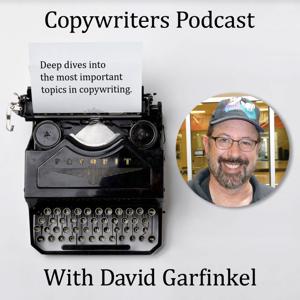
Copywriters Podcast

Copywriters Podcast

By David GarfinkelBusinessEducation
Download on the App Store

Copywriters Podcast episodes

  • TikTok Secrets, with Emmanuelle Daigle

    I’ve been aware that there’s something out there called “TikTok,” but I didn’t pay much attention to it, other than the occasional TikTok video reposed somewhere else. The reason I didn’t pay much attention was I thought it didn’t have much to do with business, and it didn’t have anything to do with advertising.
    Ummm… I was wrong. TikTok had almost $5 billion in revenue last year, and it had over a billion users. Not only that. 11% of them were over 50 years of age -- old folks, like me.
    Then I learned about today’s guest, Emmanuelle Daigle. Emmanuelle is a marketing agency owner and the founder of TokTrend, a community that keeps business owners up to date on TikTok and Instagram reels trends.
    As an early user of the TikTok platform, Emmanuelle has a deep understanding of its users preferences and how to create ads that convert (because spoiler alert, your Facebook ads won't cut it there).
    Emmanuelle told us about TikTok from way back when, and how she has seen it evolve from its early days. She explained two really important points for anyone planning to advertise on the platform:
    • How TikTok is similar to Facebook, and
    • How TikTok is very different from Facebook.
    This matters a lot, because what’s considered a good ad on Facebook is likely to be considered stodgy and out-of-place on TikTok.
    Now, with all that revenue ($5 billion last year), some companies must be spending a lot on TikTok advertising. Emmanuelle shared how some consumer brands have sold out on their offers with TikTok ads.
    Interestingly, organic content -- non-advertising that you post for free -- can also generate a lot of interest and business, because TikTok’s algorithm is fundamentally different than most other platforms. Facebook and the like have social algorithms -- based on your connections. TikTok tracks your interest and adapts much more closely than other platforms do, according to Emmanuelle. Therefore, if you hit the right theme, you have a much better chance of going viral on Tiktok.
    Emmanuelle also share some tips for creating your own TikTok content and advertising.
    https://toktrend.io/

    Download.
    33 min
  • The 4 Kinds of Proof

    One of my Facebook friends asked a question in a copywriting group about whether there are more kinds of proof than what most people think of – namely, logic and testimonials.
    This got me to thinking. I realized there are other kinds. These other kinds of proof are just not that obvious to everyone. In fact, the less obvious they are, the more they fly under the radar, and... the more powerful they are likely to be.
    Proof is one of the most under-used parts of copy, but it’s one of the most important. Why? Because it’s going to be really hard to get people to believe you without enough convincing proof elements. And no belief = no sales. So you definitely need all the proof you can get.
    I’ve identified four kinds of proof the best copywriters are already using all the time, but most people don’t fully understand or even know about at all. At least some of them. And we’ll go over all four today.
    So we’re took a deep look at four kinds of proof. Believe me, there was some overlap between the categories. Still, each kind is basically different enough to deserve a category of its own. So yes, sometimes you could come up with a piece of proof that could definitely fit in more than one category, depending on how you look at it. That doesn’t matter, though.
    The important thing here to understand is that you need to use as much proof as you can get. Remember, maybe you’re sold on your product, but your prospect probably isn’t.
    Just because someone knows you, likes you and trusts you doesn’t necessarily mean they will buy from you. Because, unless they have had experience already using a very similar product from you in the past, the chances are really good that they have their doubts and you can’t count on them to believe you completely about any particular product, just because you say so.
    If you’re not already big on proof, you’re probably not getting nearly the sales you could be getting.
    And if you are big on proof, then you need to listen closely to find out what you’re not already doing that you should be doing from now on.


    Download.
    31 min
  • Sales Copy Editing Cheat Codes, with Nathan Fraser

    When you’re all but done with your copy -- especially long-form copy, like a sales letter or a VSL script -- you’ve got to take one final pass to make sure everything is right.
    Of course you’re looking for the numbers to add up and the words to be spelled right -- you know, if you’re into “spelling,” that is.
    But there are bigger-picture copy edits to do. I haven’t heard much about them from other people, but our guest today, the Copywriters Podcast’s own Nathan Fraser, has a list that is going to knock your socks off.
    I mean it. This is good stuff. Top pro’s know this and use this, but Nathan’s the first person to write it down and organize it, all in one place. Best of all, it’s an addition to his already very useful and extremely reasonable book, “Sales Page Cheat Codes.”
    Nathan told us about three simple copy-editing cheat codes that can boost the conversion power of your copy in a big way.
    The first one is a form of big-picture editing: Looking at two goals (your own, and your reader’s) and pretty much ruthlessly editing out anything that doesn’t move the copy in those two intertwined directions.
    Sounds simple and self-evident. But there are lots of snaggles and pitfalls that can get in the way if you’re not careful. Nathan explains what the biggest ones are, and how to steer clear of them.
    The second cheat code is also deceptively simple. It’s to acknowledge and deal with your prospect’s objections. And these are beyond the well-known ones like, the price is too high, or, what happens if I don’t like the product?
    Nathan gets into the psychology of the prospects as they read your letter or watch your video. He pinpoints three areas of doubt that can kill a sale… or lead to a boatload of extra sales if they’re handled well. He tells you how to handle them the right way.
    Finally, all work and no fun makes Jack a dull copywriter. My words, not Nathan’s! But his third area of editing sales copy has to do with making sure your copy is fun and easy to read!
    Nathan has four key tests that are easy to do that fit into this part of his list. I love how he starts the first one:
    “Forget everything you learned in high school English class. Your English teacher was wrong about almost everything.”
    Then he gets down to specifics about the RIGHT way to make your copy fun and very readable.
    By the way, you can get all of these cheat codes, plus a whole lot more, in the latest edition of Nathan’s new book:
    https://www.amazon.com/dp/B09VRRL75Z


    Download.
    31 min
  • The Simpsons Approach to Copy, with Sage Polaris

    As copywriters, we draw inspiration and know-how from all kinds of sources: professional salespeople… music… the sports world… fiction… even, the movies!
    But I have to admit, our guest today is the first copywriter I’ve ever heard of who draws her approach from The Simpsons!
    Yes, those Simpsons. Marge, Lisa, Bart and of course, the most unforgettable one, Homer.
    Copywriter Sage Polaris has come up with an ingenious system for seeing the Simpsons as personality archetypes — and using that viewpoint to reach more buyers in every promotion.
    Apparently it really works, too. Today she’ll tell us how she used this system to write copy for a $1.25 million launch. Overall, Sage has written copy for more than 400 clients, with millions more in sales results.
    Now, getting your copy to that level of performance is rare enough in and of itself. But bringing it into the frame of everyone’s favorite cartoon dysfunctional family is unique, it seems to me.
    Here’s what Sage told us about on the show:
    • The four personality types of Bart, Homer, Marge, and Lisa – and what triggers their buying decisions
    • How to put these high sales conversion methods into practice, particularly regarding overall placement of testimonials, when branded photos and selfies are most effective, how music lyrics and puns can be used to close sales, and more.
    • How she used this exact method to earn her client $1.25 million in a single launch
    • How to discern when to write to just one or a couple of the buyer types
    • How these high conversion methods can help you connect beyond paid traffic and apply to organic traffic as well (Sage loves using this to build her audience in Facebook Groups)
    Sage is offering a free report, “3x Email Open Rates in 3 Steps.” Go to:
    https://sagepolaris.com/davidrocks

    Download.
    30 min
  • Let’s Talk Conversational Copy

    About 30 years ago, I saw my first Gary Halbert newsletter. It was printed, on paper.
    I was blown away. I didn’t know what I was reading. But I couldn’t stop reading it. In fact, I must have read it 20 times.
    I had been writing professionally myself for almost 20 years. But I knew I didn’t know how to write like Gary was writing. And for a good long while, I couldn’t figure out what he was doing.
    Now, I know. What Gary did, the way he wrote, was unique and is still beyond my powers of description today. I wouldn’t ever pretend that I could write the way he could – I can’t. Who can?
    But I did figure out a couple of key things, that launched my copywriting career and led to millions of dollars in sales.
    The first thing was that he knew how to sell with the written word. Which is something we’ve talked about a lot on this podcast.
    The second thing was that he wrote in a totally conversational way, at the same time he was selling. And that’s something we’ve never really dug into before today on this podcast.
    But today we do.
    Look – It should be the easiest thing in the world, but for most copywriters, it’s one of the hardest things to do. I’m talking about writing like you talk.
    Or, to use the technical term, “conversational copywriting.”
    But face it. The more your copy comes across like you talking to your prospect, the less likely your prospects are going to think to themselves, “Oh, this is an ad” — and put up their defenses.
    The worst thing about this is, as far as I can tell, no one else has thought that this is a skill that can be taught.
    Most copywriters and copy chiefs grudgingly admit that the better copywriters can do this and the lesser copywriters can’t, but that’s about as far as they go.
    I think different. I think most people can learn this, but it’s not a matter of wishing it and having it so. It’s a skill. It doesn’t come naturally and it doesn’t just sort of seep into your writing by itself over time.
    I think it’s a skill you can learn, piece by piece. And I’ve broken it down into pieces and steps to learn it.
    Today, we’ll look at
    • Why it’s so hard
    • Why it’s so important to write in a conversational way
    • What gets in the way for most people
    • And four comprehensive action steps you can take to get better at it.


    Download.
    34 min
  • Branding That Increases Sales

    We’re back with Bill Schley, the New York Times Bestselling Author and award-winning Brand Specialist. I’ve gotten to know Bill well over the past few months, working with him on the launch of his new online program, The Brand Titans MasterCourse.
    I invited Bill to come back because I’ve gotten really intrigued by his approach to branding. Anyone else in direct marketing will find it intriguing, too, because there’s a seamless connection between what we do and what he does. I have to say he’s the first branding expert I’ve run across who not only states the purpose of branding is to set a company apart to maximize sales…
    … but also who has a proven system to show anyone in any business the exact steps to take to do just that.
    Bill’s been at it for more than 30 years, after getting his foundation at the legendary New York agency Ted Bates and Company, headed earlier by the great Rosser Reeves.
    And companies are counting on Bill even today to help them stake their claim in the competitive marketplace. This year, he’s helping a high-eight-figures conglomerate in a very hot tech sector get their branding in tip-top shape.
    And a tiny startup he recently branded has been scooped up by a division of a large publicly traded company, which is looking at pouring millions of dollars into the recently acquired startup, thanks to the branding Bill initially provided for it before the acquisition.
    After going through his course and the bonuses in great detail, I can say with confidence that any copywriter or business owner can get a lot out of what Bill had to say today.
    He started by explaining the conditions that make the correct branding of a business increase its sales — something I believe every copywriter and business owner needs to know. I’ve actually ended up rebranding products on the last two copy critiques I’ve done, as only part of the work with my clients, just based on what I’ve learned working with Bill.
    Bill went on to clear up the widespread confusion — even among many so-called marketing “experts” — about what is a brand, and what is not. Following from that, he explained the mistakes people are typically making in branding, especially today, where there are some dangerous trends that woo people into going for euphoric feelings about their brands, instead of thinking about the customer first, and what message is going to make them curious and increase their desire for specific products and services.
    Then Bill shared some instructive stories about brands he has built (one was worth over one billion dollars, not just according to Bill, but also according the the company’s chairman). He also gave a few important tips and guidelines for building your own brand.
    And, naturally, he told us all about his course, which provides an easy-to-follow, step-by-step roadmap for building a brand for any business.
    You can find out more about his program, the Brand Titans MasterCourse, at
    https://garfinkelcoaching.com/branding
    Download.

    32 min
  • Copywriting for Life, with Rabbi Evan Moffic

    If today’s guest looks familiar to you, that might be because you’ve previously seen Rabbi Evan Moffic on Fox News or CNN, where he is frequently called in for commentary and analysis on events in the news.
    But here’s something you probably didn’t know: Rabbi Moffic is also a copywriter! He’s a former mentoring client of mine. I’m proud of the work we did together and where he’s taken it, and I’ve gotta tell you: He has found uses for what he learned in copywriting in places I’ve never heard of copywriting being useful, or even thought of before!
    Evan is the senior rabbi at Makom Solel Lakeside, a 600-family synagogue in the Chicago suburbs. A Stanford graduate, he’s also an popular speaker at churches, where his goal is to bring the value of Jewish learnings to as many people as possible. Evan has written several books, including ‘What Every Christian Needs to Know About the Jewishness of Jesus’ and ‘What Every Christian Needs to Know About Passover.’ His latest book is about anti-semitism.
    But today, Evan has agreed to talk about the role of copywriting inside and outside of business and religion. I really enjoy the way he looks at copywriting, and I know you will, too.
    Evan started by telling us how new things he learned about copywriting helped him write the most effective fundraising letter ever for his congregation! But for him, copywriting has had a much more wide-ranging impact. It has, in fact, changed his overall approach to persuasion, and even modified his perspective on human nature as a whole.
    Part of his work as a rabbi is to counsel members of his congregation, when they request it. And, as mentioned before, Evan speaks all over the country to Christians about The Old Testament and other Jewish topics. He’s a welcome speaker at these events — he only goes where he’s invited! — but there are opportunities to use to tools of copywriting to help make his concepts easier to understand and accept.
    As a writer, Evan has used copywriting not only in emails — as you would expect — but also in his books. And, as the father of two very bright daughters, he’s found copywriting comes in handy in family conversations.
    This is an unusual podcast today in that I can’t remember anyone on the show who has taken such a universal approach to copywriting — or, at least, talked with us about it.
    You can find out more about Evan on his substack:
    rabbi.substack.com

    Download.
    28 min
  • Lightning Fast First Draft, with Kevin Rogers

    Let’s welcome back for his third time on Copywriters Podcast, Kevin Rogers. No matter what we do, we can’t seem to scare him away.
    No, actually, we’re really grateful to have him back. Kevin has been on before to talk about humor, and we greatly appreciated that.
    But today he’s here to talk about something different -- ten rapid-fire steps to get a first draft of your sales paper down on paper or screen.
    Besides being a successful and experienced stand-up comedian, Kevin is an A-List copywriter and author of “The 60-Second Sales Hook.”
    He’s also the founder of Copy Chief, a powerful online community for copywriters.
    But let’s get to his 10-step speed process.
    Now Kevin wants to be clear: “If you’re out to beat a control, this isn’t the process for you. When you’re writing a magalog to beat another magalog, there’s a much longer process of review, with the team, and things like that.
    Instead, he says, “This is for a copywriter who knows the product very well. Whether it’s your product or a client’s product.
    “In that case, you know the audience very well, all the benefits very well, the features pretty well — but, you have this pressure to come up with a new ad.
    “It’s called the 4x6 copywriting formula. It’s the 10 essential parts of a sales pitch. Four of them, if they are not present -- the buyer’s brain will not let them proceed.”
    Kevin says this process lets you write first draft in about 60 minutes. It’s especially useful if you have to write a new ad for a product you’ve already written sales copy for.
    A couple resources to get more from Kevin:
    - https://copychief.com
    - his podcast: http://copychief.com/ccr


    Download.
    29 min
  • What You Didn’t Know About Charging Higher Prices, with John Williamson

    I’m going to tell you three words that can help you charge higher prices than you’re charging now — even higher prices than your competitors.
    Those words are “emotional risk displacement.”
    To be honest, I have NO idea of what they mean… but… our guest today does.
    He’s back! I’m talking about our returning champion, John Williamson. Today, he’s going to talk about Unique Selling Propositions and charging higher prices. And, if we’re lucky, he’ll tell us what “emotional risk displacement” means — since those three words CAN put more money in our respective pockets.
    John is coming to us from an undisclosed location on the side of a mountain in Scotland. Over the last 30 years, he has generated millions of dollars in sales for himself and his clients with his own special brand of unique selling propositions.
    He says, “A great Unique Selling Proposition will enable you to steal the attention and win the sales.
    “Including ‘financial risk reversal’ in your USP will win you even more sales.
    “But, you can take the process of USP development even further by embedding ‘emotional risk displacement’ in your USP … AND win all of those extra sales at HIGHER PRICES.”
    On today’s show, we talk about how it’s possible to charge higher prices than your competitors … and STILL get the business.
    John discusses:
    • Why increasing prices is paradoxically the first thing you should figure out how to do if you want to increase sales.
    • Why most people could care less about a money-back guarantee … and what they would prefer you gave them instead.
    • How to determine the optimum price you should charge to maximize both revenue and profit.
    • Why even rich people like a bargain and how you can give them what they really want without lowering prices by even a dime.
    • How to completely eliminate discount requests and have people pay full price with a big fat smile on their faces.
    • Why you should tell people what your ‘pricing philosophy’ is upfront, before you tell them anything about your product or service.
    • Why you should NEVER rely on your accountant or CPA to tell you what you should be charging.
    John’s Facebook Group is “Attention Bandits.”:
    https://www.facebook.com/groups/attentionbandits
    Download.
    25 min
  • How to Lock-In Your Customer’s Attention, with John Williamson

    By popular demand, we’re back with the always surprising John Williamson today. He’s going to talk about a serious problem every business faces, and some ready-made solutions to this problem.
    John is coming to us from an undisclosed location on the side of a mountain in Scotland. Over the last 30 years he has generated millions of dollars in sales for himself and his clients with his own special brand of unique selling propositions.
    The problem, of course, is getting and keeping the attention of customers. In a way that leads to sales, and repeat sales after that.
    John says, “Right at the heart of your attention getting should be your brand.”
    A lot of us direct marketers don’t pay a whole lot of attention to branding these days, but John argues that we should. All the time.
    But not just any kind of brand. One that pulls its weight in getting attention and adding new customers.
    How do you do that, and how to you make it pay off if you don’t have a huge budget to establish this brand in the way a big corporation will try to do?
    John discusses:
    • Why ‘branding bravery’ is the only way to win the war for attention.
    • How any business – no matter how boring the industry is - can be decommoditized through branding.
    • Why trying to come up with a brand name you love is almost impossible (and if you do love your brand name it’s … probably … not … very … (gulp!) … good.
    • How to make your brand stick in someone’s mind like it’s been tattooed on their brain from their very first exposure to your business.
    • How to use a linguistic shortcuts to get you people to resonate with your brand by relating it to a story they already have in their head.
    • How to give your brand ‘conversational currency’ (… so that - incredibly - other businesses prefer to promote your business over their own business!).
    • The specific 5 words people will say to you over and over again, that will let you know your branding is working.
    John’s Facebook Group is “Attention Bandits.” :
    https://www.facebook.com/groups/attentionbandits
    Download.
    24 min

About Copywriters Podcast

From the publisher's feed

Copywriting lessons from David Garfinkel

More shows like Copywriters Podcast

The GaryVee Audio Experience by Gary Vaynerchuk

The GaryVee Audio Experience

16,847 Listeners

The Amy Porterfield Show by Amy Porterfield

The Amy Porterfield Show

4,585 Listeners

The StoryBrand Podcast by StoryBrand.com

The StoryBrand Podcast

1,932 Listeners

Marketing School - Digital Marketing and Online Marketing Tips by Eric Siu and Neil Patel

Marketing School - Digital Marketing and Online Marketing Tips

1,256 Listeners

Founders by David Senra

Founders

2,204 Listeners

The Martell Method w/ Dan Martell by Dan Martell

The Martell Method w/ Dan Martell

578 Listeners

The Copywriter Club Podcast by Rob Marsh

The Copywriter Club Podcast

209 Listeners

The Game with Alex Hormozi by Alex Hormozi

The Game with Alex Hormozi

4,454 Listeners

The Diary Of A CEO with Steven Bartlett by DOAC

The Diary Of A CEO with Steven Bartlett

8,328 Listeners

The Russell Brunson Show by Russell Brunson

The Russell Brunson Show

919 Listeners

My First Million by Hubspot Media

My First Million

2,649 Listeners

Huberman Lab by Scicomm Media

Huberman Lab

29,156 Listeners

The Startup Ideas Podcast by Greg Isenberg

The Startup Ideas Podcast

210 Listeners

Marketing Against The Grain by Hubspot Media

Marketing Against The Grain

358 Listeners

Good Content with Shannon McKinstrie by Shannon McKinstrie

Good Content with Shannon McKinstrie

153 Listeners