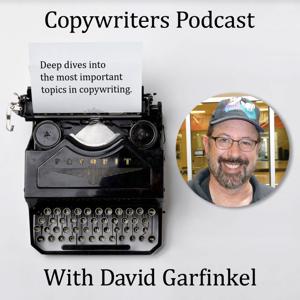
Copywriters Podcast

Copywriters Podcast

By David GarfinkelBusinessEducation
Download on the App Store

Copywriters Podcast episodes

  • How To Get Paid What You’re Worth, with Doug D’Anna

    Our guest today is a true A-List Copywriter. Doug D’Anna has written for just about about any major direct mail publisher you can think of. His client list includes Agora, Boardroom, Forbes, Prevention Health Books, Personal Finance, and dozens of other big-ticket clients.
    Like just about every other copywriters starting out, Doug was severely underpaid for his work at first. He turned that around on a project that earned him one-quarter million dollars in royalties about 30 years ago. He kept on going from there, and he’ll tell us all about that today.
    What does it take to bring in the big bucks in copywriting? Doug has figured it out. He’s also discovered how to get some pretty impressive public endorsements, like this one from legendary copywriter Gary Bencivenga:
    “Writers who can consistently create powerful direct marketing campaigns are as rare as trumpeter swans. I know of only about six in the entire country. Doug D'Anna is on that short list of star writers I never hesitate to recommend.”
    Today, Doug has agreed to share with you vitally important information about how to get paid what you are worth, which, as you can see by now, he made a lot of effort to learn and profit from himself.
    I also have some vitally important information for you:
    Copy is powerful. You’re responsible for how you use what you hear on this podcast. Most of the time, common sense is all you need. But if you make extreme claims... and/or if you’re writing copy for offers in highly regulated industries like health, finance, and business opportunity... you may want to get a legal review after you write and before you start using your copy. My larger clients do this all the time.
    Doug took us right back to the beginning, when he was struggling to get paid enough to make copywriting worth his while. It all changed when a man named Richard Stanton-Jones at Phillips Publishing hired Doug to write a promotion for a publication called Retirement Letter.
    Stanton-Jones put a lot of time into working with Doug, and did it ever pay off! Doug’s promo got double the response of the current control — and it launched his career.
    Discovering what he was worth came to Doug in phases. The more he found out, and the more successes he racked up, the more he raised his fees — even once doubling it in a one day!
    Doug shared some of his best secrets and strategies in this action-packed, value-rich show.
    He’s also offering a $51 discount ($299 instead of $350) to podcast listeners on his powerful home-study course: “How to Sell Yourself as a Copywriter. Just use this link:
    https://dougdanna.gumroad.com/l/nmufa/DAVIDG
    Download.
    34 min
  • Mind-Boggling Leads, with Joshua Henry

    Our guest today is Joshua Lee Henry, a high-powered copywriter with a very interesting career before he started writing copy. That began 12 years ago, when Joshua wrote fundraising letters for victims of the 2010 earthquake in Haiti.
    At the time, he was also a pastor for a megachurch with more than 5,000 members. Fast forward to 2018, when Joshua started freelancing and wrote for big names including Jay Abraham, Brian Tracy and the Zig Ziglar corporation.
    Like a number of high-performing copywriters, Joshua moved under the umbrella of Agora, where he has written promotions that have made millions. These days, he is copy chief for Money & Markets, an imprint of Agora’s fast-growing Banyan Hill company.
    After I spoke at Brian Kurtz’s mastermind a few weeks ago, where Joshua had also spoken, Joshua reached out to me with an idea that was truly mind-boggling: How to structure a lead that truly gets and keeps 100% of a qualified prospect’s intention.
    I’m not sure he put it exactly that way, but that’s what I took away from it. Joshua offered to share his structure with you on this show, and I said yes.
    Joshua has taken some well-known copy elements, added a couple of his own, and come up with something truly bold and audacious. What makes his approach almost impossible to ignore is a deft combination of shock, and carefully-selected breathtaking facts.
    All the while, everything is legitimate and on the level. And proven. What’s the unique about this approach is the way they are combined. Very powerful and a little unusual.
    Joshua originally developed the mind-boggling lead method for financial promos only. But for today’s show, he went out of his way to find examples of each element in non-financial promo’s. So, there’s something for everyone here.
    You can get more info about the program World of Financial Copywriting here:
    https://bit.ly/3CaB9S8
    And if you want to reach Joshua personally, his email is:

    Download.
    28 min
  • More Impact in Every Sentence

    Today’s show is our attempt to answer this question:
    How do you add more impact to every single sentence?
    It started last week when I read this article from The Economist. It’s a British magazine, and it used to be my favorite. I hardly read it at all anymore.
    But… I was scrolling through Twitter and the AKA, also called the All-Knowing Algorithm, served up an ad for an article in The Economist with the headline, “What to Read To Become a Better Writer.” So, I clicked.
    You know, many people say that the AKA knows even more than Google!
    The article starts with a very strange picture. Three women at an outdoor café. Two are having a drink, laughing, having a great time.
    The third one is writing on an old-fashioned portable manual typewriter. Scowling and trying desperately to concentrate while her friends are partying.
    I have always thought the British have a strange way of looking at things.
    The article recommends five books. I cherry-picked some tips from three of them that would be especially useful for copywriters when you want to add more impact to your writing.
    The main thing I was looking at when I was cherry-picking these ideas from more than 1,000 pages of books is: What’s going to give each sentence in your copy more impact?
    I know a lot of people recommend power words or startling statements, but a reader can only take so much of those things. Too much electric intensity can wear out a reader.
    For most of your copy, what’s important is clarity and momentum. Clarity often comes from leaving things out or fine-tuning some of the words you use.
    Momentum comes from moving your reader emotionally, which is what we usually think of as entertainment. In movies, novels and songs, that emotional movement comes from the reader’s or listener’s reaction to a story about someone or something else.
    In copy, we focus on something else: The readers themselves. People get moved when they think about something wrong in their lives, and they get just as moved, though in another direction, when they think about getting something they want that they couldn’t get before now.
    The books I went through are not copywriting books, and so they cover things that are different from what we’re concerned about when we write copy.
    But there’s one area of nearly 100% overlap: Impact. Writing that keeps the reader reading. And that’s what I was looking for when I got these tips for you.
    I found the best stuff from three books, and we’ll put links to them in the show notes.
    They are:
    On Writing Well, by William Zinsser. I first read this book nearly 50 years ago, when I was a journalist. I’ve come to appreciate it more over the years, and have assigned it to mentoring clients to polish up their writing skills. Other copywriting teachers also assign this book. It’s mostly for journalists and business writers, but many of his ideas work for copy, too.
    The second book I learned about in the Economist article: Style Lessons in Clarity and Grace, by Joseph M. Williams and Joseph Bizup. The two Josephs go into a lot of depth about little things that make a big difference. We’ll cover a few of those things today.
    The third book, I didn’t like a whole lot, even though the writer of the Economist article did. I don’t think there was too much we could use, but there was one very important thing in there. So I’m not recommending it, but I’ll include a link just in case it piques your curiosity. It’s called A Sense of Style: The Thinking Person’s Guide to Writing in the 21st Century, by Steven Pinker.
    Book Links:
    On Writing Well, by William Zinsser https://www.amazon.com/dp/B0090RVGW0
    Style Lessons in Clarity and Grace, by Joseph M. William and Joseph Bizup https://www.amazon.com/dp/0134080416
    The Sense of Style: The Thinking Person's Guide to Writing in the 21st Century
    by Steven Pinker https://www.amazon.com/dp/B00INIYG74/

    Download.

    31 min
  • Copywriting Nightmares - How to Wake Up With A Smile On Your Face (Maybe)

    If you’ve been a copywriter, a media buyer, or a business owner for a while, you have probably realized there are things that happen in this business that people don’t talk about a lot. At least publicly.
    I’m talking about stuff that you kinda wished you knew about ahead of time, so you wouldn’t be so floored when it happened to you.
    Copywriting and direct marketing make up a great business, and I’ve found most people, most of the time, are pretty decent. But not everybody all the time. And I know we generally like to be constructive and optimistic on this podcast. But I think it’s also valuable to know how things can go upside down or sideways. You can’t always avoid it, but you may be able to stop it or fix it before it gets worse.
    Or at least deal with it better than you might have before you knew about what we’re going to talk about today.
    Sometimes I think the best background for being a copywriter is having a previous life as a firefighter, an ER surgeon, or a hostage negotiator. Because on those occasions when things start to go sideways or upside down, it’s good to have crisis-management skills in the real world.
    I wanted to put this show together because I thought about some of the things I wish I had known about before I became a copywriter, a direct response business owner, and later a coach.
    To be sure, there are a number of annoying, disrespectful, and sometimes sheerly incomprehensible things that do happen. I don’t think it’s a good idea to believe you can wish it all away just by keeping a positive mindset. You know, because… some days are just better than others.
    One of my favorite success writers, Robert Ringer, has a “Theory of Sustenance” which says, “Keep a Positive Attitude Through The Expectation of a Negative Result.”
    A lot of fancy words, right? What does his elaborate theory mean?
    It basically means: Shit happens. Do not worry about this, or let it throw you off balance. Sometimes, you’ll find that negative results are simply an inevitable part of the process of success. Including great success.
    With practice and intention, you can learn to let go of the pain after a bit of time, and hold onto the lesson. Because there’s always a lesson.
    I figured, we might as well talk about problems, just to be prepared for them before they happen. Everything I’m going to talk about today has happened to me or to someone I know.

    Download.
    30 min
  • Joe Sugarman’s Triggers - Old Masters Series

    This is a unique edition of our Old Masters Series, because I knew this copywriter personally. It’s Joe Sugarman, and Joe passed away in March of this year. I was sad to see him go, as were thousands of others.
    Outside of the direct marketing world, Joe is known for his BluBlockers sunglasses, which he took to great success using infomercials. Joe also came up with the Batman credit card. He printed up a huge number, only to find DC comics wasn’t interested in selling them.
    So he gave them away at events. Joe was a fun guy. And as you’ll hear about in today’s show, quite a prankster from early in his life.
    Joe wrote a book called Triggers in 1999, and we looked at a few of the most powerful ideas in the book. The information in this value-packed book is familiar on a surface level to most copywriters and marketers, but Joe brings it to life in a unique way with some great stories.
    Each trigger, by the way, is a powerful copy element that will increase your conversions.
    I think the reason he calls them triggers is that they trigger action on the part of the prospect.
    We took a deep dive on 5 triggers in today’s show.
    Here’s what we covered:
    Trigger 1: National Hermits Convention: Desire to Belong
    Trigger 2: The Snowmobile That Bit Me: Exclusivity
    Trigger 3: Our President Drives A Rabbit: Proof of Value
    Trigger 4: Instilling Authority In The Men’s Bathroom: Authority
    Trigger 5: Help, It’s A Fire: Sense of Urgency
    Link to get Triggers:
    https://www.amazon.com/Triggers-Prospect-Motivate-Influence-Persuade-ebook/dp/B00O3QEFSK
    Download.
    31 min
  • The 10 Magic Words, with Jason Strachan

    Our guest today, Jason Strachan, went through a powerful turnaround over 10 years ago. He was deeply in debt, not doing especially well as a copywriter. He heard about Gary Bencivenga’s famous “Bencivenga 100” seminar in New York, but there was no way he could pull the money together to attend.
    However, when Gary offered the seminar on DVD, Jason moved heaven and earth, and might have missed a couple meals, to come up with the money to buy the recordings.
    And what he learned changed his life.
    Jason says, “I’ve always had this uncanny gift for assimilating new information when it interested me.” He put what he learned to work and his copy generated tens of millions for clients around the world.
    Fast forward to today. Jason has boiled down what he has learned over time into a formula made up of only 10 words, and written a book about it. I’ve reviewed the book, called The Magic Word Method.What I like about it is, any one of these words can be used, both as copy and as a strategic idea, to refresh and turbocharge just about any copy you’d like to perform better.
    The words are not unusual or unfamiliar. You’ve heard them before. But the way Jason looks at them is unique, in my experience. That’s why I invited him to come on the show and share his viewpoint and some tips from his book.
    Jason told us about the steps along his path from struggling, in-debt newbie to successful, world-class copywriter -- and how he came up with the 10 Magic Words concept.
    We went through three of the words from several angles: How it was used in a winning headline, why this particular word is so powerful, and some of Jason’s own experiences with how to get the most from this word both in copy and, as used strategically to boost response.
    And, he told us about his new book, The Magic Word Method. He has a very tempting offer with lots of bonuses.
    To get Jason’s book, go to: www.10magicwords.com/book
    If you’d like to reach out to Jason personally, here’s his email:
    Advertisingalchemy at gmail dot com.

    Download.
    24 min
  • Lessons from Great Copywriters, with Brian Kurtz

    Our guest today has a unique vantage point in copywriting. As an executive at Boardroom for 34 years, Brian Kurtz worked with many of the most successful and famous copywriters of our time, including Gene Schwartz, Gary Bencivenga, and many others. As the guy in charge, Brian was responsible for selling well over one billion dollars’ worth of products, “$39 at a time,” to millions of people.
    Seven years ago, Brian started a second career writing books and running mastermind groups. As well as republishing old direct marketing classics.
    I’ve wanted to have Brian on the show for a long time, and I was thrilled when he agreed to talk about the copywriting legends he has worked with. If you’ve ever wondered what the people at the top of this game were and are like, today’s your lucky day. Brian’s here to tell you.
    Brian started out by zeroing-in on what the greats of yesteryear (and some of the superstars he worked with are very active today) do differently from other copywriters. We can all suppose, imagine, or try to find hints from stories and their work. But Brian worked closely with these writers to create winners.
    After some sharp insights about what makes the champions a different breed, Brian and I spent a lot of our time talking about the man who just might be everyone’s favorite Old Master, Gene Schwartz.
    We went way beyond Gene’s two famous books as Brian shared some stunning stories about working with Gene, and his life outside of writing copy.
    Brian has a number of offers, including a special one (number 3) for Copywriters Podcast listeners only:
    1) Opt in to Brian’s weekly blog at briankurtz.net (and there is lots of free content at that link as well)
    2) Go to OverdeliverBook.com to buy his book. You’ll get instructions on how to buy it on Amazon, and send him the receipt to get the bonuses. Less than $20 for the book, and the bonuses are incredible.
    3) My favorite: Special offer on Breakthrough Advertising / The Brilliance Breakthrough:
    Both books together for $300 -- a $35 saving. And free shipping
    If you’re outside of the US, Brian will take half off of expedited shipping.
    So, $300 for both books, $330 for outside the US.
    We haven’t set up a link for this special offer. It’s good for up to one week after the podcast.
    You have to email Brian: brian at briankurtz dot net for this special offer, and be sure to put “Friend of David” in the subject line.

    Download.
    37 min
  • Sales Funnel Cheat Codes, with Nathan Fraser

    He’s back -- and I’m talking about Copywriters Podcast’s very own, Nathan Fraser.
    Nathan’s out with a new book, Sales Funnel Cheat Codes.
    This is my favorite book of his so far, because it’s so right-on target and full of useful strategies and tactics for putting together a sales funnel that works.
    The book is chock-full of systems, funnel diagrams, strategy, and simple rules to save you from a lot of mistakes and help you make a lot more money.
    We had a lot to cover on today’s show. Here’s what I asked Nathan:
    - What led up to you writing this book?
    - What’s the worst-performing funnel you ever created?
    - What’s the best-performing funnel you’ve ever created?
    - You have an interesting statement in the book: “Advertising is the art of buying customers.” What do you mean by that?
    - You mentioned that how-to articles and product comparison articles are great places to run your ads. What did you say that?
    - Who was Monster and what did he teach you about how great ads work?
    - Could you give us some tips about advertising to customers in the five levels of awareness?
    - Tell us more about the book!
    You can get Sales Funnel Cheat Codes here:
    https://www.amazon.com/dp/B0B6FWJG3S

    Download.
    27 min
  • Proven Headlines from John Caples, Part 2 - Old Masters Series

    OK, we’re back with part 2 of deep headline wisdom from Old Master John Caples and his book “Tested Advertising Methods,” originally published in 1932.
    Last week we covered the first half of his chapter called “Twenty-nine formulas for writing headlines,” and like I said last week, this chapter is pure gold and no fat.
    This week we cover the second half. There was simply too much in one chapter to cover it all in one show.
    Now these formulas are simple, and in most cases you have to do the heavy lifting. They are formulas, but not templates. He shows you where to start, which is always half the battle when you’re writing anything.
    So today we’re going to cover the second half of Chapter 5 in Caples’s landmark book, “Tested Advertising Methods,” 4th edition. Two groups of headline formulas in the second half of the chapter that, for me, are more fun and more interesting than the ones we covered last week.
    Don’t get me wrong. The ones we covered last week, which I summarized just a moment ago, are very powerful and very effective. I just don’t think most of them offer as many creative possibilities, that will still get results, as the ones we’re going to cover today.
    And to be sure, your headline does not need to be quote-unquote creative. It just needs to be fresh and interesting enough to work.
    But, after all, if you can have a little more fun coming up with it—no harm in that!
    To emphasize how important headlines are and what a tightrope you’re walking with them, let’s start with these powerful fourth paragraphs from the Chapter 3 “Right and Wrong Methods of Writing Headlines” in “Tested Advertising Methods”:
    Remember that the reader’s attention is yours for only a single, involuntary instant. He will not use up his valuable time trying to figure out what you mean. He will simply turn the page.
    Do not run advertisements without headlines. Some advertisers do this in the mistaken notion that it is smart, modern, and sophisticated. Because they do not test their advertising, these advertisers do not realize that about the only person who reads their copy is the proofreader, who is paid to read it.
    ---
    And this is something you should commit to memory, what he says next:
    --
    You can’t expect people to read your message unless you first give them in the headline a powerful reason for reading it. To run an advertisement without a headline is like opening a store without hanging out a sign to tell people what kind of store it is. A few customers may come in the store, but many prospective customers will be lost.
    If there is any exception to this rule, it is where an excellent picture of the product is used. For example, a beautiful, four color picture of delicious peaches with the name Del Monte at the bottom of the page conveys a message without a headline.
    Here are the 15 formulas we cover today:
    1. How to
    2. How
    3. Why
    4. Which
    5. Who Else
    6. This
    7. Wanted
    8. Advice
    9. Use a testimonial-style headline
    10. Offer the reader a test
    11. Use a one-word headline
    12. Use a two-word headline
    13. Warn the reader to delay buying.
    14. Let the advertiser speak directly to the reader
    15. Address your headline to a specific group or customer

    Download.
    31 min
  • Proven Headlines from John Caples - Old Masters Series

    Today we go deep into the headline wisdom of Old Master John Caples and his book “Tested Advertising Methods,” originally published in 1932.
    What’s so important about this book for today’s show is, it contains a chapter called “Twenty-Nine Formulas For Writing Headlines,” and this chapter is pure gold, no fat.
    It’s hard to appreciate the immense value of what he says in this chapter. I had to go through it several times to make it into podcast material. It’s clear and simple, but it’s dense.
    In fact, there’s so much there that I couldn’t fit it into one podcast. We’d have to cover one formula a minute. Going that fast would make it incredibly hard to develop useful ideas. It would all go by in a blur.
    So today is Part 1. We’ll cover 14 formulas. And we’ll cover the other 15 next week.
    By the way, don’t get intimidated by the word “formulas.” While Caples is accurate in describing them that way, they’re MUCH easier to use and understand than you might imagine.
    Now the headline formulas are in the last of four chapters about headlines. And it really makes sense to devote that much space in a book to the subject. Because headlines are BY FAR the most important part of your ad, and account for as much as 80% of how effective it is.
    To put the formulas in context, let’s quickly talk about the key points in the three chapters that lead up to the fourth chapter. You could go horribly wrong if you didn’t follow the guidance he has in those three chapters.
    The main thing he says is that headlines need to speak to the self-interest of the reader. Sounds simple enough, but so many headlines fail this simple test.
    Because… what is self-interest?
    In advertising, self-interest is what your prospect already wants or doesn’t want. Either something they want to move toward, or something they want to move away from.
    We’ll have a number of concrete examples of this as we move forward. The most important thing for now to get is: you may think something your prospect should want, or needs to figure out is self interest—but it’s not.
    Self-interest needs to be basically primal. Direct. Immediately recognizable.
    Primal things people want to move towards are things like: Money, health, popularity, prestige, pride.
    And primal things people want to move away from are things like: Threats, disrespect, loss of freedom, illness, pain.
    Stuff like that. Remember, copywriting is about what people instantly respond to, not what you think they should respond to.
    And all of this applies to headlines, especially.
    Keep in mind what I just said as we go through the formulas and the examples. Curiosity, which definitely attracts attention, does not usually set the frame for the copy by itself the way a good headline needs to do. However, curiosity combined with self-interest can work wonders. Again, more about this in a minute.
    And two other ingredients that work incredibly well when combined with self-interest are:
    - Quick and easy
    - News.
    Here are the short-form formulas, which we cover in depth on today’s show.
    1. Announcing
    2. Announcement Quality
    3. New
    4. Now
    5. At Last
    6. Put a date in your headline
    7. Write like a news headline
    8. Feature the price in your headline
    9. Feature reduced price
    10. Feature special merchandising offer
    11. Feature and easy payment plan
    12. Feature a free offer
    13. Offer information of value
    14. Tell a story
    and next week, we’ll cover the other 15.

    Download.
    27 min

About Copywriters Podcast

From the publisher's feed

Copywriting lessons from David Garfinkel

More shows like Copywriters Podcast

The GaryVee Audio Experience by Gary Vaynerchuk

The GaryVee Audio Experience

16,847 Listeners

The Amy Porterfield Show by Amy Porterfield

The Amy Porterfield Show

4,585 Listeners

The StoryBrand Podcast by StoryBrand.com

The StoryBrand Podcast

1,932 Listeners

Marketing School - Digital Marketing and Online Marketing Tips by Eric Siu and Neil Patel

Marketing School - Digital Marketing and Online Marketing Tips

1,256 Listeners

Founders by David Senra

Founders

2,204 Listeners

The Martell Method w/ Dan Martell by Dan Martell

The Martell Method w/ Dan Martell

578 Listeners

The Copywriter Club Podcast by Rob Marsh

The Copywriter Club Podcast

209 Listeners

The Game with Alex Hormozi by Alex Hormozi

The Game with Alex Hormozi

4,454 Listeners

The Diary Of A CEO with Steven Bartlett by DOAC

The Diary Of A CEO with Steven Bartlett

8,328 Listeners

The Russell Brunson Show by Russell Brunson

The Russell Brunson Show

919 Listeners

My First Million by Hubspot Media

My First Million

2,649 Listeners

Huberman Lab by Scicomm Media

Huberman Lab

29,156 Listeners

The Startup Ideas Podcast by Greg Isenberg

The Startup Ideas Podcast

210 Listeners

Marketing Against The Grain by Hubspot Media

Marketing Against The Grain

358 Listeners

Good Content with Shannon McKinstrie by Shannon McKinstrie

Good Content with Shannon McKinstrie

153 Listeners