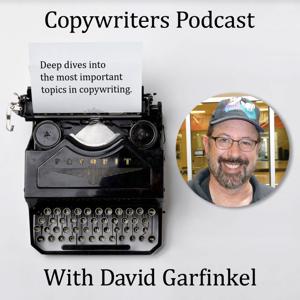
Copywriters Podcast

Copywriters Podcast

By David GarfinkelBusinessEducation
Download on the App Store

Copywriters Podcast episodes

  • Ben Settle's Email Marketing Horror Stories

    Our guest today is notorious and endlessly fascinating: Ben Settle. He’s an email specialist, author, anti-professional, and novelist.
    People go nuts over Ben. Including me. I once wrote to him, “You’re the f’in’ hottest email copywriter on the Web now.”
    But I wasn’t alone. Our recent guest Richard Armstrong says, “I start my day with reading from the Holy Bible and Ben Settle’s email, not necessarily in that order.”
    And the normally sober Gary Bencivenga admits. “Good copy intoxicates me. Yours is high proof. I’m enjoying it.”
    Well, that pretty much gives you the picture of what other copywriters think about Ben. He’s like… amazing!
    But Ben brings another skill to the party. While it is morbid, I have a morbid fascination with it and Ben has agreed to tell us about it today.
    He writes horror fiction. Let me read you this from the promo copy for Zombie Cop: The Enoch Wars, Book One.
    "The blood was still warm and there was meat and what looked like veins between his teeth - hanging out like dental floss."
    Nobody knew where the still-living decapitated head came from.
    But when the head bit Police Chief Rawger, he becomes a zombie with an insatiable appetite for human flesh, revenge, and power. But, unlike Hollywood-depicted zombies, he can think, speak, and strategize. He's also deranged, sexually perverted, and takes absolute pleasure in his evil acts.
    I think you get the idea.
    What does this have to do with copy?
    Nathan and I are hoping and praying that we’ll find out.
    And before we jump into the world of horror fiction, let’s take a moment to remember some comforting words that help little children fall safely asleep at night:
    Copy is powerful. You’re responsible for how you use what you hear on this podcast. Most of the time, common sense is all you need. But if you make extreme claims... and/or if you’re writing copy for offers in highly regulated industries like health, finance, and business opportunity... you may want to get a legal review after you write and before you start using your copy. My larger clients do this all the time.
    Wow. Now let’s get out the cloves of garlic for our personal protection and welcome Ben Settle. Ben, thank you for joining us today.
    1. A lot of successful copywriters are interested in writing fiction, but most of us, including me, kind of balk when it comes to actually sitting down and writing a book. Not you. At least, not after a certain point. Tell us how this all came about?
    2. So, when you have an idea for a book, what are the steps you go through to get it written?
    3. We talk a lot on this podcast about taking techniques from writing fiction to write copy. But we’ve never had someone who writes material as intense as you — and I’m talking about your fiction, although I could be talking about your emails — on here before. Could you share what’s similar, and what’s different?
    4. So, your emails are just bolder and more provocative than almost any other I’ve seen. OK, I’ll level with you. More than any other I’ve seen. Have you rewritten the rules for yourself, or, did you just decide a long time ago that there are no rules?
    5. Could you give us a few Ben Settle tips for writing emails that get noticed and get response?
    6. What do you think gets in the way of most people doing what you teach?
    7. What’s next for you — in your copy/marketing business, and in fiction?
    Ben Settle's Website
    Download.
    29 min
  • Saved by the Copywriters Podcast

    Our returning champion is copywriter Doug Pew. He was kind enough to be a guest a couple of months ago, when he talked about The Music of Copywriting.
    Doug is currently working on a couple of books about copywriting, but that’s not why he’s here today. The reason Doug agreed to come on and speak is The Copywriters Podcast itself.
    That is, Doug found himself in a bind a few weeks ago. The kind of bind every copywriter both dreams of and dreads.
    An onslaught of work no normal human could possibly handle. Including insane deadlines. And regular life carrying on apace.
    Did Doug survive it? We’ll leave you in suspense to let Doug tell you the story. But what’s most interesting is not the sheer number of words, emails, pages of sales letter, etc. that Doug produced in a stunningly short period of time.
    What’s most interesting is how he did it. And how we were able to help.
    In the same way, I hope we can help you in the future.
    We get into all the details in this episode, which is useful and entertaining in an unusual way!

    RockStar Copywriting


    Download.
    29 min
  • Stop Leaving Money On The Table

    With Brandon Frederickson
    Brandon is a stock market guru, turned marketer - turned copywriter.
    He’s managed product launches for the likes of Jeff Walker and he’s currently a copywriter for Stansberry Research, the 2nd largest division of Agora.
    Brandon specializes in product launches and maximizing long term value and retention. He does this by understanding how to build long term relationships with clients through marketing and copy, and by working deep inside of funnels to maximize net revenue.
    Brandon’s entrance into the world of direct marketing is at once impressive and hilarious. And, maybe, instructive and inspirational to anyone just getting started. Also, there are nuggets for every marketer who’s willing to listen deeply and think about his great origin story.
    There’s a big difference between money and fame. Or, between cash and glory. Sometimes rich people also get a lot of fame and glory, but more often than you’d think, people who act rich don’t even have next month’s rent in the bank.
    Brandon’s been doing well for a long time, and he’s well known but only among a select group of people who have knowledge of his extraordinary talents.
    It’s also worth pointing out that there’s not nearly as much glory in sweeping vast sums of the money off the table the way he does as there is in writing a sales letter that becomes a control.
    Nevertheless, Brandon is quickly becoming very well known in his own right not only as a copywriter, but also because of his knack for maximizing the value of each customer with the special magic he performs.
    Now, there is nothing wrong with making a lot of money for a client (or for your own business) by writing a profitable and long-lasting sales letter.
    But there is something not right with developing customer relationships and then letting them die, twisting slowly, slowly in the wind.
    On today’s show, Brandon will tell you how you can create multiple customer-relationship-sustaining funnels and stop leaving vast sums of money on the table!


    Download.
    26 min
  • Entertainment and Copywriting

    Three books I’ve been picking through for other projects, from entertainment fields, reminded me of the way we’re writing copy today:
    Music, the Brain, and Ecstasy, by Robert Jourdain
    The Writer’s Journey, 2nd Edition, by Christopher Vogler
    Shortcuts to Hit Songwriting, by Robin Frederick
    The rules used to be that copy was NOT to be entertaining. And that seems to have changed.
    But here’s one thing that has never changed, and never will:
    How it was in the past
    How it is now
    Three things that brought us to where we are today
    technology changes: ipad, netflix, amazon prime
    changes in news and politics
    social media: ad rules, plus the rise of content marketing
    How things are different now
    What to do differently
    be more aware of everyday life -- what’s going on around you, how you feel, how others probably feel
    use graphics to tell your story
    learn about engagement techniques from film, fiction, music
    What not to do, even today
    don’t turn your marketing into a comedy show or a mini-dramatic movie
    don’t take your eye off the ball. Remember, the primary job of your copy is to sell, or to inspire another specific action besides buying
    don’t sacrifice believability for entertainment value


    Download.
    38 min
  • Storytelling, Research and The Art of The Con with Richard Armstrong

    Richard Armstrong is a top A-List copywriter and I’m proud to say he’s my friend. He’s written for all the big mailers: Agora, Boardroom, Rodale, Kiplinger’s, Reader’s Digest, and many others.
    The late and extremely picky William F. Buckley, Jr. once allowed that Richard’s writing is “terrific.” The legendary Gary Bencivenga called Richard “one of the best copywriters on the planet.” And the great Dan Kennedy simply said of Richard, “I envy his talent.”
    Gotta agree with Dan on that one. I envy Richard’s talent, too. But envy has never prevented me from having a guest on this podcast.
    Today Richard’s going to talk about con artistry — and there’s a perfectly legitimate reason for that — as well as some storytelling stuff you’ve probably never heard before.
    1. Richard, we’re going to talk a lot about copywriting today, but I want to start by plugging your excellent new book, The Don Con, and ask you just a little about your research for that.
    Specifically, what did you learn about who con artists are and what they do?
    2. I know you’re going to be offering our listeners a free special report, and we’ll talk about it later. Besides your really cool book, I also got the chance to review your special report in advance, and I would like you share with us one of the most astonishing things I read in it:
    You said that a lot of the techniques, or maybe all the techniques, that con artists use are the same ones we copywriters use.
    So what are those techniques, and what’s the difference between a con artist and a copywriter?
    3. In a former lifetime, I interviewed you for a webinar series and you said something that keeps echoing in my brain, for years. It was that the secret A-List copywriters know, that other copywriters don’t, is about research. Could you talk about the level of research a top copywriter does, and what’s involved?
    4. Richard, as a fellow advertising guy, surely you must remember the old ad for Certs: It’s a breath mint and a candy mint. How they packed all that into one mint, I’m still puzzled about to this day.
    But in your own way, you’ve got a similarly rare distinction. You’re a copywriter and a novelist. Tell us, what do novelists know about storytelling that copywriters don’t know?
    5. One of my favorite Richard Armstrong stories is your lift note for Kiplinger’s Personal Finance about your aunt Jane. It, of course, is great storytelling in itself.
    Here, let me read it out loud so our listeners will be familiar with it:
    Dear Friend,
    My aunt Jane is rich as sin. And nobody in my family can figure out why.
    She worked as a librarian her whole life. Her husband, who passed away a few years back, was a tool-and-die maker. They never earned much money in their lives. But boy, were they ever smart with what they had.
    There was a little vacation home that they picked up for a song and wound up selling for $250,000. Some well-chosen stocks that grew in value over the years. Mutual funds. Municipal bonds. Treasury bills. Even a vintage Volkswagen “Beetle” that’s worth more now than the day they bought it.
    Nowadays my Aunt Jane -- who we always thought was just a little crazy -- is a bonafide millionaire!
    One day I asked her for the secret of her success. “I have three rules,” she said.
    1) Never let your money sit idle
    2) Never pay more than you have to for anything
    3) Never pass up anything that’s free
    Well, my friend, unless you return the enclosed card today, you’re going to break at least one -- and probably all three -- of my aunt’s rules.
    Because if you return the enclosed card, you’ll get a free issue of KIPLINGER’S PERSONAL FINANCE (Rule #3). If you decide to subscribe, you’ll get the next 11 issues at a very low price, plus three free bonus gifts (Rule #2).
    And instead of spending the rest of your life working for money, you’ll put your money to work for you. (Rule #1)
    I know my Aunt Jane wouldn’t pass up a free sample issue of KIPLINGER’S PERSONAL FINANCE magazine.
    But of course...
    She already subscribes.
    Best regards,
    Richard Armstrong
    Could you tell us about this piece of copy? I particularly love hearing you recount how you wrote it -- or how you gave up entirely, and it wrote itself.
    6. When you’ve written controls or blockbuster promotions, beside inhuman amounts of research, what are some of the other techniques you use that might be helpful to our listeners, who are copywriters and business owners interested in copy?
    7. Finally, your special report: “How to Talk Anyone Into Anything.” Besides the smidgen of your research findings that we talked about in the beginning… tell us about the other research you did writing your new book The Don Con, that led up to this report. And, tell us how our readers can get a free copy of this magnificent free special report!

    Check Out Richard's New Book

    Download.

    46 min
  • Secrets of the Close

    A row of dominoes can shed some light on the secrets of the close in copywriting.
    So can
    • Picking an apple
    • Checking out at the grocery store
    • Asking someone to marry you
    What do all these things have in common?
    We explore this in today’s show. What’s important to remember is nothing happens all by itself, and that’s excruciatingly true when it comes to closing the sale.
    Study all the power closes and tricky closing techniques you want.
    They won’t do you a bit of good until you understand where they fit into the Greater Scheme of Things.
    We outline what makes up that Scheme in today’s show. It all has to do with creating the right energy… doing the right kind of preparation… and putting in a vitally important component right before the close.
    Actually, we’ll do a lot more than outline this stuff. We’ll dig deep into the nitty-gritty.
    And finally, after all this time, you’ll know what the secrets of the close really are!


    Download.
    27 min
  • 3-D Copywriting

    Our show today features superstar public speaker and Internet marketing trainer Tom Antion, who shares some expert info about the red-hot topic of public speaking for copywriters and business owners.
    Why is this important?
    Because “the copywriter’s journey,” as we’ll call it, goes something like this:
    - You start out learning to write copy. Big mystery
    - Suddenly, it becomes clear as something you write “hits”
    - Then, almost just as suddenly, the floodgates open. You have more clients than you have time to write for (on time)
    - Eventually, you learn to write faster
    - You start to make amazing money
    - Then, a funny thing happens. You notice that your clients — especially those selling info-products, seminars, and courses — are making even more money than you are.
    As in, a LOT more.
    Now, there’s nothing wrong with their making more money than you do. And, if you’ve played your cards right, you’re still getting paid pretty well as a copywriter.
    Even so, at this point in your “copywriter’s journey,” (and the same thing happens with business owners who don’t start out in the info-product business), a question occurs:
    “Why can’t _I_ do that kind of thing and make that kind of money?”
    Well, if that’s you -- you can.
    But you need some additional skills.
    And most of those skills revolve around something many people avoid at all costs: public speaking.
    But it doesn’t have to be that hard, or that scary.
    Our guest, Tom Antion, knows how to take in huge paydays speaking from the platform — and claims to have trained more public speakers than anyone else alive.
    I’ve known Tom for 30 years and my jaw has dropped repeatedly over time at Tom’s energy, industry, willingness to help, and ability to help other people get results.
    He’s a great speaker. A terrific trainer. And genuinely nice, and generous, guy.
    Tom very generously shared a lot of tips on the podcast. As someone who has used public speaking myself (not just podcasts, but platform speaking) to substantially grow my own businesses, I strongly recommend this value-packed, and frankly very entertaining as well, podcast interview.

    Screw The Commute Podcast
    Download.
    30 min
  • New Look: Creativity and Copywriting

    A little-known book called “The Act of Creation” by Arthur Koestler says that there are three states of mind all creative people use in the process of coming up with new ideas. Broadly stated, these three states are:
    1. Humor
    2. Scientific Thinking
    3. Art
    While knowing about these is somewhat useful for the process of writing copy, being able to write copy that inspires these different states of mind in prospects while they are READING your copy is even more valuable.
    I’ve never seen anyone talk about them the way Koestler does, or even mention this book except one of the world’s greatest living creative geniuses, whose identity I reveal on the show.
    Then we go through each state, one-by-one, giving specific techniques and examples for each state. Variety is the spice of life, and variety in your copy is the key to more conversions.
    We pay particular attention to the high-wire act of using humor in copy. It’s generally not a good idea. But there are ways to adapt the principles of humor so rather than coming up with comedy, you come up with brain-jostling ideas and phrases that add extra go-power to your copy.
    After you have finished listening to today’s show, you’ll have a new toolkit of techniques to make your copy more interesting, and make it convert better.


    Download.
    37 min
  • The Greased Chute Trick

    Driving around Orange County in Western New York. What a police officer told me that, years later, really helped my copywriting.
    How you lose readers… and sales crater
    Very few people talk about this, and when people do, they tend to give it the short shrift. But not us. We’re going to give it the long shrift in today’s episode.
    Why everyone struggles so much with this problem
    The best “greased chute” copy is not only seamless; it’s virtually invisible to the untrained eye. Most people not only don’t know what the words are, but the strategy/psychology behind them. If that’s you, relax and rejoice! All is revealed ahead.
    Solution #1 - Logic
    Logic is very compelling in moving the reader along. But how do you use it effectively without coming across as stuffy or aloof? You’ll see!
    Solution #2 - Comparison
    This is like using a metaphor, but a lot simpler and, frankly, easier to do. It’s a powerful technique.
    Solution #3 - Random Phrases that work
    Sometimes it’s simpler than you think. But you gotta use the Best Words. You’ll get some of them in this part.

    Download.
    24 min
  • The Golden Triangle of Copywriting

    Before they start writing copy, people always ask me about a version of the same question:
    How can I make my copy succeed?
    But, strangely enough, after they’ve written their copy, their questions turn in a different direction. They are almost always the same question:
    Why did my copy fail?
    Today we’re going to talk about three things that really answer both questions.
    But before we do, let me answer a question I find on a lot of people’s minds. The question is, of course, what is the essential nature of copy and what should I do about it.
    How I discovered the Golden Triangle of Copywriting
    This whole episode came about after I did three critiques in a row one week. All experienced, successful copywriters. And all had the same three problems. Which were all very possible to fix. But my clients weren’t aware of these problems as something to look for after they finished their copy. So I thought it would be really helpful to do a podcast about them.
    Each problem is connected to the other two. So I put them into a triangle and called it “The Golden Triangle of Copywriting.”
    Don’t start at the beginning — when you’re writing copy, that’s a big mistake
    That is, the first point on the triangle where you should start is probably not going to be the first thing your reader or viewer will see when your finished copy gets launched.
    This can get a little tricky in the creative process, especially if you like to start at the beginning and finish at the end. But, doing so almost always will not give you the best response. In this part of the podcast, we’ll talk about where you should start, and why.
    The second point on the triangle follows naturally from the first
    A lot of well-meaning copywriters who think they understood what other copywriters have told them start here, at this point, and it’s a huge mistake. I’ll explain why. It could even get you in trouble (legal trouble) if you start here in your copy.
    But if you’re willing to put some reins on those wild horses inside you wanting to rush to the “money” part of your copy, and do some groundwork first, everything will work out so much better.
    The third point is where your copy should start, but not necessarily where you start writing or even brainstorming.
    This is the make-or-break point for copy. Frankly, it’s where I spend most of my time, and people get multiples of value, even compared to the serious fees they’ve paid to get my help.
    Most people think they can’t do this part themselves, or do it very well. Sometimes that’s true. But not always! I’ll share a simple trick you’ve probably never heard before (you’ve heard something like, but it’s been much less specific and far less useful), that will show you how you can handle this yourself, if that’s what you want to do.


    Download.
    31 min

About Copywriters Podcast

From the publisher's feed

Copywriting lessons from David Garfinkel

More shows like Copywriters Podcast

The GaryVee Audio Experience by Gary Vaynerchuk

The GaryVee Audio Experience

16,846 Listeners

The Amy Porterfield Show by Amy Porterfield

The Amy Porterfield Show

4,584 Listeners

The StoryBrand Podcast by StoryBrand.com

The StoryBrand Podcast

1,932 Listeners

Marketing School - Digital Marketing and Online Marketing Tips by Eric Siu and Neil Patel

Marketing School - Digital Marketing and Online Marketing Tips

1,256 Listeners

Founders by David Senra

Founders

2,199 Listeners

The Martell Method w/ Dan Martell by Dan Martell

The Martell Method w/ Dan Martell

578 Listeners

The Copywriter Club Podcast by Rob Marsh

The Copywriter Club Podcast

209 Listeners

The Game with Alex Hormozi by Alex Hormozi

The Game with Alex Hormozi

4,452 Listeners

The Diary Of A CEO with Steven Bartlett by DOAC

The Diary Of A CEO with Steven Bartlett

8,306 Listeners

The Russell Brunson Show by Russell Brunson

The Russell Brunson Show

919 Listeners

My First Million by Hubspot Media

My First Million

2,648 Listeners

Huberman Lab by Scicomm Media

Huberman Lab

29,138 Listeners

The Startup Ideas Podcast by Greg Isenberg

The Startup Ideas Podcast

209 Listeners

Marketing Against The Grain by Hubspot Media

Marketing Against The Grain

358 Listeners

Good Content with Shannon McKinstrie by Shannon McKinstrie

Good Content with Shannon McKinstrie

153 Listeners