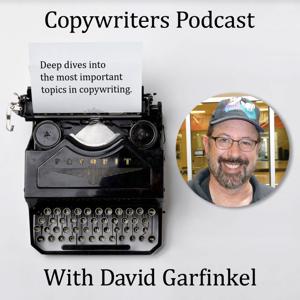
Copywriters Podcast

Copywriters Podcast

By David GarfinkelBusinessEducation
Download on the App Store

Copywriters Podcast episodes

  • The Music Of Copywriting

    We have a Special Report from the field today. In fact we might want to call it a fast-track masterclass in music and copywriting. Our special guest today is copywriter Doug Pew.
    He also happens to have a doctorate in classical music composition from the University of Cincinnati. He’s won awards for his music and he wrote an operate which was performed at the Kennedy Center. Plus, he was a Fulbright Scholar at the prestigious Ferydyrik Chopin University of Music in Warsaw, Poland.
    Now, since this is the Copywriters Podcast, Dr. Pew has agreed to give us an in-depth look at some prized secrets only composers know, that we can use ourselves to make our own copy much more compelling and profitable. And it will be easy for you to understand, even if you don’t know anything about music other than what you like to listen to.
    Doug, welcome, and thanks in advance for all the hard work you’ve done putting your part of this show together.
    Before we get into this exciting material, I have a message that could well be called the Music of the Copywriters Podcast:
    Copy is powerful. You’re responsible for how you use what you hear on this podcast. Most of the time, common sense is all you need. But if you make extreme claims... and/or if you’re writing copy for offers in highly regulated industries like health, finance, and business opportunity... you may want to get a legal review after you write and before you start using your copy. My larger clients do this all the time.
    So Doug. You’ve told me you have three musical strategies that evoke and extend emotions in copywriting. I got very excited about this idea, because that’s what every good copywriter wants to do — engage the prospect’s emotions and keep an emotional momentum through the close.
    1. Could you briefly explain the concept a composer uses to evoke emotions in a piece of music?
    2. Your first strategy, let’s call it “Variations on a Theme.” It's about a famous musical phrase that takes less than a second and keeps audiences on the edges of their seats for 45 minutes! Could you explain this strategy to us and then show us how it works in copy?
    3. Now, let’s talk about your second strategy. We can call it “Striking a Chord.” You composed three chords that you told me caused your church audience to feel the presence of the Holy Spirit. Please tell us about that, and how we can use this, even in a non-religious context, with copy.
    4. And let’s call your third example, “Off the Beaten Path,” because it involves a rhythm that is off-beat! I think you’ve got a Beatles tune in mind. Let’s hear about that.
    5. Finally, I haven’t run into too many other award-winning classical composers who are also copywriters, Doug! Would you tell us about how you got into copywriting, and about your new book?
    6. How can people get in touch with you?

    Doug's Website


    Download.
    38 min
  • Gene Schwartz’s Biggest Copywriting Secret

    How a TV interview with legendary singer/songwriter Robbie Robertson put the icing on the cake for me about a crucial problem in copywriter — on towering copywriter Gene Schwartz revealed on an obscure video, and certainly is Gene’s biggest secret for all copywriter. Something not even found in “Breakthrough Advertising.”
    The big problem with how people go about writing copy: We’ve got to shake old habits. The most important revelation is, contrary to what most people think, copy is not “written.” This new method makes things so much easier, and makes results so much better.
    What Gene Schwartz said about his biggest secret: It’s a completely new and unique perspective, but it’s really consistent with everything else Gene says. Just takes it to a new level. And, interestingly enough, it’s also remarkably similar to the way Robbie Robertson wrote his most iconic hit song.
    The pieces of the puzzle you want to put together: A quick review of the initial work you want to do in order to take full advantage of Gene Schwartz’s biggest copywriting secrets. It’s a little bit of hard work in the beginning that makes writing the copy so much easier.
    Where you get the material to assemble: This is where we talk about the three main areas that you get your “ingredients” for all of the puzzle pieces. For a lot of people, at least one of these areas will be very surprising!


    Download.
    26 min
  • Episode 098 - Selling with Spoken Copy

    Chances are very good you’ve seen and heard our guest before. Maybe on ABC News, or CNBC, or Howard Stern. Or somewhere else on the radio.
    And, if you’ve ever called Citibank, hers is the familiar voice you hear before you get to a live person.
    Chances are just as good you’ve heard at least one of her students and clients, too. In fact I know you’ve heard at least one of them on this very podcast, because Agora Financial, which Joe Schriefer heads up, is one of her clients. But that was before Susan started to work on him -- and I thought he was already pretty damn good.
    Now, there are a lot of speaking coaches and voice coaches. I know, because I used to be one of them. Not nearly as good as Susan, I’ll quickly admit.
    But precious few speaking coaches these days who are also masters of persuasion, and, more important, masters of teaching others to be persuasive. This is important especially to copywriters and direct marketers who are involved in any form of copy that goes audio or video.
    Like: Webinars, video sales letters, even radio and TV ads.
    And, of course, podcasts!
    Susan, welcome. Before we get into the interview, I want to mention, Susan is the author of “Speak to Influence: How to Unlock the Hidden Power of Your Voice.”
    1. Susan, thanks so much for making the time to be with us. I knew I wanted to get to know you better the minute I heard you on the Agora Financial Copy Call, and I’m so glad you agreed to join us on the podcast. Let’s dig right in.
    Chapter 12 of your book “Speak to Influence” includes a section on three steps to empathy. If there’s one thing the world needs more of right now, it’s empathy. Don’t you think so?
    For anyone in direct marketing, this is a special challenge and a big opportunity. In written copy, empathy with the prospect is often the difference between “I’ll buy it” and “Nice try, but no thanks.”
    Could you share some thoughts and tips on putting empathy into a spoken pitch?
    2. OK. So, I’ve saved this credibility builder for a few minutes into the show. Your voice sold $50 million worth of Topsy Tail hair gizmos on a direct response TV ad. My girlfriend knew what a Topsy Tail was, but I didn’t. And of course Nathan, with his closely cropped and very suave hairstyle, wouldn’t even need a Topsy Tail.
    Please tell the uninitiated what a Topsy Tail is!
    3. Now, I think you attribute some of that massive home run to your ability to use the four vocal influence types. I’ve found what I heard you say about them before tremendously successful, not only in speaking but also in singing!
    Could you tell us what they are and how when can use them when we’re selling something out loud.
    4. How about some more pro tips about narrating on a VSL or a Webinar?
    5. Before we get more valuable content from you, Susan, I’d really like to hear about some of your adventures in the big time. You’ve done things like Howard Stern and network TV, that many of us would be scared to even imagine! Please tell us what it’s really like and what happened to you.v
    6. OK, I think you have a covert influence secret for us -- the art of the “non-pitch.” Could you explain what that is and how to do it?
    7. Any stories about what it’s like to have a famous voice in everyday life? Have you ever been caught in voice mail jail, listening to your own voice?
    8. Finally — tell us a little about how you work with clients, and how people can reach out to you.

    Susan's Website
    Download.

    32 min
  • Episode 097 - The Job of Each Piece of Your Copy

    Without a good roadmap, most copywriters are just flying blind when they sit down to craft a sales letter. Sure, having a template can help, but even that doesn't get at the underlying problem. In order to write persuasive copy, you need to understand what each section of the copy is supposed to do.
    This week, David and Nathan break down the job of many essential parts of your sales letter. From headlines to P.S. sections, we get deep into the psychology behind each part and how to go about writing them. Tune in and you'll discover:
    • How great copy is like a full-course meal
    • Why most copy ends up muddying the point
    • Whether you should start your copy with an outline or not
    • How to write a killer headline
    • Why most headlines don't grab attention (and how to fix it)
    • Why a great "Pattern Interrupt" might actually be hurting your sales message
    • How to fix your testimonials and make them more convincing
    • What testimonials are meant to do in your reader's mind
    • 5 secret messages you need to be implanting into your testimonials
    • The real job of a bullets section (hint: it's not what you might think)
    • Why a good bullet can be as hard to write as a good headline
    • How one single bullet can close a sale all by itself
    • How to win over the fence-sitters at the end of your sales letter
    • What a P.S. section needs to do in order to sound convincing
    • How Colombo can help you write a better P.S.
    • And a lot more
    Listen Now


    Download.
    36 min
  • Episode 096 - Einstein 2.0 and Copywriting

    Einstein said: “Imagination is More Important than Knowledge.”
    It’s a quote that has led a lot of people to think they don’t need to know anything… all they need to do is “be creative” by using their imagination, and all their dreams will come true.
    That’s just not true. Because that quote, while accurate, is taken way out of context. Einstein needed to add just one word to it so the quote would stand alone and capture the meaning of the sentence in context, without the words that came before it and after it.
    He probably had no idea, even in his wildest imagination, that the sentence “Imagination is more important than knowledge” would become a social media meme to justify that self-defeating habits of the lazy and the self-indulgent. But nevertheless it has, and we’re going to set things straight in this show, at least for copywriters.
    The missing word
    We reveal what the missing word from that quote is, right here on the Copywriters Podcast.
    My holiday journey learning about Brian Wilson
    Brian Wilson of the Beach Boys didn’t go to music school. He never even took a piano lesson. He doesn’t read music. But he wrote some of the most stunning and memorable music of his time.
    I found a little-known documentary about him over the holidays in December and watched it three times. I’ll probably watch it a few more times, too. I got some unique and valuable information out of it, and it was fun to watch!
    I learned something very important that goes against the popular notion of Brian Wilson being an uneducated, intuitive genius… something he revealed in the first five minutes of the documentary. I share it in the podcast.
    What Brian Wilson did doesn’t just apply to music. It applies to copy, too.
    We get into the most important part of what Brian Wilson did, and show how you can use the exact same principle in learning to write very creative, high-earning copy.
    Joe Schriefer’s personal swipe file
    Joe Schriefer of Agora Financial provides a huge hint about what to do — by showing what he did, himself —in the voluminous personal swipe file he provided in the $2500 product, the Agora Financial Copy Camp home study course. We discuss. It’s very enlightening, and will provide a road map for anyone who wants to get better at copy — whether or not you have access to the Agora course yourself.
    But please let’s not make this all about Brian Wilson and Joe Schriefer
    Joe Schriefer is certainly a unique individual, but some of the things he has done to achieve his level of excellence are remarkably similar to what other top copywriters have done to get to where they are. We talk about what those things are.
    The difference between loading up on knowledge and informing your imagination.
    There’s a big difference. Being an “A” student in the “copywriting literature” is, in fact, taking the easy way out. And the only prize you win for stale knowledge is the consolation prize. Know the difference.
    Three things you can do, starting today, to inform your imagination and get better results with your copy.
    Obviously, there’s no substitute for writing copy when the heat is on and the stakes are high, and living with the consequences, and learning from them. But there are some other things you can do that are time-tested and consistently proven to work. We discuss.

    Download.
    28 min
  • Episode 095 - Copywriting in the Big Leagues

    Million Dollar Mike Morgan is a top copywriter currently working for a major division of the world’s largest financial publisher, Agora Inc. As a copywriter for Agora’s Money Map Press division, Mike’s in charge of promoting newsletters and other financial advisory services.
    His promotions that have made as much as $17 million apiece. Mike doesn’t like to do many interviews, but he’s one of my closest personal friends and so I was able to convince him to share some valuable inside secrets with you about what it’s really like to write for the big guys.
    Mike’s also one of my copywriting mentoring clients and I couldn’t prouder of him. And, he’s a Gary Halbert All-Star, one of a handful of top copywriters who Bond and Kevin Halbert invited to read and comment on one of Gary’s letters for their special audio series.
    1. So tell us how you got here. Everyone’s path to the top is different, and I know for a fact yours is interesting!
    2. It seems like everyone I talk to wants to write for Agora. Give us some highlights about what it’s like, and how it’s different from how you thought it would be.
    3. What’s the biggest difference, for you, between writing sales copy for an Internet info entrepreneur and writing copy for a big financial publisher?
    4. OK, so, not many people know this about you, but you’re a coach and teacher yourself. At least in a past life. You’ve coached copywriters and you even coached an Olympic cycling team at USC. These days you put 100% of your time into copywriting. But putting on your coach hat for just a minute, what advice would you give someone who wants to eventually become a copywriter for the big publishers?
    5. I rarely talk about this on the podcast, but you and I have talked about this a lot personally, so I thought I could broach the subject here. It seems that sometimes copywriters don’t have the best people skills, which is something you’re really good at yourself. Could you talk about what difference that makes, especially in the big-time?
    6. Finally, I’d like to ask you for one or two really great tips for a copywriting career nobody talks about, but you wish you’d known yourself way back when. What would those be?


    Download.
    37 min
  • Episode 094 - The Sherlock Holmes of Marketing, Part 2

    We’re back with Meron Bareket, who’s known as the “Sherlock Holmes” of funnels and conversions. He has the unique background and ability to find the “murderous leaks” in your online sales process — and fix them. When he combines that with his copywriting, you get outsized conversions and record profits.
    I know this because Meron is a mentoring client of mine. I’ve seen the kind of detective work he does and the massive sales results he’s gotten for clients. Meron can do what he does because he’s a dedicated student of buyer behavior during every step of the sales process. He uses software skills to track how buyers respond to each part of a sales funnel, and he makes adjustments accordingly.
    Today he’s going to talk about the just one horrible crime against marketing he sees people committing all the time. Often not knowingly or intentionally, but the results are the same. No matter how you kill the sale, you miss out on a lot of money you would have otherwise made.
    In this episode, Meron talks about what he calls “The Case of The Stolen Traffic.” It’s frightening on the face of it. What is worse, this could be happening to you and you wouldn’t even know it. What is more, it has the net effect of making the traffic that’s not “stolen” VERY expensive.
    Some key points from today’s show:
    • How Meron has reduced ad costs in a marketing campaign by up to 91% — simply by recovering “stolen” traffic that never should have been stolen in the first place.
    • How to find out if, when people click on your ad, they never make it to your website (yes, this really does happen!) — and, what to do about it
    • Getting emails delivered — to people who have signed up for your emails and actually WANT to receive them — is a lot trickier than most people realize. Meron shares some insider secrets. (Besides being a copywriter, he’s also a tech whiz. He has written computer code “at the server level,” for example, and created new programs to complete complex marketing tasks that no one else seems to have programs for)
    • Dead links in your emails. No, we’re not talking about when you put the wrong link in the email you sent out. There are other problems that keep people from clicking through once they’ve opened your email. Meron explains.

    Marketing Killers Cheat Sheet

    Download.
    34 min
  • Episode 093 - The Sherlock Holmes of Marketing, Part 1

    Meron Bareket, who’s known as the “Sherlock Holmes” of funnels and conversions. He has the unique background and ability to find the “murderous leaks” in your online sales process — and fix them. When he combines that with his copywriting, you get outsized conversions and record profits.
    I know this because Meron is a mentoring client of mine. I’ve seen the kind of detective work he does and the massive sales results he’s gotten for clients. Meron can do what he does because he’s a dedicated student of buyer behavior during every step of the sales process. He uses software skills to track how buyers respond to each part of a sales funnel, and he makes adjustments accordingly.
    But today he’s going to talk about the horrible crimes against marketing he sees people committing all the time. Often not knowingly or intentionally, but the results are the same. No matter how you kill the sale, you miss out on a lot of money you would have otherwise made.
    In this episode, Meron talks about the seven serial killers that take the life out of your marketing. Some copywriters and business owners know about some of these. Some don’t know about any of them at all.
    And I’ve never met anyone before who has such a thorough operational knowledge of all of them. Honestly, in my 30 years of marketing consulting, coaching, and copywriting, I was shocked by some of these that I’d never heard of before.
    We dig in deep to two of the “marketing serial killers” today, which Meron, wearing his “Sherlock Holmes” hat, refers to as “The Case of the Yawn-Inducing Offer” and “The Case of Sir Slapped-A-Lot.”
    He covers four key questions to replace yawns with eagerness and willingness to buy, in your prospects.
    And the two things you must have to avoid getting “slapped a lot” yourself!


    Download.
    36 min
  • Episode 092 - George Orwell and Copywriting

    The famous English writer George Orwell is best known for his book 1984, which is a bestseller and a major cultural signpost in the English-speaking world.
    But lesser known is a book he published three years before. 1984 was published in 1949. But Politics and the English Language was published in 1946.
    In this book, Orwell lays out six iron-clad rules for writing, which are pretty good for copywriters, too — with some notable exceptions.
    We’ll get to those in a few minutes. But first, let me show you what Orwell was worried was happening to the English language.
    He gave this comparison in his book:
    From the Bible, Ecclesiastes, 9:11
    “I returned and saw under the sun, that the race is not to the swift, nor the battle to the strong, neither yet bread to the wise, nor yet riches to men of understanding, nor yet favour to men of skill; but time and chance happeneth to them all.’
    Translated into the worst of modern English:
    “Objective considerations of contemporary phenomena compel the conclusion that success or failure in competitive activities exhibits no tendency to be commensurate with innate capacity, but that a considerable element of the unpredictable must invariably be taken into account.”
    No wonder he was worried.
    The six rules (we discuss each one, in depth, on the show)
    Rule 1: Never use a metaphor, simile or other figures of speech which you are used to seeing in print.
    Rule 2: Never use a long word where a short word will do.
    Rule 3: If it is possible to cut a word out, always cut it out.
    Rule 4: Never use the passive where you can use the active.
    Rule 5: Never use a foreign phrase, a scientific word, or a jargon word if you can think of an everyday English equivalent.
    Rule 6: Break any of these rules sooner than say something barbarous.


    Download.
    40 min
  • Episode 091 - Your Chance To Advertise on TV

    Simulmedia, a 10-year-old company based in New York and LA, helps businesses use TV advertising to get better results by bringing in data analytics. Recently Simulmedia launched a marketplace called D2Cx. It’s especially interesting for direct marketers who want to reach consumers on TV without all of the old hoops that you used to have jump through.
    I reached out to Matt Collins and invited him to come on the Copywriters Podcast to explain this. Some listeners are not ready for TV, but I’m pretty sure some will embrace the opportunity, since the opportunity to scale your business rapidly is simply unmatched by anything else. And it’s more affordable, as I understand it, than any other big-league TV ad opportunity.
    Matt will set me straight if I’ve got that wrong! Matt, welcome.
    Matt is Senior Vice President of Marketing at Simulmedia in New York City. Previously, he was VP of Marketing and Communications at Ampush, in San Francisco, which was involved in big-time Facebook marketing.
    Before we start, I’d like to give everyone a message that no one will mistake for marketing:
    Copy is powerful. You’re responsible for how you use what you hear on this podcast. Most of the time, common sense is all you need. But if you make extreme claims... and/or if you’re writing copy for offers in highly regulated industries like health, finance, and business opportunity... you may want to get a legal review after you write and before you start using your copy. My larger clients do this all the time.
    Let’s start at square 1, Matt, and thanks again for taking time from your busy schedule:
    1. Please give us a rapid tour of your background, especially in terms that would be recognizable to direct marketers and direct marketing copywriters.
    2. Now let’s talk about D2Cx. What is it and how does it work?
    3. In our earlier conversation, you told me that the minimum spend for D2Cx is $50,000. Could you give me an idea of what a company could get for that amount?
    4. I have read that Simulmedia brings data analytics to TV advertising. Could explain what that means, and how that’s different from old-school programs for TV advertising?
    5. Are there additional analytics available with D2Cx?
    6. In terms of tracking results, you mentioned that there may be new third-party applications on the horizon, in the not-too-distant future. Could you talk about those and what a marketer will be able to measure with them?
    7. What about the mechanics of actually producing a TV ad? I know that’s not your primary specialty, but a lot of people in this space are do-it-yourselfers. Is there a way to find out what the standards are? Is this doable if they don’t want to use an ad agency?
    8. Anything else that direct marketers and copywriters should know?
    9. If someone’s interested in finding out more, what are the next steps

    SimulMedia
    Download.
    41 min

About Copywriters Podcast

From the publisher's feed

Copywriting lessons from David Garfinkel

More shows like Copywriters Podcast

The GaryVee Audio Experience by Gary Vaynerchuk

The GaryVee Audio Experience

16,846 Listeners

The Amy Porterfield Show by Amy Porterfield

The Amy Porterfield Show

4,584 Listeners

The StoryBrand Podcast by StoryBrand.com

The StoryBrand Podcast

1,932 Listeners

Marketing School - Digital Marketing and Online Marketing Tips by Eric Siu and Neil Patel

Marketing School - Digital Marketing and Online Marketing Tips

1,256 Listeners

Founders by David Senra

Founders

2,199 Listeners

The Martell Method w/ Dan Martell by Dan Martell

The Martell Method w/ Dan Martell

578 Listeners

The Copywriter Club Podcast by Rob Marsh

The Copywriter Club Podcast

209 Listeners

The Game with Alex Hormozi by Alex Hormozi

The Game with Alex Hormozi

4,452 Listeners

The Diary Of A CEO with Steven Bartlett by DOAC

The Diary Of A CEO with Steven Bartlett

8,306 Listeners

The Russell Brunson Show by Russell Brunson

The Russell Brunson Show

919 Listeners

My First Million by Hubspot Media

My First Million

2,648 Listeners

Huberman Lab by Scicomm Media

Huberman Lab

29,138 Listeners

The Startup Ideas Podcast by Greg Isenberg

The Startup Ideas Podcast

209 Listeners

Marketing Against The Grain by Hubspot Media

Marketing Against The Grain

358 Listeners

Good Content with Shannon McKinstrie by Shannon McKinstrie

Good Content with Shannon McKinstrie

153 Listeners