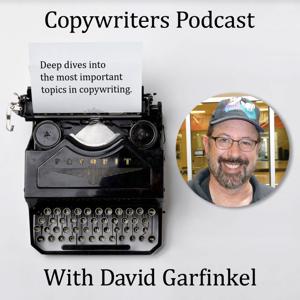
Copywriters Podcast

Copywriters Podcast

By David GarfinkelBusinessEducation
Download on the App Store

Copywriters Podcast episodes

  • Episode 011 - 10 Ways To Polish Your Copy

    A friend of mine had an old Fender Stratocaster guitar he wanted to sell. He put up an ad on Craigslist. The price was good and he got five people to come by and look at it. Most of the people liked the way the guitar played, but they all kind of hesitated and nobody bought.
    He asked me what was wrong. I looked at the guitar. It was clean enough and it had new strings. It sounded good, but it looked kind of dull.
    “Get something to polish it up with,” I said. “Then raise the price $100, and you’ll sell it.”
    My friend said he wasn’t that much “into appearances.” But he was so frustrated that he followed my advice anyway.
    And, guess what? It worked. The first person who came by from the new listing looked at the guitar… played it for five minutes… pulled the exact amount of cash out of his pocket… and walked out the door with my friend’s old guitar.
    My friend smiled. After the buyer left with the guitar, he admitted he was dumfounded. How could one coat of polish make such a difference?
    As it turns out, the same thing is true with your copy. Turning it in to a client when it’s rough and “almost good enough” does not usually work out very well. Or, if the copy is for your own product or service, showing your prospects sloppy copy will hurt your sales results.
    So, this episode is about polishing your copy once it’s written. Not with Fender Guitar Polish, but with a series of simple techniques and steps to make it shine… and sell.
    Today we’ll talk about 10 ways to polish up your copy for maximum engagement and sales.
    And before we get into these 10 ways, a quick announcement:
    Copy is powerful. You’re responsible for how you use what you hear on this podcast. Most of the time, common sense is all you need. But if you make extreme claims… and/or if you’re writing copy for offers in highly regulated industries like health, finance, and business opportunity… you may want to get a legal review after you write and before you start using your copy. My larger clients do this all the time.
    OK, now, on with these 10 ways to polish your copy:
    1. Get your spelling and grammar correct… and your punctuation, too.
    - Microsoft Word tool: “Spelling and grammar” under “tools”
    - A review will make punctuation suggestions
    - But the bottom line is, you’ll need to learn the rules yourself, or get a good editor who won’t mess up your copy but will fix the errors.
    2. Use only one idea per sentence.
    - A lot of good writers will put more than one idea in a sentence at first
    - You need to edit ruthlessly
    - Either break up the sentence into two or more sentences, or choose one idea and get rid of the other or others.
    3. Tighten things up.
    - Find the extra words you don’t need and take them out.
    - Especially, unneeded adjectives and adverbs, and the word “that”
    - Good copy moves at a pace. Extra words slow it down.
    4. Cut out the boring stuff.
    - Famous movie director Alfred Hitchcock: “Drama is life with the dull bits cut out.”
    - Same with copy. The excitement and momentum come in large part from lean writing
    - Focus on the human elements (emotions, experience, how things affect people’s lives) and minimize the technical elements that only geeks care about. Even if you are a geek and/or are selling to geeks!
    5. Read it out loud. Notice especially if you are keeping the momentum going and the excitement building.
    - Good copy is conversational
    - One of the hardest things to do is to learn to write truly conversationally
    - A great way to get closer to that is to read it out loud. If you stumble or it comes across as awkward,
    6. Change passive sentences to active sentences.
    - Passive sentence: “The ball was thrown.” Or “The ball was thrown by him.”
    - Active sentence: He threw the ball.
    - Key: use of a form of the verb “to be” before the main verb. Was, were, is, will be.
    7. Wherever and whenever you can, use visual and/or visceral and/or emotional language.
    - We experience life through our feelings and what we see.
    - You may have to learn what these kinds of words and descriptions are, if you’re not already familiar.
    - Notice in other copy. Also, The National Enquirer. Also, good fiction.
    8. Build and maintain a chain of logic.
    - Logical thinking is not natural. It’s something need to learn.
    - A clean logical flow is invisible in your copy. Everything just seems to pull together.
    - The most important thing I can tell you is start with a strong promise you can prove and deliver on, and make sure everything in your copy flows from that and is related to it in one way or another.
    9. Keep your copy focused on: your prospect… your offer… and selling your offer.
    - It’s easy to get off track. Rein yourself back in when you’re polishing your copy.
    - Think: What do my prospects need to see and hear to know this is about them, that you are for real and can be trusted, and that this is an appealing offer
    - Take out any tangents that are “interesting” but not relevant to your prospect, your offer, or selling your offer.
    10. Make sure your close is clear… and strong.
    - Tell your prospect how to buy in clear, simple language.
    - Don’t be shy.
    - Make it as impossible to screw up as you can.
    --
    If you can’t do all of these, do as many as you can. Your copy will still be a lot better than if you didn’t do any at all.
    The same thing applies to how well you do the ones you do. The better you do them, the better your copy will be. But if you do the best you can, your copy will be a lot better than if you skipped the “polish” step altogether.

    Download.
    39 min
  • Episode 010 - Getting Started on Your Copy

    Looking for some tips on how to get over the blank page blues? We've got you covered. This week's episode is all about how to get started when you're in a slump.
    I used to take a lot of road trips, especially when I was in college. 500 miles from Ann Arbor, Michigan to Rockville MD. Back in the day, the length of this trip home was never a problem for me. But getting ready to go was.
    I was a worry-wart. Did I have everything packed? Was my tank full? Did I have enough food and coffee for the trip?
    Then one day I made three important discoveries:
    - Gas stations
    - Restaurants on the turnpikes
    - And stores near home in case I forgot something.
    With those discoveries, hey – getting ready was a LOT easier, and I knew in 8 to 10 hours of drive time, I’d be back home.
    Writing copy is a lot like that. You need to prepare, but the need to over-prepare can get in the way of you getting started. And if you find you’re missing something while you’re writing, you can always take a break and get what you need.
    Today we’re going to talk about getting started. This is one of the hardest parts for most people when they’re writing copy. We’ll cover some things you can do beforehand, and three ways to actually start to get words down on the page.
    Also, I will share with you some tricks the pro’s use when they get stuck, to keep on track.
    But before we get started, a reminder to our listeners:
    Copy is powerful. You’re responsible for how you use what you hear on this podcast. Most of the time, common sense is all you need. But if you make extreme claims… and/or if you’re writing copy for offers in highly regulated industries like health, finance, and business opportunity… you may want to get a legal review after you write and before you start using your copy. My larger clients do this all the time.
    OK, that’s good to know.
    Now let’s get right into the belly of the beast – getting started writing your copy!
    Preparation
    Before you start writing, you need to have done some research. The reason for that is, if you haven’t done research, it will be harder to write anything, and what you will be writing will be off the top of your head. That’s bad for a lot of reasons. So let me tell you about the minimum and the maximum research you should do:
    - Minimum: product / how it works / what its strengths and advantages are. How it was developed. What makes it unique. What would make it appealing for others to buy.
    Other kinds of research: The sales letter might work just with product research, but it will work a lot better if you do customer research. Who is your customer; what is their biggest problem that you can solve; how do they talk about the problem.
    And the icing on the cake with research: Competitor research. What else will customers be looking at? Even look at competitors’ sales letters. You can go so far as to put together a matrix comparing all products side by side so you can see where you have definite advantages.
    Why is this so important? Because it gives you facts to start from. Your copy will be a lot more solid and believable that way.
    Other things in preparation that make getting started a lot easier:
    - Outline. Some people like this, others don’t. Advantage of an outline is you know where you’re going next. You can see the flow of the letter all at once. You can do very high level outlines, or detailed outlines. Either kind works if it helps you get a sense of the whole. Outlining software I use: OmniOutliner for Mac. Lets you collapse the outline. You can also use mindmapping software to outline – I’ll talk more about mindmapping later.
    - Get clear on the goal of what you’re writing. Who do you want to do what when they read it? How do you want that person to feel?
    Getting started
    - You really need to be able to focus on writing and nothing else. That means no distractions. No TV, nobody talking to you. No email. No facebook. Just writing.
    - Gene Schwartz method / pomodoro method. Short segments of 25 to 33 minutes. Pomodoro means tomato in Italian. You can find physical tomato timers online, as well as virtual tomato timers (called pomodoro timers). Gene Schwartz used a digital timer and punched in 3333. The idea is, you have a limited amount of time. You don’t need to rush. Just see what you can get done in that time, knowing you can stop when the timer goes off.
    -Talk it out to another person. Sometimes you’ll discover things speaking that you won’t find when the words are totally inside your head. It’s good to record in any case and then transcribe it.
    - “Theatre of the mind” technique: Imagine you’re face to face with the prospect and you want to sell them what’s going into your copy. What would you say? What would they say in response? How would you respond to that? The more conversational you can get this in your mind, the better off you are. Of course, when you actually start writing the copy, it needs to be a one-way conversation – you, to the prospect.
    - Start with the close. Or at some other part of the copy than the beginning. Write bullets first. A lot of copywriters really get into the mindset of the whole piece by writing a lot of bullets before they write anything else. Or write the guarantee. Or anything. Sometimes just getting started on something will get the flow going for the whole piece of copy.
    Tricks pros use to keep going
    Take a break. Before you feel you need to. Short spurts of work followed by short breaks. Take a walk, or listen to some music, or meditate. Don’t do anything too distracting or tiring, though. Save the liquor cabinet for later.
    Change location. You can take your computer or a pad of paper and a pen, and go somewhere else where no one will talk to you and you can work undisturbed. Sometimes a change of scene will make it much easier to write.
    Mindmapping. This is good beforehand, as an outlining tool. Sometimes while you’re writing you get a lot on your mind and it’s better to organize it visually so you can get back to the task itself, of writing the copy. You can learn how to mindmap on paper, and there are lots of free and inexpensive mind-mapping programs.
    Oh, and we announce the winner of the iTunes contest in this episode as well. Was it you? Only one way to find out.

    Download.
    33 min
  • Episode 009 - How to Provide Proof in Your Sales Copy

    When you watch a show on TV like “Law and Order” or “NCIS,” the detectives are mighty impressive. They efficiently rule out innocent subjects and nail the killers – all inside of 60 minutes!
    And how do they do it?
    First, by doing hands-on, smart research.
    And then, using what they learn to develop convincing proof …
    … to solve the case and nail the perpetrator.
    Now… copywriters are usually not called upon to solve murder cases. But we still need to be just as thorough and convincing, in proving the claims that we make in our copy.
    First I’d like to say something about what you’ll hear today:
    Copy is powerful. You’re responsible for how you use what you hear on this podcast. Most of the time, common sense is all you need. But if you make extreme claims… and/or if you’re writing copy for offers in highly regulated industries like health, finance, and business opportunity… you may want to get a legal review after you write and before you start using your copy. My larger clients do this all the time.
    Good thing we got that covered, huh?
    Now, onto the subject of today’s podcast.
    You may be wondering… why is proof so important?
    What’s the big deal about proof, anyway?
    Here’s what: Once you sit down to write your copy, there’s a big difference between how much you believe what you’re saying, and what a real prospect will believe.
    People are naturally skeptical, and rightfully so. On a scale of 1 to 10, your belief level in what you’re saying may be a 10. But your prospect may have a belief level of a 7… or a 5… or even a 2.
    If this upsets you, stop taking it personally. Now. Because this is human nature. People lose more sales arguing with, or trying to change, human nature than just about anything else. They’d be much better off learning the laws of human nature and following them, even if those laws are unfamiliar, even uncomfortable, at first.
    You need to deal with people as they are, and the fact that people are skeptical and often untrusting, even when you might think they shouldn’t be, is just something to learn to live with.
    So, that, in a nutshell, is why we need proof. You’re best off starting by assuming that the prospect has no reason to believe you. Even if you think they should! So, do the right thing and give your prospect plenty of reasons!
    This episode covers different types of proof that work in copy. Some that you may already be familiar with, and some that you may never have heard of before.
    Let’s start with:
    • Testimonials and case studies
    This category includes quotes from others about you, your company, your product, and sometimes even the idea that your product represents – and, stories about customers using your product, or service – and what their experience was like.
    Big warning: Be very careful about reporting results. Especially financial and health results. I’m not a lawyer so I can’t give you expert or specific advice here. The general rule is to use disclaimers to let people know results are not typical or guaranteed. But if you are going to use testimonials or case studies with results, you’d be wise to consult with a lawyer who really knows advertising law – what you can get away with and what you can’t.
    The examples I’m giving you are safe, because no reasonable person could expect they will get the exact same results, or even comparably similar results, to the ones I’m sharing. They are examples that show my capabilities, and how my coaching and critiques have increased the capabilities of my clients.
    - Why proof elements need to include both emotional and logical components
    - The purpose of proof is to overcome skepticism and resistance. Proof by itself doesn’t sell, but it greatly bolsters the sale.
    1. Testimonials – three types: customer results testimonials, customer experience testimonials, expert testimonials
    For the examples in this episode of Copywriters Podcast, I’m going to use testimonials, case studies, and reviews from my own website, Garfinkelcoaching.com. Because I already have permission to use those testimonials. You need to get permission to use testimonial quotes, and written permission is best.
    o Customer results testimonials
    from Brett Alcorn, an internet marketer, on copy critiques:
    “I’ve worked with David twice so far and will continue to do so. On one promotion, David’s small but meaningful changes increased conversions of my sales video by 139.43%. As I said before, I intend to continue working with David and would encourage anyone else to as well. His expertise is well worth the investment.”
    Comments:
    - Specifics:
    - Brett mentions he has worked with me twice so far
    - “small but meaningful changes”
    - 139.43% increase in conversions
    - His conclusion: work with me again (he’s hired me 20 times)
    - Any prospect who measures their results and wants better results –
    o Can relate
    o Would be interested
    o Customer experience testimonials (describe)
    From Chris Haddad, a/k/a Michael Fiore, who many now consider a legend in the digital marketing industry.
    “Before I met David Garfinkel I was a wet-behind-the-ears wannabe copywriter way more concerned with protecting my ego than I was with writing copy that CONVERTS. David took me under his wing, brutalized my copy, burned away the bullshit keeping me from reaching that next level and transformed me into a world-class writer with well over 9 figures in sales to my name.”
    Comments:
    - he talked about his experience
    - future mentoring clients can identify with Chris’s situation at the beginning of his testimonial
    - To this day, Chris reaches out to me when he needs some outside clarity on a situation. He actually did so a few days ago, this week. That conversation is private so that’s all I’ll say about it.
    o Expert testimonials
    From Guerrilla Marketing author and former big Ad Agency exec Jay Conrad Levinson
    “David Garfinkel is the best copywriter I know.”
    Comments:
    - I think the quote speaks for itself
    - The expertise/authority of Jay is massive. He is one of the best known authors, if not THE best known, author of small business marketing books. And he was Sr. VP for a well known ad agency, J. Walter Thompson. So surely he must have known a lot of other copywriters.
    Why testimonials work: People like to hear about experiences from others so they can compare that to what they want. Best of all, they like to hear it “right from the horse’s mouth.” That what a reference is. But a testimonial is the next best thing.
    2. Customer Results Case Studies (describe)
    o From my Professional Copywriting mentoring page
    One of my mentoring clients, “Million Dollar Mike” Morgan, wrote a sales letter for Agora Financial that has the highest customer value in the history of the company. Another client, Angie Lole, wrote a VSL that rose to the number-two position in ALL of Clickbank. My client Jim Clair is writing copy for a group of digital fitness products that bring in eight figures a year. And his income is significantly higher than it used to be.
    Comments: These are one-sentence case studies that spotlight accomplishments of some of my most successful clients. The kind of accomplishments others would like to aim for.
    3. Product/company history (describe)
    • The experience and effort that went into creating the product
    - Example: iCoffee coffee-maker.
    Sum-up: The importance and necessity of proof.
    Next episode: How to get started on your copy. Even when you have no idea where to start.

    Download.
    30 min
  • Episode 008 - Copywriting Is a Team Sport

    Special Episode with copywriting legend John Carlton, on the topic of "Copywriting
    Is a Team Sport"
    Key takeaways:
    - Beginning and intermediate copywriters need mentors and critiques on their work.
    But, surprisingly, so do A-Listers and super-successful entrepreneurs. A different
    kind of support -- but, what's similar, is, they need to hear the truth about their
    work and their businesses from supportive, experienced people who aren't
    afraid to point out flaws and missing pieces.
    - Dan Kennedy on how to decide what creativity fits and what should be cut
    from your copy: "Does it advance the sale?"
    - Golden advice from Gary Halbert: "When all else fails, give people what
    they want."
    - To this day, other top marketers and copywriters count on Carlton to
    round out their advice and presentations: Two current examples -- Dan
    Kennedy at Cleveland event, Clayton Makepeace at online Mastermind.
    - The Mastermind process, first described by Napoleon Hill in "Think
    and Grow Rich," is uniquely valuable for writers and business owners
    - David read "Think and Grow Rich" in the mid-1980s, and has been
    in a number of Masterminds continuously since 1989
    - Early in his career, Carlton learned and benefited from what he calls
    "mind melds" with people like copywriting legend Jim Rutz; marketing
    master Jay Abraham; some other famous people he declined to mention;
    and of course Gary Halbert, who was his business partner and writing
    partner
    - Sometimes Halbert would take his copy into a bar and read it to
    folks over a beer. If he heard, "That's a great ad," he knew he had
    a loser. If he heard "How can I get that???", he knew he had a
    winner
    - There's no way short of testing to know for sure if copy will
    be successful, but the closest you can come is to have someone
    with a lot of successful experience (and a lot of remembered
    failures) to look at what you've written and be completely
    honest with you
    - The Platinum Mastermind is a relatively small group (about
    a dozen people) that offers a classic Napoleon Hill-style
    Mastermind, using the hot-seat format Carlton has refined
    and perfected over many years
    - More info on the Platinum Mastermind:
    http://garfinkelcoaching.com/love
    Download.
    41 min
  • Episode 007 - Copywriting Research

    Stephen Covey famously said "seek first to understand, then to be understood." Too bad most copywriters skim over this important part of selling.
    For many copywriters, market research is just too difficult. For others, they just don't know where to start. In this episode, David covers those bases, and more.

    Many years ago, a golf ball company was running a successful mail-order ad in a golfing magazine. The company owner decided to update the ad, and brought in a top designer from New York to redesign it.
    To everyone’s horror, response to the ad dropped to zero. No one could figure out why. The copy had not been changed. The market was still hot and growing. There was no bad news about the golf ball company that anyone was aware of.
    Turned out, the top designer had redone the coupon in the ad to be solid black, with white lettering and white blanks to fill in. This caused a problem for customers, because to fill out the coupon, they would have needed a pen that wrote in white ink!
    The business owner ordered the coupon to be changed back to white, with black lettering. Once the ad published with the normal coupon, response shot right back up.
    What’s important here is that the company could figure out what was wrong until they did hands-on research, step by step, to determine what the customer would have to do to order.
    This episode is all about copywriting research, which makes a huge and measurable difference in the profitability of your advertising.
    But first, my friendly reminder for you:
    Copy is powerful. You’re responsible for how you use what you hear on this podcast. Most of the time, common sense is all you need. But if you make extreme claims… and/or if you’re writing copy for offers in highly regulated industries like health, finance, and business opportunity… you may want to get a legal review after you write and before you start using your copy. My larger clients do this all the time.
    • How to research your customers: what they want, and what they need to read or hear in order to buy
    1. Basic research – talk to them
    o Don’t ask them about your product – ask them about their problems
    o Ask questions like:
    ■ What’s the one problem with __ you’re having trouble finding a solution for
    ■ What happens or will happen when you don’t solve this problem?
    ■ Do you have an idea of what caused this problem?

    o Conversationally, ask them what specific solution to a specific problem, that’s important to them, they would like… that they can’t find anywhere right now
    o Or, if they can find a solution, ask them about what they don’t like, or they wish they had, that they don’t, in that solution
    o Pay close attention to the words they use. The exact words. Don’t try to “help” them, or to correct them. Just listen and keep ’em talking. The way they talk about problems and solutions, the exact words they use, are very important in the crafting of your copy.

    2. Read reviews. Especially on Amazon and social media. Pay less attention to what they gush about (positive) than what they complain about (negative)
    o One review doesn’t make a trend. Multiple similar complaints do
    o The same languaging for the same complaint in different locations (ie on Amazon, in a forum, in a blog post) is a sure sign that you’re onto something you can use in your copy.
    o A reminder: You don’t just want to repeat their complaints. You want to also offer a unique, valuable solution that SOLVES their complaints!

    3. If you have a product going and a customer service department, listen in on the customer service calls – make sure it’s legal – or, better yet, do a shift or two on customer service. You’ll learn tons.
    o People never have a hesitancy to complain.
    o Just listen at first. Don’t try to fix it right away.
    o Sometimes, the REAL complaint is “below the surface.” That’s why you want to give people time to get to it. The REAL complaint is the one charged with emotion. Sometimes it will come out of nowhere. Cherish that information… it is gold.
    o Example: Someone is talking about dry skin… then it gets to wrinkles… finally the REAL complaint comes out: “I just don’t want to look that OLD!”

    • What to research about your competition – especially, how to determine what’s missing in their products, and what you can do better and/or differently to make them prefer you over your competition
    1. The simplest thing you can do with the highest probability of success is find out what complaints are about WINNERS – and fix the biggest complaints in your offer – and trumpet it loudly.
    o The first place to start is to look at successful competing ads from present day. Just look around; opt-in to lists of competitors; watch your Facebook account. You’ll start getting related ads remarkably quickly.
    o The second place to look is successful ads in different fields from present day. Could be closely related or not related at all. What you’re looking for is an example of a complete package of words and … that’s plagiarism, and you wan to avoid that at all costs. More about that a little later on.
    o Third place to look is old ads. There are a bunch of books like The Greatest Direct Mail Letters of All Time and They Laughed When I Sat Down: An Informal History of Advertising in Words and Pictures.

    Also, there’s a website – swiped.co. It’s free, and it has copies of many old ads you can look at. Claude Hopkins, John Caples, etc. Has current ads too. Promo’s running right now. As best I can tell, it’s free.
    2. Find out what appeal current winners leading with in their ads… especially ads that rank high (like on Clickbank) or appearing often (like Google AdWords, or Facebook ads).
    o By now you should be familiar with the range of features and benefits of your product and related products.
    o Simply find out which one(s) are being used in headlines and lead generation.
    o That should give a starting point for your ad. Don’t copy word for word, but use the same idea in different words. Example: For a sleep aid, instead of “sleep soundly,” you could say “sleep all through the night.” It means the same thing, but the words are different, so you’re much safer.

    3. Buy a competitor’s product and go through the entire sales cycle. Note what the upsells are. A successful product with successful upsells has zero’d in on, and nailed, the exact “mass desire” that will buy the most.
    o Get a sense of the structure and the content
    o Successful promotions usually have a theme. You’ll find the theme in the main product is repeated in the upsell. I heard a great example at a seminar, I think it was Nick Andrews who said it. If the main offer is Excedrin, the first upsell should be “extra strength Excedrin.” Look for patterns that you can adapt and duplicate.
    o A good funnel with email follow-up is very valuable research. Learn all you can before you design yours.

    • The secrets of profitably researching other ads that are winners in your field and other fields. Without plagiarizing, using what they are doing by adapting it to improve results with your own copy
    1. Swiping – the difference between plagiarism and borrowing/adapting concept
    o This is hard to teach and advanced concept – but, worth knowing about.
    o The important thing to remember is there is a concept behind each successful ad… at least almost all of them. Also known as the Big Idea.
    o It might be a metaphor… it might be a huge claim… it might be comparing a well known news situation or landmark, like global warming or the Eiffel Tower, to a specific situation your prospect is concerned about or wants. Global warming could be compared to toxic mold in a person’s home. You could make a case that there is gold buried under the Eiffel Tower.
    (But you need to have some backup!) And then compare it to a business or investment opportunity.
    o The key thing is not to use the same elements. Instead of global warming, you might talk about disappearing species of animals. Instead of the Eiffel Tower, you might use London Bridge. That steers you away from plagiarism.

    2. Swiping – the difference between plagiarism and borrowing/adapting structure
    o Same idea here
    o The way to swipe structure is to identify the different elements in copy, map it out, and follow your map with different copy
    o Headline – warning about threat
    o Opening – expands on the threat
    o Writer of letter introduces himself and talks about his relevant experience in regard to protecting yourself against this threat
    o … and so on.

    3. Notice how competing successful ads get into the customer’s head (conversation already going on in the prospect’s mind) and what they’re doing with their offer that is fresh and innovative.
    o At the end of the day, this is what you’re looking for: The conversation going on in your customer’s mind
    o It’s always very specific and down-to-earth
    o More often than not, it’s about avoiding some specific pain or achieving some specific and probably elusive goal
    o That, more than anything else, is what your research should help you figure out.

    Download.
    32 min
  • Episode 006 - How to Write Better Bullets

    Bullet points can be tricky to get right, but they pay off big when you do. This week's episode will teach you how.
    An Afghanistan vet and his wife went to the housewares department of a “big box” store. They were looking for an electric can opener. The vet was an amputee. He only had his right arm, but it worked fine. The salesman showed the couple the best model, and started rattling off the features: U.L. Approved, cordless operation, easy to clean, 5 star reviews online. The couple listened politely but didn’t say a thing.
    This made the salesman nervous. “Are there any questions I can answer for you?”
    “Just one,” said the vet with a smile. “If I get this, can I open a can with just one hand?”
    The salesman was embarrassed that he had failed to mention this, but he recovered quickly enough. He said yes—and the couple happily bought a new can opener.
    Every customer is like the vet. I don’t mean that every customer is an amputee. What I mean is that there’s usually one feature or benefit the prospect is looking for. Or maybe they’re not even looking for it, but when they find out about it, that alone may be enough to get them to buy.
    Bullet points are where you highlight individual features and benefits. Better bullets = more sales.
    And here’s the first thing I would like to remind you of:
    Copy is powerful. You’re responsible for how you use what you hear on this podcast. Most of the time, common sense is all you need. But if you make extreme claims… and/or if you’re writing copy for offers in highly regulated industries like health, finance, and business opportunity… you may want to get a legal review after you write and before you start using your copy. My larger clients do this all the time.
    Now, back to bullets.
    How to screw up a bullet point – and how not to
    - Don’t use bullet points to list your features example: you’ve got a device to hang business suits for guys six foot seven hand higher
    Don’t: • One foot taller than your average standalone suit hanger
    Do: • Built for guys like you, so the bottom of your suit will NEVER touch the ground
    or even: • At one foot taller than other suit hangers, it’s built for guys like you. That means the bottom of your suit will NEVER touch the ground.
    - Don’t make bullet points obscure, or hard to understand
    - Don’t make them so short that people need to strain their brain to figure out what they’re all about
    - DO: Focus on a benefit very close to what they prospect already wants, or would want if he or she knew about it
    - DO: Use intrigue to “tease” the prospect about unusual benefits they might want, without always spelling it out 100%
    example: you’ve got a tropical resort with a petting zoo for children.
    Don’t: • Your children will have a great time with our friendly petting zoo crew: seven sheep, two ponies, four llamas and three kangaroos.
    Do: • Your children will love our special petting zoo with familiar and exotic animals. They’re all safe, and your kids will learn about animals they’ve never seen before!
    - DO:
    Do your best to keep one simple idea to each bullet. Because if it is clear and compelling enough, one bullet alone can knock your prospect off the fence and convince them to buy.
    • What the best copywriters do when they write their bullet points
    - When you’re swinging for the fences, take some time crafting really good bullets
    ° One of my A-List friends, who has had multiple controls in the mail for a major mailer at the same time, told me he writes each bullet four times
    ° Another A-Lister, known for beating controls of other A-Listers, admitted that at times he would spend hours on one bullet
    ° If you’re going for a major-league grand slam, this is what you do. If you’re not in the most competitive market in the world, you don’t have to. But it certainly pays to put more time and craft into bullets than you have been doing in the past, unless you’ve been doing what these A-Listers have been doing.
    ° Most people don’t spend nearly enough time on bullets. Good idea to put more into them.
    - Go over the whole product slowly and carefully – when you write and edit bullets, this is a time when you really need to slow down
    ° Pull out as many unique features as you can
    ° Make each feature into a bullet
    ° Then make each bullet as good as you can make it
    ° This is what the pro’s do
    - Vary the length and style of your bullets
    ° All should be written in as few words as possible to get the idea across, like a headline or a subhead
    ° But some should be short and punchy
    ° Some can be longer and more in-depth
    ° As a rule, it’s always a good idea if you can start with one of the 5 W’s or an H: Who, What, Why, When, Where, How
    5 tips for writing better bullet points
    1. Know your prospect, inside-out, so you can write from the point of view that will most like get your prospect interested… intrigued… or SOLD.

    Download.
    29 min
  • Episode 005 - Stories That Demonstrate

    Ask any experienced, successful salesperson what the single best form of selling is, and you’ll nearly always get back the same answer: “Demonstration.”
    That’s why savvy car dealers let customers take a new car home for the weekend before they actually buy the car. It’s the same reason Internet marketers offer a $1 trial for the first month, on products or services that are billed for far more than that every month. They know that when people get to try what they’re selling, a lot more of those people will buy it.
    That’s why pet stores let people take a puppy they’re interested in, home for the weekend. In sales, there’s even a term for this kind of hands-on (paw’s on?) demonstration – “the puppy dog close.”
    Oddly enough, you can get your prospect to demonstrate your products for themselves without ever letting the touch the product! How? By telling them what I call “demonstration” stories. Prospects get to try out your product in their imaginations.
    How to create and use stories is known by some of the best marketers and salespeople—but virtually unknown by everyone else. If you don’t know what they are, we’ll turn that around now.
    Now for my friendly reminder:
    Copy is powerful. That’s why I’m going to give you some really powerful new strategies today. And then, you’re responsible for how you use what you hear on this podcast. Now, most of the time, common sense is all you need. But if you make extreme claims… and/or if you’re writing copy for offers in highly regulated industries like health, finance, and business opportunity… you may want to get a legal review after you write and before you start using your copy. My larger clients do this all the time.
    OK, back to demonstration stories, and other tiny little stories that really pack a wallop! And by that I mean, for the small number of words in these stories, you’ll get a disproportionate payoff.
    How? In advancing the sale in your copy. In getting your customers to want to learn about and then buy what you are selling, more than they did before they heard the tiny little story.
    • How to get your prospect to imagine experiencing the benefit of your product, without ever having the product yet
    So the great artist Pablo Picasso said: “Everything you can imagine is real.”
    Easy for him to say. When he died in 1973, he had an estimated net worth of $500 million – which would be $2.8 billion today. And on June 21, 2016, his 1909 painting “Femme Assise,” which means “Woman Sitting Down,” sold at an auction in London for $63 million and change.
    I’m not bringing up all these numbers to make the point that he was a great artist.
    I’m just saying, when someone can dream up images, put them on canvas, and sell them for big bucks, it’s easy for him to say, “Everything you can imagine is real.”
    But Picasso was right. In this way. If you imagine doing something or seeing something or hearing something vividly enough, your mind really cannot tell the difference between what you imagined and what actually happened (or never happened). It seems that real.
    This is important with the kind of stories we’re going to talk about today.
    Because these stories are designed to get your prospect imagining enjoying one or more of the benefits of what you are selling. In such a vivid way that they actually feel like they experienced it.
    Then, when they realize they don’t really have what they just imagined having, they will want it all the more!
    We’ll come back to that point and explore it in depth in a few minutes. For right now, let’s look at some very short stories that get the customer imagining benefits.
    These are from a full-page ad in the National Enquirer that’s been running for at least a year and a half. The ad is for a product called “Jitterbug,” and it’s a cell phone designed especially for seniors who do not want complicated, sophisticated smart phones like an iPhone or an Android phone.
    Each one of these paragraphs appears in the ad, and each one of them, by itself, is a story that gets the prospect to not only experience the benefit of the Jitterbug.
    They also tell a wonderful mini before-and-after story – contrasting the storyteller’s frustration with the old, difficult phone to the delights and ease of the new, easy Jitterbug phone.
    FIRST ONE: In quotes – “Cell phones have gotten so small, I can barely dial mine.” Close quotes. That first sentence was from a person like the prospect, talking to the prospect, and it’s in quotes. The next three sentences are from the company that makes Jitterbug. All part of the same paragraph:
    Not the Jitterbug Flip. It features a large keypad for easy dialing. It even has a larger display and a powerful, hearing aid-compatible speaker, so it’s easy to see and conversations are clear.
    That’s it. WOW! Incredible story there. I had this problem – so small, I could barely dial it. Jitterbug offers this solution: large keypad, large display, powerful speaker that works with hearing aids.
    Covered the waterfront in four sentences…
    Another one:
    SECOND ONE: Quote “I had to get my son to program it.” Unquote. The copy from the company follows: Your Jitterbug Flip set-up process is simple. We’ll even program it with your favorite numbers.
    THIRD ONE: Quote “What if I don’t remember a number?” Close quote. Friendly, helpful Personal Operators are available 24 hours a day and will even greet you by name when you call.
    In all – there are six short paragraphs like that. It’s 90% of the full page ad.
    Structure
    - Objection (that most prospects have about current phones)
    - Description (of how Jitterbug is different, better)
    - Gives prospect experience in imagination of new phone
    - Complete story:
    -- it was like this before
    -- it’s like this now
    -- this is much better than it was
    Completely different from hero’s journey.
    Here’s another one. By A-List copywriter Richard Armstrong. This was a control for Kiplinger’s personal finance for over a decade. This little story on a one-page letter:
    Dear Friend,
    My aunt Jane is rich as sin. And nobody in my family can figure out why.
    She worked as a librarian her whole life. Her husband, who passed away a few years back, was a tool-and-die maker. They never earned much money in their lives. But boy, were they ever smart with what they had.
    There was a little vacation home that they picked up for a song and wound up selling for $250,000. Some well-chosen stocks that grew in value over the years. Mutual funds. Municipal bonds. Treasury bills. Even a vintage Volkswagen “Beetle” that’s worth more now than the day they bought it.
    Nowadays my Aunt Jane -- who we always thought was just a little crazy -- is a bonafide millionaire!
    One day I asked her for the secret of her success. “I have three rules,” she said.
    1) Never let your money sit idle
    2) Never pay more than you have to for anything
    3) Never pass up anything that’s free
    Well, my friend, unless you return the enclosed card today, you’re going to break at least one -- and probably all three -- of my aunt’s rules.
    Because if you return the enclosed card, you’ll get a free issue of KIPLINGER’S PERSONAL FINANCE (Rule #3). If you decide to subscribe, you’ll get the next 11 issues at a very low price, plus three free bonus gifts (Rule #2). And instead of spending the rest of your life working for money, you’ll put your money to work for you. (Rule #1)
    I know my Aunt Jane wouldn’t pass up a free sample issue of KIPLINGER’S PERSONAL FINANCE magazine.
    But of course…
    She already subscribes.
    Best regards,
    Richard Armstrong
    Brilliant. And short. Less than 300 words.
    Now, how would this have gone as a hero’s journey story?
    Aunt Jane, graduates from an archivist program with a degree in library science. Ordinary life. Gets a job. Expenses go up, faster than salary. Gets married. Starts saving. Sees the writing on the wall. Jane and husband start investing. Husband gets laid off. Government budget crunch, Jane’s job is in danger. Will she continue to invest or is she going to start looking for a new job…
    And so on until she retires and discovers she’s a millionaire…
    But what Richard did was much more pared down, much more elegant, and much more effective.
    The first good thing about a demonstration story is that it quickly and effectively gets the prospect imagining they have the product or are using the service you’re offering – and this increases their desire.
    But there’s a second good thing about a demonstration story, too…
    • How not having the product (after hearing or reading a “demonstration story”) has the same effect as a super-powerful “takeaway close.” In other words, your prospect close themselves!
    Takeaway close – works probably better than any other close. Get a prospect excited about having something, and then telling them they can’t have it
    - after a deadline
    - after a limited quantity is no longer available
    - at the same price after a certain date, because the price goes up
    and there are other versions. Usually comes at the end of a spoken pitch, or the end of your copy.
    Reason: Human nature. People want what they can’t have. If they can wait forever, they will…
    With these demonstration stories, you’re doing a second level of takeaway… because… each time a prospect reads one, they “have” the product/service in their imagination… and then, boom! It’s gone. So with the Jitterbug ad: Five demonstration stories, five takeaways. Then they end with a fairly simple and light close, which simply pushes the prospect off the fence:
    Enough talk. Isn’t it time you found out about the cell phone that’s
    changing all the rules? Call now. Jitterbug product experts are
    standing by.
    By the way, if this a phone you’re interested in… jitterbugdirect.com I don’t have any business relationship with the company, but, for example, I know this is something my girlfriend’s parents would probably be interested in!
    So… you can see the power in these demonstration stories
    • How to create your own “demonstration story.”
    These stories are incredibly easy to write.
    Here’s the catch: You need to know your prospects well. You need to know what’s on their mind. What they’re unhappy with about competing products. What they’re afraid of. How they’ve been disappointed in the past.
    And, most important, how they talk about it.
    Once you know that, you simply state their objection, and answer it in a sentence or two.
    Example:
    Website software is too rigid and difficult to use.
    “I used to go crazy trying to put a web page together.” Well, with EasyWeb, you can put a professional looking web page together in 10 minutes or less. And you have complete flexibility as to what it looks like – or you can use one of our six proven templates for your page if you don’t want to design it yourself.
    This kind of thing is easy to do if you know what’s on the mind of your prospects, and how they talk about it, and how what you offer solves the problem that you’re talking about.
    So the key to these stories is not the formula – that’s simple, and by now you should understand what it is.
    The key is knowing how to fill in the formula – and the only way you’re going to be able to do that so it works is by knowing your prospects—ideally, knowing them inside-out.
    You can get this information in a number of ways. By talking to prospects. Talking to customers. If you have salespeople, talk to them. If you have customer service people, ask them about the most common questions and complaints. Look on sites like Amazon where there are reviews… you’ll find common themes if you read enough and think about what you read.
    In short, once you start to become an expert on your own customers, the copy starts to almost write itself!

    Download.

    28 min
  • Episode 004 - The Hero's Journey

    Birds and airplanes don’t always get along so well. Just ask Sully Sullenberger, the Air Force Academy graduate. On January 15, 2009, Captain Sullenberger was piloting a commercial flight on an Airbus A320 as it took off from New York’s LaGuardia Airport—and the plane ran smack-dab into a flock of birds.
    Both engines went out immediately. One caught fire. Sullenberger quickly decided there was only one way he could save the lives of the people on the the plane, and that was to do the impossible: land it on the Hudson River. It was a risky move, but he correctly concluded it was his only option.
    What happened next has been called “The Miracle on the Hudson.” Captain Sullenberger and his co-pilot Jeff Skiles made a safe landing on the icy river. All 150 passengers, 5 crew members, and both pilots of U.S. Airways Flight 1549 were rescued safely.
    That’s a truly heroic story. And, it’s a perfect example of what mythologist Joseph Campbell calls “The Hero’s Journey.” This kind of story can work very well sometimes in sales copy. Yet at other times, a hero’s journey is the worst possible kind of story you can use.
    We’ll cover what a hero’s journey is – a six-step formula. When this kind of story works in your copy, and when it doesn’t.
    How to create your own hero’s journey.
    But first, let me tell you a true story about copywriting:
    Copy is powerful is powerful… it’s SO powerful. I’m going to give you some really powerful new strategies today. And then, you’re responsible for how you use what you hear on this podcast. You. Yes, you! Most of the time, common sense is all you need. But if you make extreme claims… and/or if you’re writing copy for offers in highly regulated industries like health, finance, and business opportunity… you may want to get a legal review after you write and before you start using your copy. My larger clients do this all the time.
    What are the elements of a hero’s journey story?
    you have an ordinary person on a typical day, who is suddenly thrown into a MISSION (Captain Sullenburger, another day, another flight)
    the MISSION gradually becomes more and more crucial, and difficult (bird strike! No engines)
    the ordinary person is now walking the path of a HERO (he’s evaluating his options, but all the doors close except landing the plane on the river. He has no other choice. None.)
    At a crucial point, the mission becomes a matter of life-and-death. Either literally or symbolically
    Happy ending – hero overcomes insurmountable odds, wins, then goes on to share what he learned with others (wisdom)
    Tragedy – hero fails, dies.
    My own hero’s journey
    Trying to make a living as a writer after my big corporate gig
    Things got worse and worse; debt; tax problems; relationship blew up
    I discovered copywriting
    I HAD to make it work
    Abacus letter – I died a thousand deaths writing it, but, it worked. Company went on to make $40 million with it over the course of a decade
    People started asking me to teach them copywriting
    I started to put out products, write books, and become The World’s Greatest Copywriting Coach
    (ORDINARY LIFE – trying to make a living as a writer SUDDENLY THROWN INTO MISSION – I need to change something to survive
    WALKING PATH OF HERO – It’s copywriting… and it’s do-or-die) CRUCIAL POINT – Abacus letter. HAVE to make it work or my new career dies. And I can’t go back to the old one. Life-or-death. HAPPY ENDING – It works – into eight figures of sales. I continue in my new life, adding: putting out products, writing books, and becoming the World’s Greatest Copywriting Coach.
    Every hero’s journey has some version of this. It’s true in romances and comedies, too. It’s true in comic books.
    I just saw the movie Jack Reacher, Never Look Back. Classic Hero’s Journey. The Rocky and Bullwinkle movie, from the year 2000, was basically a cartoon brought into 3D. It was a hero’s journey.
    Singin’ in the Rain, the 1950s romantic comedy, follows a fun and light-hearted version of the hero’s journey.
    It’s a flexible format… and it’s pretty universal.
    There are some fairly convincing theories that we are genetically wired to tell and hear stories.
    When this kind of story works in your copy — and when it doesn’t
    I started studying the Hero’s Journey in New York City in 1982, at a playwriting class, and I’ve been studying it in one form or another for over 30 years.
    Hollywood classes; books on fiction writing; observation and analysis of movies; writing stories… long list of different ways I’ve studied it.
    It took me a long time to really get. I understand it pretty well.
    Bringing it into copy is another story.
    I’ve used it; I’ve coached others on how to use it.
    It can really work great, but there’s one thing to remember.
    Often it doesn’t work, and you’re better off without it.
    Also, there are lots of little details to keep track of. For the story, your hero really needs an inner journey and an outer journey. And for a solid hero’s journey, what they hero wants needs to be at odds with what he really needs. Dialogue needs to match and end character traits. And it goes on and on and on. It can get really complicated.
    It doesn’t have to all the time when you use a hero’s journey story in a sales letter, but you do need to know what to leave in and what to take out… and while sometimes it’s no big deal and it’s a perfect fit, other times it’s more trouble than it’s worth.
    I’ll get into some alternatives that work better than a hero’s in many cases in the next podcast.
    But you still need to know how to build one in case you need to use one.
    How to create your own hero’s journey story
    It’s probably going to be a story about transformation
    It’ll go like this
    I had this problem
    I looked for / tried everything
    Nothing worked
    I was about to give up
    Then I discovered [PRODUCT] [SERVICE]
    I used [IT]; here’s what happened
    It might be easier and better in the third person
    Jane had this problem
    She looked for / tried everything
    Nothing worked
    She was about to give up
    Then she discovered [PRODUCT] [SERVICE]
    She used [IT]; here’s what happened.
    Next podcast: Simple little stories anyone can use
    along with a hero’s journey story
    or without a hero’s journey story at all!

    Download.
    31 min
  • Episode 003 - Problem-Solution Headlines

    I was recently watching a video sales letter from an investment advice publisher. The narrator told the story of Steve Jobs, in 2008, walking in the hills of San Jose, California, with one of Apple’s best engineers.
    Jobs had the vision of an Apple car. The one problem he couldn’t see his way past at the time was the enormous amount of data back and forth needed to make this kind of car work.
    The technology was not available in 2008 to transmit, manage, store, and access all that data – fast enough to operate the kind of car Steve Jobs had in mind.
    Fast forward to today, nearly a decade later. The narrator of the VSL said, one company now has the technology needed to bring into physical reality Steve Jobs’s unrealized vision.
    That one mystery company, the narrator said, has solved the one problem standing in the way of building the Apple car. (Of course, the narrator wouldn’t reveal which company it was. You had to buy the investment newsletter for that, which I didn’t do.)
    Now here’s the point: Solving one crucial problem can be worth A LOT to a company… or, to an individual. Or both.
    And, when you put the promise of a solution to an important problem into your headline… that can be a crucial ingredient in a very profitable sales message.
    Today we’re going to talk about how all that works, and how you can do that… but first…
    Let me remind you that copy is powerful. Now, you’re responsible for how you use what you hear on this podcast. Most of the time, common sense is all you need. But if you make extreme claims… and/or if you’re writing copy for offers in highly regulated industries like health, finance, and business opportunity… you may want to get a legal review after you write and before you start using your copy. My larger clients do this all the time.
    OK, now back to problems and solutions… and the problem-solution headline.
    • Why you get your best results when you identify the itch that they can’t scratch… and, how to identify that itch.
    - Let’s talk about carpet-bombing versus laser focus. Out with the carpet and in with the laser.
    ° O.M. Scott, founder of a company in the 1800s that today is known as Scott’s Miracle Grow
    ° Carpet-bombing approach. Could have advertised his original grass - seed with all of these possible benefits
    - The speed that the grass grows
    - the research that went into developing the grass seed
    - the cost-effectiveness of the product
    - that the grass seed required less fertilizer than other brands
    - awards the grass seed had won
    ° But Mr. Scott was smarter than that. He knew people didn’t care or worry about those things.
    ° What they did worry about was: that their grass would turn brown in the summer, or just that it “wasn’t green enough.” (You’ve probably seen people worry about this. Maybe you’ve even experienced this worry yourself about your own lawn.)
    ° So – he told his marketing team: “People don’t buy our grass seed… they buy greener lawns.”
    ° Because Mr. Scott knew the itch they couldn’t scratch was, “How can I get a greener lawn?”
    ° It looks simple. And the result is simple. Getting to that result, though, is rarely simple. As you will discover the next time you try to do this yourself.
    ° But I’d like to make it simpler for you.
    ° So… how do you do this for your own product or service, and your own marketing?
    ° Step 1. Get to know a few of the people who are likely to be your customers.
    ° Step 2. Talk to them. LISTEN to what they say. Listen closely. Nail down what they say and how they say it. Especially, their complaints. Not about your product or politics or religion or sports. Their complaints about the problem your product or service seeks to solve.
    ° Then… get the answer to this famous question: “What keeps them awake at night?”
    ° The answer to this is “the itch they cannot scratch.”
    ° IMPORTANT: DON’T rephrase it to make it more “correct.” Don’t say, “We increase the chlorophyll content of every blade of grass you grow.”
    Say it the way they say it, so they’ll instantly recognize it: “We give you a greener lawn.”
    • The hard core reality is most people are NOT driven by goals or dreams. Instead, they simply live their life dealing with one problem after another. Knowing this helps you to get people to buy into your solution.
    How to “reach people where they live” with your headline:
    ° First, understand that seeking out and focusing on problems is built into human biochemistry. There’s a solid feeling of familiar certainty that courses through us when we have the chemical cortisol in our system, which is associated with worry and danger. We automatically revert towards the negative. This default response is built in to protect us.
    ° For the purpose of creating your winning problem-solution headline, consider this: Every complaint you hear is the expression of a problem in search of a solution.
    ° Again, the language people most commonly use in their complaints, or in descriptions of their worries and their problems, is the language you want to make careful note of. (Yes, that means “write it down.”)
    °As a business owner or copywriter or marketing pro, you may have worked hard to keep your thinking and even all your languaging very positive.
    Understand – this is a learned and added skill. And that most people are not like that. Even people who are very positive most of the time are not always so positive when it comes to how they think and feel about problems.
    ° The key to problem-solution headlines – as with so much of copywriting – is to really understand at a very specific level how your customers actually think, feel, and talk about the problem or problems you can help them solve.
    ° The point of greatest pain and urgency is always a good bet on where to start, and what to talk about in your headline.
    It’s the itch they cannot scratch.
    • How to create a great problem-solution headline for your next promotion
    ° Here’s a classic problem-solution headline most people already know:
    They laughed when I sat down at the piano. But when I began to play…
    (John Caples)
    ° Why is this a “problem-solution” headline? And why is it good?
    ° Well-known fear of most people is public speaking. Seinfeld joke.
    Playing the piano in front of others has got to be right up there with public speaking.
    ° So what’s the problem with public speaking? People will laugh at you. You’ll be embarrassed.
    ° Same thing with playing the piano in front of a group.
    ° In this headline, the implied solution is that they weren’t ridiculing… they were impressed. Appreciative.
    ° WARNING: This is a very hard kind of headline to write from in many instances. Writing first person copy can be tough until you have enough experience. It requires more advanced skills than second person (you) or third person (he, she) copy.
    Easy and acceptable solution: Write it in third person.
    This way: They laughed when he sat down at the piano… but when he began to play…
    ° The key thing is to focus on the problem / fear of problem / your prospect has… and promise, or at least strongly hint at, a solution.
    Here are a few templates to get you started on your problem/solution headline:
    People Who Used To __(have problem)__ Now __(have arrived at this solution)__
    Finally… A Way To __(solve a problem)__
    Once You Know This, You’ll Laugh At __(problem)__
    Famous European Secret For __(solving the problem)__ Now Available In America
    Why This __(someone like your prospect)__ never worries about __(problem)__ anymore


    Download.
    29 min
  • Episode 002 - Laziness Headlines

    In the late 1970s, famous copywriter Joe Karbo rocked the direct marketing world with his full-page newspaper ads. The headline was: “The Lazy Man’s Way To Riches.” Many people thought this was revolutionary. But actually, he wasn’t onto a new concept.
    You see, people had already been appealing to prospects’ laziness for decades.
    For example, in 1923, the legendary dancer and dance instructor Arthur Murray ran an ad in Popular Science magazine with this headline: “See How Easily You Can Learn To Dance This New Way.”
    So, it’s a time-tested technique. But can you use laziness headlines yourself?
    Absolutely! Even If your prospects are the hardest-working people on planet Earth, they’ll be more inclined to order your product when you use a laziness headline in the right way.
    We’ve got a lot to cover so you’ll really understand this and know how to do it. And we’ll have some fun along the way.
    First, though, fair warning:
    Copy is powerful. You’re responsible for how you use what you hear on this podcast. Most of the time, common sense is all you need. But if you make extreme claims… and/or if you’re writing copy for offers in highly regulated industries like health, finance, and business opportunity… you may want to get a legal review after you write and before you start using your copy. My larger clients do this all the time.
    OK. Now that we have that out of the way and my lawyer can go off and invent other things to do for me, let’s dig into laziness headlines.
    • How laziness is just part of human nature (even though many people go to great lengths to hide their laziness from you).
    “Life is hard and then you die”
    - may be true, but that is not a valid sales proposition :->
    - everything has an easy part and a hard part. Start by emphasizing the easy part.
    - human brain. Frontal cerebral cortex – ego – “hard work.” Brain stem – old mammalian brain – busy enough keeping you alive and running your emotions – they like simple, easy. And they decide what you buy.
    -Just because someone works hard at one thing doesn’t mean they want to, or even are willing to, work hard at everything.
    - Look at how many advances have been commercial advances. No-iron shirts. I don’t know much about women’s clothes, but I imagine no-iron blouses, too. Automatic dishwasher. How much easier is it to use an iPad than a vintage 1995 Windows computer? Progress favors laziness.
    - People are so busy these days. Who wants to add one more difficult, time-consuming activity to their schedule?
    • People will pay you their hard-earned money for the opportunity to be lazy

    The 7 reasons people buy:

    1. Make money
    2. Save money
    3. Save time
    4. Reduce effort
    5. Increase pleasure
    6. Reduce or eliminate pain
    7. Improve health

    4 of these reasons appeal directly or indirectly to laziness
    ◆ (1) Save time – time is work (in prospect’s mind). Less time = less work
    ◆ (2) Save effort – very direct appeal to laziness
    ◆ (3,4)Increase pleasure, reduce pain – Hard work, no fun; pleasure is fun. Hard work – pain. Less pain = less hard work.
    - Garfinkel’s Law of Work
    > applies to how easy or hard it is for people to read your copy (not whether or not you talk about laziness in your copy)
    > “He who works, gets paid.” (“She who works, gets paid.”)
    > When they work hard trying to understand what you’re saying in your copy – they get paid (by keeping the money that you were supposed to get)
    > When you do the work necessary to make it easy for them to read and understand, they read easy, and you get paid.
    When you’re the one looking out for them (and their time, and their energy, and their peace of mind) – and you show it – you are much, much more likely to get the order.
    • The steps to putting together a great laziness headline
    1. Think about what your product or service will do for your prospect – or how it will take the burden of doing something off their shoulders

    2. In what way does that make it

    - easier
    - faster
    - less painful
    - more enjoyable
    - or in some other way, “less hard?”

    3. From that, try one of these templates
    How Would You Like To ____ The Easy Way To ____
    Save Up To ____ With ____
    What If You Could ____
    What Our Customers Love Most Is How _____


    Download.
    24 min

About Copywriters Podcast

From the publisher's feed

Copywriting lessons from David Garfinkel

More shows like Copywriters Podcast

The GaryVee Audio Experience by Gary Vaynerchuk

The GaryVee Audio Experience

16,844 Listeners

The Amy Porterfield Show by Amy Porterfield

The Amy Porterfield Show

4,583 Listeners

The StoryBrand Podcast by StoryBrand.com

The StoryBrand Podcast

1,930 Listeners

Marketing School - Digital Marketing and Online Marketing Tips by Eric Siu and Neil Patel

Marketing School - Digital Marketing and Online Marketing Tips

1,255 Listeners

Founders by David Senra

Founders

2,197 Listeners

The Martell Method w/ Dan Martell by Dan Martell

The Martell Method w/ Dan Martell

577 Listeners

The Copywriter Club Podcast by Rob Marsh

The Copywriter Club Podcast

209 Listeners

The Game with Alex Hormozi by Alex Hormozi

The Game with Alex Hormozi

4,448 Listeners

The Diary Of A CEO with Steven Bartlett by DOAC

The Diary Of A CEO with Steven Bartlett

8,279 Listeners

The Russell Brunson Show by Russell Brunson

The Russell Brunson Show

919 Listeners

My First Million by Hubspot Media

My First Million

2,645 Listeners

Huberman Lab by Scicomm Media

Huberman Lab

29,124 Listeners

The Startup Ideas Podcast by Greg Isenberg

The Startup Ideas Podcast

209 Listeners

Marketing Against The Grain by Hubspot Media

Marketing Against The Grain

359 Listeners

Good Content with Shannon McKinstrie by Shannon McKinstrie

Good Content with Shannon McKinstrie

153 Listeners