
Sign up to save your podcasts
Or



Today Barbara is joined by Bonnie Waddles, the executive director of Hilarity for Charity (HFC), a non-profit that uses humor to raise awareness among young people about Alzheimer’s disease. They discuss the concept of brain health, and how one out of three Alzheimer’s cases can be prevented through life-style changes and interventions.
Today Barbara is joined by Bruce Ettinger whose wife, Honey, was diagnosed with Parkinson’s disease and then dementia. With the diagnosis, Bruce says that Honey sank into a deep depression that she’s never come out of. They discuss the unpredictability of her mood swings -- one day she’ll wake up happy and loving, then the next day in a panic attack. “Her struggles make me love her more,” he says.
Now 26, America Garza started noticing something was wrong with her 81-year-old father when she was still in high school. She joins Barbara to talk about the early signs of Alzheimer’s, and how, as a child, she struggled to interpret the symptoms. They discuss her journey, when she knew something was wrong but was too young to trust her own judgement or to have the vocabulary to define what she was noticing.
Today Barbara is joined by Jill Davis,* whose father is battling dementia on the east coast. Jill says at first, the symptoms seemed mild: he was mixing pronouns and forgetting words. But from there, it progressed quickly. She describes the shock and confusion she felt when she realized her dad had lost most of his memories, and how she struggles to understand their relationship now that he has no memory of her childhood.
*not her real name
It was Ramona Garza’s daughter who first noticed that George (Ramona’s husband) seemed different. A fastidious engineer, he was ignoring bills and letting important things fall through the cracks. George was officially diagnosed with Alzheimer’s in 2016 but looking back, Ramona says the signs were there much earlier. Ramona joins Barbara to discuss the early signs of memory loss, and how sometimes a spouse can be too close to see them.
By the time Chris Zenner’s mother was diagnosed with Lewy Body Dementia in 2020, she had lost her short-term memory, her concept of time, and her ability to rationalize and reason. Chris joins Barbara to talk about caring for his mother, who was a fiercely independent and strong-willed woman, as her personality radically changes and she can no longer take care of herself.
Barbara is joined by Megan Dobkin on the day she learns her father is moving into the memory unit of an assisted living facility. Megan talks about how hard it was in the early days, when her father was cognizant enough to realize something was happening to his brain. She and Barbara discuss the limitations of testing for diseases like Alzheimer’s, particularly when doctors don’t have a baseline to compare their patients’ responses. Megan says one of the biggest struggles for her and her family was knowing her father changed, but not having anything show up in the tests. “Only we as a family knew where he was coming from,” she says.
Today Barbara is joined by Kenneth Mitchell, whose wife Mary Ann was diagnosed with Parkinson’s disease in 2013 and Lewi bodies dementia in 2016. Ken recounts how hard it was for him to accept the diagnosis, and the irrational lengths he went to in the beginning trying to help her. Looking back, he says that accepting that she won’t get better has been one of the hardest parts. As Mary Ann’s condition declines, Ken is overwhelmed by what she’s forced to endure: “She’s my hero, I don’t know what I’d do if I had what’s going on with her.”
Marina Day joins Barbara to talk about her husband, Paul, who was diagnosed with Alzheimer’s 10 years ago. She describes how difficult it was in the beginning, when Paul realized he coudn’t drive anymore and had to shut down his law office. “The world opened up in a dark way for him,” she says, “he became really depressed.” Marina tells Barbara about hiring their first caregiver, and telling Paul he was his driver. She also describes techniques she used to help Paul remember things -- detailed charts she ultimately turned into an art piece.
Bill Coleman returns to talk to Barbara more about caring for his wife, Deborah, who was diagnosed with posterior cortical atrophy eight years ago. Deborah was a talented and beloved architect, but this condition affected her ability to draw, read plans, organize her thoughts, and process information. After decades of deciding things together, Bill talks about how hard it is to make all the decisions by himself, and how painful it was to close down Deborah’s architecture firm.
For more information on posterior cortical atrophy please visit this link.
From the publisher's feed
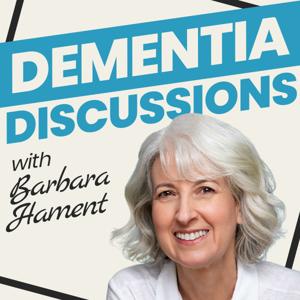
A monthly podcast about dementia. Join your host, Barbara Hament every 2nd Tuesday of the month, as she interviews medical professionals, caregivers, and various experts on how to better understand…

111,865 Listeners
170 Listeners

5,041 Listeners

59 Listeners

2,024 Listeners

10,526 Listeners

19,273 Listeners

1,613 Listeners

10,666 Listeners
47 Listeners

15 Listeners

1,171 Listeners

727 Listeners
8,792 Listeners