
Sign up to save your podcasts
Or

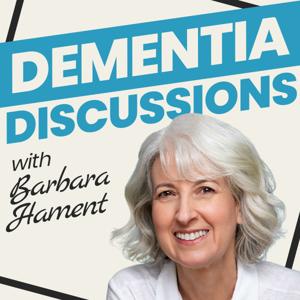


In her first episode with both spouses, today Barbara is joined by Bill and Deborah Coleman. Eight years ago, Deborah was diagnosed with a rare form of Alzheimer’s which affects visual and spatial relationships. An accomplished architect, Deborah had to stop working. “It feels like part of my brain is missing,” she says. They discuss the challenges of managing her disease, and the importance of maintaining a sense of structure and routine.
Today Barbara is joined by social worker and co-facilitator of her Alzheimer’s support group, Monica Moore. Monica is the community health program manager for the Mary S. Easton Center for Alzheimer´s Disease Research at UCLA and co-director training and education activities at UCLA-CADC. They talk about how isolating the world of dementia is for the caretaker, and how it’s helpful to know other people are going through the same thing you are. They discuss how to find the right group and why it’s so powerful to hear someone else tell your story.
When Linda’s mother Grace was diagnosed with Lewy body dementia (LBD) in 2019, Linda felt sadness and relief at the same time. (LBD is a degenerative condition with many similarities to Alzheimer's disease, but it takes hold much more quickly.) LBD is difficult to identify, and now they had an answer for why Grace seemed different -- why she was repeating stories and feeling depressed and bored. Linda and Barbara discuss the difficult transition of moving her parents from their home on the east coast out to California. The plan was for them to stay in Linda’s pool house temporarily before moving into an assisted living facility, but COVID happened, so they’re still there.
If you’d like to learn more about LBD, here is a link to some resources: https://www.lbda.org/
UCLA science professor Harvey Hershman talks to Barbara about the biggest challenges he’s faced as a caretaker. It was in 2010 when Betty, his talented and creative wife of 50+ years, first showed signs of memory loss. Harvey says he was in denial for years -- it wasn’t until joining Barbara’s support group in 2016 that he came to terms with her illness. At first, Harvey was sceptical about the group and what it had to offer. He and Barbara discuss how much he has benefitted from the group and how much can be learned from fellow caretakers.
Bette Wilkes talks to Barbara about her late father-in-law, David Wilkes, who died in 2016. She describes how painful it was to watch a brilliant and proud man lose his mind to dementia. Toward the end, when he no longer cared about the things that had once mattered to him, Bette realized how much harder it is on the caregiver; he was able to just give up, but watching it happen is so hard. She and Barbara also discuss her experience with assisted living, and what she’d do differently if she had to go through it again.
After years of healthy meals and daily exercise, it was a surprise when Rhonda was diagnosed with Alzheimer’s disease. Her adoring husband, Owen, tells the story of their life together, and his strengths and struggles as he navigates her dementia. He and Barbara discuss how caregivers need to educate themselves about the disease and get the help they need.
This week Barbara talks to NYU professor and filmmaker Linda Mills, whose mother was diagnosed with early onset dementia in 2011. Linda describes her mother’s traumatic escape from Nazi Vienna as a small child in the 30s. She and Barbara discuss how hard it is for dementia sufferers to articulate their frustrations -- and how caretakers need to learn how to listen to their loved ones in a new way. They also discuss the complexities of transitioning loved ones out of the home or between different assisted-living situations, and why transitions often evoke decline.
Winston Greene first noticed his wife Pansy was forgetting things and repeating herself in 2010. As the disease progressed, he progressed along with it, taking over more of the little things that Pansy could no longer do. Winston tells Barbara how joining an Alzheimer’s support group saved him by making him feel less alone. They also discuss the important advocacy work the couple does on behalf of the Alzheimer’s Association. They’ve even lobbied in Washington, DC and Sacramento, appearing in person to raise money and awareness. “They hear our story,” Winston says. “It’s so much more powerful coming right from us.”
alzla.org
This week, Barbara is joined by Sara Kaye, Director of Family Services at OPICA. The first Adult Day Program and Counseling Center in Los Angeles, OPICA supports caretakers and patients in every phase of memory loss. They talk about how difficult it is for dementia sufferers to advocate for themselves, and how the Center offers its members a much-needed sense of purpose, structure, and community. They also discuss how geriatric healthcare was forced to evolve pre- and post-COVID, and how OPICA has created programs like OZ -- a virtual program with a monthly subscription for daily programming and activities.
OPICA.org
It’s been a rough five years for Snuffy Walden, whose wife Debby was first diagnosed with cognitive problems in 2016. Snuffy says he’s not a natural caretaker. He talks to Barbara about how stressful it was in the beginning; taking over all the responsibilities of their home while trying to find the right caregivers for his angry and defiant wife. He shares his creative method for helping his wife beat a dependency on alcohol, and how he made it easier for her to accept new caretakers into their home. Snuffy also talks about his decision to move Debby out of their home, and how he’s been working through his feelings of guilt and sadness.
From the publisher's feed
A monthly podcast about dementia. Join your host, Barbara Hament every 2nd Tuesday of the month, as she interviews medical professionals, caregivers, and various experts on how to better understand…

111,865 Listeners
170 Listeners

5,041 Listeners

59 Listeners

2,024 Listeners

10,526 Listeners

19,273 Listeners
1,613 Listeners

10,666 Listeners
47 Listeners

15 Listeners

1,171 Listeners
727 Listeners
8,792 Listeners