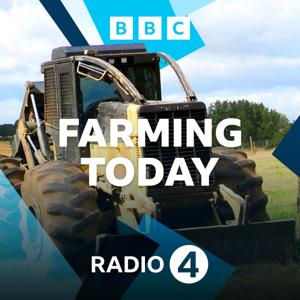
Farming Today

Farming Today

By BBC Radio 4Science
Download on the App Store
  • Favorites

    227

    Followers

  • Typical duration

    14 min

    per episode

Based on Podcast App listening data

Farming Today episodes

  • 07/12/2022 Defra minister questioned by MPs; COP15; abattoir labour.
    DEFRA Secretary Therese Coffey has appeared before the EFRA select committee of MPs for the first time since her appointment. For two hours she faced queries on a wide range of issues from food security to using farmland for solar panels. She gave a clear indication that the Local Nature Recovery scheme could be subsumed into an enhanced version of the current Countryside Stewardship Scheme and said the £2.4 billion promised in the 2019 manifesto would still be available to farmers.
    COP15 - the International convention on biodiversity begins in Montreal in Canada. It set targets to turn around biodiversity loss by 2030, but says that is unlikely to be met. One of the conundrums facing biodiversity improvement is the pressure to grow more food and there is concern that UK food production is dipping. With the emphasis on food security, are environmental considerations being pushed to the back burner at the moment by farmers? The Green Alliance says the answer to food security has to got to have bio-diversity at its heart.
    All week we're talking about abattoirs. Its a crucial part of the meat food chain and yet abattoirs and meat processing plants are facing chronic staff shortages. Last year a lack of butchery workers caused by Covid and Brexit, led to a huge build up of pigs on farms, because they couldn't be processed. That situation has eased, but some companies have spent millions of pounds recruiting staff from countries as far afield as the Phillipines. Abattoirs and processors say they try very hard to recruit locally, but cannot get the staff. Why do British workers shy away from taking up jobs in abattoirs? Martin Anderson a researcher in recruitment at the meat sector at Harper Adams University, has some of the answers.
    14 min
  • 06/12/2022 Devolved powers and rural communities. Small abattoirs
    The Labour Party has launched a commitment to major political reforms which it says would see a transfer of power 'from Westminster to the people of Britain'. Included in the plan titled 'A New Britain', would be the devolution of certain powers to regions and counties. The current government has already announced Cornwall, Suffolk, and part North East England would be granted more devolved powers including extra funding and elected mayors, if the local communities there support it. But what could Labour's devolution plan mean for rural communities? We speak to Mark Shucksmith, Professor of Planning at Newcastle University who's worked widely on rural communities and the economy.
    All week we're looking at abattoirs, large and small. While large abattoirs are finding it difficult to staff their operations, smaller abattoirs say the burden of regulation, which is more expensive on very low throughput, is causing them to close. The future of small abattoirs has been a concern for many farmers for years and Farming Minister Mark Spencer has said he is actively looking at supporting smaller abattoirs, to keep them running. It might not be in time to save some though. The Tottingworth abattoir in Heathfield in East Sussex is earmarked for closure in January. We speak to farmer Guy McNaughton who's been campaigning to save it.
    In Scotland, farmers and crofters in the Western Isles, where producers tend to have small numbers of livestock,  rely on small abattoirs. The abattoir in Stornoway is run and subsidised by the Islands' Council. It's a modern operation and takes stock from the length of the Outer Hebrides. We speak to the people who run it and the crofters who rely on it.
    14 min
  • 05/12/2022 Farm Soil Carbon Code; abattoirs; new road plans
    How much carbon can farms store in the soil, and how should it be measured? Farmers are being encouraged to look at new ways of making money and improving the environment by sequestering carbon, but there hasn't been much agreement on the details. Now Academics from the University of Leeds, businesses and farmers have published a new Farm Soil Carbon Code. The report, funded by the Environment Agency, aims to set some industry standards and help farmers avoid "green washing" or schemes that are meaningless.
    All week we're looking at the state of the UK's abattoirs - from animal welfare to the challenges of finding staff. There are about 245 abattoirs in the UK, slaughtering millions of animals. Government figures for October this year show 173,000 cattle, 1.1 million sheep and 926, 000 pigs were killed. There used to be many more abattoirs, but tighter regulations and economies of scale have seen consolidation. Finding skilled butchers to work in the industry is a challenge and the British Meat Producers Association says big meat processing plants are spending a lot of money recruiting skilled staff from countries as far afield as the Philippines.
    The A1 is one a major route between England and Scotland, but one which is in parts still single carriageway and when it passes through rural Northumberland that can mean slow tractors or lorries - and tailbacks After decades of talk, it seemed relief was in sight with a scheme to dual stretches of the road in the county just awaiting the final go ahead from the Transport Secretary - that's been postponed, twice, recently but a final decision is expected. In the meantime many whose homes, farms and businesses lie on the proposed new route are in limbo.

    12 min
  • 03/12/22 Farming Today This Week: cost of food production, turkeys and avian flu, Rural Payments Agency strike, horses.
    Where's the money? We discuss how much farmers make from the food we buy.
    We hear warnings of turkey shortages this Christmas and pleas from small turkey farmers still in business not to forget them.
    Staff at the Rural Payments Agency look set to strike for a month over Christmas, just as they’re meant to be sending out crucial basic payment cheques to farmers.
    And we're looking at all things equine, hearing how the cost of living crisis and the spiralling cost of keeping a horse is making life difficult for owners of riding schools and stables.
    Presented by Charlotte Smith and produced by Beatrice Fenton.
    25 min
  • 02/12/2022 - Cost of food production, free-range turkeys, equine stud
    Farmers earn less than a penny a pack for much of the food they produce for supermarkets, according to a new report 'Unpicking Food'. The charity Sustain says it’s often less than one per cent. They say supply chains are too long and complex, resulting in producers losing out. For instance, the report says a 480 gram pack of supermarket cheddar costs a dairy farmer £1.48 to produce, yet he receives less than a penny of the £2.50 selling price.
    One of the consequences of the bird flu outbreak has been a flurry of news stories about a shortage of turkeys for Christmas. 'Christmas Dinner at Risk!' warned headlines after the British Poultry Council predicted 'big big shortages', because around half of the free-range poultry grown for this year’s dinner plates has either died or been culled due to the disease. But the widespread publicity about shortages has had unintended and undesirable consequences for some small-scale turkey farmers. Paul White produces around 500 free-range turkeys near Burnley in Lancashire, but he says he's only sold 10 per cent of his birds, when normally he'd have sold half by now. He says customers are panicking about shortages and buying frozen turkeys in supermarkets.
    Equine vet Emma Tomlinson runs a stud and an IVF clinic for horses in Gloucestershire, alongside a mobile equine vet service. On 150 acres of organic pasture - which was once her dad’s dairy farm - she's created an international business, collecting and storing semen from stallions, harvesting eggs and transplanting embryos in mares. It's a top-end service for top-end clients - show jumpers, polo ponies, eventers and dressage horses. She says when she started the business 20 years ago, she was the first commercial embryo transfer service in England.
    14 min
  • 01/12/22 - Rural Payments Agency strikes, farriers
    Staff at the Rural Payments Agency look set to strike for a month over Christmas, just as they’re meant to be sending out crucial Basic Payment cheques to farmers.
    All this week we’re talking about horses. Today we hear from a farrier and discuss why some are promoting leaving horses 'barefoot'.
    Presented by Caz Graham and produced by Beatrice Fenton.
    14 min
  • 30/11/2022 Avian flu and turkeys, forestry, conservation grazing.
    Nearly half the free-range turkeys being produced for Christmas in the UK have been culled or died because of avian flu. that was the message from the poultry industry to the Environment Food and Rural Affairs select committee which has been taking evidence about the spread of bird flu. But one turkey farmer who wants to cull his turkeys early, to avoid the risk, says he is struggling to get hold of the Animal and Plant Health Agency to ensure he can slaughter his birds in time for Christmas.
    It was a year ago that Storm Arwen struck the North East of England and Eastern Scotland causing three deaths, and damaging swathes of woodland and countryside, with power cuts for hundreds of thousands of homes. The first official report showing how much damage was caused to woodland by Storm Arwen is being published by the government . The chairman of the Forestry Commission is calling for landowners to plant more diverse woodlands, that can better withstand climate change.
    Conservationists are using horses to graze land and encourage biodiversity. They say ponies graze in a way which creates a perfect habitat for insects, reptiles and small mammals. Gloucestershire Wildlife Trust says that by using Welsh Mountain ponies on a reserve near Cirencester, they've managed to reintroduce a rare species of butterfly.
    14 min
  • 29/22/2022 Pigs; dwarf wheat; Clydesdale horses
    Pig producers are still facing difficult times. Although the price they receive has gone up, pig farmers are reported to be losing on average £33 per animal. The AHDB estimates the sector's lost £750 million over the past two years. It's now reported that major processors, Cranswick, are spending £4 million recruiting and training 400 butchers from the Philippines for their factories in Hull and Norfolk. There are also reports that the Danish pig herd has dropped to its lowest level in 22 years. and a significant amount of pork is imported into the UK from Denmark.
    As Avian flu continues to hit farmed and wild birds, Wales and Northern Ireland join the rest of the UK this week, in having to house all domestic and commercial poultry.
    Since the 1960's 'green revolution', farmers have been planting wheat which is shorter - or dwarfed varieties - which means they don't fall down in the field. However, climate change and lower water tables mean farmers need to plant wheat deeper in the ground and sometimes these dwarf varieties fail to emerge at all. Now scientists at John Innes in Norwich have isolated a gene which can be bred into new varieties without gene editing, which means the plants are still short but have better early growth to improve emergence.
    Clydesdale horses are a native breed of Scotland, originally bred for heavy farm and industrial work. Now they're now on the Rare Breeds Survival Trusts' "at risk" register. The World Clydesdale Show in Aberdeen brought together more than 300 animals from all over the country, Europe - and even North America. An underground car park was turned into a giant livery yard and vintage machinery store for the week. Nancy Nicolson spoke to the breeders who champion Clydesdales around the world.
    14 min
  • 28/11/2022: The application of science in farming, food in Wales and equine business
    There should be a national body to deliver science more quickly to farmers - that’s the conclusion of a report looking at ways to boost productivity and innovation on UK farms. The Application of Science Report says the current system is too fragmented and the UK is falling behind other countries. Lord Curry of Kirkharle who chaired the working group behind the report tells Charlotte Smith that there is an urgent need for farms to boost productivity.
    Farmers, food producers and campaigners have been discussing a better food system for Wales. Farming Today has a report.
    And we begin a week looking at all things equine, hearing how the cost of living crisis and the spiralling cost of keeping a horse, is making life difficult for owners of riding schools and stables.
    Presenter: Charlotte Smith
    Producer: Alun Beach
    Editor: Dimitri Houtart
    12 min
  • 26/11/22 - The eggs shortage, seasonal workers and game shooting
    The difficulties in the egg supply chain continue, with some supermarkets rationing eggs while others import them from Europe. The British Retail Consortium has been saying avian flu is disrupting supply - but farmers say it's because egg producers are losing money on every egg they sell. They say the cost of the ingredients for feed alone has risen by 90% since 2019 - while they're being paid only 35% more. As a result, many are reducing the number of hens they have or even pausing production entirely. The NFU is calling for Government intervention.
    It's not just the cost of producing eggs that's rising - a report from consultants, Promar International, says the cost of producing fruit and veg in the UK is up by 27% year on year. We hear from one farmer who is concerned about his labour costs for next year. The National Living Wage will be increased from April, and it's not yet clear what that will mean for seasonal workers here on temporary visas, who this year had to be paid above the minimum wage.
    And the Scottish Government is consulting on plans to introduce licences for grouse moors. Under the proposals - which follow a string of illegal killings of birds of prey - there would be new rules on muirburn, or heather burning. We hear from campaigners who want reform, and visit one grouse moor to discuss the future of the industry.
    Presented by Charlotte Smith
    Produced for BBC Audio in Bristol by Heather Simons
    26 min

More shows like Farming Today

Global News Podcast by BBC World Service

Global News Podcast

7,599 Listeners

The Archers by BBC Radio 4

The Archers

1,111 Listeners

From Our Own Correspondent by BBC Radio 4

From Our Own Correspondent

374 Listeners

More or Less by BBC Radio 4

More or Less

880 Listeners

Newshour by BBC World Service

Newshour

1,048 Listeners

Wake Up to Money by BBC Radio 5 Live

Wake Up to Money

55 Listeners

Money Box by BBC Radio 4

Money Box

42 Listeners

The Martin Lewis Podcast by BBC Radio 5 Live

The Martin Lewis Podcast

119 Listeners

In Our Time by BBC Radio 4

In Our Time

5,527 Listeners

The Documentary Podcast by BBC World Service

The Documentary Podcast

1,803 Listeners

6 Minute English by BBC Radio

6 Minute English

1,807 Listeners

Learning English Conversations by BBC Radio

Learning English Conversations

1,041 Listeners

Last Word by BBC Radio 4

Last Word

49 Listeners

Gardeners' Question Time by BBC Radio 4

Gardeners' Question Time

284 Listeners

The Food Programme by BBC Radio 4

The Food Programme

262 Listeners

Scotland Outdoors by BBC Radio Scotland

Scotland Outdoors

246 Listeners

Ramblings by BBC Radio 4

Ramblings

162 Listeners

The Bottom Line by BBC Radio 4

The Bottom Line

36 Listeners

The Plodcast by Our Media

The Plodcast

110 Listeners

Gardening with the RHS by Royal Horticultural Society

Gardening with the RHS

257 Listeners

You're Dead to Me by BBC Radio 4

You're Dead to Me

3,338 Listeners

The Missing Cryptoqueen by BBC Sounds

The Missing Cryptoqueen

1,004 Listeners

Americast by BBC News

Americast

822 Listeners

The Farmers Weekly Podcast by Farmers Weekly

The Farmers Weekly Podcast

14 Listeners

The Bomb by BBC World Service

The Bomb

1,005 Listeners