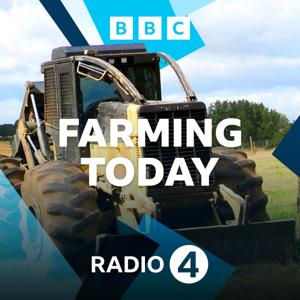
Farming Today

Farming Today

By BBC Radio 4Science
Download on the App Store
  • Favorites

    227

    Followers

  • Typical duration

    14 min

    per episode

Based on Podcast App listening data

Farming Today episodes

  • 26/08/22 - Fertiliser, food prices, reviving a Scottish island
    There's a warning of welfare problems for livestock sent to slaughter, as the supply of carbon dioxide - which is used for stunning the animals - is once again drying up. It could lead to issues on farms as a rising number of pigs and poultry can't be sent to the abattoir. Carbon dioxide is a by-product of the manufacture of ammonia - and the UK's last remaining ammonia plant is no longer going to produce it. CF Industries says the cost of operating is too high, so for now it's going to import ammonia instead, and - as the gas is a by-product of ammonia production - it won't be making CO2. This will also have an impact on the supply and price of fertiliser.
    All this week Farming Today has looking at the causes and consequences of rising food prices. A survey from the Nat West bank reveals that 99 per cent of the 252 farmers they asked say they're facing above inflation price rises on at least one main input - things like energy, fuel, feed or fertiliser. Some are planning to grow less or change what they produce in the coming year to limit their losses. Many had agreed prices with their customers before the rise in energy prices, for instance, and so will be looking for much higher prices next season. We speak to a livestock farmer in Somerset.
    In 2018 the island of Ulva, which sits off the coast of the Isle of Mull and had a population of just five, was bought by a community group for around £4.5 million. Plans to restore the housing on the island are well under way and the population has doubled to ten. But now the island’s farmland has to be brought back to life, too. We hear from the man tasked with doing just that. You can hear the full story on On Your Farm on BBC Sounds.
    Presented by Charlotte Smith
    Produced by Sally Challoner

    14 min
  • 25/08/2022 Grain Trade, Organic Grazing, Rent a Robot
    As we continue our week looking at the causes and consequences of increasing food prices, we hear how the world's largest grain trading companies are making huge profits at the same time as food prices increase rapidly. Some charities are now calling for them to face a windfall tax. We speak to IPES-Food which has been monitoring how recent global events are affecting global food prices.
    How sustainable is the meat you eat? Some people pay more for organic and grass-fed beef and lamb with the belief that it will have less of an impact on the environment, however conservation writer George Monbiot says they are wrong, as it is some of the most damaging. Anna Hill speaks to George Monbiot and Cambridge University professor Donald Broom who says there needs to be a wider assessment of what is meant by sustainable.
    And we’ve reported regularly about the use of robots on farms, from weeding crops to picking fruit. But they are still too expensive for many farmers to think of using. Now the idea of hiring in robots, rather like seasonal workers, is on the cards.
    Presented by Anna Hill
    Produced in Bristol by Natalie Donovan
    14 min
  • 24/08/22 Methane Emissions, Hay Yields, Cost of Food
    The Government is asking the agricultural industry, scientists and the wider public for information on how new types of animal feed can reduce methane emissions from cattle and sheep. For several years farmers have been working with scientists to find out if feeding dairy cattle differently might reduce how much methane they produce - which is a contributor to the warming climate. Now the Government wants to find out what role feed additives are having, and what barriers there are that might prevent the introduction of methane suppressing feed products.
    Research published today forecasts that climate change will reduce spring hay yields by 20-50% between 2020 and 2080. Hay, which is made from dried meadow grass, is used to feed a wide range of livestock, and is a major part of horses’ diets too. In very dry years such as the one we have had this year, hay production is reduced, which has been adding pressure to farmers who are also facing higher fertiliser costs.
    And this week we're looking at some of the reasons behind the rising food prices. Today, Radio 4's "The Food Programme" presenter Dan Saladino finds out how the pressure on supermarkets has been driving up prices.
    Presented by Anna Hill
    Produced in Bristol by Natalie Donovan
    14 min
  • 23/08/22 - Carbon neutral meat processing, labour costs, river pollution
    A meat processing plant is claiming to be carbon neutral, using animal fats from the abattoir process to power the plant. ABP has invested millions of pounds in the vast new site at Ellesmere in the Midlands, using state of the art equipment to make the process as easy as possible for the animals themselves, and providing data and insight for the farmers that supply them.
    A new report by a group of charities says chemicals are the hidden killer in our rivers. WildFish (formerly Salmon and Trout Conservation) worked with the RSPB, BugLife and the Pesticide Collaboration, testing invertebrates from 12 rivers to assess river health. They found the number of species had declined, and are calling on the government to better regulate and police water quality rules. Defra says it is committed to river health, including through the new Environment Act.
    As part of our week looking at the rising cost of food, today we meet a farmer who says a 'perfect storm' of Brexit, war in Ukraine and the effects of Covid, have led to a drastic shortage of labour to work on farms and in food processing, pushing prices up for farmers and consumers.
    Presented by Charlotte Smith.
    14 min
  • 20/08/22 Farming Today This Week: Fishing bans, Seasonal labour and Sheep farming
    Now the UK has left the EU, changes afoot in how farmers are supported by government. Uplands sheep farmers are at the sharp end of these changes, as their incomes often rely heavily on the old Basic Payment Scheme. Many are frustrated with how long it’s taking to get the new schemes up and running - as Caz Graham finds out, speaking to a sheep farmer in the Lake District fells. Meanwhile others say nature and biodiversity would be better off without sheep-farming altogether...
    This week saw revelations about the exploitation of seasonal workers coming to the UK from Indonesia. Caz Graham speaks to Emily Dugan, who wrote about this for the Guardian newspaper; And following a full virtual mailbag of feedback from listeners, we address questions about why international workers are needed in the first place with Tom Bradshaw from the National Farmers' Union.
    And the government's announced plans to create Highly Protected Marine Areas in five locations around the UK coast, where there'll be a total ban on all commercial and recreational fishing. But at one of those sites, around Holy Island off the Northumberland coast, islanders say the move will rip the heart out of their community.
    Presented by Caz Graham
    Produced in Bristol by Lucy Taylor
    26 min
  • 19/08/22 Eco food labelling, sheep on drought resistant lucerne, farm shop closes
    Researchers at Oxford University have come up with a new way of assessing the eco-credentials of supermarket food, which could lead to a new eco-label.
    They’ve estimated the environmental footprint of 57000 food products in the UK, ranging from beef to biscuits to ready meals and fizzy drinks. There’s an algorithm and scoring system to rank food, and ready meals and sausage rolls are logged as 90% less harmful than beef and lamb. The Department for Environment Food and Rural Affairs has welcomed the initiative. But it has its critics who argue it’s too simplistic and that algorithms and broad estimates are too blunt a tool in the complex world of global food.
    All week we’ve been looking at sheep farming. Sheep are typically farmed on land which is no good for growing crops, like the high Lake District fells where we were yesterday, but some farmers are adding sheep into the arable rotation on their farms in order to improve soil health with a bit of natural fertiliser, manage weeds and provide another income stream. But having enough grass for sheep to graze in dry areas like East Anglia can be a challenge - so a sheep farmer in Norfolk has swapped grass for lucerne which is a legume plant valued for its drought tolerance, and used to feed sheep in New Zealand.
    With inflation exceeding 10% for the first time since 1982, more and more small businesses are counting the cost. One family-run farm-shop near York has told us they’re ‘devastated’ at having to close after nearly a quarter of a century serving the community. They simply can’t afford their soaring energy bills.
    Presented by Caz Graham and produced by Beatrice Fenton.
    14 min
  • 18/08/22 Rules relaxed to help farmers feed livestock in drought, sheep in the uplands.
    There’s been some very welcome rain in parts of the country. But the on-going drought has made life very difficult for farmers. Some don’t have enough grass in their fields to feed their livestock and are using up winter stores already. Now George Eustice, the Environment Secretary, has announced that Defra is relaxing some of the rules for agri-environment schemes, meaning farmers who are paid for managing some of their land for nature, like wildflower margins around fields, will be allowed to cut or graze it earlier than usual. But what will this mean for the wildlife it's supposed to support?
    Continuing our week looking at sheep, Caz Graham visits a Cumbrian hill farmer in the northern fells of the Lake District, to hear his frustration at the length of time it’s taking to get the post-Brexit farm support schemes up and running. Farm incomes in the uplands rely heavily on the old EU Basic Payment Scheme, and many are worried how they will survive after they are phased out completely in 2027.
    Sheep farming is controversial, with some conservationists thinking the uplands would be much better off without them. We speak to Professor of Upland Landscapes at the University of Cumbria in Ambleside, Lois Mansfield.
    Presented by Caz Graham and produced by Beatrice Fenton.
    14 min
  • 17/08/33 - A prototype land use framework, seasonal farm safety, rare breed sheep
    The Food, Farming and Countryside Commission, an independent charity, has spent the last three years working with local and national stakeholders, seeking a practical way to develop a Land Use Framework for England. They’ve just published their latest report, and Caz Graham speaks to Tom Burston, the Commission's director of policy and research, to find out more.
    A viral video on social media has sparked discussions around on-farm safety during harvest season. Off the back of the incident where a man apparently stood in front of a combine harvester, Caz speaks to Stephanie Berkeley from the Farm Safety Foundation.
    And Castlemilk Moorits are one of our native sheep breeds, they have a fascinating history and their fleece is highly prized by hand spinners. But with only just over a thousand in the whole of the UK, they’re officially at risk. Mariclare Carey-Jones meets the Welsh Representative of the Castlemilk Moorit’s Society, Vicky Phillips, and her flock.
    Presented by Caz Graham; produced in Bristol by Lucy Taylor.
    14 min
  • 16/08/22 Seasonal workers, Sheep's milk cheese, Drought support
    Claims that seasonal workers from Indonesia have taken on debts of up to £5000 to pick British fruit are to be investigated by the Gangmasters and Labour Abuse Authority (GLAA). An investigation by The Guardian found some were charged by unlicensed recruitment brokers for unnecessary tests and training, and are now struggling to recoup the costs.
    Farmers are to be told this week if they will be allowed to cut and graze areas of land which have been protected under Countryside or Environmental Stewardship schemes. The Rural Payments Agency is planning to relax some of the rules farmers follow for payments since the dry weather has reduced the amount of feed available for livestock.
    Plus sheep milk cheese. It's still relatively rare to milk sheep in the UK. We visit one farm that's aiming to make its operation more sustainable.
    Presented by Caz Graham
    Produced in Bristol for BBC Audio by Natalie Donovan
    14 min

More shows like Farming Today

Global News Podcast by BBC World Service

Global News Podcast

7,599 Listeners

The Archers by BBC Radio 4

The Archers

1,111 Listeners

From Our Own Correspondent by BBC Radio 4

From Our Own Correspondent

374 Listeners

More or Less by BBC Radio 4

More or Less

880 Listeners

Newshour by BBC World Service

Newshour

1,048 Listeners

Wake Up to Money by BBC Radio 5 Live

Wake Up to Money

55 Listeners

Money Box by BBC Radio 4

Money Box

42 Listeners

The Martin Lewis Podcast by BBC Radio 5 Live

The Martin Lewis Podcast

119 Listeners

In Our Time by BBC Radio 4

In Our Time

5,527 Listeners

The Documentary Podcast by BBC World Service

The Documentary Podcast

1,803 Listeners

6 Minute English by BBC Radio

6 Minute English

1,807 Listeners

Learning English Conversations by BBC Radio

Learning English Conversations

1,041 Listeners

Last Word by BBC Radio 4

Last Word

49 Listeners

Gardeners' Question Time by BBC Radio 4

Gardeners' Question Time

284 Listeners

The Food Programme by BBC Radio 4

The Food Programme

262 Listeners

Scotland Outdoors by BBC Radio Scotland

Scotland Outdoors

246 Listeners

Ramblings by BBC Radio 4

Ramblings

162 Listeners

The Bottom Line by BBC Radio 4

The Bottom Line

36 Listeners

The Plodcast by Our Media

The Plodcast

110 Listeners

Gardening with the RHS by Royal Horticultural Society

Gardening with the RHS

257 Listeners

You're Dead to Me by BBC Radio 4

You're Dead to Me

3,338 Listeners

The Missing Cryptoqueen by BBC Sounds

The Missing Cryptoqueen

1,004 Listeners

Americast by BBC News

Americast

822 Listeners

The Farmers Weekly Podcast by Farmers Weekly

The Farmers Weekly Podcast

14 Listeners

The Bomb by BBC World Service

The Bomb

1,005 Listeners