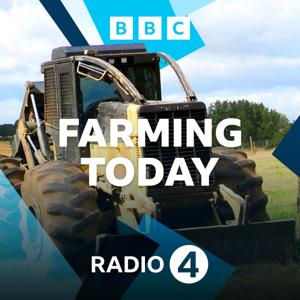
Farming Today

Farming Today

By BBC Radio 4Science
Download on the App Store
  • Favorites

    227

    Followers

  • Typical duration

    14 min

    per episode

Based on Podcast App listening data

Farming Today episodes

  • 24/06/22 - Labour Shortages, Bird Flu, Pollution Fine
    The government doesn’t understand labour shortages in food and farming, and is putting the future of the sector in danger, according to MPs on the Environment Food and Rural Affairs committee who wrote a report on the issues earlier this year. The government has just published its response – rejecting their calls for the Seasonal Workers Scheme to be made permanent, and for the English language requirement for skilled workers in the sector to be lowered. Ministers say they’ve worked closely with industry to respond to labour shortages, pointing to the extra 10,000 visas added to the seasonal worker scheme this year and the plan for an independent review of labour in food and farming.
    Conservationists in Scotland are warning that the current bird flu outbreak could drive a seabird species into extinction in the country. The government has already launched a consortium of experts to tackle this, the largest and longest-running bird flu outbreak.  But it could come too late for Great Skua’s on St Kilda, a series of remote islands off the Scottish mainland. A hundred have been found dead this season, with numbers thought to be down around two thirds over the past three years.
    Dairy Crest has been fined one and a half million pounds after admitting a host of pollution and odour charges. The company, which produces cathedral city cheese and country life butter, admitted 21 pollution incidents at its Davidstow creamery in Cornwall between 2016 and 2021, two of which killed fish in a local river.
    14 min
  • 23/06/22 - Groundswell 2022
    The principles of regenerative agriculture include increasing crop diversity, protecting the soil with ground cover, involving livestock, reducing tillage and keeping living roots in the soil. But why do it? In this programme, Charlotte Smith visits the regenerative agriculture show, Groundswell, to find out.
    Presented by Charlotte Smith
    Produced for BBC Audio in Bristol by Heather Simons
    14 min
  • 22/6/22 - Surplus food, legumes and slug-resistant wheat
    The average annual grocery bill in the UK is set to rise by £380 this year, according to research firm Kantar, which monitors food prices. We ask whether farmers with surplus produce could be the answer in providing food to those who need it and reducing food waste.
    Many farmers take part in on-farm trials to try to find solutions to issues they are facing. We hear about a network whose latest experiment is a slug-resistant wheat.
    All this week on Farming Today we're looking at legumes. As organic farms can't use artificial fertilisers, legumes play a vital part in fixing nitrogen in the soil and we hear how one farm is looking at growing pulses as a cash crop for human food.
    Presented by Anna Hill and produced for BBC Audio by Caitlin Hobbs
    14 min
  • 21/06/22 - Farming Rules for Water, legumes for cattle, red clover for sheep
    Since last Autumn, there’s been confusion about the rules governing muck spreading - outlining when and how much farmers can spread on their land. In March, DEFRA released new guidance, allowing autumn spreading, and also allowing farmers to spread more muck than their soil or crop required. The Salmon and Trout Conservation group believed the guidance given to the Environment Agency was essentially encouraging farmers to break the law. It threatened to take DEFRA to judicial review. Now, the government has altered its guidance. The National Farmers Union says it’s “disappointed", saying the changes "seemingly prevent some farmers applying organic manures to certain fields.”
    Red clover is a legume, which fixes nitrogen in the soil. Its flowers attract bees and its leafy growth provides calcium and protein-rich grazing, but fifty years ago research suggested the legume could reduce fertility in sheep. Now, a group of farmers in the Midlands and Wales have been testing these findings. The field trials are being run by the “Innovative Farmers” - a group that links up farmers with scientists - and the agricultural consultancy, ADAS. The conclusion is that the original findings were wrong and red clover can actually improve fertility rates.
    And a significant part of livestock feed is made of plant-based protein and while feed costs are rising sharply for farmers, a Welsh government funded scheme has been getting more farmers to grow their own cattle-feed ingredients - and that means growing pulses in their fields. We visit one of the farmers who has taken up the challenge.
    Presented by Anna Hill
    Produced for BBC Audio in Bristol by Heather Simons

    14 min
  • Bird Flu Consortium launched
    The Government has launched a consortium of scientists and researchers to tackle the biggest ever outbreak of bird flu. There have already been more than 100 cases - leading to strict restrictions on poultry earlier this year. It's also now killing some sea birds. The task force aims to find out why this outbreak is so bad, and what can be done to contain it in future. However a recent government report found out that the main lab used by teams to tackle these outbreaks is itself run down, with some facilities described as 'not fit for purpose'.
    How do you keep cattle in a field? It may seem an obvious question but the obvious answer – a fence or hedge - is no longer the only one. GPS electric collars keep cattle in the defined area by delivering a small electric shock – less than an electric fence - if the animals stray too close to the digital boundary. The collar also emits a high-pitched tone until they back away. These ‘invisible borders’ are set by farmers using a phone app. We meet a farmer trialling this teach, and hoping it will lead to a much larger regional grazing project.
    This week we're also talking about legumes - plants which produce a pod with seeds inside, so anything from peanuts to beans and peas. Today we hear from a farmer growing fava beans in Yorkshire.
    12 min
  • 17/6/22 - Scottish Good Food Nation bill, salmon and rising farming costs
    Another day, another food strategy, this time for Scotland where Members of the Scottish parliament have just passed the ‘Good Food Nation’ bill. But what do these new food strategies mean for farmers?
    All this week we're talking about salmon on the programme. The Scottish government commissioned a major review into the industry and say that in the coming months they’ll be setting out a ‘vision’ for salmon farming.
    And we hear how farmers in Northern Ireland are responding to rising costs impacting fuel, feed and fertiliser prices, which have all risen sharply over the past few months.
    Presented by Caz Graham and produced for BBC Audio by Caitlin Hobbs
    14 min
  • 16/6/22 - Seasonal workers and salmon farming
    One of the biggest challenges for the UK's fruit and vegetable farms is finding a workforce. In recent years UK farmers have relied heavily on labour from eastern Europe, but leaving the EU means those numbers are now restricted and the war in Ukraine is having a further impact. So the search for seasonal workers is being widened, with people coming from Nepal and Indonesia.
    And all this week on Farming Today we're talking about salmon. We hear about a Scottish-based company hoping to open Scotland’s first ‘semi-closed’ fish farm, which they say could reduce pollution and sea lice in their salmon.
    Presented by Caz Graham and produced for BBC Audio by Caitlin Hobbs
    14 min
  • 15/6/22 - Regenerative farming, wild salmon and seabird deaths
    The Sustainable Food Trust publishes a report today exploring regenerative farming and what impact this might have on self-sufficient food production in the UK.
    This year was one of the worst avian flu outbreaks for poultry and the disease is also hitting sea birds. Hundreds of bird carcasses have been found across Scotland, with more being discovered in North East England, which the RSPB believes could be linked.
    And all this week on Farming Today, we're looking at the salmon industry - from wild populations to salmon farming - and today we hear about the dangers faced by migrating wild salmon which travel from river to sea and back again.
    Presented by Anna Hill and produced for BBC Audio by Caitlin Hobbs
    14 min
  • 14/06/2022 - The National Food Strategy and salmon farming
    The government’s White paper in response to The National Food Strategy, which it commissioned three years ago, has been criticised as lacking long-term planning. One of the main focuses is increasing domestic food production but with issues such as labour shortages and increased costs of production, this could be a challenge.
    This week we’re focusing on salmon - both farmed and wild. Catches of Scottish wild salmon are at a record low, due to rising ocean temperatures, pollution and fish farming. We also hear about a project hoping to revitalise one of the most important salmon rivers in the West Highlands.
    Presented by Anna Hill and produced for BBC Audio by Caitlin Hobbs
    14 min
  • 13/06/22 - salmon and rising egg costs
    All week on Farming Today we're looking at the salmon industry - from wild populations to salmon farming. Scottish salmon is the UK’s biggest fresh food export with overseas sales hitting £614 million in 2021, up 36 per cent from 2020. But it can be a controversial topic and we hear from both sides of the fence - the economics of the industry and the environmental impact and welfare concerns.
    With rising costs of feed, egg farmers are making a loss. There are fears many farmers will just get out of the industry - leaving consumers to pay more.
    Presented by Charlotte Smith and produced for BBC Audio by Caitlin Hobbs
    12 min

More shows like Farming Today

Global News Podcast by BBC World Service

Global News Podcast

7,599 Listeners

The Archers by BBC Radio 4

The Archers

1,111 Listeners

From Our Own Correspondent by BBC Radio 4

From Our Own Correspondent

374 Listeners

More or Less by BBC Radio 4

More or Less

880 Listeners

Newshour by BBC World Service

Newshour

1,048 Listeners

Wake Up to Money by BBC Radio 5 Live

Wake Up to Money

55 Listeners

Money Box by BBC Radio 4

Money Box

42 Listeners

The Martin Lewis Podcast by BBC Radio 5 Live

The Martin Lewis Podcast

119 Listeners

In Our Time by BBC Radio 4

In Our Time

5,527 Listeners

The Documentary Podcast by BBC World Service

The Documentary Podcast

1,803 Listeners

6 Minute English by BBC Radio

6 Minute English

1,807 Listeners

Learning English Conversations by BBC Radio

Learning English Conversations

1,041 Listeners

Last Word by BBC Radio 4

Last Word

49 Listeners

Gardeners' Question Time by BBC Radio 4

Gardeners' Question Time

284 Listeners

The Food Programme by BBC Radio 4

The Food Programme

262 Listeners

Scotland Outdoors by BBC Radio Scotland

Scotland Outdoors

246 Listeners

Ramblings by BBC Radio 4

Ramblings

162 Listeners

The Bottom Line by BBC Radio 4

The Bottom Line

36 Listeners

The Plodcast by Our Media

The Plodcast

110 Listeners

Gardening with the RHS by Royal Horticultural Society

Gardening with the RHS

257 Listeners

You're Dead to Me by BBC Radio 4

You're Dead to Me

3,338 Listeners

The Missing Cryptoqueen by BBC Sounds

The Missing Cryptoqueen

1,004 Listeners

Americast by BBC News

Americast

822 Listeners

The Farmers Weekly Podcast by Farmers Weekly

The Farmers Weekly Podcast

14 Listeners

The Bomb by BBC World Service

The Bomb

1,005 Listeners