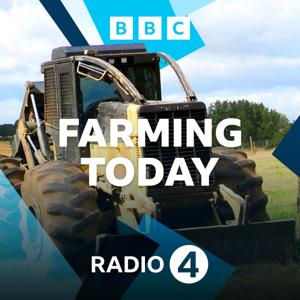
Farming Today

Farming Today

By BBC Radio 4Science
Download on the App Store
  • Favorites

    227

    Followers

  • Typical duration

    14 min

    per episode

Based on Podcast App listening data

Farming Today episodes

  • 05/04/22 IPCC climate report and succession planning
    The Intergovernmental Panel on Climate Change has published its report looking at mitigating the impact of a warming climate, and the role agriculture will have to play to secure all our futures. It points out that global greenhouse gas emissions must peak in just three years’ time, and then reduce by 43 percent by 2030. And it highlights that methane - a major emission from livestock farming - would need to be reduced by a third by the same time.
    We speak to the lead author in charge of the report's agricultural chapter, Professor Jo House, about how crucial land use management is in a global climate challenge. And hear what the Nature Friendly Farming Network think about the report.
    All this week we're talking about leaving farming and with the government offering a lump sum to farmers to leave the industry, to allow the next generation to take up the reins, we hear from arable farmer Henry DuVal about his own succession planning. After realising he couldn't continue to support three generations unless things changed, Henry enlisted his son Ed to take on the family farm. They decided to set up a bio-gas plant, where instead of growing crops for food, their fields are now producing fuel for anaerobic digestion and much of the methane they produce goes into the gas grid or makes electricity.
    Presented by Anna Hill and produced for BBC Audio by Caitlin Hobbs
    14 min
  • 02/04/22 - Farming Today This Week: Australia Trade Deal and food waste
    This week the Trade and Agriculture Commission sent its advice to the Government on what the new Free Trade Agreement with Australia could mean for UK Food and Farming - although the report has yet to be made public. The FTA was signed at the end of last year, when the UK Government hailed it as a ‘world class deal’. The Australians called it a ‘once in a generation deal.. which will give farmers improved access to UK consumers’. But food and farming businesses here have been less enthusiastic - the deal will remove all import tariffs on meat from Australia after 15 years, and farmers point to differences in welfare standards to highlight their fears that cheaper imports produced in ways which wouldn’t be allowed here will undercut UK agriculture. So what do Australian producers think?
    It’s been a week of major price hikes for all of us, and for farmers costs just seem to be going in one direction. The price of fertiliser, in particular, has been rocketing - with farmers telling us they've been asked to pay a thousand pounds a tonne - compared to two hundred and eighty pounds a tonne this time last year. The rise in input costs lead to MPs debating the UK's food security in Westminster Hall this week. But while much of the focus was on production, the latest figures from the food waste charity, WRAP, estimate just over 3% of food harvested is wasted before it gets to consumers. We hear from a farmer having to compost 500 tonnes of beetroot - and find out about a new app that hopes to solve the problem once and for all.
    Presented by Caz Graham
    Produced for BBC Audio Bristol by Heather Simons
    26 min
  • 01/04/22 - Upland farmers, trade deals and Australian beef farmers
    England’s upland farmers are facing an uncertain future despite increases in payments announced this week. The payment under the Sustainable Farming Initiative for moorland was £6.45 a hectare, which has now been increased to £10.30 a hectare, plus an added £6.15 a hectare for common land - so a possible increase of £16.45. However the Foundation for Common Land warns that the transition from the EU system of direct payments to a public money for public goods approach will leave many farming on fells and moorland significantly worse off.
    All week we’ve been looking at the free trade deal agreed between the UK and Australia and its impact on food and farming here. We consider what it might mean for the UK's beef industry and we hear from the BBC’s Global Trade Correspondent Dharshini David about other trade deals currently in negotiation.
    Presented by Charlotte Smith and produced for BBC Audio by Caitlin Hobbs
    14 min
  • 31/03/22 - Fertiliser, food waste and Australian sheep farmers
    With fertiliser prices rising, Defra Secretary George Eustice responds by delaying new restrictions on some, and clarifying the rules on muck spreading. And we hear more detail on have also been released about the Sustainable Farming Incentive or SFI - part of the new system of farm payments being introduced in England.
    The food waste charity WRAP estimate that just over 3% of food harvested is wasted before it gets to consumers - and once in our homes we waste far more. With MPs discussing food security and prices in a Westminster Hall debate called for by the SNP, we hear from farmer Will Woodhall who grows spring onions and beetroot alongside cereal crops - but who this year hasn’t been able to sell all his produce.
    The Trade and Agriculture Commission deliver their advice on the Australia-UK trade deal to ministers today - looking at the impacts of the deal on UK food and farming - and that’s what we’ve been doing all week. Farmers here are worried they will be exposed to imports of cheaper meat, and in particular lamb meat, which is produced in ways that aren’t allowed here. Peter Hadfield has been in Merriwa to hear what Australian sheep farmers make of it.
    Presented by Charlotte Smith and produced by Caitlin Hobbs
    14 min
  • 30/03/22 - New fertiliser technology, grassland sulphur use and whisky exports to Australia.
    The huge hike in fertiliser prices has prompted DEFRA to set up an Industry Fertiliser Roundtable, chaired by Farming Minister Victoria Prentis. The group will discuss the impact a shortage of fertiliser will have on UK farms and also look at alternatives. We hear from one company working on just that - CCM Technologies makes pellets of fertiliser out of products like manure or digestate, combined with waste carbon dioxide and ammonia from industry.
    A farming trial backed by the Welsh Government has found that applying fertilisers enhanced with selenium and sulphur can increase grass yield by up to 11%. Tests were carried out on three farms in Wales, where soils are often deficient in those minerals.
    And until now, exports of Scotch whisky to Australia have been subjected to a 5% tariff. But the new UK-Australia Trade Deal will see that removed - so how are distillers responding to the change?
    Presented by Anna Hill
    Produced for BBC Audio in Bristol by Heather Simons
    14 min
  • 29/03/22 - Chicken muck, seed potatoes, Australian dairy and NI climate
    With the price of fertiliser reaching new heights, one alternative is to use manure - or organic waste. Sarah Godwin and her husband run a dairy, arable and egg enterprise in North Wiltshire and have been trialling using out their own waste on their farm, causing them to look at their chicken poo in a new light.
    This week on Farming Today, we're looking at the impact of the Australia and UK trade deal. Before the UK joined the EU in the 1970’s, the UK was Australia’s largest dairy export market - they shipped around 55,000 tonnes of dairy products, including cheese and milk powders, to the UK each year. But things have changed. UK customs data shows we imported almost 1.5 million tonnes of dairy products in 2020, mostly from the EU. We hear from Dairy Australia, the levy body for the country’s dairy farmers, about which dairy products they plan to import.
    And a planned shipment of seed potatoes from Scotland to Russia has been shelved after criticism that it went against Scottish Government advice to ‘dis-invest’ in trade with Russia, following the invasion of Ukraine.
    Presented by Anna Hill and produced in Bristol by Caitlin Hobbs

    14 min
  • 26/03/22 Farming Today This Week: Seed potatoes going to Russia, Manure to replace fertiliser, Lambs
    A large consignment of seed potatoes is being sent from Scotland to Russia, despite a plea from the Scottish Government for businesses to 'disengage from trade with Russia' in response to the war in Ukraine.
    High artificial fertiliser prices remain a worry for farmers. One farmer in Lancashire is reported to be spending a lottery win on it. The cost has quadrupled with some farmers saying they’re being asked to pay around £1,000 a tonne, and there are warnings that the knock-on effect will be less, and more expensive grain. But the Defra Secretary George Eustice says there is a longer term solution: manures.
    And to celebrate spring actually springing over much of the country this week, complete with lambs, Farming Today has been talking sheep.
    Presented by Charlotte Smith and produced by Beatrice Fenton.
    26 min
  • 25/03/22 - NI badger cull, shellfish deaths and lamb imports
    There is to be a badger cull in Northern Ireland as part of measures to control TB in cattle. Announcing the move the Agriculture Minister, Edwin Poots, said the cull would be only in targeted areas and will not be a wholesale removal of badgers. Farmers in Northern Ireland have been critical of the time it has taken to get this decision, but wildlife charities said the policy is unjustifiable and morally wrong, and legal challenges have already been issued against the proposed cull.
    Fishers in Whitby say they’re unsure the industry will ever recover after widespread shellfish deaths along the North East Coast of England last winter. As we’ve reported they’re unhappy with official explanations about what's causing the problem - but now the Department for Environment, Food and Rural Affairs has closed its investigation into the deaths for a second time. It says surveys done this month found healthy catches of crabs and lobsters - but fishermen are still concerned.
    And talks between Canada and the UK about a Free Trade Agreement are underway. Canada is the world’s fifth largest exporter of agricultural and agri-food products.
    Presented by Charlotte Smith
    Produced for BBC Audio in Bristol by Heather Simons
    14 min
  • 24/03/22 - The Welsh NVZ, manure instead of fertiliser and selling lamb direct
    A farmer in Lancashire is reported to be spending a lottery win on...fertiliser! The cost of artificial fertilisers has quadrupled this year - some farmers tell us they’re being asked to pay around £1,000 a tonne. The DEFRA Secretary George Eustice says the long term solution is using more manure. We ask an expert whether that could work.
    Meanwhile, farmers in Wales face stricter rules on the use of manures - and yesterday NFU Cymru lost its legal bid to change that. The High Court ruled the Welsh Government had not acted illegally in making the whole country a Nitrate Vulnerable Zone to tackle water pollution.
    And though over the past few years as a country we’ve been eating less lamb, we visit a farm where a meat box scheme has uncovered a new enthusiasm for the meat.
    Presented by Charlotte Smith
    Producer for BBC Audio in Bristol by Heather Simons
    14 min
  • 23/03/22 - Seed potatoes sent to Russia, money for tree planting and a new breed of sheep
    A large consignment of seed potatoes is being sent from Scotland to Russia, despite a plea from the Scottish government, for businesses to ‘disengage from trade with Russia’ in response to the war in Ukraine. The shipment by Saltire Seed is believed to be for Pepsi-Co, which grows potatoes in Russia and owns Lays Crisps.
    We find out about the England Woodland Creation Offer which will provide “financial incentives to help you plant the right tree, in the right place, for the right reason.”
    And a group of farmers in South West England have bred a new type of sheep which don’t need shearing, they lamb safely outdoors and are parasite resistant. They are called the "Exlana" - it’s Latin for "without wool". Under lockdown the group started selling their animals online, and they’ve even been exporting their genetics to New Zealand.
    Presented by Anna Hill
    Produced for BBC Audio in Bristol by Heather Simons
    14 min

More shows like Farming Today

Global News Podcast by BBC World Service

Global News Podcast

7,599 Listeners

The Archers by BBC Radio 4

The Archers

1,111 Listeners

From Our Own Correspondent by BBC Radio 4

From Our Own Correspondent

374 Listeners

More or Less by BBC Radio 4

More or Less

880 Listeners

Newshour by BBC World Service

Newshour

1,048 Listeners

Wake Up to Money by BBC Radio 5 Live

Wake Up to Money

55 Listeners

Money Box by BBC Radio 4

Money Box

42 Listeners

The Martin Lewis Podcast by BBC Radio 5 Live

The Martin Lewis Podcast

119 Listeners

In Our Time by BBC Radio 4

In Our Time

5,527 Listeners

The Documentary Podcast by BBC World Service

The Documentary Podcast

1,803 Listeners

6 Minute English by BBC Radio

6 Minute English

1,807 Listeners

Learning English Conversations by BBC Radio

Learning English Conversations

1,041 Listeners

Last Word by BBC Radio 4

Last Word

49 Listeners

Gardeners' Question Time by BBC Radio 4

Gardeners' Question Time

284 Listeners

The Food Programme by BBC Radio 4

The Food Programme

262 Listeners

Scotland Outdoors by BBC Radio Scotland

Scotland Outdoors

246 Listeners

Ramblings by BBC Radio 4

Ramblings

162 Listeners

The Bottom Line by BBC Radio 4

The Bottom Line

36 Listeners

The Plodcast by Our Media

The Plodcast

110 Listeners

Gardening with the RHS by Royal Horticultural Society

Gardening with the RHS

257 Listeners

You're Dead to Me by BBC Radio 4

You're Dead to Me

3,338 Listeners

The Missing Cryptoqueen by BBC Sounds

The Missing Cryptoqueen

1,004 Listeners

Americast by BBC News

Americast

822 Listeners

The Farmers Weekly Podcast by Farmers Weekly

The Farmers Weekly Podcast

14 Listeners

The Bomb by BBC World Service

The Bomb

1,005 Listeners