
Sign up to save your podcasts
Or



Based on Podcast App listening data
It's a familiar idea that batteries store electricity and now a new European project, called Water Grid, is encouraging farmers to create ponds as 'water batteries' for storing rainwater, to draw on in times of drought. Researchers think they could even be used to top up rivers. The Water Grid project will run across 13 European countries, and the 22 partners involved are being coordinated by the Westcountry Rivers Trust.
We visit the National Perry Pear Collection in Gloucestershire, as it's the season for pressing fruit to make perry. Thecollection has just won an award from the Campaign for Real Ale and Cider.
The sugar beet campaign, or harvest, is underway but farmers are looking ahead to lower prices next year.
Presenter: Anna Hill
An independent review of the way pigs are slaughtered has called for the use of carbon dioxide gassing to be prohibited, because it causes too much distress and pain to the animals. 90% of pigs reared in England and Wales are slaughtered this way. The report was carried out by the Animal Welfare Committee, an independent expert committee from the Department for Environment, Food and Rural Affairs, the Scottish government and the Welsh government. It recommends that argon gas should be used instead. We speak to vet Dr Jane Downes, who led the Animal Welfare Committee at the time the report was prepared. We also speak to the National Pig Association.
All week we're looking at beer and cider. One of the biggest cider producers in the UK, producing 65 million litres every year, is Westons, based in Herefordshire. The business started in 1880, and now works with 180 apple growers and orchard owners in Gloucestershire, Worcestershire and Herefordshire – the heart of apple country. We visit the production line.
Presenter: Anna Hill
The Government’s bill to ‘get Britain building’ returns to the House of Lords for its report stage. The Planning and Infrastructure Bill gained more than sixty Government amendments earlier this month to streamline the process and give ministers more power to grant permission for big planning projects. However conservation campaigners are not happy about the developments, and the Government's rhetoric.
All this week we’re taking a look at the beer and cider industry, and the UK growers who make it possible. There are around 45 hop growers across the country, around half of them in the West Midlands. We speak to a farmer in Herefordshire as he harvests his crop and ask the Campaign for Real Ale about the market for home-grown hops.
Presenter = Charlotte Smith
There will be no U-turn on the Government’s plans for inheritance tax for farmers, according to the Farming Minister. Dame Angela Eagle says planned changes will go ahead in next month’s budget, in spite of press reports to the contrary.
"Too little too late", that’s what we’re hearing from some farmers who’ve already ploughed up and planted fields that were being farmed for nature. They say this is because the Government took too long to come up with an extension to their environmental funding.
Red Tractor, the UK’s largest farm assurance scheme, has had a TV advert banned by the Advertising Standards Authority. The watchdog says the advert exaggerated the environmental credentials of the scheme and misled customers.
Presented by Charlotte Smith and produced by Beatrice Fenton.
There will be no U-turn on the government’s plans for inheritance tax for farmers, according to the Farming Minister. Dame Angela Eagle says planned changes will go ahead in next month’s budget, in spite of press reports to the contrary. We also ask her about the Sustainable Farming Incentive. Some farmers are furious because they say the latest scheme, which has only just opened, comes far too late for those farmers who were looking for a replacement for agreements under a previous agri-environment scheme, the Countryside Stewardship scheme, which ends on 31st December.
Several councils in England and Wales are carrying out reviews of their farm estates at the moment, including Powys, Dorset and Cornwall and all week we've been reporting on the issues affecting farms owned by councils. According to the CPRE, the countryside charity, there were 6,700 individual council holdings back in the 1980s, but that number has shrunk by almost two thirds, down to fewer than 2,300 now. Today we hear from a livestock farmer in Cornwall who's concerned about what could happen once Cornwall Council’s consultation comes to an end.
Nearly a quarter of a million trees have been planted across the Outer Hebrides as part of the ‘Western Isles Croft Woodland Project’. It aims to create a mosaic of small woodlands on under-used crofts.
"Too little too late", that’s what we’re hearing from some farmers who’ve already ploughed up and planted fields that were being farmed for nature. They say this is because the government took too long to come up with an extension to their environmental funding.
A House of Lords Committee says the Windsor Framework, the post-Brexit agreement between the UK and EU that’s meant to simplify trade between Great Britain and Northern Ireland, is "overwhelmingly complex".
Powys Council has just closed a consultation on plans for a new farm policy, which includes the possibility of selling some of its council owned farms. The Council says incomes are too low and maintenance costs too high on some of its farms, but local council farm tenants hope farming will remain a key part of council plans.
Presented by Caz Graham and produced by Beatrice Fenton.
Some milk processors have made dramatic cuts to the price they pay farmers, citing a global oversupply. Some of you emailed us to ask why prices for dairy products, like butter, still seem to be going up in the shops? Dairy analyst Chris Walkland explains how global commodity prices influence the price UK farmers receive.
We continue our exploration of the role the County Council Farm system plays in helping new farmers into the industry. Today, what it takes to win a competitive application process for, often oversubscribed, council farm tenancies.
Presenter: Anna Hill
A new report says that the presence of microplastics in seafood has been overstated by the media. The paper, by researchers at Heriot-Watt University, says although media reports tended to concentrate on seafood contamination, the levels of microplastics in seafood is no greater than in other foodstuffs. It also says that dust and indoor air contain more microplastic particles than food.
All week, we're taking a closer look at county council tenant farms. These farms have traditionally been a first step on the ladder, often for young aspiring farmers to get a foothold in agriculture. However county council tenancies have become harder to find and in recent years many cash-strapped councils have sold off a significant number of their farms. Not so in Staffordshire, where one young farmer Tom Chapman is building up his herd of sheep after securing a tenancy.
Farm machinery manufacturers who export to the United States say their trade is being made 'almost impossible' after tariffs on steel and aluminium were extended. Originally tariffs on steel and aluminium were just for bulk items, but now, if a UK-made tractor is exported to the US, every steel or aluminium component - down to individual nuts and bolts - has to be taxed on the basis of where it came from, so the correct overall tariff payment is made. We speak to the Agricultural Engineers Association.
Presenter = Anna Hill
England's current approach to planning for floods is "underpowered and fragmented". That's according to a report from MPs which is published today.
We've been talking to all the major political parties over the past few weeks, during party conference season. The SNP conference continues in Aberdeen today and with elections to the Scottish Parliament in May there is a lot to discuss.
Over the past few decades many councils have been reassessing their property portfolios and council farms have been sold off. This week we'll look at why, and why some feel that's a mistake.
Presented by Charlotte Smith and produced by Beatrice Fenton.
We report on the increasing amounts of waste dumped in the countryside and how to tackle it.
As party conference season continues, we're hearing from most of the major parties on their farming and rural policies. Agricultural policy is devolved and with elections for the Welsh Parliament in May next year, Plaid Cymru's conference this weekend may well be seen as a launch for that election campaign.
Farmers whose land was compulsorily purchased say they're frustrated that they still can't buy it back.
Presented by Charlotte Smith and produced by Beatrice Fenton.
From the publisher's feed
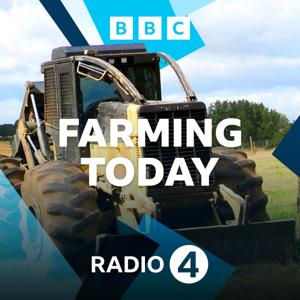
The latest news about food, farming and the countryside
Ranked by our users in the last 21 days

7,593 Listeners

1,084 Listeners

374 Listeners

880 Listeners

1,050 Listeners

55 Listeners

42 Listeners
121 Listeners

5,526 Listeners

1,804 Listeners

1,802 Listeners

1,037 Listeners

49 Listeners

285 Listeners

262 Listeners

245 Listeners

164 Listeners

36 Listeners

110 Listeners

256 Listeners

3,157 Listeners

1,004 Listeners

820 Listeners

14 Listeners

1,005 Listeners