
Sign up to save your podcasts
Or



Based on Podcast App listening data
Politicians have been setting out their stall to farmers at the NFU Conference in Birmingham. With a general election on the horizon, we hear from all three main political parties: Conservative farming minister Mark Spencer; shadow environment minister Daniel Zeichner; and Liberal Democrat spokesperson on environment, Tim Farron.
Presenter = Anna Hill
1500 farmers from across England and Wales have gathered in Birmingham for the National Farmers' Union annual conference. President Minette Batters is standing down after six years at the helm, and Prime Minister Rishi Sunak told farmers "I've got your back". He arrived with a raft of announcements including an annual national food security index, measuring the amount of food grown in the UK, a review of transparency in the poultry supply chain, an annual "farm to fork" summit in Downing Street, and increasing payments for managing environmental agreements.
Presented by Anna Hill and produced by Beatrice Fenton.
The First Minister of Wales says it shouldn't be up to farmers to decide how subsidy money is spent. Mark Drakeford was responding to the ongoing farmer protests in Wales over the Sustainable Farm Scheme. It will see direct subsidy payments phased out and farmers will have to plant 10% of their land with trees while putting a further 10% into wildlife habitats to qualify. We also speak to English farmers protesting at Dover.
The government is giving a £220 million funding package to English farmers. The Prime Minister is to make the official announcement at the National Farmers Union Conference. The money will be targeted at grants for technology and productivity schemes. He will also highlight fairness in the supply chain, with new rules for the dairy, pig and egg sectors and the announcement of a review of the poultry sector. Also the 'Farm to Fork Summit' is to become an annual event. The Liberal Democrat's have dismissed the move as a 'cynical pre election giveaway' which won't win back farmers.
An independent review into the Red Tractor scheme says that while it is sound and has not breached its own rules, there has been a failure of communication. This is the first of two reviews of the scheme and looks at the organisation's governance. A further report into Red Tractor's future will be published later. We speak to Red Tractor chair Christine Tacon.
Farming's next generation is something we're looking at all this week, from the challenges they face to their hopes for the future. The Duncan family run three successful farms close to Loch Lomond. Three of the family's four children now work in the farm operation, and plan to make it their home and livelihood long-term.
Presenter = Charlotte Smith
The return of the Northern Ireland Assembly means there's a new man in charge at the Department of Agriculture, Environment and Rural Affairs, or DAERA. We speak to Andrew Muir about his priorities.
After leaving the EU, the four nations of the UK have decided on different payment systems for farmers. In England the Environmental Land Management Scheme, or ELMS, has several parts to it. The Sustainable Farming Incentive or SFI is part of that. It pays farmers for doing environmental work, like planting hedges or improving soils. Some English farmers felt there was little ‘incentive’ to join it, because payments were too low. However in January that changed. 50 new things farmers could do to attract money were added to the scheme and some payments were increased. We discuss what those were with the Farming Minister Mark Spencer.
All week we've been looking at the business side of running a farm. Farmers have long argued that they deal with far too much paperwork. One company set up to help them with form filling says it’s been inundated with requests and believes many farmers feel burdened and isolated by the sheer amount of red tape.
Diversification is often key to a successful farm business. According to DEFRA, 69% of farm businesses were engaged in some kind of diversification in 2022-23. We visit a small upland farm in the Lake District to find out how diversification has worked for them.
In the Scottish Highlands vast tracts of land and whole estates are being bought as ‘green investments’. Tree planting and rewilding are used to offset carbon. A report for the Scottish Government has tried to quantify the impact of this on rural communities.
Presenter = Charlotte Smith
Another small abattoir has announced it’s to close its doors for good. McIntyre Meats in Bainbridge in the Yorkshire Dales has been working with local farmers for the last 23 years and is just the latest small abattoir to decide to call it a day.
Graham Bottley produces Mutton from his flock of Swaledale sheep in the Yorkshire Dales, and until now, has been using McIntyre Meats regularly
We are looking into the business side of farming this week, now for most non-farming companies or organisations, training, appraisal and continuing professional development is the norm. But if you’re a small family farm business, already dealing with rising costs, increasing paperwork, as well as the unpredictability of markets and weather, training courses can come a long way down the priority list.
In the Scottish Highlands, rewilding and planting trees for carbon capture are increasingly attractive for big new landowners, but what impacts do these activities, taking over vast tracts of the countryside, have on the communities around them? A report for the Scottish Government tries to quantify those impacts and not all are positive. We visit affected communities and speak to the author of a new report.
All week we've been looking at the business side of farming. According to DEFRA, 69% of farm businesses were engaged in some kind of diversified enterprise in 2022-23. Having an extra income strand can make the difference between a viable farm and one that can’t pay its way, so nowadays the business of farming often means looking at what other businesses a farm can grow. Branching out can give both farm and farmers a whole new lease of life as we find out on a small upland farm in Cumbria.
Presenter = Caz Graham
As more farmers take up payments to farm in a more environmentally-friendly way, will that mean growing less food? After leaving the EU, the four nations of the UK have decided on different payment systems for farmers. In England, the Environmental Land Management Scheme, or ELMS, has several parts to it - the simplest being the Sustainable Farming Incentive or SFI. Some farmers said there was little incentive to sign up, because payments to do environmental work were too low. However, in January that changed and some payments were increased. We unpick the details of the scheme and find out who the winners and losers are. We also talk to the Defra farming minister, Mark Spencer.
Some farmers in Northern Ireland fear a new scheme designed to reduce emissions from livestock will put slower-growing breeds of cattle at a disadvantage. They are concerned it will make rearing grass-fed or native breed cattle less viable.
Presenter: Anna Hill
After two years without a government, Northern Ireland's got a minister for agriculture and the environment again. We speak to Andrew Muir, who's just started his new job at DAERA - the Department of Agriculture, Environment and Rural Affairs. His in-tray is bulging with a raft of issues: farming subsidy changes, environmental concerns and bovine TB, among other things. Anna Hill speaks to the Ulster Farmers' Union about what they want from the new minister, and also to Northern Ireland Environment Link - a coalition of conservation groups.
All week we’re looking at the business of farming. Paperwork is a big part of the job and one firm which was set up to assist farmers with their form-filling says it’s been inundated with requests for help. The Herefordshire-based company says many farmers feel burdened and isolated by the sheer amount of red tape involved in the modern farming industry.
Presenter: Anna Hill
Today Biodiversity Net Gain becomes the law in England. It means that any developer building ten or more homes must not just replace the biodiversity they've destroyed, but have to show a 10% net gain over what was there before. The net gain can be on the housing estate, or builders can buy a biodiversity unit from a landowner. If that's not possible they can get a (more expensive) biodiversity credit from the Government, which will then invest in habitat projects across the nation.
Farming is going through a tough time; prices, the supermarkets, massive changes in public subsidy systems, endless rain, or drought. The word many use a lot is 'challenging' and this week we're going to look at the challenge of running a farming business. We start with an overview from Martin Hanson, Head of Agriculture at HSBC UK.
A rescue plan for nature is being drawn up in The Ashdown Forest in Sussex. The project could see rare plants and animals including nightingales, turtle doves, pine martens and beavers being restored to the landscape.
Presented by Charlotte Smith and produced by Beatrice Fenton.
From the publisher's feed
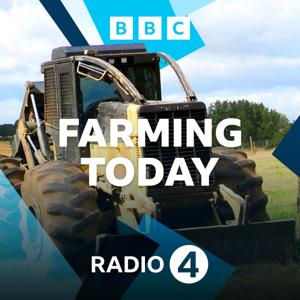
The latest news about food, farming and the countryside
Ranked by our users in the last 21 days

7,599 Listeners

1,111 Listeners

374 Listeners

880 Listeners

1,048 Listeners

55 Listeners

42 Listeners
119 Listeners

5,527 Listeners

1,803 Listeners

1,807 Listeners

1,041 Listeners

49 Listeners
284 Listeners

262 Listeners

246 Listeners
162 Listeners

36 Listeners
110 Listeners
257 Listeners

3,338 Listeners

1,004 Listeners

822 Listeners

14 Listeners

1,005 Listeners