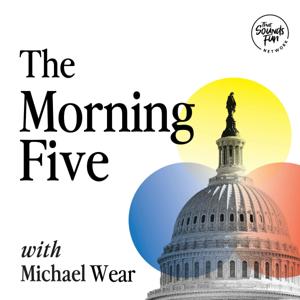
For the Good of the Public | The Morning Five

For the Good of the Public | The Morning Five

By The Center for Christianity & Public LifeBusinessNewsGovernmentNon-Profit
Download on the App Store

For the Good of the Public | The Morning Five episodes

  • Episode 9: DCCC polling and "anti-ambition"
    Wear is the Love, Episode #9

    This week, we chat about the recent polling commissioned by the DCCC and reported by Politico (article here) that shows how Democrats, especially in vulnerable districts, are faring against Republican culture war attacks (spoiler: not well!). After, we discuss the NYT Magazine piece in the first Top 5 on what might be driving “anti-ambition” across American workplaces.

    Episode notes:

    IFYC report: “Evangelicals and Interfaith Engagement: Assessing Evangelical Resources, Motivations, Hesitancies, Hopes”

    IFYC webinar registration, 2/21 at 1pm EST/12pm CT

    Ezra Klein interview with David Shor (NYT)

    “The Digital Gap Between Rich and Poor Kids Is Not What We Expected” (NYT)

    The Top 5 articles for your week:

    “The Age of Anti-Ambition” (NYT Magazine)

    Because the “Great Resignation” isn’t happening just because of burnout or because some would like a better title or salary. There are multiple factors causing workers to ask “ what is all this striving for?”

    “A Child’s TikTok Stardom Opens Doors. Then a Gunman Arrives.” (NYT)

    Because children and their parents are being given choices: pursue fame and fortune on social media apps and risk all kinds of negative consequences, or limit the potential for stardom, income and avenues of self-expression that comes with hyper-connectivity and virality. In a world where it seems there are no gatekeepers to attracting the attention of millions, how is one expected to turn down the opportunity to seek their affirmation and be validated by it? Our society has few ready, constructive answers to turn to when answering these kinds of questions.

    “On Attentional Norms” (Hedgehog Review)

    Because Alan Jacobs looks at the norms we’re creating on Zoom, that is how little time and attention we give to meetings and speakers. “But Zoom, it seems to me, is a medium that offers constant permission to be distracted. And while the norms of any particular moment are in a sense not objectively good or bad, they can be good or bad in relation to certain human purposes. The purposes I have in my classes are not compatible with the attentional norms that we’ve learned to employ in our teleconferencing pandemic.”

    “COVID and the Brittle West” (The New Atlantis)

    Because we’re at the point in the pandemic — two years in — where we can start asking questions about when the US’s public health policy succeeded in doing its job, and when it failed. And this essay argues that the West’s fixation on data and personal choice caused reactive rather than proactive policy decisions. “Our need to fully justify action by politicians and public officials — a basic requirement of the rule of law — tended to reduce their ability to make decisions in a moment of emergency, when full justification by data, let alone publicly avail
    ---
    Support this podcast: https://podcasters.spotify.com/pod/show/wear-we-are/support

    Learn more about your ad choices. Visit megaphone.fm/adchoices

    47 min
  • Episode 8: Let your kids be bad at things
    Wear is the Love, Episode 8

    This week’s episode is chill (pun intended, which will make sense when you listen to the episode) because Michael just got back from a lot of travel. We enjoyed discussing The Atlantic article featured below about parenting and perfectionism.

    Episode notes:

    Get your tickets to the That Sounds Fun Tour here. February 17th in Philadelphia, 730pm

    As always, if you like this podcast, like this newsletter, you should consider supporting us!
    The Top 5 articles for your week:
    1. “Let Your Kids Be Bad at Things” (The Atlantic) Because this essay is a bit more nuanced than its title, and it’s pretty hilarious, but it asks the question: do we ever stop caring about what other people think?
    2. “Dear Sweethearts: Don’t tell me I ‘GOT THIS’” (Washington Post) Because Christine Emba tells it like it is: toxic positivity from the makers of sweethearts and M&Ms won’t solve our societal ills.
    3. “The search for lost slave ships led this diver on an extraordinary journey” (National Geographic) Because some estimate around 1,000 ships sunk during the mid-Atlantic slave trade, and one diving group is helping to preserve artifacts [and history] from these ships.
    4. “Grow Deep, Not Wide” (Comment Magazine) Because the entire new issue of Comment Magazine is beautiful and ruminates on the idea of “gift logic,” but my favorite essay in the bunch is from Joy Ike on what it was like to open up free painting on her porch in her Philadelphia neighborhood.
    5. “How to Make a Deal With Putin” (Foreign Affairs) Because Michael McFaul, a former ambassador to Russia proposes this bold solution to the current Ukraine crisis because it could de-escalate tensions and provide a door for the energizing of many other US-Russia agreements: “Biden should seize the diplomatic offensive and counter with a comprehensive, grand bargain for enhancing European security. Call it “Helsinki 2.0.” This agreement could refresh and modernize the Helsinki Accords signed during the Cold War, which stabilized the continent even as U.S.-Soviet competition grew in other parts of the world. It could resuscitate and amend defunct arms control agreements and provide a bigger framework for European security, and in the process help solve the issues surrounding Ukraine.”

      ---
      Support this podcast: https://podcasters.spotify.com/pod/show/wear-we-are/support

      Learn more about your ad choices. Visit megaphone.fm/adchoices

      31 min
    6. Episode 7: Boris Johnson & Larry Hogan
      Wear is the Love, Episode #7

      This week’s episode was recorded early due to Michael’s travel, and so instead of talking Top 5, we caught up on politics, including the latest scandal for UK PM Boris Johnson and how COVID has changed some conventional political wisdom on scandals. We also chatted about Maryland Governor Larry Hogan’s statements that he might run in 2024, and how leaders can still change the trajectory of party politics, especially for the GOP.

      Episode notes:

      Former PM Theresa May’s comments at Parliament (CNN)

      More on the PM’s scandal (The Independent)

      Hogan’s appearance on CBS about a potential 2024 presidential run

      The Top 5 articles for your week:

      “The moral calculations of a billionaire” (Washington Post)

      Because one billionaire looks at where he’s come from, where he is now, and how he struggles with stewarding his fortune.

      “Is This Still an Emergency?” (The New Atlantis)

      Because this article on pandemic polarization is a great chaser to last week’s Top 5 and podcast feature on Thomas B. Edsall’s article. M. Anthony Mills observes: “…two years after the pandemic began, quite like two years after 9/11, today we are no longer united around a common purpose but divided. We are divided over the nature of the threat, what it will take to defeat it, and what defeating it even means. We are a long way from the tornado politics that seemed to characterize our pandemic response in the winter of 2020, and we are not likely to go back.”

      “What College Students Really Think About Cancel Culture” (The Atlantic)

      Because when we think about polarization, we tend to ask “how will any of us ever get along again?” There are many grassroots and nationally organized civil dialogue groups taking place on college campuses which gives us a bit of hope for the future of social cohesion.

      “What Was the TED Talk?” (The Drift Magazine)

      Because “…as Chris Anderson, TED’s longtime curator, puts it, “We live in an era where the best way to make a dent on the world… may be simply to stand up and say something.” And yet, TED’s archive is a graveyard of ideas. It is a seemingly endless index of stories about the future — the future of science, the future of the environment, the future of work, the future of love and sex, the future of what it means to be human — that never materialized. By this measure alone, TED, and its attendant ways of thinking, should have been abandoned.”

      “If Everything Is ‘Trauma,’ Is Anything?” (NYT)

      Because I (Melissa) am personally interested and invested in “semantic drift” or how our lexicon changes to fit the moment (the pandemic) and the
      ---
      Support this podcast: https://podcasters.spotify.com/pod/show/wear-we-are/support

      Learn more about your ad choices. Visit megaphone.fm/adchoices

      40 min
    7. Episode 6: Pernicious Polarization
      Wear is the Love Podcast #6

      This week, we take on Thomas B. Edsall’s article, “America Has Split, and It’s Now in ‘Very Dangerous Territory.’” The articles, which is listed in the Top 5 below, covers “pernicious polarization” and some really fascinating studies about the level of polarization in the US. At the end, we also discuss the provocative question of the day: “Will there be a civil war in the US?”

      Episode Notes

      In the podcast, we mentioned this study out of Stanford on political sectarianism.

      The Top 5 articles for your week:

      “America Has Split, and It’s Now in ‘Very Dangerous Territory.’” (NYT)

      Because “Polarization has become a force that feeds on itself, gaining strength from the hostility it generates, finding sustenance on both the left and the right. A series of recent analyses reveals the destructive power of polarization across the American political system.”

      “What fast fashion costs the world” (Experience Magazine)

      Because “Since 2000, the global production of clothing has doubled. Today, the average American buys about 68 new items of clothing a year.”

      “The school shooting generation grows up” (Vox)

      Because school shootings began in the 80s, and those young kids that experienced them are now fully grown adults who are dealing with the consequences of the events themselves and the lack of language and healthcare and dialogue afterwards.

      “The Dream of Virtual Reality” (Substack - Convivial Society)

      Because recent writing from David Chalmers argues for the actual “reality” of “virtual reality” and L.M. Sacasas dives into Chalmers’ points and asks some thought-provoking questions:
      For example, I wonder for how many of us the experience of the world is already so attenuated or impoverished that we might be tempted to believe that a virtual simulation could prove richer and more enticing? And how many of us already live as if this were in fact the case?…The claim that, even now, virtual realities can outstrip my experience of the world is increasingly plausible when I have lost the capacity to wonder at and delight in the gratuity and beauty of the world. And there may be many reasons why such capacities may have diminished, ranging from the ever-more complete enclosure of our experience within a frame of human artifice to the loss of the arts of perception and the power of social structures that eliminate the gift of leisure in principle and in practice for so many. In other words, I mean for us to consider how we might have already begun to sever our relation to our common world long before the virtual worlds Chalmers envisioned are, if ever, realized.

      “A Grand Unified Theory of Buying Stuff” (Wired Magazine)

      Because one writer discovered that much of the time, the stuff we buy needs even more stuff. And during a supply chain crisis, that’s a critical realization.
      I am learning about the supply chain, procurement, product life cycle, and overall greenhouse gas emissions of the goods we buy. When I opened a spreadsheet to calculate the emissions of my drum machine excursion, listing all the stuff I’d bought and
      ---
      Support this podcast: https://podcasters.spotify.com/pod/show/wear-we-are/support

      Learn more about your ad choices. Visit megaphone.fm/adchoices

      52 min
    8. Episode 5: Culture Bubbles
      Wear is the Love, Episode #5

      We chat about Alissa Wilkinson’s “A Syllabus for a new world” and Yair Rosenberg’s “Your Bubble is Not the Culture” in this week’s episode. We also talk about the Buffalo Bills’ divisional game tonight against the Chiefs. Go Bills!!

      The Top 5 articles for your week:

      “Your Bubble is Not the Culture” (The Atlantic)

      Because “The deep-seated need to justify one’s own relevance is how we end up with cultural criticism that evaluates art as politics, rather than as art which also has political elements.”

      “A Syllabus for a new world” (Vox)

      Because “…real hope — not the kind politicians talk about, but the kind that keeps you alive — requires something other than violence and forgetting. To put it in Hannah Arendt’s terms, living well (perhaps living at all) requires amor mundi, or love of the world: the commitment to see the world not as we imagine it to be but as it really is, and to love it anyhow. Truly living means being willing to understand how we got here, and where we could go, to face our anxieties and agree together that mere survival is not sufficient.

      Art can give us binoculars to see in both directions.”

      “You Quit. I Quit. We All Quit. And It’s Not a Coincidence.” (NYT)

      Because “Quitting rates were high in August, September and October. Then, according to Labor Department data, they climbed even further: More than 4.5 million people left their jobs voluntarily in November, a record high in two decades of tracking. Economists explained the numbers by noting that competition for workers led to better pay and benefits, driving some to seek out new opportunities. Psychologists have an additional explanation: Quitting is contagious.”

      “Americans Feel Burnt Out — Personally And Politically” (FiveThirtyEight)

      Because this is a detailed and comprehensive write-up of all the polling we have on-hand to try and explain why Americans across all political spectrums feel hopeless, embattled, or apathetic towards our politics.

      “In Defense of Shame” (Gawker)

      Because this is a provocative examination of performative vulnerability, and the expectations that often come with it. “Some combination of social media and reality television has led to a society in which fewer and fewer people seem to understand that self-expression is not unambiguously good. Vulnerability has been commodified, but so has a certain never-apologize mentality, despite the fact that the two are diametrically opposed. In fact, few acts require more vulnerability than admitting you were wrong. It is now widely accepted by many that the more publicly vulnerable you are and the more you over-share, the more you know yourself. Yet there is something much more productive and honest about sitting quietly with your own feelings, digging in before lashing out. Expressing does not necessarily equal processing.” (n.b. there’s some vulgarity in this essay)

      Get full access to Reclaiming Hope Newsletter at reclaiminghope.substack.com/subscribe
      ---
      Support this podcast: https://podcasters.spotify.com/pod/show/wear-we-are/support

      Learn more about your ad choices. Visit megaphone.fm/adchoices

      35 min
    9. Episode 4: The Future of Food
      This week, we discuss 3 out of 5 of our Top 5 articles, this time on the future of food. We really enjoyed recording this episode because we get to talk about Italy and Italian cuisine. Enjoy!

      The Top 5 articles for your week:

      “Massimo Bottura Wants You to Stop Wasting Your Food” (TIME)

      Because there’s something incredibly special about using food and space and place to transform the notion of a typical soup kitchen.

      “Welcome to invasivorism, the boldest solution to ethical eating yet” (Popular Science)

      Because there are plenty of invasive species that could be eaten, and through their use, controlled better. But also, “‘Creating a market engenders pressure to maintain that problematic species,’…In other words, building demand for invasives on consumers’ plates might actually encourage their persistence in the long term.”

      “Is the ‘Future of Food’ the Future We Want?” (Eater)

      Because the restaurant industry and tech industry are teaming up to discuss and pilot new ways to provide celebrity food experiences to your front door. (n.b. there is cussing in the article)

      “The Dirty Work of Cleaning Online Reputations” (The Walrus)

      Because in exchange for several thousand dollars, anyone can curate their online history and reputation.

      “Against the Stream: The forgotten pleasures of analog media” (The Yale Review)

      Because the author, Jason Guriel, writes an ode to physical, slow-paced media and art. “If the present age, the Age of Scrolling, abets sampling and second thoughts, the Age of Browsing encouraged second chances. Owning physical media forced you to reckon with it, to appreciate it. (Maybe you sometimes tried too hard to appreciate something, but there are worse sins.) We steeped ourselves in stuff, and the stuff would start to sink in. Art has always required second—and third and fourth—chances to saturate the mind. Streaming platforms, on the other hand, flood the mind. They set it afloat and bear it away—on to the next novelty. They promise abundance but deliver a deluge.”

      Like the podcast? Like this weekly list of articles? Like us? Then consider supporting us by becoming a paid subscriber!

      Get full access to Reclaiming Hope Newsletter at reclaiminghope.substack.com/subscribe
      ---
      Support this podcast: https://podcasters.spotify.com/pod/show/wear-we-are/support

      Learn more about your ad choices. Visit megaphone.fm/adchoices

      37 min
    10. Episode 3: CTC and charcuterie boards
      The Top 5 articles for your week:

      “Routine Maintenance” (Harper’s)

      Because - are habits and routines “machine-like” or are they closer to what Benedictine monks discovered in medieval times as a healthy way to live?

      “It does not escape me that what I’ve been describing as a spiritual discipline bears an uncomfortable resemblance to the cruder ethos of “life hacking.” Perhaps I am no different from those data fetishists in Silicon Valley who refer to Benjamin Franklin as a “productivity master,” and speak of free time as a “release valve.” It is difficult today to avoid the thought that we are becoming as rigid and inflexible as the machines that structure our lives. The New York Times columnist Kevin Roose calls this process “machine drift,” arguing that it’s degrading our humanity and making us professionally obsolete.”

      “Why Isn’t Biden’s Expanded Child Tax Credit More Popular?” (NYT)

      Because, as we discuss in the podcast, many expected the program to receive higher approval, but several factors might be limiting support.

      “The Forever Culture War” (The Atlantic)

      Because “Elites in both parties enjoy a certain privilege—one appropriate to a rich, advanced democracy—that allows them to emphasize culture while deprioritizing economic well-being. Civilizational concerns gain more political resonance precisely as perceptions of civilizational decline intensify on right and left alike. But this particular kind of decadence—characterized, per The New York Times’ Ross Douthat, by reproductive sterility, economic stagnation, political sclerosis, and intellectual repetition—is an ideal foil for young conservatives cum reactionaries. It gives them something worthy of reaction. And, importantly, it doesn’t require being religious as much as it requires a recognition that religion is a vital societal good, regardless of whether it’s true.”

      “The future of Europe hinges on the coming talks between the West and Russia” (Washington Post)

      Because WaPo’s Editorial Board issues a dire warning about the situation the US finds itself in with Russian President Vladimir Putin threatening to imperil Europe if the US does not react strongly towards Putin’s threat of invasion of a sovereign country.

      “Rootin’ Tootin’ Charcutin’” (Substack - Mothers Under the Influence)

      Because charcuterie boards are all over our social media and our social gatherings, and it might be a deeper commentary on cultural trends — of abundance and individualism, of aesthetics and algorithm — than we’d expect.

      Wear is the Love Podcast

      A subscriber, Mitchell Atencio, sent us this hilarious image for the podcast. Like it?

      In Episode 3, we discuss article #2 above on the Child Tax Credit. We also discuss Wordle (girdle????) and the Buffalo Bills.

      Episode notes:

      “Here's why we can't stop playing ‘Wordle’” (Ma
      ---
      Support this podcast: https://podcasters.spotify.com/pod/show/wear-we-are/support

      Learn more about your ad choices. Visit megaphone.fm/adchoices

      44 min
    11. Episode 2: Family Politics
      Dear Friends,

      Happy Epiphany! We’ve got a name for the podcast - Wear is the Love. Like it? Hate it? Michael is still open to another option, so let us know your best case for a different name.

      In our second episode, we discuss predictions for 2022 amongst other things, like having COVID in our household this week.

      After this podcast episode, all new episodes will appear via the weekly Top 5 email, instead of a separate email. We know your email inbox is already full, and we don’t want to fill it up more. There is a private RSS feed in the lower right hand corner of the play box area so that you can subscribe to just episodes on a favorite podcast app.

      Let us know your thoughts! Comment! Email us! Subscribe and support us!

      Today is the last day to get our $25 annual subscription deal.

      M&M

      Episode notes:

      “The ideas and arguments that will define the next 12 months” (Washington Post)

      “Pope Francis: Society loses when ‘dogs and cats take the place of children’” (Catholic News Agency)

      Get full access to Reclaiming Hope Newsletter at reclaiminghope.substack.com/subscribe
      ---
      Support this podcast: https://podcasters.spotify.com/pod/show/wear-we-are/support

      Learn more about your ad choices. Visit megaphone.fm/adchoices

      43 min
    12. Episode 1: Hello! It's us. The Wears.
      As you can see, we decided to try out a podcast together.

      We hope you’ll like it, and most of all, we hope it’ll be fun. The podcast will be a companion to the newsletter, and it will feature marital chatter about the latest in politics, faith and family life. Sometimes we may talk about things or issues outside of what’s written on Substack, but mostly we want this to be a place where we talk about 1-2 big, interesting, infuriating, and/or confounding news items. Those of you who love podcasts or listening to news will hopefully benefit from this form of the newsletter.

      But! We need a name for the podcast. We suggest a few in the recording, so please let us know in the comments.

      —Michael & Melissa

      Episode 1 notes:

      Articles mentioned:

      U.S. population growth has nearly flatlined, new census data shows (Brookings)

      About Three-in-Ten U.S. Adults Are Now Religiously Unaffiliated (Pew)

      In Good Spirits (NYT)

      Is a new kind of religion forming on the internet? (Vox)

      The Great Opportunity, Pinetops Foundation

      Jude 3 Project

      Also, if you like this podcast and would like to support it, consider becoming a subscriber! You can still get 50% off of our annual subscription right now.

      Get full access to Reclaiming Hope Newsletter at reclaiminghope.substack.com/subscribe
      ---
      Support this podcast: https://podcasters.spotify.com/pod/show/wear-we-are/support

      Learn more about your ad choices. Visit megaphone.fm/adchoices

      45 min

    About For the Good of the Public | The Morning Five

    From the publisher's feed

    For the Good of the Public brings you daily news and weekly conversations at the intersection of faith and civic life. Monday through Thursday, The Morning Five starts your day off with scripture and prayer, as we catch up on the news of the day together. Throughout the year, we air limited series on Fridays to dive deeper into conversations with civic leaders, thinkers, and public servants reimagining public life, for the good of the public.

    More shows like For the Good of the Public | The Morning Five

    Wild at Heart by John Eldredge

    Wild at Heart

    1,694 Listeners

    That Sounds Fun with Annie F. Downs by That Sounds Fun Network

    That Sounds Fun with Annie F. Downs

    10,475 Listeners

    The Russell Moore Show by Christianity Today, Russell Moore

    The Russell Moore Show

    1,118 Listeners

    The Carlos Whittaker Podcast by That Sounds Fun Network

    The Carlos Whittaker Podcast

    2,881 Listeners

    The Next Right Thing by with Emily P. Freeman

    The Next Right Thing

    5,452 Listeners

    Knowing Faith by Kyle Worley, JT English, Jen Wilkin

    Knowing Faith

    2,376 Listeners

    The Church Politics Podcast by AND Campaign

    The Church Politics Podcast

    888 Listeners

    Raising Boys & Girls by That Sounds Fun Network

    Raising Boys & Girls

    1,912 Listeners

    Being Human with Steve Cuss by Christianity Today

    Being Human with Steve Cuss

    123 Listeners

    The Jennie Allen Podcast by Jennie Allen

    The Jennie Allen Podcast

    6,569 Listeners

    Rhythms for Life by Rebekah Lyons and Gabe Lyons

    Rhythms for Life

    1,261 Listeners

    Annie and Eddie Keep Talking by That Sounds Fun Network

    Annie and Eddie Keep Talking

    3,142 Listeners

    Happy & Healthy with Jeanine Amapola Ward by Jeanine Amapola

    Happy & Healthy with Jeanine Amapola Ward

    1,993 Listeners

    Dadville with Dave Barnes and Jon McLaughlin by That Sounds Fun Network

    Dadville with Dave Barnes and Jon McLaughlin

    1,389 Listeners

    Live in Love with Lauren Akins by That Sounds Fun Network

    Live in Love with Lauren Akins

    3,145 Listeners

    Hope Still Wins with Ben Higgins by Hope Still Wins

    Hope Still Wins with Ben Higgins

    98 Listeners

    What If I'm Wrong? by That Sounds Fun Network

    What If I'm Wrong?

    14 Listeners

    Annie's MiniBFF Podcast by That Sounds Fun Network

    Annie's MiniBFF Podcast

    182 Listeners

    The Pour Over: Politically Neutral, Christ-First News by The Pour Over

    The Pour Over: Politically Neutral, Christ-First News

    4,381 Listeners

    Coffee with Kailey by That Sounds Fun Network

    Coffee with Kailey

    966 Listeners

    FAITHFUL Podcast by That Sounds Fun Network

    FAITHFUL Podcast

    106 Listeners

    The Snack Show with Jami Fallon by That Sounds Fun Network

    The Snack Show with Jami Fallon

    305 Listeners

    Imagine Faith Talk by Kevin Olusola and Donovan Donnell

    Imagine Faith Talk

    132 Listeners

    Let's Read the Gospels with Annie F. Downs by That Sounds Fun Network

    Let's Read the Gospels with Annie F. Downs

    2,437 Listeners

    The After Party: a TSF Network Podcast by That Sounds Fun Network

    The After Party: a TSF Network Podcast

    25 Listeners

    Curiously Kaitlyn by Kaitlyn Schiess

    Curiously Kaitlyn

    854 Listeners

    Well Coached with Chris Weinberg by Chris Weinberg

    Well Coached with Chris Weinberg

    9 Listeners

    The David Magee Show by That Sounds Fun Network

    The David Magee Show

    16 Listeners

    Neurodivergent Conversations |  Autism, ADHD, AuDHD, PDA, Emotional Regulation, SEND parent, Meltdowns, Special Needs Parent by That Sounds Fun Network

    Neurodivergent Conversations | Autism, ADHD, AuDHD, PDA, Emotional Regulation, SEND parent, Meltdowns, Special Needs Parent

    10 Listeners