
Sign up to save your podcasts
Or



China's boom ran on the largest credit expansion ever recorded — roughly a third of global GDP in eight years. Rhodium Group's Logan Wright, who spent fourteen years tracking the financial plumbing from Beijing and Hong Kong, argues that engine has been shutting down since 2018 and the economy behind the headline numbers is growing at 1.5–2%, not 5%. China peaked at 18.5% of global GDP in 2021 and has been sliding ever since. The US has quietly outgrown it every year since.
Wright and host Dmitri Alperovitch talk through why PPP flatters an economy suffering from deflation, why $52 trillion of RMB penned behind capital controls makes outflows inevitable, and why the widely-cited pivot from property to EVs, batteries and AI doesn't survive contact with the data. Rhodium tracks industrial land sales and local-government revenue bonds: strategic industries went from 2% to 6% of issuance while the share of loans priced at or below the prime rate climbed to 59%. The story of China's credit of the last decade: not reallocation to productive industries but forbearance.
What emerges is a picture with no Lehman moment and no bank runs. Just deflation, a 9.5%-of-GDP deficit buying less each year, export competitiveness that comes from weak domestic demand rather than strength, and a decade that looks uncomfortably like Japan's.
00:00 Introduction
01:16 China's economic decline
03:25 How the US has outgrown China for five years
06:11 Why China's PPP lead doesn't matter
12:41 Beijing's fear of capital outflows
16:39 What could trigger a financial crisis
17:14 Credit is flowing to the least productive sectors
19:31 Throwing good money after bad
26:59 China's dependence on Europe
34:19 Can China boost domestic demand?
38:58 The Chinese economy in 2035
Franz-Stefan Gady just played the Russian Chief of General Staff in a German war game — and won. He joins Dmitri Alperovitch to explain how he manufactured a NATO crisis in the summer of 2026, why the U.S. is built for the wrong war over Taiwan, and how Ukraine quietly turned its fortunes around heading into 2026.
In this episode:
How Russia could beat NATO without firing on it. Inside the Bundeswehr war game where Gady cut off the Baltics with a "humanitarian corridor" into Lithuania, an information-warfare campaign that split European politics, and nuclear saber-rattling aimed at Berlin — and his unsettling conclusion that Russia may not need a ground invasion at all.
A war of attrition over Taiwan. Why sinking China's invasion fleet — the celebrated "hellscape" — is the easy part, and what happens on "day after" once U.S. precision munitions run dry and Xi refuses to go home. Alperovitch and Gady debate whether denial alone wins anything, and how a conflict neither side can decisively win punishes whoever has the weaker defense-industrial base.
How Ukraine turned the tide. Stabilized manpower, a cleaner chain of command, a real edge in unmanned warfare (helped by Starlink finally going dark for Russian units), and a new mid and long-range strike advantage — set against the relentless Donbas grind and the debate over whether drones have killed maneuver warfare or just split the sky in two.
00:00 Introduction
00:58 How Russia Could Defeat NATO: A War Game
07:42 Potential Russian Air Campaign Against Europe
09:48 Result of the Russia-NATO War Game
13:13 German Brigade in Lithuania: Obstacle for Russia?
15:34 Can Russia Achieve Strategic Surprise?
17:10 How to Defend the Baltics
24:04 NATO's Deficiencies in Ballistic Missiles
27:28 US-China Conflict: Could It Turn Into a War of Attrition?
29:35 Maritime vs. Land Warfare: The Taiwan Dilemma
35:10 What Happens After the PLA Fleet is Sunk?
40:48 Ukrainian Military Successes in 2026
48:15 Are Conditions Right for the Return of Maneuver Warfare?
49:36 Splitting the Air Space: High and Low Altitude Air Superiority
Three weeks into the US-Israel war with Iran, the Strait of Hormuz remains closed — and reopening it may be far harder and slower than many may realize. Dmitri Alperovitch talks to RADM Mark Montgomery (Ret.), who has transited the strait 25+ times and lays out what it will actually take, why Kharg Island is a distraction, and the possible uncomfortable timeline for return to normalcy.
00:00 Introduction
01:09 Threat Environment in the Strait of Hormuz
03:37 Military Strategies for Reopening the Strait
05:19 Cruise Missile Threat
11:43 Tackling the Mine Problem
19:57 Convoy Operations in the Persian Gulf
26:43 Kharg Island
31:41 How long to return of normal traffic in the Gulf?
36:14 The Endgame 42:20 The Houthi problem
Dmitri Alperovitch talks with Sarah Stewart, CEO at Silverado and former senior US trade negotiator, about the Trump-Xi meeting in South Korea. They discuss the details of the agreement reached and why it is a temporary trade truce at best.
00:00 Introduction
01:13 US Objectives for the Trump-Xi Meeting
08:43 The Rare Earths Truce
11:29 A Temporary Truce, Not a Deal
12:31 China's Historical Record of Delivering on Their Commitments
16:11 Why This Truce Is Unlikely to Last a Year
17:39 Deals With the Rest of the World
18:45 Strategic Implications of the Malaysia Trade Deal
20:27 No Concessions on AI Chips Export
Is Russia close to an economic collapse? Dmitri Alperovitch sits down with Chris Weafer, an expert on the Russian economy, to assess how long the Kremlin can keep this high wire act going.
00:00 Introduction
01:17 Current State of the Russian Economy
10:02 Budget Challenges and Military Spending
19:29 Impact of Oil Prices and Sanctions
30:10 Economic Headwinds
32:20 Impact of Ukrainian Strikes on Refineries
Dmitri Alperovitch talks to air power expert Justin Bronk about why it's a bad idea for Western militaries to follow Ukraine's lead and overly invest in production of small drones like FPVs and other loitering munitions. They also dive into best counter-drone strategies, as well as the implications of Ukraine's Operation SpiderWeb and Israel's forward deployed drones neutralizing Iranian air defenses during Operations Rising Lion for strategies to protect aircraft and air-defenses against such threats.
00:00 Introduction
00:28 Why NATO Should Not Follow Ukraine Into Overreliance on Drones
09:22 Small FPVs vs Other Drone Types
15:42 Best Strategy for Effective Anti Drone Defense
26:06 Would Ukraine Be Better Off Spending Money on Conventional Systems?
28:01 Orchestration of Combined Arms Warfare
29:11 Does Ukraine Need More FPVs or Artillery?
31:33 Can America Afford to Invest in Both Small Drones and Conventional Systems?
34:06 Options for Neutralizing Air Defenses
36:53 The State of Russian Air Defenses
38:53 How to Protect Air Forces Against Operation SpiderWeb-style drone tactics
44:35 Assessing the Efficacy of Ukrainian F-16s
NATO Should Not Replace Traditional Firepower with ‘Drones’: https://www.rusi.org/explore-our-research/publications/rusi-defence-systems/nato-should-not-replace-traditional-firepower-drones
Dmitri Alperovitch talks with Vipin Narang, a former Acting Assistant Secretary of Defense for Space Policy, a portfolio which includes U.S nuclear weapons employment strategy, about why we are now entering the New Nuclear Age and the urgent changes that the United States has to make to its nuclear deterrence posture and strategy. They also debate the utility of counterforce vs countervalue nuclear targeting approaches and how believable the U.S. extended nuclear deterrence is to allies.
00:00 Introduction
00:57 Israel-Iran War
11:47 CAT5 Hurricane of Nuclear Threats
13:50 Is China Preparing to Fight a Nuclear War?
18:04 Debating Counterforce vs. Countervalue Nuclear Targeting Strategies
24:32 Is Nuclear Extended Deterrence Believable to Allies?
40:02 Is Pakistan Building ICBMs to Target the United States?
42:44 Does America Need Mobile ICBM Launchers?
How to Survive the New Nuclear Age by Vipin Narang and Pranay Vaddi: https://www.foreignaffairs.com/united-states/how-survive-new-nuclear-age-narang-vaddi
Dmitri Alperovitch talks with Dr. Jeffrey Lewis, a nuclear nonproliferation expert, to assess the damage that has been inflicted upon the Iranian nuclear program over the course of the past 11 days and potential for reconstitution.
00:00 Introduction
00:49 Assessment of Damage to Each Part of the Iranian Nuclear Program
07:34 What is the Level of Difficulty of Reconstitution?
09:53 Did Iran Evacuate Fordow?
11:55 The Importance of the 400kg of Highly Enriched Uranium issue
12:49 Where Is the New Secret Enrichment Facility?
13:58 What Are the Nonproliferation Lessons From This War?
16:26 Impact of the Assassinations of Nuclear Scientists
18:16 Capabilities of Iran's Ballistic Missiles
20:27 Origins of Iran's Nuclear Weapons Designs
22:46 Is There a Legitimate Need for Iran to Have Uranium Enrichment?
24:45 Was The War Worth It?
32:31 What Will Iran Do Next?
Dmitri Alperovitch talks with Israeli Gen Amos Yadlin (Ret.), perhaps the world's only person who has participated in the destruction of three Middle Eastern nuclear weapons programs: first, as an F-16 pilot in 1981 against Iraqi nuclear reactor at Osirak, as Head of Military Intelligence in 2007 against Syrian nuclear reactor Al Kibar, and in various IDF roles for the last nearly 20 years planning the current operation against Iran.
00:00 Introduction
01:29 Strategic Objectives of the Operation Against Iran
07:30 How to Deal With Fordow Enrichment Facility
08:16 Shocking Success
11:20 Danger of Euphoria
14:08 Where Are the Iranian Proxies?
15:40 Threat to the Strait of Hormuz
18:00 Khamenei's Psychological State and Strategic Decisions
20:56 Likelihood of Regime Change
23:38 Implications for the Broader Middle East
From the publisher's feed
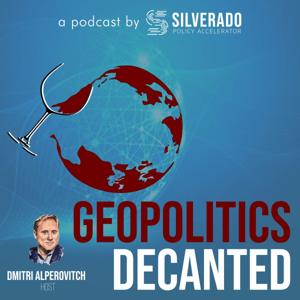
In-depth conversations on the conflicts and rivalries shaping our world, explored in the detail the subject deserves. Dmitri Alperovitch speaks with the military commanders, intelligence officials, diplomats, historians, and strategists who shape events and study them closely — on the war in Ukraine, strategic competition with China and the future of Taiwan, nuclear deterrence, sanctions and semiconductors, and the changing character of warfare. Throughout, the aim is to understand not merely what has happened, but why — and what is likely to follow.
Geopolitics Decanted is hosted by Dmitri Alperovitch — chairman of the Silverado Policy Accelerator in Washington, D.C., national bestselling author of World on the Brink: How America Can Beat China in the Race for the Twenty-First Century, and co-founder of CrowdStrike.

1,049 Listeners
143 Listeners

770 Listeners
718 Listeners
408 Listeners

80 Listeners
421 Listeners

346 Listeners

366 Listeners
403 Listeners
143 Listeners

22 Listeners
496 Listeners
475 Listeners
266 Listeners