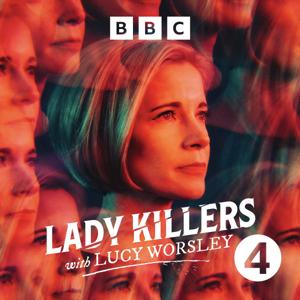
Lady Killers with Lucy Worsley

Lady Killers with Lucy Worsley

By BBC Radio 4True CrimeHistory
Download on the App Store
  • Favorites

    465

    Followers

  • Typical duration

    29 min

    per episode

  • If it hooks

    74%

    finish an episode

Based on Podcast App listening data

Lady Killers with Lucy Worsley episodes

  • 17. Marguerite Fahmy

    Lucy Worsley takes a fresh look at an infamous shooting that took place at London’s Savoy Hotel, amid all the wealth and glamour of the Roaring ‘20s.

    On 10th July 1923, at the height of a violent thunderstorm, Marguerite Fahmy shoots her new husband at close range with a pistol – in the corridor, outside their opulent suite. It’s clear she’s killed him, but why?

    Lucy is joined by Nneka Akudolu KC, a barrister with 20 years’ experience of exactly this kind of complex case, and Lady Killers’ in-house historian Professor Rosalind Crone from the Open University, to get to the bottom of this 100 year old mystery.

    Together, they untangle the complexities of Marguerite’s relationship with Ali Kamel Fahmy Bey, a super-rich Egyptian ‘playboy prince’. Ros goes to the scene of the crime to meet Savoy archivist Susan Scott and find out more about this notorious incident in the hotel’s history.

    The team discover that, while the coroner’s court returns a straightforward verdict of ‘wilful murder’, when Marguerite’s case comes to trial at the Old Bailey, the story gets a whole lot murkier. She is defended by legal legend Sir Edward Marshall Hall KC and cuts a tragic figure in the dock, glamorous and apparently bereft. She alleges that Ali was violently abusive and there is huge public sympathy for her plight, with her husband cast as a 'bestial' monster.

    Lucy, Nneka and Ros examine these claims and counterclaims to unpick the prejudice at work in the courtroom and ask if justice was served in this case.

    Would Marguerite’s story play out any differently today?

    Producer: Sarah Goodman

    Readers: Meena Rayann and Jonathan Keeble
    Sound Design: Chris Maclean
    Series Producer: Julia Hayball

    A StoryHunter production for BBC Radio 4

    29 min
  • 16. Edith Thompson

    In this episode of Lady Killers, we travel back to the Roaring 20s as Lucy Worsley and guest detective Sasha Wass KC investigate how Edith Thompson, a woman who merely witnessed the violent killing of her husband, found herself on trial for his murder.

    Sasha Wass KC has taken on some of the legal system's most notable cases - involving Rosemary West, Rolf Harris and Johnny Depp. As a judge, prosecutor and defender, she has the benefit of understanding all dimensions of the criminal process, which is crucial when examining one of the most controversial cases of all time. It’s a trial that shook the nation.

    Edith Thompson, with her choppy bobbed hair and jaunty dresses is the quintessential ‘Flapper’. A working woman living in the rapidly expanding London suburb of Ilford, she’s one of the new commuters, traveling to her job at Carlton and Pryor (a wholesale milliners in the City of London), producers of some very fashionable hats.

    She teaches herself French and goes on buying trips to Paris. She spends her own money, frequenting theatres and dancing the nights away.

    But back in the suburbs, Lucy and Sasha discover how Edith Thompson lives another, less glamorous life with husband Percy. While Edith is embracing some of the new found freedoms of a 1920’s woman, Percy wants a more ‘traditional’ wife.

    Then, on the night of 3rd October 1922, their life together takes a very dramatic turn when Percy is fatally stabbed by a mysterious stranger.

    As Lucy and Sasha discuss the now infamous court hearing, historian Professor Rosalind Crone visits the Ilford streets where Edith lived and where our bloody murder took place, to discover what life was really like for our 1920’s ‘murderess’.

    Producer: Nicola Humphries

    Readers: Clare Corbett and Jonathan Keeble
    Sound Design: Chris Maclean
    Series Producer Julia Hayball

    A StoryHunter production for BBC Radio 4

    29 min
  • 15. Women's Bodies. Women's Rights

    In this episode of Lady Killers, Lucy Worsley, Professor Rosalind Crone and broadcaster Ayesha Hazarika discuss the first four cases - brothel-keeper Mary McKinnon, chocolate-cream killer Christiana Edmonds, enslaved woman Margaret Garner and abortionist Elizabeth Taylor. They examine legal prejudice, frustrated sexual desire, illegal abortion, and slavery.

    They explore women’s rights over their own bodies, and dig a little deeper into the parallels between women in the 19th century and women in contemporary society. Together they consider the extent to which progress can be taken for granted, and ask whether anything might have been better for women in the past than today.

    Producer: Emily Hughes

    Sound Design: Chris Maclean
    Series Producer: Julia Hayball

    A StoryHunter production for BBC Radio 4

    29 min
  • 14. Mary McKinnon

    In Lady Killers, Lucy Worsley investigates the crimes of 19th and early 20th century women from a contemporary, feminist perspective.

    In this episode, Lucy is joined by Dr Anastacia Ryan, Founder of SISU, a Glasgow-based charity for women at risk and Lecturer in Social Policy at the University of Glasgow, to explore the case of Mary McKinnon.

    Mary lives in Edinburgh, Scotland in the 1820s, and runs a tavern on South Bridge. Except her tavern, like many at the time, has another side to it – it’s also a brothel.

    On 8th February 1823, Mary McKinnon is out having a drink with her friend, when she is called back to the inn as a group of men are causing trouble. She arrives to find a chaotic scene, and in the midst of the frenzy, one of the men is stabbed. He accuses Mary of stabbing him, yet she protests her innocence. Despite this, she’s arrested and put on trial.
    She faces animosity and judgment every step of the way. The judge even directs the jury to pay more heed to the evidence of the men who visited her tavern that night, than to the evidence of her fellow workers and other women.

    But did she do it? And did she face increased prejudice not only because she was a woman, but because she looked after sex workers?

    Lucy Worsley is also joined by Professor Rosalind Crone from the Open University. Together, Anastacia and Rosalind visit the vaults under Edinburgh’s Old Town to see what Mary’s tavern would have been like in the 1820s.

    Lucy asks if the way society treats sex workers has changed since Mary’s time.
    Producer: Hannah Fisher
    Readers: Clare Corbett, Jonathan Keeble, Hannah Fisher, Katy Duff, Jacob Smyth and Fraser Coutts
    Sound Design: Chris Maclean
    Series Producer: Julia Hayball

    A StoryHunter production for BBC Radio 4

    30 min
  • 13. Elizabeth Taylor

    Lucy Worsley looks at the crimes of Victorian women from a contemporary, feminist perspective.

    In this episode, Lucy is joined by Deborah Frances-White, women’s rights campaigner, comedian and host of The Guilty Feminist podcast, to explore the case of Elizabeth Taylor, a backstreet abortionist in late 19th century Melbourne, Australia who spent decades playing cat and mouse with the law. They consider Elizabeth Taylor’s story in the context of women’s rights in 19th century Australia and the subsequent campaign for legal, safe abortion around the world.
    Lucy is also joined by historian Rosalind Crone, Professor of History at the Open University, who has searched immigration, court and prison records to give new insights into Elizabeth Taylor’s life.
    When the Taylor family emigrates from Manchester to Melbourne, Australia in 1872, Elizabeth begins to advertise in the classified columns of the newspapers as a ‘midwife and ladies’ nurse’. These are thinly veiled adverts for her extremely profitable, and completely illegal, abortion clinic.
    Many desperate women with unwanted pregnancies find their way to her door. But sadly, not all of them survive the abortions Elizabeth Taylor performs and, over three decades, she is in and out of court - twice on murder charges and facing the death penalty.
    Lucy wants to know why Elizabeth Taylor worked for so many years as an illegal abortionist knowing that she was risking her own life. Was she acting out of compassion for desperate women or cashing in on their terrible situations? What light does her story shine on the abortion debate today, with the overthrow of Roe vs Wade in the USA? How much do 19th century views, and laws, about the rights of women over their bodies resonate now? What does the case of Elizabeth Taylor tell us about women’s lives in the late 19th century and women’s lives today?

    Producer: Jane Greenwood

    Readers: Susan Dean, Clare Corbett and Jonathan Keeble
    Sound Design: Chris Maclean
    Series Producer: Julia Hayball

    A StoryHunter production for BBC Radio 4

    29 min
  • 12. Margaret Garner

    Lucy Worsley looks at the crimes of women from the 19th and early 20th centuries from a contemporary, feminist perspective.

    Lucy explores the story of Margaret Garner, an enslaved mother in 1850s America, who commits a murder that transforms her into an icon of tragedy and resistance. Her life inspired Tony Morrison’s Pulitzer-winning novel Beloved.
    To explore Margaret Garner’s remarkable story and its contemporary resonances Lucy is joined by Nikki M Taylor, Professor of African American History at Howard University in Washington DC and the author of Driven Towards Madness: The Fugitive Slave Margaret Garner and Tragedy on the Ohio.
    Margaret Garner and her small four children are owned by a farmer in the slave state of Kentucky, and they live a tantalising 16 miles from Cincinnati in the free state of Ohio. Margaret and her husband Robert, who is enslaved on a nearby farm, decide to risk their lives, and the lives of their children, for a chance of freedom on the other side of the Ohio River. On the night of 27th January 1856, in temperatures close to -20 degrees celsius, the family escapes on a sleigh and, against the odds, they evade capture and make it across the frozen river to what they hope will be freedom and safety. But their owners are hard on their heels, and soon Margaret will have to give a terrible answer to the question ‘is slavery a fate worse than death?’.
    Lucy wants to know what life was like for Margaret as an enslaved woman, wife and mother. How can we hear the voices of enslaved women when they left so few records of their lives? What does Margaret’s story tell us about the lives of black women in America today? What effect did her story have on the abolitionist movement, and how can her story inform the fight against slavery and sex trafficking today?

    Producer: Jane Greenwood

    Readers: Moya Angela and Laurel Lefkow
    Sound Design: Chris Maclean
    Series Producer: Julia Hayball

    A StoryHunter production for BBC Radio 4

    30 min
  • 11. Christiana Edmunds

    Lucy Worsley looks at the crimes of Victorian women from a contemporary, feminist perspective.

    In the first case in her new series, Lucy explores the story of Christiana Edmunds, a respectable spinster who embarks on a mass poisoning spree when the man she loves fails to return her affection.
    Lucy is joined by Dr Gwen Adshead, a forensic psychiatrist and psychotherapist who has worked for many years at Broadmoor Hospital. Gwen offers fascinating insights into one of the most remarkable, and bizarre, cases of the Victorian era, a story of thwarted passion, lethal confectionery – and a very dangerous Lady Killer indeed.
    When Christiana Edmunds and her elderly mother move to Brighton after a series of family bereavements, Christiana develops a dangerous romantic obsession with her doctor, Charles Beard, bombarding him with love letters. Happily married with small children, he asks Christiana to leave him alone, and she takes drastic action: she tries to kill his wife Emily with a chocolate she has poisoned with strychnine. Emily survives but to cover her tracks Christiana comes up with a devious, clever and deadly plan.
    Rosalind Crone, Professor of History at the Open University, visits Brighton to explore how Christiana Edmunds procured her poison and presided over a reign of terror in the town in the early 1870s; and she goes to the Sussex County Archive to find out how the case gripped the public imagination and sent the press into a frenzy.
    Lucy wants to know what might have caused Christiana to become a stalker and a poisoner? Was she driven mad by the boredom of her middle-class spinster life or was she just clever and devious? What would a psychiatrist, and a court of law, make of her today?
    What does the case of Christiana Edmunds tell us about the lives of Victorian women, and about the lives of women today?
    Producer: Jane Greenwood
    Readers: Clare Corbett and Jonathan Keeble
    Sound Design: Chris Maclean
    Series Producer: Julia Hayball

    A StoryHunter production for BBC Radio 4

    30 min
  • Bonus episode: Lucy Worsley talks to Greg Jenner

    Lucy talks to fellow historian Greg Jenner about "larking about" on the TV show Horrible Histories, how to triumph at a Tudor history quiz (visit a museum on the subject first!), working with your idols (Stephen Fry) and the process and extraordinary detail that goes into making You're Dead To Me.

    You can listen to Greg's podcast by searching for You're Dead To Me on BBC Sounds or wherever you get your podcasts.

    15 min
  • 10. Mad, Bad And Dangerous To Know

    In this final episode of Lady Killers, Lucy Worsley and Dr Rosalind Crone look back and discuss the last four cases and the issues and themes they share.

    Together they re-examine two of Britain’s most notorious serial killers, Amelia Dyer who’s thought to have killed hundreds of babies and children and Mary Ann Cotton who murdered three of her husbands and numerous children and step-children. Over in the United States they look back at Hannah Mary Tabbs, who killed her lover and back in London delve into the sad case of Esther Lack, the mother who murdered three of her own children.

    Lucy and Ros dig deeper into the social issues and circumstances that helped create these murderesses. They look back at an era when newspapers were booming and examine the part the press played in shaping the stories of these women and how they were presented to a scandal hungry public. With that in mind they chat through the new discoveries sweeping through society in terms of toxicology and new understandings around mental health. Finally they scrutinise all eight cases and ask, what has changed today that could have made a difference?

    Producer: Alex Baxter

    Sound design: Chris Maclean

    A StoryHunter production for BBC Radio 4

    30 min

About Lady Killers with Lucy Worsley

From the publisher's feed

Lucy Worsley investigates women from the past being put on trial from a feminist perspective.

Best of Lady Killers with Lucy Worsley

Ranked by our users in the last 21 days

  1. Number 3: 3. Lizzie Borden
    29 min

More shows like Lady Killers with Lucy Worsley

Global News Podcast by BBC World Service

Global News Podcast

7,624 Listeners

Business Daily by BBC World Service

Business Daily

519 Listeners

Newshour by BBC World Service

Newshour

1,044 Listeners

World Business Report by BBC World Service

World Business Report

286 Listeners

In Our Time by BBC Radio 4

In Our Time

5,482 Listeners

Friday Night Comedy from BBC Radio 4 by BBC Radio 4

Friday Night Comedy from BBC Radio 4

2,111 Listeners

The Life Scientific by BBC Radio 4

The Life Scientific

219 Listeners

RedHanded by RedHanded

RedHanded

12,662 Listeners

Evil Genius with Russell Kane by BBC Radio 4

Evil Genius with Russell Kane

349 Listeners

Talking Tudors by Natalie Grueninger

Talking Tudors

743 Listeners

Have You Heard George's Podcast? by BBC Sounds

Have You Heard George's Podcast?

233 Listeners

Historic Royal Palaces Podcast by Historic Royal Palaces

Historic Royal Palaces Podcast

473 Listeners

Elis James and John Robins by Significant Productions

Elis James and John Robins

321 Listeners

You're Dead to Me by BBC Radio 4

You're Dead to Me

3,224 Listeners

British Scandal by Audible

British Scandal

2,532 Listeners

Gone Medieval by History Hit

Gone Medieval

1,893 Listeners

Not Just the Tudors by History Hit

Not Just the Tudors

2,053 Listeners

Sport's Strangest Crimes by BBC Radio 5 Live

Sport's Strangest Crimes

72 Listeners

Uncanny by BBC Radio 4

Uncanny

727 Listeners

Betwixt The Sheets: The History of Sex, Scandal & Society by History Hit

Betwixt The Sheets: The History of Sex, Scandal & Society

1,391 Listeners

Believe in Magic by BBC Studios

Believe in Magic

629 Listeners

History's Heroes by BBC Radio 4

History's Heroes

502 Listeners

After Dark: Myths, Misdeeds & the Paranormal by History Hit

After Dark: Myths, Misdeeds & the Paranormal

1,135 Listeners

Legacy by Original Legacy Productions

Legacy

395 Listeners

The Global Story by BBC World Service

The Global Story

384 Listeners

Miss Me? by Persephonica

Miss Me?

242 Listeners

The History Podcast by BBC Radio 4

The History Podcast

59 Listeners

Crime Next Door by BBC Sounds

Crime Next Door

117 Listeners

Rory Stewart: The Long History of... by BBC Radio 4

Rory Stewart: The Long History of...

74 Listeners

The History Bureau by BBC

The History Bureau

71 Listeners