
Sign up to save your podcasts
Or



Based on Podcast App listening data
Latino USA goes inside the biggest free health clinic in the country, which serves only people without insurance. There are nearly 28 million uninsured people in the United States, and for some of them, free clinics are their safety net. For undocumented people, healthcare options are very limited. For this story, we spend three days behind the scenes at CommunityHealth in Chicago, where more than half of the patients speak Spanish. We shadowed doctors and patients to observe the daily dramas that unfold there and listen in on intimate conversations—all to try to capture a snapshot of how life as an undocumented person can affect an individual's physical and mental health.
NOTE: This is a bilingual episode, where some of the audio is untranslated. A transcript of the story with full English translation is available online at www.latinousa.org.
The episode originally aired in 2019.
See omnystudio.com/listener for privacy information.
This week Latino USA shares an episode of the In The Thick podcast.
Maria Hinojosa and Julio Ricardo Varela reflect on the one-year anniversary of the school massacre in Uvalde, Texas, and the lasting impacts on the community. We go deeper in our roundtable to look at how families of victims—especially mothers, both past and present, bring about change. Maria leads the discussion with Keith Beauchamp, award-winning filmmaker and producer on the film “Till,” and Monica Muñoz Martinez, historian and associate professor at the University of Texas at Austin.
You can subscribe to the In The Thick podcast here.
See omnystudio.com/listener for privacy information.
One year after the mass shooting at Robb Elementary School in Uvalde, Texas, Latino USA and Futuro Investigates explore how families in the community are dealing with grief, how they’re navigating their journey to healing, and calling for accountability.
“Uvalde Rising,” tells the story of how victims’ parents and survivors are fighting for gun reform and calling for more mental health resources.
Some of the reporting for this episode is based on the PBS Frontline documentary film “After Uvalde: Guns, Grief & Texas Politics."
See omnystudio.com/listener for privacy information.
The Mexican singer-songwriter, Julieta Venegas, took a seven-year break before releasing her latest album, a journey of self-discovery in 10 songs that she named “Tu historia.” Now, she shares what happened during that long pause, which included making some major life decisions.
See omnystudio.com/listener for privacy information.
For mother and son chefs Zarela Martinez and Aarón Sanchez, educating others about the cuisines that make up Mexico is a family tradition. Zarela and Aarón have each opened restaurants, written cookbooks, appeared on TV shows, and won awards. In 2020, this duo decided to combine their talents for a podcast, where they discuss the recipes and ingredients that make up their favorite Mexican dishes.
In this episode of Latino USA, Aarón and Zarela discuss their careers, how they made it in New York City, and how they’ve navigated Zarela’s Parkinson's diagnosis as a family.
See omnystudio.com/listener for privacy information.
José Ralat is the Taco Editor at Texas Monthly Magazine and consequently the only taco editor in the United States. In his book, “American Tacos: A History and Guide,” Ralat dives into the evolution of tacos in the United States and its history in the borderlands. According to Ralat, tacos were introduced into the U.S. in the late 1800s. Since then, tacos have evolved into fusions —like Korean and Cajun tacos— as cultures blended with one another and chefs across the country experimented with different flavors. In this episode, Ralat gives us a brief history of the American taco and why eventually, all foods will make its way into a tortilla.
This episode originally aired in 2020.
See omnystudio.com/listener for privacy information.
Over 300,000 students in the U.S. migrate every year to work in agriculture, from spring to fall. At a high school in South Texas, when these students return, they gather at the Migrant Student Club to discuss their experiences and get support from a migrant student counselor. At a special gathering of the club we met Reyes, who started picking asparagus in Michigan to help support his family when he was 9 years old. And over the course of his last semester of school, we follow him as he works to graduate, financially support his family, and deal with an unexpected twist: the pandemic.
This episode originally aired in 2020.
See omnystudio.com/listener for privacy information.
Mariana Enríquez is one of the best-known writers of a growing literary trend in Latin America that uses the horror genre to denounce the violent realities of the region—past and present. Mariana was born in Buenos Aires in 1973, just a few years before a military junta took over the democratic government in Argentina, and grew up in a country under a brutal dictatorship. She retreated to books and writing to process that historical trauma.
In this episode, Mariana shares how her connection with horror started, how she uses the genre to speak of her reality, and she reads from her latest novel Our Share of Night.
See omnystudio.com/listener for privacy information.
We continue to celebrate our 30th anniversary, bringing you the voices of some of the most influential Latinos and Latinas in the last three decades. In this episode, we catch up with music legend Linda Ronstadt, known as the “First Lady of Rock.” We talk to her about her memories growing up in Tucson, Arizona, and her decision to return to the traditional Mexican music of her childhood. Linda brings us into her life after retiring from music, and her memoir “Feels Like Home: A Song for the Sonoran Borderlands,” which reckons with her family history.
See omnystudio.com/listener for privacy information.
We start today’s episode at El Edén—the center in San Pedro Sula, Honduras, where child migrants are processed after being deported from Mexico and elsewhere. Then, before diving into the reasons why Hondurans leave for Mexico and the United States, Maria Hinojosa and Latino USA producer Marlon Bishop talk about some of the history of Honduras.
This story was produced in association with Round Earth Media. German Andino, in Honduras, co-reported this story with Marlon.
This Peabody award-winning episode originally aired in 2014.
See omnystudio.com/listener for privacy information.
From the publisher's feed
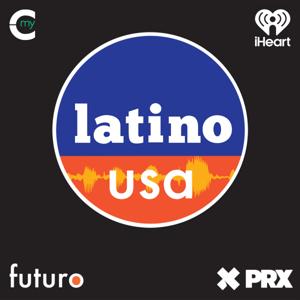
Latino USA is the longest-running news and culture radio program in the U.S. centering Latino stories, hosted by Pulitzer Prize winning journalist Maria Hinojosa Every week, the Peabody winning team brings you revealing, in-depth stories about what’s in the hearts and minds of Latinos and their impact on the world.
Want to support our independent journalism? Join Futuro+ for exclusive episodes, sneak peaks and behind-the-scenes chisme on Latino USA and all our podcasts. www.futuromediagroup.org/joinplus
Ranked by our users in the last 21 days

90,603 Listeners

37,863 Listeners

43,355 Listeners

9,176 Listeners

8,430 Listeners
694 Listeners

14,648 Listeners
4,449 Listeners

4,692 Listeners

56,400 Listeners
9,062 Listeners
282 Listeners

16,314 Listeners

6,338 Listeners
846 Listeners

100 Listeners

113 Listeners

2,018 Listeners
250 Listeners
191 Listeners

1,400 Listeners
27 Listeners

505 Listeners
130 Listeners

283 Listeners
20 Listeners

86 Listeners

45 Listeners
22 Listeners

2 Listeners

72 Listeners

7 Listeners