
Sign up to save your podcasts
Or

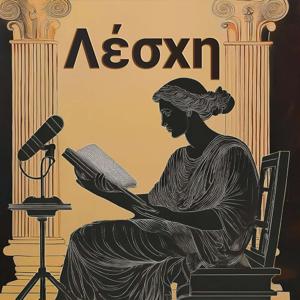


Art historian Verity Platt joins me in the Lesche to discuss her much-anticipated new book Epistemic Impressions: Making and Mediating Classical Art and Text (Oxford 2026).
On May 11, the Queen Mary University of London Imagination Research Network will be hosting a "launch symposium" to celebrate the book's publication. Information and tickets are available here.
The novel that Verity recommends at the end of the podcast is When the Museum is Closed, by Emi Yagi. Read an excerpt here, in Yuki Tejima's translation.
Ancient sources
Modern bibliography/references
About our guest
Verity Platt is a professor of Classics and History of Art at Cornell University, where she is also co-curator of the plaster cast collection and directs the Humanities Scholar Program for undergraduates. She is the author of Facing the Gods: Epiphany and Representation in Graeco-Roman Art, Literature, and Religion (Oxford 2011), and the newly published Epistemic Impressions: Making and Mediating Classical Art and Text (Oxford 2026). She is also an editor of the Classical Receptions Journal.
________________________________
Thanks for joining us in the Lesche!
Podcast art: Daniel Blanco
Theme music: "The Song of Seikilos," recomposed by Eftychia Christodoulou using Sibelius
This podcast is made possible with the generous support of Brown University’s Department of Classical Studies and the John Nicholas Brown Center for Advanced Study.
Instagram: @leschepodcast
Email: [email protected]
Suggest a book using this form
Marie-Louise Nosch, former director of the Centre for Textile Research at the Saxo Institute of the University of Copenhagen, joins me in the Lesche to discuss her new book Time of Textiles in Ancient Greece (DeGruyter 2025).
If you like this episode, you might also enjoy Lesche episode 1.10, "Wedding Poetics in Ancient Greek Literature," with Andromache Karanika.
Ancient texts
Modern bibliography
About our guest
Marie Louise Nosch studied Ancient Greek History in Nancy and Naples and completed her doctoral thesis at the University of Salzburg. Her special field of research is Aegean epigraphy and Mycenaean Linear B inscriptions, as well as ancient textile production. She was the Director of the Danish National Research Foundation’s Centre for Textile Research (2005-2016) at the University of Copenhagen and has been Professor of Ancient Greek History at the University of Copenhagen since 2011. She was elected to the Royal Danish Academy of Sciences and Letters in 2017 and served as President from 2020-2024.
________________________________
Thanks for joining us in the Lesche!
Podcast art: Daniel Blanco
Theme music: "The Song of Seikilos," recomposed by Eftychia Christodoulou using Sibelius
This podcast is made possible with the generous support of Brown University’s Department of Classical Studies and the John Nicholas Brown Center for Advanced Study.
Instagram: @leschepodcast
Email: [email protected]
Suggest a book using this form
Christos C. Tsagalis joins me in the Lesche to discuss the Doloneia, i.e., Iliad 10, which is the topic of both Christos' monograph The Homeric Doloneia: Evolution and Shaping of Iliad 10 (Oxford 2024) and his chapter in Jonathan Ready's recent edited volume, the Oxford Critical Guide to Homer's Iliad (Oxford 2024).
The Doloneia/Iliad 10 is traditionally divided into two sections: the Nyktegersia (the 'night watch' or nocturnal council scene, lines 1-179) and the spy-mission itself.
Bibliography
Danek, Georg. (1988) Studien zur Dolonie. Vienna.
Dué, Casey and Mary Ebbott (2010. Iliad 10 and the Poetics of Ambush: a Multitext Edition with Essays and Commentary. Hellenic Studies 39. Washington, DC: Center for Hellenic Studies, Harvard University Press.
Also mentioned
Homeric scholarship by Gregory Nagy and his pupils
The Parry-Lord Hypothesis (of oral composition)
About our guest
Christos C. Tsagalis is Professor of Ancient Greek Literature at the Aristotle University of Thessaloniki, Ordinal Member of the Academia Europaea, Corresponding Member of the Cypriot Academy of Sciences, Letters, and Arts, Member of the Governing Board of the Center for the Greek Language in Thessaloniki. He is the Co-Editor of the Yearbook of Ancient Greek Epic (Brill), the series of monographs Key Perspectives on Classical Research (Walter de Gruyter), Assistant Editor of the series Trends in Classics Supplementary Volumes (Walter de Gruyter), and Member of the scientific board of the series of classical commentaries Aris and Philips. Ηe specializes in Early Greek Epic Poetry.
________________________________
Thanks for joining us in the Lesche!
Podcast art: Daniel Blanco
Theme music: "The Song of Seikilos," recomposed by Eftychia Christodoulou using Sibelius
This podcast is made possible with the generous support of Brown University’s Department of Classical Studies and the John Nicholas Brown Center for Advanced Study.
Instagram: @leschepodcast
Email: [email protected]
Suggest a book using this form
Rosa Andújar joins me in the Lesche to discuss her new book, Playing the Chorus in Greek Tragedy (Cambridge, 2025).
Tragedies mentioned
Aeschylus
Sophocles
Euripides
Other ancient texts
Modern works
About our guest
Rosa Andújar is Associate Professor of Classics and Ancient Studies at Barnard College, Columbia University. She has published widely on Greek drama in its fifth-century Athenian context as well as on its modern global reception, particularly across the Americas. She is the author of Playing the Chorus in Greek Tragedy (Cambridge, 2025) and the editor of The Greek Trilogy of Luis Alfaro (Methuen Drama, 2020), which won the 2020 London Hellenic Prize.
________________________________
Thanks for joining us in the Lesche!
Podcast art: Daniel Blanco
Theme music: "The Song of Seikilos," recomposed by Eftychia Christodoulou using Sibelius
This podcast is made possible with the generous support of Brown University’s Department of Classical Studies and the John Nicholas Brown Center for Advanced Study.
Instagram: @leschepodcast
Email: [email protected]
Suggest a book using this form
Michael Satlow joins me in the Lesche to discuss his new book An Enchanted World: The Shared Religious Landscape of Late Antiquity, which will be published on February 3 by Princeton University Press.
Resources
"Lived Religion Project" at the University of Erfurt's Max Weber Institute
If you're new to Late Antiquity, the foundational work is Peter Brown's 1971 The World of Late Antiquity: AD 150-750. It's been reissued in various editions, including a 2024 illustrated one from Thames & Hudson (relatively affordable!).
I mention Philogelos joke 203 in the episode introduction.
About our guest
Michael Satlow is Professor of Judaic Studies and Religious Studies at Brown University. A historian of religion in antiquity, his work explores how Jews, Christians, and others experienced the sacred in everyday life. His new book, An Enchanted World, draws on inscriptions and material culture to reveal a shared religious landscape in Late Antiquity, one filled with gods, angels, demons, and divine presence.
________________________________
Thanks for joining us in the Lesche!
Podcast art: Daniel Blanco
Theme music: "The Song of Seikilos," recomposed by Eftychia Christodoulou using Sibelius
This podcast is made possible with the generous support of Brown University’s Department of Classical Studies and the John Nicholas Brown Center for Advanced Study.
Instagram: @leschepodcast
Email: [email protected]
Suggest a book using this form
Piero Boitani joins me in the Lesche to discuss his new book Timaeus in Paradise: Metaphors and Beauty from Plato to Dante and Beyond (Princeton University Press 2025).
Ancient texts
Later sites of reception & influence
In Literature and Philosophy
In Visual Art and Architecture
About our guest
Piero Boitani is Professor Emeritus of Comparative Literature at the University of Rome “Sapienza.” A Fellow of the British Academy, the Medieval Academy of America, the Accademia dei Lincei, and the Italian National Institute of Astrophysics, in 2016 he received the Balzan Prize for Comparative Literature. He is chairman of the Fondazione Lorenzo Valla and general editor of its series of Greek and Latin Writers.
His most recent books include Il grande racconto dei classici (Bologna, Il Mulino, 2024); «Reconnaître est un Dieu». L’anagnorisis dans la littérature occidentale (Paris, Garnier, 2025); Timaeus in Paradise: Metaphors and Beauty from Plato to Dante and Beyond (Princeton University Press 2025). A new book, The Five Elements-I cinque elementi, with a preface by Stephen Greenblatt, will be published by Mondadori, in the Lo Specchio series, in February 2026.
________________________________
Thanks for joining us in the Lesche!
Podcast art: Daniel Blanco
Theme music: "The Song of Seikilos," recomposed by Eftychia Christodoulou using Sibelius
This podcast is made possible with the generous support of Brown University’s Department of Classical Studies and the John Nicholas Brown Center for Advanced Study.
Instagram: @leschepodcast
Email: [email protected]
Suggest a book using this form
Inger Kuin joins me in the Lesche to discuss her new book Diogenes: The Rebellious Life and Revolutionary Philosophy of the Original Cynic (Basic Books 2025).
Ancient sources
For an accessible English-language collection of testimonia for Diogenes, see Robert Dobbin's The Cynic Philosophers, from Diogenes to Julian (Penguin Classics, 2012).
About our guest
Inger Kuin is a researcher, writer, and teacher focused on the intellectual history of ancient Greece and Rome. She is Associate Professor of Classics General Faculty at the University of Virginia. Originally from The Netherlands, she splits her time between Charlottesville (VA) and Rotterdam, and publishes both in English and in Dutch.
________________________________
Thanks for joining us in the Lesche!
Podcast art: Daniel Blanco
Theme music: "The Song of Seikilos," recomposed by Eftychia Christodoulou using Sibelius
This podcast is made possible with the generous support of Brown University’s Department of Classical Studies and the John Nicholas Brown Center for Advanced Study.
Instagram: @leschepodcast
Email: [email protected]
Suggest a book using this form
Tatiana Bur joins me in the Lesche to discuss her new book Technologies of the Marvellous in Ancient Greek Religion (Cambridge University Press 2025).
Ancient texts
Modern bibliography
________________________________
Thanks for joining us in the Lesche!
Podcast art: Daniel Blanco
Theme music: "The Song of Seikilos," recomposed by Eftychia Christodoulou using Sibelius
This podcast is made possible with the generous support of Brown University’s Department of Classical Studies and the John Nicholas Brown Center for Advanced Study.
Instagram: @leschepodcast
Email: [email protected]
Suggest a book using this form
Mary Beard, Classics editor at the Times Literary Supplement, and Clifford Ando, senior editor of the Bryn Mawr Classical Review, join me in the Lesche to discuss the state of Classics reviewing today.
Some bibliography
About our guests
Clifford Ando teaches Classics and History at the University of Chicago. His work focuses on the histories of law, religion, and government in the ancient world. He is the author, editor, and translator of some 20 books, and he has served as an editor, associate editor, or senior editor of Bryn Mawr Classical Review for not quite twenty years.
Mary Beard is professor emerita of classics at the University of Cambridge, a fellow of Newnham College, and professor of Ancient Literature at the Royal Academy. She is also the classics editor of the Times Literary Supplement, a fellow of the British Academy, and an international member of the American Academy of Arts and Sciences. She is the author of more than twenty books on the ancient world. Her latest book, Talking Classics: The Shock of the Old, is due out in spring 2026 with Profile Books (UK) and the University of Chicago Press (USA).
________________________________
Thanks for joining us in the Lesche!
Podcast art: Daniel Blanco
Theme music: "The Song of Seikilos," recomposed by Eftychia Christodoulou using Sibelius
This podcast is made possible with the generous support of Brown University’s Department of Classical Studies and the John Nicholas Brown Center for Advanced Study.
Instagram: @leschepodcast
Email: [email protected]
Suggest a book using this form
Harvard University historian Paul Kosmin joins me in the Lesche to discuss his recent book The Ancient Shore (Harvard University Press 2024), winner of the American Historical Association's 2025 Prize in History Prior to CE 1000.
Works mentioned
About our guest
Paul Kosmin completed his undergraduate degree at Oxford and earned a PhD in Ancient History from Harvard University in 2012. He was appointed an Assistant Professor in Harvard's Classics Department in 2012, was tenured in 2019, and in 2020 became the Philip J. King Professor of Ancient History, where he currently serves as Interim Chair. His research focuses on the political and cultural history of the ancient Greek world, concentrating on the globalizing and colonial Hellenistic period, and now includes an environmentally-oriented turn.
________________________________
Thanks for joining us in the Lesche!
Podcast art: Daniel Blanco
Theme music: "The Song of Seikilos," recomposed by Eftychia Christodoulou using Sibelius
This podcast is made possible with the generous support of Brown University’s Department of Classical Studies and the John Nicholas Brown Center for Advanced Study.
Instagram: @leschepodcast
Email: [email protected]
Suggest a book using this form
From the publisher's feed
In Greek antiquity a lesche (λέσχη) was a spot to hang out and chat. Here Brown University professor Johanna Hanink hosts conversations with fellow Hellenists about their latest work in the…

11,409 Listeners

5,485 Listeners
1,995 Listeners
2,889 Listeners
6,224 Listeners
4,800 Listeners
8,304 Listeners
5,235 Listeners
427 Listeners

3,344 Listeners

3,219 Listeners

185 Listeners
3,377 Listeners

816 Listeners
195 Listeners