
Sign up to save your podcasts
Or

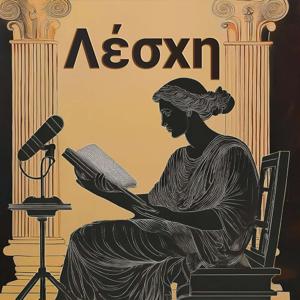


Andromache Karanika joins me in the Lesche to discuss how we can detect traces of wedding poetics in early Greek literature, especially poetry (hexamter and lyric). Andromache is the author of Wedding, Gender, and Performance in Ancient Greek Poetry (OUP 2024).
Primary texts
Also mentioned
About our guest
Andromache Karanika is Professor of Classics at the University of California, Irvine. She is the author of Voices at Work: Women, Performance and Labor in Ancient Greece (Johns Hopkins University Press, 2014) and Wedding, Gender, and Performance in Ancient Greece (Oxford University Press), and co-editor of Emotional Trauma in Greece and Rome: Representations and Reactions (2020). She served as editor of TAPA (2018-2021) and President of CAMWS (2023-2024).
________________________________
Thanks for joining us in the Lesche!
Podcast art: Daniel Blanco
Theme music: "The Song of Seikilos," recomposed by Eftychia Christodoulou using Sibelius
This podcast is made possible with the generous support of Brown University’s Department of Classical Studies and the John Nicholas Brown Center for Advanced Study.
Instagram: @leschepodcast
Email: [email protected]
Suggest a book using this form
James Diggle joins me in the Lesche to discuss the 2021 Cambridge Greek Lexicon (2 vols.) of which he was editor-and-chief. We discuss why it was time for this sort of thing (and why it took 24 years to complete), how to use it, and why it improves on LSJ ... plus, how the team approached translating some of the naughtier words.
Some links
About our guest
James Diggle, CBE, FBA, is Professor Emeritus of Greek and Latin at the University of Cambridge and a Fellow of Queens' College, where he was Director of Studies in Classics for over forty years. His publications include The Phaethon of Euripides (Cambridge, 1970), Flauii Cresconii Corippi Iohannidos Libri VIII (joint editor, Cambridge, 1970), Euripidis Fabulae (Oxford Classical Text, 3 vols., 1981–1994), Studies on the Text of Euripides (1981), The Textual Tradition of Euripides' Orestes (1991), Euripidea: Collected Essays (1994), Tragicorum Graecorum Fragmenta Selecta (1998), Theophrastus, Characters (Cambridge 'Orange' 2004; 'Green and Yellow' 22). He was University Orator at Cambridge for eleven years and has published a selection of his speeches (Cambridge Orations 1982–1993 (Cambridge, 1994)). He is also joint editor of The Classical Papers of A. E. Housman (Cambridge, 1972), joint author of Odysseus Unbound: The Search for Homer's Ithaca (Cambridge, 2005), and Editor-in-Chief of The Cambridge Greek Lexicon (Cambridge, 2021). He is a Fellow of the British Academy and a Corresponding Member of the Academy of Athens.
________________________________
Thanks for joining us in the Lesche!
Podcast art: Daniel Blanco
Theme music: "The Song of Seikilos," recomposed by Eftychia Christodoulou using Sibelius
This podcast is made possible with the generous support of Brown University’s Department of Classical Studies and the John Nicholas Brown Center for Advanced Study.
Instagram: @leschepodcast
Email: [email protected]
Suggest a book using this form
John Ma joins me in the Lesche to discuss the longue durée of the Greek polis. John is the author of the new, monumental, and much anticipated book Polis: A New History of the Ancient Greek City-State from the Early Iron Age to the End of Antiquity (Princeton 2024).
Happy Holidays!
About our guest
John Ma was born in New York of Chinese parents. He grew up in Geneva, where he studied Greek and Latin at school and outside school. He went on to study Classics, then ancient history at Oxford. He has taught ancient history in Classics Departments at Princeton, Oxford, and Columbia. Ma is deeply interested in studying Greek history, especially in the Hellenistic period, using documentary and material sources.
Ancient texts
Also mentioned
Too many to list! But I'll note:
________________________________
Thanks for joining us in the Lesche!
Podcast art: Daniel Blanco
Theme music: "The Song of Seikilos," recomposed by Eftychia Christodoulou using Sibelius
This podcast is made possible with the generous support of Brown University’s Department of Classical Studies and the John Nicholas Brown Center for Advanced Study.
Instagram: @leschepodcast
Email: [email protected]
Suggest a book using this form
(Spoiler alert! This episode is jam-packed with plot spoilers for THE RETURN.) Homeric scholar Barbara Graziosi joins me in the Lesche to discuss Umberto Pasolini's THE RETURN, a film adaptation of the second half of the Odyssey starring Ralph Fiennes as Odysseus and Juliette Binoche as Penelope.
About our guest
Barbara Graziosi is Department Chair and Professor of Classical Studies at Princeton, holding the C. Ewing Chair of ancient Greek. Graziosi attended Oxford University (Corpus Christi College B.A. and MSt in Classics) and Cambridge University (Ph.D. in Classics) and taught at Oxford, Reading, and Durham before joining the faculty at Princeton in 2018. She also held various visiting positions in Italy. She has written widely on ancient Greek literature (especially Homer) and its reception, as well as more autobiographical pieces on how we make ancient literature our own. Her latest books are Homer (OUP 2018) and Classics, Love, Revolution: The Legacies of Luigi Settembrini, with Andrea Capra (OUP 2024).
Ancient texts
Homer's Iliad and Odyssey
Also mentioned
Emily Wilson's discussions of the murder of the "disloyal" enslaved women in Odysseus' household -- and the sexual politics of translation. See, e.g., Wilson's New Yorker article: "A translator's reckoning with the female characters of the Odyssey" (Dec. 18, 2017).
________________________________
Thanks for joining us in the Lesche!
Podcast art: Daniel Blanco
Theme music: "The Song of Seikilos," recomposed by Eftychia Christodoulou using Sibelius
This podcast is made possible with the generous support of Brown University’s Department of Classical Studies and the John Nicholas Brown Center for Advanced Study.
Instagram: @leschepodcast
Email: [email protected]
Suggest a book using this form
Emma Greensmith and Tim Whitmarsh join me in the Lesche to discuss how Imperial Greek epic fits into our understanding of Ancient Greek epic as a whole. Emma has just edited the Cambridge Companion to Ancient Greek Epic, and she was also a member of the research project Greek Epic of the Roman Empire: A Cultural History, which Tim directed.
About our guests
Emma Greensmith is Associate Professor of Classical Languages and Literature at the University of Oxford and Fellow of St John’s College. She is the editor of Omnibus and an associate editor for the Yearbook of Ancient Greek Epic. She specialises in imperial Greek literature, particularly epic poetics and religious culture. Her 2020 book, The Resurrection of Homer in Imperial Greek Epic, offers a new reading of the role of epic and the reception of Homer in the Graeco-Roman world. She has written many articles on ancient Greek literature and has co-edited a volume on ‘Writing Homer Under Rome’ (2022). She works on several public engagement initiatives with the charity Classics for All, and recently filmed a documentary on Homer’s Odyssey and its cultural legacy.
Tim Whitmarsh FBA is Regius Professor of Greek at the University of Cambridge, and Fellow of Trinity College. A specialist in the literature, culture and religion of ancient Greece, he is the author of 10 books, including Battling the Gods: Atheism in the Ancient World (Knopf 2015), and over 100 academic articles. He has contributed to newspapers such as The Guardian, the Times Literary Supplement and the London Review of Books, and to BBC radio and TV.
Ancient texts
Homer's Iliad and Odyssey
Triphiodorus, Sack of Troy
Quintus of Smyrna, Posthomerica
Anon., Vision of Dorotheus
Nonnus, Dionysiaca
Eudocia, Homeric Centones
Colluthus, Abduction of Helen
Also mentioned
Jasper Griffin, "Greek Epic," in the Cambridge Companion to the Epic (Cambridge 2010).
________________________________
Thanks for joining us in the Lesche!
Podcast art: Daniel Blanco
Theme music: "The Song of Seikilos," recomposed by Eftychia Christodoulou using Sibelius
This podcast is made possible with the generous support of Brown University’s Department of Classical Studies and the John Nicholas Brown Center for Advanced Study.
Instagram: @leschepodcast
Email: [email protected]
Suggest a book using this form
Emily Wilson, acclaimed translator, joins me in the Lesche to discuss the challenges and pleasures of translating the Iliad.
We discuss the Greek of two passages in detail: Book 6 lines 482-502 and Book 22 lines 199-204 (lines as in the OCT).
Ancient texts
Also mentioned
About our guest
Emily Wilson is Department Chair and Professor of Classical Studies at the University of Pennsylvania, holding the College for Women Class of 1963 Term Professor in the Humanities. Wilson attended Oxford University (Balliol College B.A. in Classics and Corpus Christi College M.Phil. in Renaissance English Literature) and Yale University (Ph.D. in Classics and Comparative Literature). She has been named a Fellow of the American Academy in Rome in Renaissance & Early Modern scholarship, a MacArthur Fellow, and a Guggenheim Fellow.
Emily's substack
Emily on Blue Sky
________________________________
Thanks for joining us in the Lesche!
Podcast art: Daniel Blanco
Theme music: "The Song of Seikilos," recomposed by Eftychia Christodoulou using Sibelius
This podcast is made possible with the generous support of Brown University’s Department of Classical Studies and the John Nicholas Brown Center for Advanced Study.
Instagram: @leschepodcast
Email: [email protected]
Suggest a book using this form
David M. Pritchard joins me in the Lesche to discuss what appears to have been, in Nicole Loraux's famous words, a "very Athenian invention": the epitaphios logos, or funeral oration given over the war dead at their public burial. Both the Athenian funeral oration and the legacy of Nicole Loraux's pioneering study of it are the subjects of David's new edited volume The Athenian Funeral Oration: After Nicole Loraux.
About our guest
David M. Pritchard is Associate Professor of Greek History at the University of Queensland in Australia. He is well known internationally for researching the symbiosis between war, democracy and culture in classical Athens. He has held some fifteen fellowships in Australia, Europe and the US. Associate Professor Pritchard speaks on radio and regularly writes for newspapers around the world.
Ancient texts
Athenian funeral orations
Also mentioned
________________________________
Thanks for joining us in the Lesche!
Podcast art: Daniel Blanco
Theme music: "The Song of Seikilos," recomposed by Eftychia Christodoulou using Sibelius
This podcast is made possible with the generous support of Brown University’s Department of Classical Studies and the John Nicholas Brown Center for Advanced Study.
Instagram: @leschepodcast
Email: [email protected]
Suggest a book using this form
Rachel Kousser joins me in the Lesche to discuss Alexander III of Macedon's post-Persepolis campaigns in Asia (330-323 BCE), the subject of her recent book Alexander at the End of the World: The Forgotten Final Years of Alexander the Great.
About our guest
Rachel Kousser writes and teaches about Alexander the Great, the destruction of monuments in ancient Greece, and the representation of gender and power in the Mediterranean world. For her work, she has received fellowships from the National Endowment of the Humanities, the Getty Research Institute, and the Center for the Advanced Study of the Visual Arts. She’s published articles in Art Bulletin, American Journal of Archaeology, and Res: Archaeology and Aesthetics, as well as two books with Cambridge University Press. Rachel is currently the chair of the Classics Program at the Graduate Center, City University of New York and a professor of ancient art and archaeology at Brooklyn College. She has a B.A. in Classics and Art History from Yale University and a Ph.D. in Classical Art and Archaeology from New York University’s Institute of Fine Arts.
Ancient texts
Also mentioned
________________________________
Thanks for joining us in the Lesche!
Podcast art: Daniel Blanco
Theme music: "The Song of Seikilos," recomposed by Eftychia Christodoulou using Sibelius
This podcast is made possible with the generous support of Brown University’s Department of Classical Studies and the John Nicholas Brown Center for Advanced Study.
Instagram: @leschepodcast
Email: [email protected]
Suggest a book using this form
Ferdia Lennon joins me in the Lesche to discuss his award-winning and bestselling novel, Glorious Exploits (UK Penguin Fig Tree/US Macmillan 2024), which is set in Syracuse in the aftermath of the Athenian invasion of Sicily during the Peloponnesian War.
About our guest
Ferdia Lennon was born and raised in Dublin. He holds a BA in History and Classics from University College Dublin and an MA in Prose Fiction from the University of East Anglia. Glorious Exploits is his first novel. It was broadcast on BBC Radio 4 as a Book at Bedtime, was a Sunday Times bestseller and the winner of the Waterstones Debut Fiction Prize 2024. After spending many years in Paris, he now lives in Norwich with his wife and son.
Ancient texts
Also mentioned
Further reading
________________________________
Thanks for joining us in the Lesche!
Podcast art: Daniel Blanco
Theme music: "The Song of Seikilos," recomposed by Eftychia Christodoulou using Sibelius
This podcast is made possible with the generous support of Brown University’s Department of Classical Studies and the John Nicholas Brown Center for Advanced Study.
Instagram: @leschepodcast
Email: [email protected]
Suggest a book using this form
Charlie Covell joins me in the Lesche to discuss their hit Netflix show KAOS, a modern, dark dramedic take on Ancient Greek mythology. The show, set in something like modern-day Crete (and on Olympus and in Hades), interweaves stories of Prometheus, the Olympian gods, Orpheus and Eurydice, Minos/Ariadne/Theseus/the Minotaur, and Caeneis.
Special thanks on this one to Mike Farah & Jess Sze.
About our guest
British creator-writer Charlie Covell (pronouns: they/them) recently created the Netflix original series “Kaos” starring Jeff Goldblum, Janet McTeer, Nabhaan Rizwan, David Thewlis, and Debi Mazar, among others. The 8-episode debuted on August 29, 2024.
Previously, Charlie wrote the hit series “The End of The F***ing World” for Channel 4 in the UK (also available on Netflix). The series was praised for its writing, execution and subject matter, and has gone on to win a BAFTA TV Award, Peabody Award, and Royal Television Society Award. Charlie was also individually nominated for a British Screenwriters Award, BAFTA TV Craft Award, Royal Television Society Award, and Writers’ Guild of Great Britain Award. Charlie was also part of BAFTA’s prestigious Breakthrough Brits program and previously named one of Screen International’s Stars of Tomorrow.
________________________________
Thanks for joining us in the Lesche!
Podcast art: Daniel Blanco
Theme music: "The Song of Seikilos," recomposed by Eftychia Christodoulou using Sibelius
This podcast is made possible with the generous support of Brown University’s Department of Classical Studies and the John Nicholas Brown Center for Advanced Study.
Instagram: @leschepodcast
Email: [email protected]
Suggest a book using this form
From the publisher's feed
In Greek antiquity a lesche (λέσχη) was a spot to hang out and chat. Here Brown University professor Johanna Hanink hosts conversations with fellow Hellenists about their latest work in the…
11,409 Listeners

5,485 Listeners
1,995 Listeners
2,889 Listeners
6,224 Listeners
4,800 Listeners
8,304 Listeners
5,235 Listeners
427 Listeners

3,344 Listeners

3,219 Listeners
185 Listeners
3,377 Listeners
816 Listeners
195 Listeners