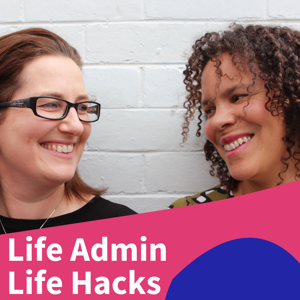
Life Admin Life Hacks

Life Admin Life Hacks

By Life Admin Life HacksSociety & CultureEducation
Download on the App Store

Life Admin Life Hacks episodes

  • 072: Laura Vanderkam on calming the chaos

    In this episode, we interview author and time-tracking expert Laura Vanderkam.

    Laura Vanderkam is the author of several time management and productivity books, including the new Tranquility by Tuesday: 9 Ways to Calm the Chaos and Make Time for What Matters, along with Juliet’s School of Possibilities, Off the Clock, I Know How She Does It, What the Most Successful People Do Before Breakfast, and 168 Hours. Her work has appeared in publications including the New York Times, the Wall Street Journal, Fast Company, and Fortune. She is the host of the podcast Before Breakfast and the co-host, with Sarah Hart-Unger, of the podcast Best of Both Worlds. She lives outside Philadelphia with her husband and five children.

    We loved chatting with Laura Vanderkam in this episode about time tracking. The topics we covered included:

    • thinking about time management as a strategy to make life more memorable and fun
    • outsourcing – how to make the decision on what to outsource and let go of the guilt – particularly for traditionally female tasks
    • getting your kids to think about time management and to establish good mindsets about time from an early age
    • the nine time management rules from Laura’s latest book Tranquility by Tuesday
    • the benefits of a weekly planning session and why Laura likes to plan on Fridays
    • creating a backup slot in your calendar to make your schedule more resilient
    • the benefit of having two things in your week worth remembering – one big adventure and one little adventure
    • the importance of sleep – and to give yourself a bedtime  – that if you get the amount of sleep you need every single night and you’ll have far more energy and life will feel more in control.
    LIFE ADMIN RESOURCES
    • Laura Vanderkam’s website
    • Tranquility by Tuesday – Laura’s latest book
    • The 9 rules from Tranquility by Tuesday
    • Best of Both Worlds Podcast
    SHARE

    Please head to the Life Admin Life Hacks Facebook,  Insta or Linked In pages to connect with listeners and share your thoughts, questions or suggestions.

    35 min
  • 071: Embracing lists

    In this episode we discuss the importance of using lists to improve productivity, save time, and reduce mental load. Lists are the secret to successful adulthood.

    Mia and Dinah discuss the different types of lists: to-do lists, checklists, and reference lists. To-do lists consist of time-bound tasks that require action, while checklists help with recurring activities and ensure efficiency. Reference lists capture suggestions and recommendations and serve as a source of information.

    Mia and Dinah highlight the importance of having a single source of truth for lists to avoid confusion and to easily share them with others. We recommend going digital by using apps like Notes or Reminders, which provide the convenience of accessing and sharing lists anytime and the added benefits of using voice commands through devices like Siri or Google Home Assistant.

    Dina and Mia share their personal experiences with using digital lists and how it has improved their productivity. They mention the ability to set reminders, integrate lists with email, and even link tasks to specific people or locations. They recommend choosing a simple app that suits individual preferences and investing time in learning its features for automation.

    The hosts also discuss the pitfall of including unnecessary items on lists. They suggest distinguishing between tasks that can be done immediately and those that require planning or execution at a later time. They mention the concept of "two-minute time killer tasks," which are better completed right away instead of adding them to a list.

    Mia and Dinah stress the importance of using lists effectively to free up mental space, prioritize tasks, and streamline daily activities. They encourage listeners to embrace digital tools and develop a consistent system that works for them. By implementing these list hacks, individuals can enhance productivity, save time, and reduce stress associated with life admin tasks.

    RESOURCES

    Life Admin Hacks the book

    Best List Apps - PC Mag

    SHARE

    Please head to the Life Admin Life Hacks Facebook,  Insta or Linked In pages to connect with listeners and share your thoughts, questions or suggestions.

    26 min
  • 070: Your money mindset

    In this episode, Mia and Dinah tap into the expertise of coach Nicole Alesios to discover how your money mindset and archetype impact your relationship with money, your habits and decisions about money management, saving, investing and outsourcing.

    About Dr Nicole Alesios

    Nicole is an economist, money mindset coach and speaker who is passionate about helping people to have easier money conversations through money mindset coaching and also helping them set a clear and achievable strategy that is in alignment with their unique money personality.

    One of the biggest benefits of getting your life admin organised is that it can save you money, through budgeting and money monitoring, sorting out your tax and estate planning, and comparison shopping major household expenses. 

    But money is an area where people bring complex feelings, childhood lessons and personality traits to the decision-making. Having the right app and a process will get you most of the way there, but recognising your behaviours when it comes to money is also important.

    In this bumper episode, we interview Nicole Alesios and discuss:

    • the taboo that still surrounds talking about money, which can limit our financial literacy
    • what your money stories and money mindset are
    • the eight money archetypes Nicole uses in her work to describe your predisposition toward money.
    RESOURCES
    • Nicole's website
    • Nicole’s Money Personality Quiz
    • Nicole's Instagram
    SHARE

    Please head to the Life Admin Life Hacks Facebook,  Insta or Linked In pages to connect with listeners and share your thoughts, questions or suggestions.

    59 min
  • 069: Sharing the mental load with your partner

    In this episode, Mia and Dinah dive into how to share the mental load, drawing on expertise from relationship expert and psychologist Dr Morgan Cutlip.

    About Dr Morgan Cutlip

    Morgan Cutlip has a PhD in Psychology, is a wife, mom to two kids and life-long lover of all things relationships.  Dr Morgan's work centres on creative content development for My Love Thinks.com and delivering educational content for your relationships in a way that is not just professional but also practical. Dr Cutlip has been a featured relationship expert for Teen Vogue, the New York Times, Flo Tracker app and is the upcoming author of two books with Thomas Nelson, How to Love your Kids Without Losing Yourself and The Mother Load.

    In this episode we talk about:

    • what inequity in the mental load looks like
    • the impact this inequity has on other areas of your relationship
    • how to explain the mental load without your partner getting defensive
    • the difference between ‘within work’ and ‘between work’, and why you need to do both
    • thoughts and behaviours that can sabotage an equitable relationship
    • minimum acceptable standards and letting go of control
    • taking initiative versus making requests for support
    • how frequent check-ins with your partner are essential
    RESOURCES
    • MyLoveThinks.com
    • My Love Thinks podcast
    • The 5 Love Languages
    SHARE

    Please head to the Life Admin Life Hacks Facebook,  Insta or Linked In pages to connect with listeners and share your thoughts, questions or suggestions.

    43 min
  • 068: Managing investments

    In this ep, Mia and Dinah talk to an expert about the life admin side of investing - it's a great way to build your wealth but also comes with paperwork and passwords. While anyone of working age has investments through their superannuation, in the last two years there’s been a surge of first-time share investors.

    About Sophie Dicker

    Sophie Dicker is an M&A consultant by day and the co-host of You're in Good Company (YIGC), a podcast that aims to make investing accessible to anyone, by night. Although working in finance, she had no idea about investing until her partner encouraged her to start. Her investing goal is to build the freedom to do things that she's passionate about - whether it be starting a business, donating to causes close to her, or taking time out of the workforce to start a family. The ultimate goal of YIGC is to build a community of like-minded people right alongside.

    In this episode we talk about:

    • the challenges of getting into the property market in Australia and other factors leading to an influx of younger investors in the share market
    • developing an investment strategy and the importance of understanding your money type and risk tolerance
    • why you might want to engage a financial adviser and how to find one
    • where to find information from experts to guide you on your investment journey
    • micro-investing: investing small amounts regularly through apps like Spaceship and Raiz
    • ETFs: a bundle of shares that provide exposure to a range of companies listed on the stock market, allowing you to diversify your investments more easily
    • finding an online trading platform that works for you and testing out the apps
    • managing the paperwork that comes with investing by adopting a folder structure to keep all the paperwork for purchases and dividends 
    • the importance of your HIN on CHESS statements and making sure you keep these in a secure place like your password manager
    • managing your account and password with the share registry
    • the process of setting up an online share trading account 
    • the benefits of developing a consistent investment routine
    • setting up investment goals (short, medium and long term) 
    • considering auto investing - a regular direct debit into an ETF 
    • using your Hours of Power to do the initial research and education into investing so that ongoing investing can become a Ten Minute Timekiller task in the long run.
    RESOURCES
    • YIGC podcast
    • YIGC Instagram
    • YIGC Investing Podcast Discussion Group on Facebook
    • Invest Like The Best podcast
    • How I build this with Guy Raz - podcast
    • Livewire Markets
    • Spaceship app
    • Raiz app
    • Stockspot
    SHARE

    Please head to the Life Admin Life Hacks Facebook,  Insta or Linked In pages to connect with listeners and share your thoughts, questions or suggestions.

    36 min
  • 067: Life admin for new parents

    In this ep, Mia and Dinah share their experiences and top hacks to streamline life admin for new parents. Conventional wisdom recommends parents-to-be focus their discussions and planning on housework and parenting. But there is a third dimension of domestic life to discuss and organise: life admin. Life admin explodes when you have a baby, just at the time you are sleep deprived and learning to care for a new member of your family.

    In this ep, Mia and Dinah discuss:

    • that before you have children you have more leisure time, physical and mental energy and life admin is done independently or designed around two people. When a baby enters your family life admin systems need to accommodate another person. 
    • When the baby is first born it's really important to prioritise what life admin you need to do. Prioritising is about deciding what you won’t do, getting clear about what’s truly urgent or important and letting go of the rest
    • that in different-sex couples there is a tendency for stereotypical domestic roles to kick in and that it's essential to have the negotiation early with your partner about who will do what in terms of housework, child care and life admin. It's important to get good at having this conversation as the discussion will need to be had again and again as the baby develops, its needs change, parental leave finishes and paid work resumes. 
    • Some of the life admin you can attend to before you have a baby: 
      • choosing your healthcare provider and managing appointments
      • adding your baby to waiting lists for childcare 
      • meal preparation - planning for sleep deprivation
      • creating a checklist of what to take to the hospital
      • setting up a keepsake system
      • securing all the baby equipment  and supplies you will need
      • updating your budget to reflect your new circumstances and be confident about how much time off from work you can take
      • preparing or updating your will including identifying guardians for your children
      • reviewing your life and income protection insurance
      • identifying options for online shopping and meal kits for the first few months when leaving home can be challenging
      • planning a babymoon!
    • After the baby is born and you are on parental leave, the day and week lack the normal structure that work once provided. It can be helpful to create a schedule for the housework and life admin tasks and a daily routine for yourself and baby.
    • When you return to work, routines and schedules support the smooth functioning of your household. As the baby develops your daily routine needs to shift as eat, sleep and play times will change from month to month. You need to embrace the idea that you need to redesign your life every three-six months as their needs change.
    • Some of the other life admin hacks for after the baby is born include:
      • lists! -  checklists and to-do lists that are shared with your partner 
      • registering with Services Australia for the parental leave payment
      • decluttering - developing habits to declutter as you go
      • meal planning and bulk cooking - particularly when your baby starts solids
      • keeping track of health appointments in a shared digital calendar
      • starting a cloud storage system for filing important documents
      • adding your baby to your private health insurance policy if you have one
      • planning your social Life - hard but important - people priority vs event priority - lots of changes - need to be deliberate.
    RESOURCES

    Life Admin Hacks the book

    Episode 26: Optimising kid admin

    38 min
  • 066: 7 Steps To Save Thousands On Household Bills

    With the cost of living on the rise, a key way to save money is to comparison shop your major household bills. In this ep we’ll help you get an understanding of the payoff to a methodical approach, seven steps to make your choices straightforward and point you to the best comparison websites.

    We start this episode talking about why you need to make the effort to comparison shop - not only to save money but also to give peace of mind that your product or service fits with your needs. We also chat about the frustration that most providers offer the best discounts and deals for new customers. This means you need to accept that you'll need to do the work if you want to save money.

    We also talk about the challenges of finding the time and the complexity of comparison shopping:

    • We have more products that we need to choose due to the privatisation of services like utilities
    • It can be complex to choose between the hundreds or thousands of products out there
    • 'Satisficing' - achieving a good result as fast as possible by choosing something sufficient that satisfies you - will yield a better result than trying to find the best possible deal.

    We also talk about the elephant in the room: making the time to get the comparison shopping done. We recommend you set up a regular Hour of Power in your schedule to get more complex life admin tasks done, including comparison shopping.

    We talk through the seven steps that make choosing a better deal efficient and effective:

    1. Take stock
    • Jump onto your online account or review recent statements – to gain an understanding of your current plan, assess your usage and sense of value
    • If it's a product you're not that familiar with, listen to one of our podcast eps or dive into the relevant book chapter, where we break down the jargon and the typical product features
    • Then think about what will make you happy. Is it saving $100 a year or $500?  Is it getting more convenient service in some way? Or simply peace of mind that you have the right product for your needs? Decide on the goalposts upfront so that you know when you’ve scored.
    1. Set up your comparison table
    • The next step is to create a table to set out the criteria you need to compare
    • A comparison table makes it much simpler to pick the best offer, rather than tirelessly going through the features of each, one at a time
    • You can use one of the downloadable checklists from our website or set up your own table.
    1. Compare three
    • We recommend that you compare three options: your current provider and two others
    • There are diminishing returns if you compare beyond a handful of alternatives, and the more options you compare, the more confused and dissatisfied you will be
    • The key thing is to use the best comparison website to find the three offers to compare
    • Where possible, you want to use the government websites, so for PHI and energy that is usually your best bet
    • Choice, Canstar, Finder and Whistelout are the comparison sites we recommend the most but in our book we recommend which sites are best for which service.
    1. Make the 'keep me' call
    • Sometimes your current provider can offer you a better deal. When you’re armed with the details of what competitors are selling, calling your current provider may b
    26 min
  • 065: Navigating aged care

    At some stage, we all have to navigate appropriate aged care for ourselves or a loved one, so in this episode we turned to aged care expert Grace Petherick to demystify it for us all.

    Many of us are in the sandwich generation, and are the support people for parents as well as young children. Some of us are also of an age where we’re having to investigate aged care services for ourselves or our partner.

    This can be an overwhelming task because, let’s face it, the aged care system in Australia is complex, unfamiliar and bureaucratic, and if your family member is suffering poor health or has had a health incident, it's all the more anxiety-triggering.

    About Grace Petherick

    Global experience in service industries and the shock of accessing aged care for her grandparents sparked Grace Petherick’s passion to revolutionise an industry.

    It became clear for her that what her grandparents had suffered was unacceptable, and it was time to shake up 100 years of unchanged service standards in aged care. 

    Her visionary and innovative approach has attracted extensive investor and media attention, including placing as a finalist in the current Telstra Business Awards and winning a City of Melbourne Innovative Business Grant, for her business Age Up Health.

    Our recent survey revealed that one in three of our listeners is doing life admin for a parent or elderly relative and that often includes researching aged care services. In this episode we discuss:

    • how the aged care system is very complex and waiting lists can create a lot of stress for families
    • that you shouldn’t wait until a crisis occurs to investigate aged care -  as soon as everyday things feel harder you should consider investigating options
    • the preventive measures you can put in place - allied health to improve balance, ramps and handrails
    • the differing roles for Residential Aged Care - including temporary respite and rehabilitation after a hospital stay
    • how to fund aged care - the first step should be the government website - My Aged Care 
    • you can also find information on aged care provider websites and there are paid aged care advisers you can access
    • the range of services and products that Home Care Package funding can be used for including home modifications, cooking and meal delivery, supplements, companionship and social support - anything to keep you safe and well at home
    • the assessment process for Home Care Packages - government assessors come to your home and consider what support/funding you are eligible for - a letter of support from a GP can be helpful
    • after your Home Care Package is approved - means testing is conducted by Services Australia to determine what (if any) income tested fee you will need to pay (there is an income and asset test similar to that for the Aged pension - the maximum contribution you can make is $40 per day)
    • after an assessment you receive a notification of your level of funding and estimated the waiting time until the funding will be available 
    • the wait list for a Home Care Package can be up to 9 months - while you are waiting you may be able to access CHSP or other organisations that may provide support - Carers Gateway and some providers provide limited free support while you wait
    • after the funding comes though you need to select from one of 900 providers within 56 days or you will lose the funding
    • 3 months before your funding is allocated you will receive notification and this is a good time to start selecting a provider
    • things to think about when selecting a provider include: what support you need, what level of admin you are
    41 min
  • 064: Organising a wedding

    In this episode, we interview Ayla Toyokawa, certified wedding planner and founder of WedSites, about the key steps in planning a wedding.


    About Ayla


    Ayla Toyokawa is a certified wedding planner and founder of WedSites, an all-in-one project management platform designed for collaboration and streamlining the wedding planning process for modern couples.


    There are two types of life admin:


    • Everyday life admin -  occurs cyclically or seasonally - daily, weekly, monthly, annually
    • Life event admin - occasional life events that trigger life admin.


    If your everyday life admin isn't humming then dealing with a major life event can tip you into overdrive.

    Weddings have always been a significant life event for people to manage and in the last two years since the pandemic kicked off, planning a wedding takes Olympic-level administration skills. In addition, some life events like getting married have an ongoing impact on your life admin and in our survey 27% of you identified planning a wedding as generating a significant amount of life admin  so we thought we should talk with an expert.


    We discuss:

    • setting a budget and vision for the day
    • selecting a date and contemplating a weekday wedding to save money - in particular because there have been so many weddings delayed over the past two years
    • booking a venue as a key first item as it is likely to be one of the biggest expenses.
    • booking a photographer, videographer and wedding planner with enough lead time
    • that the average couple will spend 200-300 hours planning their wedding 
    • selecting a dress which can take 6-9 months to be made or 4 months even if purchased in store
    • the overwhelm of so many options and the risk of the comparison trap
    • that the pandemic has reduced the expectation to have a large wedding
    • being prepared to have a Plan B - like reducing guest numbers or changing the date
    • having a wedding website - to provide all the information for guests that can change as things evolve
    • using the RSVP process to collect guest information including dietary requirements, assistance with transportation to the venue, song requests, choice of plated meals, travel plans for overseas guests, RSVP to additional events
    • using checklists to remember important tasks - checklists that might be helpful include wedding planning checklist, checklist for photographer of photos you want, questions for venue, packing checklist for the actual wedding day
    • using checklists to help share the load with your partner and other members of the bridal party and family members
    • wedding planning is a marathon so take breaks you as you need 
    • plan a regular time when you will talk with your partner about wedding planning.


    We also talk about the admin tasks that need to be done after the wedding including:

    • thank-you notes for guests and gifts
    • cleaning and/or selling wedding dress
    • sharing photos with family members
    • changing your name on all legal documents if you choose to change your name
    • combining your finances if you choose to do that.
    35 min

About Life Admin Life Hacks

From the publisher's feed

Tools, techniques and tips to tackle your life admin and housework with efficiency. Mia Northrop and Christie Flora  introduce ways to drop your mental load, save you time and money, create…

More shows like Life Admin Life Hacks

Parenting Out Loud by Mamamia Podcasts

Parenting Out Loud

52 Listeners

No Filter by Mamamia Podcasts

No Filter

596 Listeners

Conversations by ABC Australia

Conversations

813 Listeners

All In The Mind by ABC Australia

All In The Mind

758 Listeners

Mamamia Out Loud by Mamamia Podcasts

Mamamia Out Loud

562 Listeners

Ladies, We Need To Talk by ABC Australia

Ladies, We Need To Talk

316 Listeners

Crappy to Happy by Cass Dunn

Crappy to Happy

46 Listeners

Parental As Anything by ABC Australia

Parental As Anything

40 Listeners

The Imperfects by The Imperfects

The Imperfects

392 Listeners

Body Bites With Bec by Bec Miller, Health with Bec

Body Bites With Bec

13 Listeners

The Nutrition Couch by Susie Burrell & Leanne Ward

The Nutrition Couch

59 Listeners

Nothing To Wear by Mamamia Podcasts

Nothing To Wear

99 Listeners

But Are You Happy? by Mamamia Podcasts

But Are You Happy?

26 Listeners

The Aging Project by The Aging Project

The Aging Project

29 Listeners

MID by Mamamia Podcasts

MID

45 Listeners