
Sign up to save your podcasts
Or



Send us Fan Mail
Before You Teach Math, Build BelongingBefore students are willing to share their thinking, take risks, make mistakes, persevere through a challenging problem, or disagree with a classmate's strategy, they need to believe one thing:
I belong here.
That's why building a Community of Problem Solvers starts with belonging.
In this episode, we're talking about how to intentionally build belonging from the very beginning of the school year, not as something separate from mathematics, but through the way students experience mathematics in your classroom.
Because belonging isn't just about making students feel welcome.
It's about creating a mathematical community where every student believes their ideas matter, their thinking has value, and they are capable of doing mathematics.
Math Survey [download here]
FREE First Week Math Plans [download here]
The plans will help you intentionally build relationships, establish norms and routines, and get students thinking, solving, and talking about mathematics from the very beginning.
Download your free First Week Math Plans using the link below and start building your Community of Problem Solvers from day one.
Belonging isn't something we build before mathematics. We build it through mathematics.
Send us Fan Mail
What if some of the chaos in your classroom isn't actually a behavior problem?
What if it's a routine problem?
In this episode, we're talking about one of the simplest ways to create a calmer, more confident, and more independent classroom: intentionally teaching and practicing routines.
Because routines aren't just about getting students to line up quietly or put their manipulatives away.
Great routines remove unnecessary decision making so students can focus their energy on what actually matters: learning.
And in the math classroom, routines can do even more.
When students know how to begin a problem, share their thinking, work with a partner, use materials, discuss strategies, and reflect on their learning, they spend less time trying to figure out what they're supposed to do and more time actually thinking about mathematics.
In this episode, we'll talk about:
• Why classroom chaos is often a signal that a routine needs to be taught or strengthened
• How routines create confidence, independence, and ownership
• Why routines need to be modeled, practiced, reflected on, and practiced again
• How Thinking Routines help students focus on how they're thinking rather than what the teacher wants them to do
• Why the predictable structure of Word Problem Workshop allows the routine to fade into the background so mathematical thinking can take center stage
• How to identify the places in your classroom where a stronger routine could make everything feel easier
Resources Mentioned:
Thinking Routines Collection: monamath.com/thinking-routines
Routines and Procedures Resource: Grab them Here
First Week of Word Problem Workshop: K-2 Resource, 3-5 Resource
Send us Fan Mail
Every classroom has norms, but they might not be the ones hanging on your wall.
In this episode we're chatting about why most math classroom norms fail... Asking ourselves, are the "norms" reflected in students' daily experiences?
If we want to build a true community of problem solvers, we have to stop focusing on what our norms say and start focusing on what students actually experience every day.
In this episode, we'll chat about:
Whether you're planning for the first week of school or rethinking your classroom culture, this episode will challenge you to build norms you're truly willing to defend with your decisions.
Resources Mentioned in the Episode:
📘 Word Problem Workshop: 5 Steps to Creating a Classroom of Problem Solvers
https://monamath.com/book
🎁 Free First Week of School Math Plans
https://monamath.com/firstweek
Want to keep learning about math classroom norms here are a few of previous episodes on Math Norms, how to form them, and get your school on board!
🎧 Episode 12: Math Classroom Norms That Actually Matter
https://monamath.com/podcast/12/
📝 Blog: Math Classroom Norms That Build a Community of Problem Solvers
https://monamath.com/math-norms/
🎧 Episode 122: Rethinking Math Classroom Norms
https://monamath.com/podcast/122/
Send us Fan Mail
Build Belonging in Your Math ClassroomDo all your students feel like they belong in math class?
In this episode of Math Chat, we're wrapping up the Creating a Community of Problem Solvers series by exploring the foundation that holds every other instructional practice together: belonging.
You'll hear why students can't become confident problem solvers until they know their ideas matter, how each part of your math block can strengthen (or weaken) classroom community, and practical ways to create a math classroom where every child feels safe to think, share, struggle, and grow.
In this episode, we'll discuss:
🎁 Grab your free First Week of School Math Plans: monamath.com/firstweek
📚 Book Mentioned: Power Up Your Math Community by Holly Burwell & Sue Chapman (Grab your Copy on Amazon Here)
Don't forget to subscribe so you don't miss next week's episode, where we'll dive into one of the most overlooked ways to build belonging in math class: creating classroom norms together.
Send us Fan Mail
Assessment shouldn't be something we do to students. It should be something we do with them.
In this episode of the Math Chat Podcast, we're continuing our Creating a Classroom of Problem Solvers series by exploring the fifth strand of the framework: Student-Engaged Assessment.
Too often, assessment data stays in teacher binders, spreadsheets, and data meetings. But what if we invited students into the process? When students understand the learning goal, reflect on their progress, and use feedback to determine their next steps, assessment becomes a powerful tool for learning, not just grading.
In this episode, we'll chat about:
Mentioned in this episode:
This is Part 5 of the Creating a Classroom of Problem Solvers summer series. Next week, we'll wrap up the series by exploring the strand that ties everything together: Belonging & Identity.
If this episode encouraged you, be sure to subscribe, leave a review, and share it with a teacher friend who is building a classroom where every student thinks, solves, and grows.
Send us Fan Mail
When do you actually teach in a student-centered math classroom?
Teacher friend... if you've ever wondered that, you're not alone.
In Part 4 of the Creating a Classroom of Problem Solvers series, we're talking all about Strategic Instruction—the teaching moves that happen because of what your students show you.
We'll unpack why student-centered instruction absolutely includes direct instruction... just not the way many of us were taught. Instead of teaching what's next because the curriculum says so, you'll learn how to notice student thinking, decide what matters most, and teach with purpose.
In this episode, we'll chat about:
Because here's the truth...
The best lessons don't always start with your lesson plan.
They start with what your students show you.
📘 Learn more about Word Problem Workshop:
https://monamath.com/wordproblemworkshop
📚 Get the book, Word Problem Workshop: 5 Steps to Creating a Classroom of Problem Solvers Get it here using code WORKSHOP25 for 25% off & free shipping
🎧 Listen to more Math Chat Podcast episodes:
https://monamath.com/podcast
📩 Free teacher resources:
https://monamath.com/5questions
Follow along for more elementary math teaching ideas:
Instagram: @hellomonamath
Send us Fan Mail
What if math fluency wasn't about speed... but about thinking?
In this episode of the Math Chat Podcast, we're rethinking what it means to build mathematical fluency in elementary classrooms. Instead of timed tests and memorization, discover how purposeful fluency helps students develop flexible strategies, notice patterns, explain their reasoning, and build lasting mathematical understanding.
You'll learn practical math fluency activities that promote reasoning, discussion, and confidence, including:
If you want to create a classroom where students think, solve, talk, and make sense of mathematics every day, this episode is for you.
📘 Learn more about Word Problem Workshop:
https://monamath.com/wordproblemworkshop
📚 Get the book, Word Problem Workshop: 5 Steps to Creating a Classroom of Problem Solvers Get it here using code WORKSHOP25 for 25% off & free shipping
🎧 Listen to more Math Chat Podcast episodes:
https://monamath.com/podcast
📩 Free teacher resources:
https://monamath.com/5questions
Follow along for more elementary math teaching ideas:
Instagram: @hellomonamath
Send us Fan Mail
Before students can confidently solve problems, they need opportunities to confidently share ideas.
We're continuing our Creating a Classroom of Problem Solvers series by exploring one of my favorite places to start: Thinking Routines.
These routines create low-pressure opportunities for students to notice patterns, share ideas, compare strategies, justify their thinking, and build confidence as mathematicians.
We'll discuss why thinking routines matter, how they support mathematical identity, and why they're such a powerful companion to Word Problem Workshop and problem-solving classrooms.
In this episode, you'll learn:
• How these routines build confidence and engagement
• Several favorite routines to try in your classroom
• The biggest mistake teachers make when facilitating thinking routines
• How thinking routines support discourse and problem solving
Resources Mentioned:
Free Thinking Routine Sample:
https://monamath.myflodesk.com/thinkingroutines
Christopher Danielson's How Many? books:
https://www.amazon.com/dp/1032898356
Let's Connect!
Website: MonaMath.com
Instagram: @hellomonamath
Listen on YouTube https://youtu.be/D1Xa3fgZ8fM
If you enjoyed this episode, be sure to subscribe, leave a review, and share it with a teacher friend who is working to create a classroom of problem solvers.
Send us Fan Mail
Creating a classroom of problem solvers can feel overwhelming when you're trying to fit problem solving, fluency, discourse, assessment, intervention, and curriculum pacing into a single math block.
In this episode we're unpacking the six essential elements that help students become confident, capable mathematicians and how these elements work together to create a classroom where students do the thinking, talking, and problem solving.
Inspired by the research in Adding It Up: Helping Children Learn Mathematics, we'll explore why mathematical proficiency is about so much more than getting the right answer and how small shifts in instruction can help students develop deeper understanding, stronger reasoning, and greater independence.
In this episode, we're chatting about:
Whether you're implementing Word Problem Workshop, exploring student-centered math instruction, or simply looking for ways to increase student thinking and engagement, this episode will help you reimagine what your math block can be.
Resources Mentioned:
📘 Word Problem Workshop: 5 Steps to Creating a Classroom of Problem Solvers https://amzn.to/4enq6bD
📚 Adding It Up: Helping Children Learn Mathematics https://amzn.to/4vLN1o3
🌎 monamath.com/
📲 Instagram: @hellomonamath
If you're enjoying the Math Chat Podcast, be sure to subscribe, leave a review, and share this episode with a teacher friend who wants students doing more of the thinking in math class.
Find Math Chat Podcast on YOUTUBE!
Send us Fan Mail
What if the most important thing you teach at the beginning of the year isn’t a routine… but a belief about what math actually IS?
In this episode of the Math Chat Podcast, we’re talking about how to launch the school year with a true problem-solving mindset so students learn to think, persevere, discuss ideas, and trust themselves as mathematicians from day one.
Because students learn what math is by experiencing math.
If math is always watching, copying, and repeating, students learn math is about compliance. But when math becomes noticing, wondering, trying, discussing, revising, and making sense of ideas… students learn math is about thinking. And teacher friends… that changes everything.
In this episode, we’ll chat about:
Mentioned in this episode
👩🏼🏫 Word Problem Workshop Teacher Training
🆓 5 Questions to Ask in Math Class to Get Students Thinking
📒 The BOOK! Word Problem Workshop: 5 Steps to Creating a Classroom of Problem Solvers
📱 @hellomonamath on Instagram
A few favorite reminders from this episode:
If you’re enjoying the Math Chat Podcast, leaving a quick review helps more teachers discover the show and build classrooms full of thinkers too.
From the publisher's feed
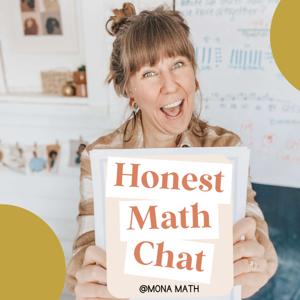
Mona, of Mona Math, reveals the mysteries of how to teach elementary math even if you aren't a math person. Discover how you can develop a buzzing student led math classroom. We cover all things…
1,306 Listeners

2,415 Listeners

111,852 Listeners

56,432 Listeners
424 Listeners
138 Listeners

440 Listeners
643 Listeners
258 Listeners

57,574 Listeners
206 Listeners
41,386 Listeners

19,223 Listeners
81 Listeners

12,466 Listeners