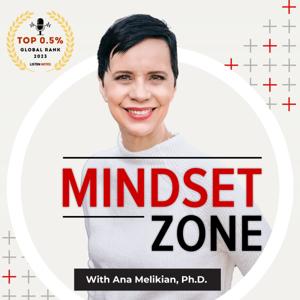
MINDSET ZONE
Download on the App Store

MINDSET ZONE episodes

  • From Affirmations to PowerSongs with Lowry Olafson
    “It's your life. Make it sing.”Lowry Olfson
    Lowry joins me on the podcast to talk about his definition of mindset. He talks about the importance of being aware of your mindset and we discuss what makes a good mindset. We talk about managing your energy to avoid burnout. He explains what PowerSongs are, sharing the story of how he stumbled onto them and explaining why they have the power to transform a mindset. He tells the stories of different people he’s worked with to create their own PowerSongs, and he shares how you can reach out to write one with him yourself.
    This Week on The Mindset Zone:
    Lowry’s definition of mindset.The importance of being aware of your mindset.What makes a good mindset.Managing your energy to avoid burnout.The power of PowerSongs.The meaning of magnificence.What goes into creating a PowerSong.
    The Guest:
    Lowry Olafson has written songs since he was a kid. He has made it as a singer/songwriter, releasing nine albums and touring the globe. As a keynote speaker, Lowry inspires people to be more resilient. He also leverages talent and experience to produce audio branding for businesses and organizations, and he loves to co-create PowerSongs with teams, families, couples, and individuals so that they can connect more deeply with their mission, value, and vision.
    Resources from this Episode:
    Connect with Lowry Olafson: Website | LinkedInLearn more about PowerSong at powersongs.ca
    Related Mindset Zone episodes:
    Shift Your Mindset With Music
    Expand what's possible!
    34 min
  • Is It Mindset or Is It Action?
    Josh Patrick interviews Ana Melikian, Ph.D.
    “There are times when action needs to lead mindset.” Josh Patrick
    In this interview previously aired on Josh’s podcast, we ask the question: which comes first, action or mindset? We define mindset and discuss the difference between worldview and mindset. We discuss the glasses analogy and talk about Carol Dweck’s distinction between growth mindset and fixed mindset. We share how to tell when to improve your strengths and when to improve your weaknesses, and we discuss the importance of a capacity to learn. Josh notes the need to be honest with yourself when assessing your strengths and weaknesses, and we talk about what it means to live your values while running your business.
    This Week on The Mindset Zone:
    Which comes first: action or mindset?Defining mindsetWorldview vs mindsetGrowth mindset vs fixed mindsetWhen to focus on your strengths and when to work on improving your weaknessesTransitioning from the beginning stages of your business to the more advanced stagesLiving your values while running your business
    About Josh:
    Josh Patrick is a dear friend with deep experience as a business consultant and is passionate about helping business owners create extraordinary value with their companies and their lives. Josh is also the author of two easy-to-read and powerful books: Sustainable: A Fable About Creating a Personally and Economically Sustainable Business and The Sale Ready Company: What it Takes to Create a Business Someone Would Want to Own, Even If You Have No Intention of Selling.
    Resources from this Episode:
    Connect with Josh Patrick: Website | LinkedIn | PodcastBooks:Sustainable: A Fable About Creating a Personally and Economically Sustainable Business by Josh PatrickThe Sale Ready Company: What it Takes to Create a Business Someone Would Want to Own, Even If You Have No Intention of Selling by Josh Patrick
    Related Mindset Zone episodes:
    Growth Mindset – Yes, We Can Learn ItThe Power of YET – A Growth Mindset SecretThe Other Side of Mindset Limitations
    Expand what's possible
    34 min
  • Leap Into Your Best Self with Katie Peuvrelle
    “Listen to the still quiet voice in our mind.”Katie Peuvrelle
    Katie Peuvrelle joins me to talk about what it means to leap. She discusses mindset as a belief system and explains why she believes “growth mindset” is a dichotomy. She talks about her book and shares the numerous reasons that skating is an apt analogy to taking a leap in life. She defines multi-dimensional leadership and notes the physical aspect of intuition.
    This Week on The Mindset Zone:
    What is a mindset? How to define mindset as a belief system or philosophy.The dichotomy between mindset and growth, and how to overcome it.How to uplevel our mindsets in whatever were are being, doing, and performing in the world.A space for exploration, rediscovering, and reimagining.Different types of leaps, and jumps we can do in our own mindsets.Multidimensional leadership in the post-COVID world.The concentric spheres model, as an alternative to the top-down or bottom-up linear models.How to cultivate our intuition.Connection with the body.
    The guest
    Katie Peuvrelle is a masterful high-performance coach based in San Jose, California, who works with executives and emerging leaders in big-name companies, as well as, with many startups’ founders, and VCs who are out there leaving their dent in the world. She also loves to work with athletes, from amateurs to Olympians, and professionals who want to take their game to the next level.
    She is the author of "Leap."
    Resources from this Episode:
    Connect with Katie Peuvrelle: website | LinkedInBook: Leap: Own Your Excellence and Engage Your Best Self in Business, Sports, the Arts & Life
    Related Mindset Zone episodes:
    Growth Mindset – Yes, We Can Learn ItThe Power of YET – A Growth Mindset SecretThe Other Side of Mindset Limitations
    Expand what's possible!
    30 min
  • Ana talks Mindsets with CB Bowman
    “In a very bizarre way, I was lucky to experience the racism because, to me, it made me a whole person.”CB Bowman
    CB Bowman joins me to share her story, noting the power of a mindset of undefeatability. She discusses how this mindset brought her through everything from her experiences with extreme racism to the time she took an unplanned, seemingly unrealistic trip to Panama to visit her father unannounced. We discuss the flexibility of mindset, and she notes the difference between diversity and inclusion. We also discuss the importance of bringing distinctive perspectives to the conversation.
    This Week on The Mindset Zone:
    Why we don’t need to be stuck in a mindset.Overcoming odds through an unbeatable mindset.The importance of pinpointing what needs to be fixed.The prevalence of racism, and the different types of racism.The importance of diversity.
    The guest
    CB Bowman is the founder of ACEC, or the Association of Corporate Executive Coaches; the CEO of Workplace Equity and Equality; and was recently selected for the Thinkers50 2021 Coaching and Mentoring Award Shortlist.
    Resources from this Episode:
    Connect with CB Bowman: website | LinkedInCB Bowman LIVE! Challenges of the C-SuiteACEC - Association of Corporate Executive Coaches
    Expand what's possible!
    37 min
  • The Other Side of Mindset Limitations
    In a previous episode, I spoke about “mindset limitations” as some of the beliefs, conscious or unconscious, that constrain the way we see, think, and feel the world around us. I explore some of my own mindset blind spots around the pursuing happiness fallacy.  Here, I want to focus on the other side of mindset limitations.
    The term “mindset” in itself has become very popular. If we google the word, we get more than 150 million results. In Amazon’s books, more than 50 thousand results for "mindset" come up - 20 thousand in book titles. On ListenNotes.com, a great podcast search engine reveals 2,432 with “mindset” in the show title. And I’m thrilled to inform you that at the time of this recording, our very own Mindset Zone, is number two on that list.
    Self-help books, like “The Secret” have popularized the idea that our thoughts are the primary cause of everything. This principle is also core for many high-performance systems. One of my favorites, The 12 Week Year: Get More Done in 12 Weeks Than Others Do In 12 Months, Brian P. Moran explicitly argues “It’s important to understand that the results you achieve are a direct byproduct of the action you take. Your actions, in turn, are manifestations of your underlying thinking. Ultimately, it is your thinking that drives your results; it is your thinking that creates your experiences in life.” In sum, the more prevailing perspectives see our mindsets–the way we think, and the beliefs we have–determining what we do and the results we get. 
    Even the well-researched CBT, Cognitive Behavioral Therapy–a form of talk therapy that has been demonstrated to be effective for a range of problems including depression, anxiety disorders, alcohol and drug use problems, marital problems, eating disorders, and severe mental illness–focuses on changing thinking patterns. A basic CBT technique, originally developed by Albert Ellis, is known as the ABC model, and it assumes our beliefs about a specific event affect how we react to that event, being its goal to help us restructure these beliefs to adapt a healthier response. For instance, you sent an important email out with a proposal that if accepted can help you achieve your goals for your next quarter, but one week has passed and you didn’t get any reply. This can be seen as the Activation event, the A in this ABC model. This situation can lead to negative feelings, emotions, like anxiety, fear, lack of confidence that can lead to procrastination, or inaction. These emotional responses and behaviors are the Consequences, the C in the ABC model. So, the B is at the center of the model and represents the Beliefs that are triggered by A, and are the real cause of C. So, the goal is to change the B, the Beliefs, to change underlying thoughts. So, for example, when you haven’t yet heard back about that proposal, instead of thinking, “How awful! I'm never going to be good at this!” which will most certainly lead to less than optimal feelings, and probably a lack of action. You can disrupt the self-fulfilling prophecy by changing your thoughts.
    Thoughts. Feelings. Behaviors.
    It’s easier to use a linear model to describe what is happening when we are trying to change. Yet, we can argue that this linear perspective is too simplistic, and that doesn’t allow us to see the whole multidimensional picture.
    CBT acknowledges that our thoughts, feelings, and behaviors are all interconnected, but most of the time it focuses on changing thinking patterns first as if that was a unidirectional relationship. But if this was the case, gaining a new insight, or becoming aware of a thought pattern would be enough to change our feelings and behaviors, and we painfully live the reality that it’s not that easy.
    Wouldn’t it be great if an inspiring TED talk was enough to change us? 
    Yes, it can ignite a spark that leads to change, but usually, there are more moving parts involved in the process of lasting change. Many times small behaviors can determine the way we think and feel. Consider the well-documented dopamine hits we get when we see a “Like” on one of our social media posts. We keep looking, waiting to see if there will be another one. So we can continue the high. We rationalize.  We may even say to ourselves, “Likes show that people resonate with my opinion.” Or perhaps the likes feed our beliefs, “Someone cares.” This is an example of how small actions, in this case, looking at our phones, affect the way we think and the beliefs we have. How many of us believe that we must keep our phone around, just in case? How many of us feel anxious when we don’t have our phone at arm’s reach?
    Another example would be, walking in nature or taking a shower. Doing one of these activities can absolutely help us to feel more relaxed, more in tune with nature and our bodies, and open our mind’s eye to new ideas and possibilities.
    The other side of the mindset limitation is that mindset is not the end-all, do-all. Yes, changing our beliefs, our lenses, the ways we see the world, makes a huge difference but we need to do more than that. Mindsets have limitations too. To make things happen, we have to feel the energy and mood that helps us transform and live it in actions day in and day out. And let’s not forget the social contexts and the systems we are part of–but that’s a topic for another episode.
    Sometimes, it’s easier to start with small actions, like exhaling fully, to the point that we activate the muscle in our belly, almost like a kid who is determined to blow out all the candles, even the tricky ones that light up again almost immediately. That simple act has the potential to change the way we feel and think too. Just give it a go.
    Instead of seeing your thoughts, feelings, behaviors in a linear way, many times even in a unidirectional way, I would like to invite you to see them in a triangle, a form of three sides. If a triangle loses one of its sides, it ceases to exist. I even invite you to form a triangle with your hands. Your thumbs can connect to form the base of the triangle, the left fingers together can make another side, and the right fingers make the third side, touching each other at the top to form the triangle. Then you can imagine that one side of this triangle represents your thoughts or mindsets, another your feelings or emotions, and the other your actions or behaviors. You can expand a lot of possibilities this way. 
    Remember the example of the important email that was still unanswered one week later? That can trigger some anxiety, and judgy thoughts towards oneself “You didn’t write a strong enough proposal,” or towards others “How inconsiderate are they?” or even get overgeneralized and impact the way we see the world, “Not fair. This should be easier.” Looking at your triangle, you can start to focus on one action. For instance, breathing out fully–like the kid who is determined to blow those candles–you can let your body inhale deeper. From that place of connection with your breath, you can see things in front of you with more detail, colors look more vibrant. You can remember that stat you heard some time ago, that an average person can receive more than 100 emails per day. Maybe, you decide to send another email, phone or text the person confirming that they received your proposal. Why not?
    After watching an inspiring TED talk or presentation, that elicits an insight or a new awareness, you can consider how that new thought reflects its power on the other sides of the triangle. How that new way of thinking is going to change your energy, how you feel, and how this will impact your day-to-day actions. What daily habits would be helpful to develop and sustain to make that mindset shift stick? And, as you move forward, what will you need to do to sustain the thinking required for the upleveled way you feel? How can you make this new way of being your default? 
    Yes, this is a more complex picture, and it also provides more entry points for change. We know that change is difficult. When the rubber meets the road, it’s easier to go back to old patterns of doing, feeling, and thinking. Yet, we can transform this almost into a game, a sandbox where we play, and try different options–that will expand what’s possible for you, for the ones around you, for the world.
    “Wouldn’t it be great if an inspiring TED talk was enough to change us?”~Ana Melikian, Ph.D.

    17 min
  • Mindset Limitations: Pursuing Happiness
    When we hear the words “mindset limitations” we often think about our beliefs, conscious or unconscious, that constrain the way we see, think, and feel the world around us. These beliefs affect our present reality and also impact what we can envision for the future and the possibilities we chose to explore.
    Often, we are not aware of these limitations. They are mindset blind spots and as such, they are hidden. Sometimes, others can see them, but we don't. It often takes many painful life circumstances to expose them and give us the impetus to change.
    Visual blind spots are great metaphors for our mindset limitations.
    When we are driving and look into the side-view mirrors, we know there is a blind spot that remains, a zone around the car that we have to turn our head to see.
    The eye blind spot is even more amazing. Our eyes have a natural blind spot, the area where the optic nerve exits the eye, that doesn’t have light receptors so, we cannot see any images that fall on that spot.
    When I first learned about the eye blind spot, I wondered why so many of us never become aware of it.
    We usually view with both eyes, so one eye sees the information that falls into the other eye's blind spot, and even when we look at something only with one eye, our brain fills in the missing information – our brain tricks us to see what is supposed to be there. Just google “blind spot test” to find easy-to-follow experiments that expose our visual blind spots.
    It’s truly awe-inspiring how our brain can fill in the information that’s supposed to be there.
    One of my biggest mindset limitations was the belief that one of the noblest goals in life was to pursue happiness. That was the goal I aspired to and was proud of. I consider myself an optimist by nature, always trying to see the silver lining in people and life circumstances. I focus on the positive, and wholeheartedly embrace the study of positive psychology, speaking about it, teaching it, even doing a podcast where most of the topics are about how to cultivate positivity.
    I only very recently realized my blind spot around the concept of pursuing happiness.  If I have this as a goal, by definition I'm always pursuing it, and therefore not enjoying, not being fully happy. This is a great strategy to keep detached from feelings, rationalizing everything, and being dissociated from the present moment. When I started to see my own blind spot, I started to see the possibility of choosing happiness at almost every step of the way. Happiness doesn't need to be a goal; it can be a way of being. Choosing to make lemonade out of lemons, adding some sugar (positivity), and enjoying drinking it! Yes, I was doing lemonade before, but not giving myself permission to flavor it or enjoy it.
    I started to understand why I admired people like Victor Frankl, Nelson Mandela, and the kids playing in the rumbles of a war-destroyed city. I used to ask myself how could they smile?
    Viktor Frankl survived the Nazi concentration camps, where his mother, father, brother, and wife were all killed. Afterward, he wrote “Man's Search for Meaning,” and created Logotherapy, a form of psychotherapy that is focused on the search for meaning.
    Several years ago, I had the opportunity to interview Frankl’s grandson, Alexander Vesely, who describes him as a really interesting person, funny and witty, with a positive energy that would fill the room. I truly admire Viktor Frankl’s zest for life and his belief in the potential in us all.
    Nelson Mandela is another inspiring human being. He spent twenty-seven years in prison fighting apartheid in South Africa. He is known for winning the Nobel Peace Prize and for having a fantastic sense of humor.
    My own personal hero, my husband’s grandmother, Armen Melikian lived through the Armenia genocide in 1915–only she and her mother in her family of ten survived the killing and expulsion of the Armenian population from Turkey. She came to the United States in 1923, married, and endured the Great Depression with a young son. Only 4'10" in height, full of energy, and with a dynamic personality and biting sense of humor. On her 100th birthday, surrounded by family and friends, she grabbed the microphone and told one of her favorite jokes.
    All these amazing people had such difficult life circumstances, yet they seized every opportunity to enjoy living.
    I had to overcome two bouts with cancer to learn that pursuing happiness is a fallacy. During my first go-around with cancer, I was diagnosed with Inflammatory Breast Cancer, a rare form of cancer (representing 1 to 5% of all breast cancers) with a 5-year survival rate of 41%. Six years later, I’m healthy and strong and choosing to be happy. Grateful for the advances in medical treatments, I embraced my healing journey with all my strengths. At the time my mindset was, I can beat this with all my might, my strength, and determination. I came to understand, first-hand, what it is to fight cancer. I did it, I won the battle. 
    Two years later, when I was allowing myself to relax and start to enjoy life again, I found another cancer on my left breast. This time a more common type that represents 70 to 80% of all breast cancers, Invasive Ductal Carcinoma. I embraced my healing journey and treatments again, but my mindset had shifted. I realized that feeling betrayed by my body–and going to war against it–wasn’t the most effective way to heal it. I decided to embrace what was my current reality and treat my body like the amazing ally it was to help me get through to the other side….and perhaps most importantly I decided to stop the “When… Then…” cycles, I chose to learn how to flavor happiness. Even in the midst of cancer, I decided to make the best out of it. For instance, for the chemo, I requested to be seated in the treatment chair in front of the window with magnificent views of the Arizona desert. When all the food tasted like cardboard, I still set the table nicely to enjoy dinners with my family. We even created a ritual of sharing what we are grateful for that day before we start eating. Nowadays, when my 12 years old daughter’s best friend dines with us, my daughter loves to try to list as many thankfulness items as possible, and that truly makes my heart sing.
    The COVID19 pandemic has been an awakening to so many of us. Yes, some are still holding their breath waiting for life to go back to normal. Others dealt with “lockdowns” by communing with nature, rediscovering a latent creativity, writing that book, picking up that paintbrush, enjoying that favorite room in the house, or embracing extended time with family.
    Whatever your circumstances:
    What mindset limitations did these crazy times reveal to you?
    Were blind spots exposed to light?
    What can you learn about yourself, the ones around you, and the world?
    Can you train yourself to focus on the good stuff?
    Can you train yourself to enjoy, to flavor every bit of the good stuff?
    What strengths can you develop to help you be more resilient?
    What inspiring action can you take to be happier and live a more meaningful life?
    “Happiness doesn't need to be a goal; it can be a way of being.” Ana Melikian, Ph.D.
    15 min

About MINDSET ZONE

From the publisher's feed

Our mindsets determine the way we see the world, as well as, the way we behave and who we are as people. It’s very easy and normal to stay stuck in fixed mindsets – limiting beliefs about our…

More shows like MINDSET ZONE

The One You Feed | Personal Growth, Emotional Resilience & Purpose by Eric Zimmer

The One You Feed | Personal Growth, Emotional Resilience & Purpose

2,590 Listeners

Happier with Gretchen Rubin by Gretchen Rubin / The Onward Project

Happier with Gretchen Rubin

12,890 Listeners

Untangle by Untangle

Untangle

828 Listeners

The Psychology Podcast by Scott Barry Kaufman

The Psychology Podcast

1,797 Listeners

The Life Coach School Podcast by Brooke Castillo

The Life Coach School Podcast

8,778 Listeners

The Terri Cole Show by Terri Cole

The Terri Cole Show

1,410 Listeners

The School of Greatness by Lewis Howes

The School of Greatness

21,054 Listeners

The Marie Forleo Podcast by Marie Forleo

The Marie Forleo Podcast

1,637 Listeners

Kwik Brain with Jim Kwik by Jim Kwik, Your Brain Coach, Founder www.KwikLearning.com

Kwik Brain with Jim Kwik

4,827 Listeners

Oprah's Super Soul by Oprah

Oprah's Super Soul

31,724 Listeners

Extraordinary Minds by Vishen Lakhiani

Extraordinary Minds

1,275 Listeners

On Purpose with Jay Shetty by Perfect Strangers

On Purpose with Jay Shetty

27,826 Listeners

Meditative Story by WaitWhat

Meditative Story

3,064 Listeners

The Daily Motivation by Lewis Howes

The Daily Motivation

914 Listeners

The Mel Robbins Podcast by Mel Robbins

The Mel Robbins Podcast

19,273 Listeners