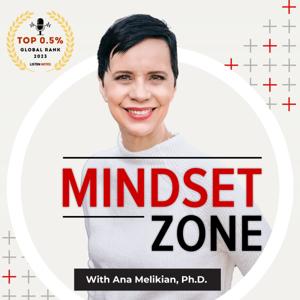
MINDSET ZONE
Download on the App Store

MINDSET ZONE episodes

  • The Courage Mindset with CB Bowman
    “My intent is not to shame or blame. My intent is to create awareness.”CB Bowman
    Today, CB joins me to redefine courage. She explains that our classic understanding of courage is too lofty and unattainable and that the real thing is much more down-to-earth. She gives examples of everyday tasks that take courage and defines courage as the ability to act despite adversaries and despite supporters.
    She notes the importance of creating awareness, and she posits that everyone holds responsibility for how what they say comes across to others. She also introduces her 6-step process of courage.
    This Week on The Mindset Zone:
    Redefining courageThe different parts of the world we live in that require courageThe importance of being aware of how your actions come across to othersThe 6-step process of courage
    The Guest:
    Meet CB Bowman, MBA, the host of the "Courage: To Leap & Lead” videocast & podcast. CB is a Certified Master Corporate Executive Coach with 20+ years of experience working in marketing, coaching, and branding. Her keynote, "The Courage to Leap & Lead" inspires others to go for the gold by finding courage through simple solutions to complex problems, by re-envisioning how we think about courage in terms of profitability, and a willingness to see failure as a success. CB was named one of the Power List of the Top 200 Biggest Voices in Leadership in 2022 by Leadershum; Top 50 Coaches in the World by Thinkers50; Global Gurus also named her as one of the top 15 experts in branding and ranked by Marshall Goldsmith Top Global Coaches as the #1 coach for increasing the quality of coaching. She is also a Member of MG100.
    Resources Mentioned:
    Connect with CB Bowman: LinkedIn | WebsiteBook recommendation: It's the Little Things: Everyday Interactions That Anger, Annoy, and Divide the Races by Lena WilliamsRelated Mindset Zone episode:Ana Talks mindsets with CB Bowman
    Expand what's possible!
    28 min
  • The Howard Stern Show – How to Show Up and Create a Best Selling Book: A True Story by Debbie Allen
    "You’ll never have it perfect. You just have to jump in sometimes with as much knowledge as you have, and go from there."Debbie Allen
    Today, Debbie returns to the show to share her story—in particular, the story of how she got on the Howard Stern Show. She talks about how to toot your own horn and stand up for yourself and shares the story of how she challenged Howard on the air.
    She notes the value of asking: what do I have to lose? She also shares what she learned about entrepreneurship with and from her dad in his successes and failures.
    This Week on The Mindset Zone:
    Debbie’s story of being on the Howard Stern ShowStanding up for yourselfThe value of asking what you have to loseLessons in entrepreneurshipWhy you shouldn’t wait for the perfect moment to jump in
    The Guest:
    The World’s #1 Authority on Expert Positioning, Debbie Allen—AKA The Expert of Experts—is an internationally recognized business growth and market positioning expert. She has been a professional speaker and business mentor for 25 years and has presented before thousands of people in 28 countries. Debbie is a bestselling author of 9 books including Confessions of Shameless Self-Promoters and Success is Easy. She also hosts the Access to Experts Podcast, is VIP Contributor for Entrepreneur Magazine, and is an award-winning entrepreneur who has built and sold numerous million-dollar companies in diverse industries. She has appeared on the Howard Stern Show.
    Resources Mentioned:
    Connect with Debbie Allen: Website | LinkedInTwo of Debbie's books:Confessions of Shameless Self-PromotersSuccess Is Easy: Shameless No-Nonsense Strategy to Win in BusinessRelated Mindset Zone episodes:Success is Easy with Debbie AllenGrowth Mindset – Yes, We Can Learn It
    Expand what's possible!
    27 min
  • A Woman’s Mindset Development with Clementina Esposito
    “Not everybody is willing to do that work, but until we really stand for ourselves and for what is real-unconditional love-all the other changes will be very hard-pressed to stick.”Clementina Esposito
    Today, Clementina joins me to share her story. We discuss the no-win situation many women find themselves in, talk about the power of dress, and explore how to create a space to talk about gender equality.
    We note the importance of getting rid of shame and blame, discuss the power of curiosity, and emphasize the importance of being patient and accepting when stories are shared.
    This Week on The Mindset Zone:
    Finding your way out of a no-win situationCreating a space to talk about gender equalityThe nuances of the gender conversationGetting rid of shame and blameThe power of curiosity in constant learningThe importance of patience and acceptance
    The Guest:
    Clementina Esposito is the founder of The Clementina Collective, where no one writes alone, everyone values the power of a well-told story, and ugly truths become beautiful in “the end.”  She teaches Authors and Entrepreneurs at the intersection of business, health, and spirituality to find their voice, speak their truth, and heal the wounds that keep them from expressing themselves. Equally and rigorously trained in business and creative writing, Clementina was an English professor for 20 years before starting her own business. Her deep reverence for the coupling of story and strategy is what energizes the results-driven, intellectually sound, emotionally resonant, and instinctively true-to-voice content she helps clients create. Skilled at delivering feedback with energy and passion that makes the next steps clear, Clementina helps the people who work with her stay the course to excellence while making much more efficient use of time, energy, and emotion in the process.
    Resources Mentioned:
    Connect with Clementina Esposito on LinkedInVisit her website at clementinacollective.comRead her article Open Letter Ms. Wenger #Ilooklikeanengineer
    Expand what's possible!
    34 min
  • The Art of Supportive Confrontation with Flip Brown
    “You can’t grow your business without growing yourself.”Flip Brown
    Today, Flip joins me to talk about supportive confrontation. He notes that, contrary to popular belief, confrontation can be a good thing. He points out that no one can make a person feel anything, and he distinguishes between happiness and other similar states such as contentment or fulfillment.
    He defines business culture and explores what’s behind the Great Resignation. He shares what James Taylor said about the secret to life, and he discusses the importance of taking care of our planet.
    This Week on The Mindset Zone:
    Supportive confrontationWhy confrontation can be a good thingWhy no one can make you feel anythingThe importance of working from the presupposition that everyone has good intentHappiness vs. contentment vs. fulfillmentBusiness culture and what people look for in itThe Great ResignationThe importance of taking care of the planet
    The Guest:
    Flip Brown is the founder and owner of Business Culture Consultants and the author of Balanced Effectiveness at Work: How to Enjoy the Fruits of Your Labor without Driving Yourself Nuts. Flip’s work is based on the belief that our work can serve to unlock our human potential and produce greater meaning and fulfillment. He assists his business and individual clients to help them see, change, and integrate their patterns of communication, interaction, and behavior. He draws from his extensive experience over five major careers in business, nonprofit management, psychology, teaching, and coaching. He also incorporates being a craftsman, musician, and gardener. Flip subscribes to the philosophy that business should be a force for good, and his company is a Certified B Corp and a member of 1% for the Planet and Vermont Businesses for Social Responsibility. He loves his job.
    Resources Mentioned:
    Connect with Flip Brown on LinkedInVisit his website at businesscultureconsultants.com/Read his article The Art of Supportive ConfrontationBuy his book Balanced Effectiveness at Work: How to Enjoy the Fruits of Your Labor without Driving Yourself Nuts
    Expand what's possible!
    30 min
  • Beyond Optimism & Resilience with Janice Perkins
    “Authentic optimism is a deep-seated mindset and a daily practice that, over time, means that I face things looking for something good to come from it, even when it’s a setback or a trauma. And I think all of those things come from that deep well of hope.”Janice Perkins
    Today, Janice joins me to talk about optimism versus hope. She talks about what authentic optimism really means, noting that it needs to be founded in a deep well of hope. She notes that hope can coexist with trauma and sadness, and she shares her BRIGHT acronym.
    Janice explores what makes a good support system, observes the importance of stubbornness, and points out that your legacy will be the impact you leave on people. We discuss the difference between “critical” and “urgent”, and she notes the importance of figuring out how you personally define “important”.
    This Week on The Mindset Zone:
    Optimism vs hopeWhy hope can coexist with traumaThe BRIGHT acronymWhat makes a good support systemBuilding authentic positivity and hopeThe importance of stubbornnessLetting go of dead yesterdays and unborn tomorrowsCritical vs urgent
    The Guest:
    Janice Perkins, MBA is an international speaker, trainer, and leadership coach. She is known as the Leadership Warrior who liberates hope-inspired capacity for individuals, teams, and organizations. Janice is the founder of Capacity Communications where she helps people get out of their own way for larger impact and higher innovation. She also hosts the Methods of Leaders webinar series with Marshall Goldsmith and the MG 100 Coaches program. Janice is very active in her local community, being a board member of Global Connections for Women Foundation (GC4W), on the advisory board for the NXTUS organization which helps connect startups to investors and pilot partners from around the globe, a board member of the Wichita Independent Business Association (WIBA) and a member of Women of Wichita which unites the power and donations of women back into our community.
    Resources Mentioned:
    Connect with Janice Perkins: ihavecapacity.com | LinkedIn
    Expand what's possible!
    34 min
  • Change is a Messy Journey: From Wall Street to New Hope with Irma Jennings
    “It’s these magic moments that drop in and say, ‘It’s time to go left now.”Irma Jennings
    Today, Irma joins me to share her story. She talks about how she got involved in Wall Street in the first place and gives an insight into what it was like to be a woman on Wall Street in the 1970s.
    She notes the power of curiosity, talks about being a good parent while working, and discusses handling the messiness of life.
    Irma also shares how she pivoted from trading to identifying food as medicine and the ensuing lessons she learned.
    This Week on The Mindset Zone:
    How Irma got involved in Wall StreetBeing a woman on Wall Street in the 70sThe power of curiosityBeing a good parent while workingIdentifying food as medicineHandling the messiness of changeThe power of resilience
    The Guest:
    Irma Jennings, INHC, Holistic Bone Coach, went from the boardroom on Wall Street to the cutting board in her kitchen to pursue her true passion, Food for Healthy Bones®.  She has never looked back. Irma earned her certification from the Institute for Integrative Nutrition, continued her studies with extraordinary "Food as Medicine” teachers around the world in India, Bali, Costa Rica, and Thailand. She keeps learning more every day to help women with osteopenia and osteoporosis navigate these diagnoses, treatment options, as well as, how to eat (and live) healthier to strengthen their bones (and themselves) from the inside out. Irma sees clients privately (in person and on zoom) and has a thriving community, Bones Tribe, where members exceed their expectations about living vibrant lives.
    Resources Mentioned:
    Connect with Irma Jennings on LinkedInFind great resources on her website: https://food4healthybones.comCheck her out on the PBS special, “Stronger Bones, Longer Life” with Dr. Lani Simpson where she showcased Food for Healthy Bones.You can check out her “Food Stamp Challenge” blog where she’ll show you how to feed your bones for less than $5.00 a day.
    Expand what's possible!
    35 min
  • From Fear to Greatness with Izabela Lundberg
    “For me, there was no option of ‘Can I? Should I?’ I just did it.”Izabela Lundberg
    Today, Izabela joins me to share her story, discussing how her experience escaping the war zone of the Yugoslav Wars with her sister helped to prepare her for the work she does with organizations and leaders today. She talks about the turning point that occurred with her father’s dying words, notes the power of following your instincts when it comes to defeating fear, and emphasizes the importance of embracing change.
    We talk about the problem with directly comparing your struggles to others’, and Izabela discusses how to overcome the fear of being rejected.
    This Week on The Mindset Zone:
    Izabela’s storyThe power of following your instinctsIzabela’s experience coming to the USHow Izabela’s experience prepared her for her work todayEmbracing changeExamining your fear
    The Guest:
    Izabela Lundberg hosts the Legacy Leaders Show, a top-rated global business and entrepreneurship podcast offering real and raw business, sport, and life lessons with practical advice for current and upcoming leaders. Izabela's superpower is working with leaders and organizations ready to disrupt the status quo, take risks, and lead like a champion while solving, transforming, and accelerating the expansion and growth of their thriving teams and organizations. She has a dynamic worldview after living in six countries, speaking six languages, and traveling to over 50 countries working with diverse organizations. Izabela is a recognized catalyst of sustainable solutions for global leaders and their most pressing challenges.
    Resources Mentioned:
    Connect with Izabela Lundberg: Website | LinkedInRecommend book: The World Messenger: From Fear to Greatness: Business, Sports & Life Lessons by Izabela Lundberg
    Expand what's possible!
    31 min
  • Spiral Dynamics Leadership Mindset with Natasha Todorovic
    “Defining a belief is filling in the gap between knowing and not knowing.”Natasha Todorovic-Cowan
    Today, Natasha joins me to talk about Spiral Dynamics®. She explains what it is and why it’s important, sharing clients’ stories. She discusses relationship systems, explaining why they’re important for mutual understanding as we change, evolve, develop, and grow.
    Natasha shares her experience and memories of former Yugoslavia. She offers her tips on navigating the change and disruption caused by Covid-19, notes the importance of asking how other people hold their beliefs and shares her 5 Point Model of Change.
    This Week on The Mindset Zone:
    What is Spiral Dynamics®Human nature and how we change, evolve, develop, and growWhy we need to see each other in systems instead of transactionallyNavigating Covid 19 disruptionsThe 5 Point Model of Change
    The Guest:
    Natasha Todorovic-Cowan is the CEO and co-founder of the National Values-Center Consulting (and owner of Spiral Dynamics® brand). For over 25 years, she has been working with leaders, consultants, coaches, and organizations applying her proprietary Spiral Dynamics® cultural DNA survey, leadership assessments, and change readiness index to predict hurdles to change. Her techniques for handling corporate change are rooted in 70 years of research and application in a variety of industries and sectors. She has delivered over 200 Spiral Dynamics® certification programs in 14+ countries and on 5 continents! She has spoken at the World Future Society Conference on the future of work and running online programs since 2010, helping people connect and understand human factors through technological tools as well as in person.
    Resources Mentioned:
    Connect with Natasha Todorovic-Cowan: spiraldynamics.org | LinkedInRecommend book: Levels of Human Existence
    Expand what's possible!
    34 min
  • Cultivating Innovation with Libba Pinchot, Ph.D.
    “The antidote is action.”Dr. Libba Pinchot
    Today, Dr. Pinchot joins me to talk about how we can help people cultivate innovation. She defines innovation, explaining why it’s not top-down.
    We discuss the mindset of innovation and talk about the different types of failure, noting that some failure is good and acceptable. We talk about the price of disengaged employees and share some statistics on the mindset of today’s youth.
    Dr. Pinchot notes the need for integrity in companies, emphasizes the importance of avoiding blaming and shaming, and posits that people are basically good.
    Scroll down for the transcript...
    This Week on the Mindset Zone:
    Cultivating innovationThe definition of innovationWhy innovation isn’t top-downWhy the mindset doesn’t just reside in the individualThe different types of mistakesHow the definition of intrapreneurship has changed over the yearsThe definition of integrity
    The Guest:
    Dr. Libba Pinchot is a nationally recognized expert in helping leaders achieve triple bottom line success (Profit, People, Planet) through widespread innovation and intrapreneurial engagement. She specializes in creating organizational transformations designed to spread throughout the company, the supply chain, and well beyond. She loves working with extraordinary leaders and organizations dedicated to making people and the world better. She has worked with companies such as Apple, IBM, Intel, HP, Texas Instruments, DuPont, Exxon, GE, P&G, J&J, Ford, and Stanford University.
    Resources Mentioned:
    Connect with Libba Pinchot: Intrapreneur.com | LinkedInBook recommendation: Intrapreneuring in Action: A Handbook for Business InnovationArticle: Young People's Voices on Climate Anxiety, Government Betrayal, and Moral Injury: A Global Phenomenon.
    Summary transcript of the interview:
    Ana Melikian: Dr. Libba Pinchot is a nationally recognized expert on helping leaders achieve triple bottom line success through widespread innovation and intrapreneurial engagement. It’s truly my pleasure to have you here in the Mindset Zone podcast to speak about how can we help people cultivate innovation and seems logical that the first question to be: how do you define innovation?
    Libba Pinchot: Thank you so much, Ana. The simplest definition is meeting the needs of the future starting now. The point about innovation is that there was a long tradition of innovation being very top-down in these big organizations. And it wasn't very successful because in actual fact the number of people in the organization, the number of brains in the organization, are spread throughout the employee base. Everybody has an opportunity to improve the way work is done, how the customer is served, how other employees can benefit, how communities and societies can benefit, and so. Innovation isn't top-down. Everyone sees ways that they can improve things. And if they're engaged and supported in making changes, that benefit both the company and the future and society, they love coming to work, being able to innovate.
    Ana Melikian: I love that. So, it's not so much about gaskets or technology, but about a mindset of innovation.
    Libba Pinchot: It is about the mindset of innovation. I'm in the right place. I see.
    Ana Melikian: Yes. I love it. Innovation as "meeting the needs of the future." And by tapping into the collective, not just the leaders of the organization, but truly the collective of all stakeholders it may be possible to be in sync with what is going to happen in the future to be able to meet those needs. Is that the idea?
    Libba Pinchot: Yes. The mindset isn't just residing in the individuals, whether they're an innovation specialist or sustainability specialist, or just all of us average people who have jobs in companies. The innovation is in a context with a lot of barriers in it. For example, there's a drive in all companies that everything has to be profitable. To get the resources, to make an innovation, you often have to prove that it will be profitable, which is really hard to do ahead of time. That's a barrier and the short-term focus of companies and they really are not used to investing in things that have a long payoff. And yet, if you're meeting the needs of the future, a lot of those things will have to have a long term payoff. And there are the internal silos: the finance people, the sustainability people. They now work together, but it's not necessarily official. And then there's the individualism in this idea of what a firm is. That's a mindset: that a firm is supposed to be competitive with all the other firms, and it's not necessarily supposed to be part of the community and so forth. And yet some of the biggest cost savings around sustainability have been when people in organizations have gotten together and done some long-term purchases of power and save millions and millions of dollars, so that the Finance people say, "Oh, my God, this is so incredible. Would you please do more," but that's across organizational endeavor that kind of breaks the rules.
    Ana Melikian: One of the definitions of mindset is that the beliefs, conscious and unconscious, that an individual or organization has determined the way they see the world, the way they behave. So, by creating and cultivating a place that allows innovation, new solutions can come up. If they see challenges as an obstacle that they cannot solve, there is not much room for innovation, but if they see them as something they can expand possibilities and play with, maybe some innovative solution can be generated.
    Libba Pinchot: Yes. And, the context that the leadership creates. It's the culture that the leadership creates so that people are actually allowed to make mistakes. Failing your way to success, you learn. Are the mistakes above the waterline or below the waterline? Think of a boat and drilling a hole in a boat. Is it above the water line or below? You don't have the authorization to make a mistake that would harm the company, but you do have the authorization to make some little mistakes.
    Ana Melikian: So, to cultivate this innovation mindset in the organization and individuals, there has to be room for playing, room for exploring.
    Libba Pinchot: Yes, and that has to be the culture of the company, which is true in some companies, but not all of them. Paul Polman who was CEO of Unilever and wrote this book called "Net Positive" with Andy Winston, had a blog today where he said, that it's the employees that are going to be the key accelerator of getting business to be more environmental and more ethical. He said, what if CEOs treated their employees with the same respect that they treat their investors; and build a purpose-driven culture. So, when I'm talking about a culture, it's a culture that is very employee-focused.
    Employees seem to have a more accurate view of what's going on in companies. If three-quarters of the leaders say, “Oh, we're doing everything we can for climate change” for instance, only half of the employees agree with that. And if three quarters say that the leaders put the same emphasis on sustainability as profit, only half the employees believe that. Yet, two-thirds of the employees - this was in 2017, I bet, it's way more now - two-thirds of employees say that they want their employers to more actively address social and environmental issues. And when you look at the great resignation that's going on – and I believe so much of it is people who have had an illness and inadequate daycare and inadequate social support – there are companies that are waking up to the fact that they're losing talent because they do not have a purpose-driven company.
    Ana Melikian: And I think this is an opportunity. I think if we apply innovation to the great resignation situation is also an opportunity to come up with many changes.
    Another concept that I think you are the originator of, that connects with this beautifully, is the concept of intrapreneurship. Can you tell us a little bit about it?
    Libba Pinchot: Intrapreneurship is a concept we've been talking about for 35, 40 years, and it's changed over time. Originally, these innovators who saw an idea, gather a team, and they always would have to find a sponsor because you can't get resources unless you have someone who's a little higher up and you have to be protected from the hierarchy. And they would get together and do a project. You can look at the history of the wonderful things, whether it's the scotch tape I have in my hand, or some wonderful technology or health care innovations. It often would come out of an informal team called intrapreneurs. We would do training and train the sponsors and train the intrapreneurs on how to basically have a small business within the organization. So, they had to learn to do all the aspects of a business. And although they didn't take home the profits at the end of the day, the company got stronger and they were so thrilled to be able to have that independence, to put their ideas into play. Nowadays we actually need that intrapreneurial spirit spread throughout the organization, in part, because the change that's required, the innovation that's required, given the incoming change in society and the planet requires so much innovation. And plus, people are not settling for just being cogs in the wheel.
    Ana Melikian: It's almost that now intrapreneurship has to be part of the culture.
    Libba Pinchot: That's right.
    Ana Melikian: And, going back again to create that safe place, to play, to try new things, to fail forward and, and to make mistakes in a context that allows innovation and that allows people to try new things.
    Libba Pinchot: One thing I've been thinking about in the last three or four months is the price of disengaged employees, the price of inaction. It's a psychological price too. We have a lot of despair in society now for very legitimate reasons,...

    32 min

About MINDSET ZONE

From the publisher's feed

Our mindsets determine the way we see the world, as well as, the way we behave and who we are as people. It’s very easy and normal to stay stuck in fixed mindsets – limiting beliefs about our…

More shows like MINDSET ZONE

The One You Feed | Personal Growth, Emotional Resilience & Purpose by Eric Zimmer

The One You Feed | Personal Growth, Emotional Resilience & Purpose

2,587 Listeners

Happier with Gretchen Rubin by Gretchen Rubin / The Onward Project

Happier with Gretchen Rubin

12,884 Listeners

Untangle by Untangle

Untangle

828 Listeners

The Psychology Podcast by Scott Barry Kaufman

The Psychology Podcast

1,797 Listeners

The Life Coach School Podcast by Brooke Castillo

The Life Coach School Podcast

8,778 Listeners

The Terri Cole Show by Terri Cole

The Terri Cole Show

1,410 Listeners

The School of Greatness by Lewis Howes

The School of Greatness

21,048 Listeners

The Marie Forleo Podcast by Marie Forleo

The Marie Forleo Podcast

1,638 Listeners

Kwik Brain with Jim Kwik by Jim Kwik, Your Brain Coach, Founder www.KwikLearning.com

Kwik Brain with Jim Kwik

4,826 Listeners

Oprah's Super Soul by Oprah

Oprah's Super Soul

31,730 Listeners

The Mindvalley Podcast by Mindvalley

The Mindvalley Podcast

1,275 Listeners

On Purpose with Jay Shetty by Perfect Strangers

On Purpose with Jay Shetty

27,762 Listeners

Meditative Story by WaitWhat

Meditative Story

3,064 Listeners

The Daily Motivation by Lewis Howes

The Daily Motivation

915 Listeners

The Mel Robbins Podcast by Mel Robbins

The Mel Robbins Podcast

19,254 Listeners