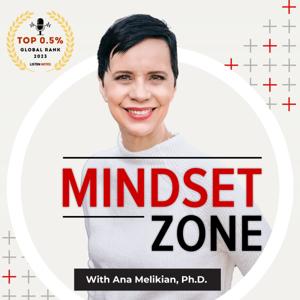
MINDSET ZONE
Download on the App Store

MINDSET ZONE episodes

  • From Resistance to Embracing Mel Robbins #5SecondRule
    “You were inspired by somebody and you have a request? Make it! That's why you're here! Experiment with it, and I think you'll be shocked about what happens."Mel Robbins
    Sometimes we humor our knee-jerk reactions of resistance too much. In this episode, I talk about Mel Robbins’ The 5 Second Rule, explaining why and how to listen more to our good impulses before doubts have a chance to creep in.
    I summarize Mel’s thesis that, if you don’t physically act on an impulse within five seconds, you kill it. I explain why I initially resist her message and why I’ve been converted. I note the power of counting backward, explaining why it’s effective, and I explore the different ways to use the #5SecondRule.
    This Week on The Mindset Zone:
    Mel Robbins’ 5 Second RuleWhy your problem isn’t that you don’t have enough ideasWhy counting down to the moment of action is effectiveThe different ways to use the 5 Second RuleHow a triangle can help us change
    Resources Mentioned:
    The 5 Second Rule by Mel RobbinsMel Robbins: How to Stop Screwing Yourself Over
    Expand what's possible!
    Transcript of this episode:
    I still remember clearly, walking down the stairs in my family house where I grew up in Portugal, thinking about something I wanted to do. 
    Without saying anything to my mom about my desires she would somehow suggest the same thing I had been thinking.
    And just like that, her suggestion was the kiss of death to my desire. Maybe this is typical teenage resistance. Annoying as it must have been to my mother, perhaps my resistance was good, a sign I  wanted to create my own way and identity. 
    Fast forward to the present time, now in my late forties, I still sometimes get the knee-jerk reaction of resisting things that are good for me.
    In 2021, I had come across the work of Mel Robbins several times, by references to her book "The 5 Second Rule," her keynotes, or interviews she did in podcasts and other media. My first impression of Mel was very positive. I like her high energy and go-getter attitude. My curiosity was further sparked by her telling the story that her 5-second rule was almost an after-thought to end her now-famous TEDx "How to stop screwing yourself over." So, I decided to watch it. I thought she had done a great job and found the 5-second rule concept interesting. Mel explains:
    "If you have one of those little impulses that are pulling you, if you don't marry it with an action within five seconds, you pull the emergency brake and kill the idea. Kill it!
    If you have the impulse to get up and come dance while the band is playing, if you don't stand up in five seconds, you're going to pull the emergency brake.
    If you have an impulse about, you were inspired by somebody's speech today, and you don't do something within five seconds – write a note, send yourself a text –anything physical to marry it with the idea, you will pull the emergency brake and kill the idea."
    She follows up by saying, and I absolutely love this part:
    "Your problem isn't ideas. Your problem is you don't act on them.
    You kill them. It's not my fault. It's not anybody's fault.
    You're doing it to yourself. Stop it!"
    Then, she goes on to challenge the audience:
    "I want you to practice the 5-second-rule. You see somebody and you think you have an impulse, they look interesting? Walk over there!
    You were inspired by somebody and you have a request? Make it! That's why you're here!
    Experiment with it, and I think you'll be shocked about what happens."
    I love this challenge to action. It's a great example of how we can start the change process through a simple act - just doing it!
    But do you need a book, a 240-page book to explain what Mel did so clearly in 2-minutes in her talk?
    So, I initially resisted getting the book, but because references to it keep popping up in several places, and Mel Robbins is one of the most sought-after motivational speakers in the world, and the book sold over a million copies and was translated at least into 32 languages, I decided to listen to it in Audible.
    I love her story, how Mel discovers the 5 Second Rule, and the realization that knowing what you need to do isn't enough to create change. As I like to say, insight is not enough.
    It was powerful to listen to how she struggled to get out of bed each morning. How she never felt like getting up, how hitting the snooze button was a habit so difficult to break, and how the 5-second rule changed that.
    It was interesting to learn how research supports the 5-second rule, the moment you have the instinct to act on a goal that is important to you, you can count backward 5-4-3-2-1 and physically move or your brain will stop you with excuses, fears, and anxiety.
    As Mel put it:
    "Whenever you feel an instinct fire up to act on a goal or a commitment, or the moment you feel that yourself hesitate on doing something and you know you should do, use the Rule. Start by counting backward to yourself: 5- 4- 3- 2- 1. The counting will help you focus on the goal or commitment and distract you from the worries, thoughts, and fears in your mind. As soon as you reach “1,” move. That’s it. It’s so simple but let me hammer this home one more time. Anytime there’s something you know you should do, but you feel uncertain, afraid, or overwhelmed…just take control by counting backward 5- 4- 3- 2- 1. That’ll quiet your mind. Then, move when you get to “1.” "
    It all made sense, but I kept resisting, with a startling resemblance to my teenager self’s defiant and annoying "I can do better" attitude. I have two masters and a Ph.D. in Psychology. I'm a Board Certified Coach and an expert in human potential, I know many different avenues of helping people change. This can be one way, but there are other ways too. Sure, but the reality is that even being able to wake up early, I couldn't break my habit of hitting the snooze button, and the idea of implementing the 5-4-3-2-1-launch out of bed to begin my day started to grow on me.
    So, more than halfway through the book I decided to give it a try. Why not? And, guess what? It worked! And 30 days later it still works!
    The proof was in the pudding.
    I wake up earlier without hitting the snooze button, started owning my mornings–another concept from the book.
    Suddenly, I had time to do yoga, and start running again.
    Powerful stuff. Why had I resisted so long?  I began to recriminate myself but recognized I was falling into the trap of my critical voices, so I decided to use the 5-second rule in a different way: 5-4-3-2-1-be gentle with myself.
    I'm now embracing the 5-second rule to help me stop and start all kinds of things and that's what counts.
    I often invite people to see their thoughts, feelings, and behaviors as a triangle, instead of seeing them in a linear, unidirectional way. Imagine a triangle with one side representing our thoughts or mindsets, another our feelings or emotions, and the other our actions or behaviors.  If a triangle loses one of its sides, it ceases to exist. 
    The same thing is true of the change you want to create in your life. 
    Change happens when you think, feel, and act it into being so. And you can start the change process by entering any of these three sides in any order at any time, and shifting one side will change the other sides too. The 5-second rule is a great example of starting the change process with a simple action that can lead to a powerful mindset shift. And, we can expand a lot of possibilities this way.
    As Mel Robbins says it:
    “Just Do It” is a concept—it’s what you need to do. The #5SecondRule is a tool—it’s how you make yourself do it.
    So if you feel inspired to know more about the 5-second rule, go ahead and get the book, or go listen to Mel's TEDx. Just 5-4-3-2-1-and expand what's possible!

    14 min
  • Success is Easy with Debbie Allen
    “Every business I’ve ever started, I knew nothing about…it just shows, if you’re passionate about wanting to learn something, you can learn it.”Debbie Allen
    Today, Debbie joins me to share her story. She talks about the importance of the learning journey, shares why she moved from entrepreneurship to coaching and mentoring and notes the importance of putting one foot in front of the other.
    She discusses why she decided to write her most recent book, explaining why success is easy and noting that all you need to do to succeed is be willing to learn.
    She emphasizes the power of coaches and mentors, and we discuss growth mindset. She notes the importance of having a backup plan, explains why failure is a lesson, defines success, and shares how to know if you’re on the wrong path.
    This Week on The Mindset Zone:
    The need for a sharp mindsetThe importance of putting one foot in front of the otherThe power of coaches and mentorsGrowth mindsetThe importance of backup plansFailing forwardWhy it shouldn’t be hard to be successfulHow to know when it’s time to switch gears
    The Guest:
    Debbie Allen was an entrepreneur at 19, and over the course of her career, she has built and sold several billion-dollar businesses. She is an accomplished speaker and the author of nine books, her latest being Success Is Easy: Shameless, No-nonsense Strategies to Win in Business.
    Resources from this Episode:
    Connect with Debbie Allen: Website | LinkedInDebbie's book: Success Is Easy: Shameless, No-nonsense Strategies to Win in Business by Debbie Allen
    Related Mindset Zone episodes
    Growth Mindset – Yes, We Can Learn It
    Expand what's possible!

    27 min
  • Success is Easy with Debbie Allen
    Debbie Allen was an entrepreneur at 19, and over the course of her career, she has built and sold several billion-dollar businesses. She is an accomplished speaker and the author of nine books, her la
    27 min
  • Life is Two Days…
    Tommy Acierno Interviews Ana Melikian, Ph.D.
    “Life is two days, and the first we spend waking up.”Ana Melikian, Ph.D.
    In this rebroadcasted episode, Tommy and I have a conversation about how our mindsets influence our relationships, career, and success. We note that to create real, sustainable, and lasting change, it’s up to us to align our mindsets with a sound strategy and take actions to implement it.
    We note a line from a Portuguese song, discussing what it means to wake up, why we have multiple “wake-ups” in our life, and what to do about it.
    This Week on The Mindset Zone:
    The influence of mindsets on relationships, careers, and successes.Aligning mindsets with sound strategy and concrete actions.What it means to wake up in life.
    About Tommy Acierno:
    After 12 years working and leading teams at companies like Google and Trimble, Tommy Acierno created a unique private coaching practice focused on helping successful professionals experience deep fulfillment in their careers, relationships, and spirituality. He is also a Lead Trainer for the Institute for Professional Excellence in Coaching (iPEC).
    Resources from this Episode:
    Connect with Tommy Acierno: Website | LinkedIn
    Related Mindset Zone episodes:
    Life is two days, and the first we spend waking upMindset Limitations: Pursuing HappinessThe Other Side of Mindset Limitations
    Expand what's possible!
    35 min
  • Networking Fixed and Growth Mindsets with Joe Apfelbaum
    “The process of networking means doing the work of connecting with people. Whether you’re introverted or extroverted, you like connecting with people.”Joe Apfelbaum
    Joe joins me to talk about his book and how to overcome the fear of networking. He tells the story of his first failed experience with networking and shares what it taught him about the real meaning of networking. He explains why networking doesn’t have anything to do with being introverted or extroverted, and he notes that there are many shades of mindset between fixed and growth.
    He issues a call to stop making excuses, and he shares the three facets that make up a mindset. He notes the power of consistency, explains why being in business for the money doesn’t work, and notes the importance of self-knowledge and doing what brings you joy.
    He also gives an overview of what you’ll find in his book, “High Energy Networking: get anything you want in life while building meaningful relationships that last a lifetime.”
    This Week on The Mindset Zone:
    Fixed and growth mindsets and everything in between.Why networking doesn’t have anything to do with being introverted or extroverted, and what these terms really mean.Why it’s time to stop making excuses.How our mindset differs in different areas.Networking as a way of looking to add value to others’ lives.
    The Guest:
    Joe Apfelbaum is the author of five books and CEO of Ajax Union, a B2B digital marketing agency based in New York. He is a business strategist, a marketing expert, and a certified Google trainer. He is a divorced dad of five, a rollerblader, a runner, a stand-up comedian, and an amateur rapper. His most recent book is High Energy Networking: Get Anything You Want in Life While Building Meaningful Relationships That Last a Lifetime.
    Resources from this Episode:
    Connect with Joe Apfelbaum: Website | LinkedInJoe's book: High Energy Networking: get anything you want in life while building meaningful relationships that last a lifetimeMindset: The New Psychology of Success by Carol S. Dweck
    Related Mindset Zone episodes
    Growth Mindset – Yes, We Can Learn ItBlind Spots – We All Have ThemThe Power of YET – A Growth Mindset Secret
    Expand what's possible!

    34 min
  • How to Change Our Mindset
    Don Hutcheson interviews Ana Melikian, Ph.D.
    “We have to learn to be forgiving [towards ourselves]--that is part of the process. And by persisting, mainly in the beginning...that is what allows us to transform and then create a new habit.”Ana Melikian
    In this episode, we are rebroadcasting a conversation where Don Hutcheson interviews Ana Melikian, Ph.D., the host of the Mindset Zone podcast. We talk about how to change our mindsets, what mindset is, Carol Dweck’s work, and glasses as a mindset metaphor.
    We note that the capacity to change is especially important when circumstances demand more flexibility, resilience, and innovative solutions. I also share advice on what to do when you’re finding it hard to change your mindset, emphasizing that, though it is difficult, it’s worth it.
    This Week on The Mindset Zone:
    What is mindset?The glasses metaphor of mindset.The work of Carol Dweck on growth and fixed mindsets.Learning to identify our fixed mindset and how to talk back to our fixed mindset voice with a growth mindset voice.Going beyond awareness.The blind spot analogy.
    About Don Hutcheson:
    Don Hutcheson is an entrepreneur for the last 45 years and has created six innovative companies in the fields of career planning, publishing, and advertising. Except for the three years he served in the U.S. Army as a Russian Linguist, he has never had a “boss.” He is also a coach, author, and host of the "Discover Your Talent–Do What You Love" podcast.
    Resources from this Episode:
    Connect with Don Hutcheson: Website | LinkedInDiscover Your Talent PodcastMindset: The New Psychology of Success
    Related Mindset Zone episodes:
    Growth Mindset – Yes, We Can Learn ItThe Power of YET – A Growth Mindset SecretMindset Limitations: Pursuing Happiness
    Expand what's possible!
    26 min
  • How to Be Flexible & Resilient
    Vered Kogan interviews Ana Melikian, Ph.D.
    “Try not run to fix it. Listen. Ask questions. Be more coach like.”Ana Melikian
    In this episode, we are rebroadcasting a conversation where Vered Kogan interviews Ana Melikian, Ph.D., the host of the Mindset Zone podcast. Vered starts by asking Ana about her professional background and hobbies, and then they quickly dive into the mindset topic that both are passionate about. Ana starts by explaining how she defines mindsets. She goes on to explain her conceptual model that sees mindsets as one side of a triangle, that is complemented by the other two sides, strategy, and implementation. They explore how mindsets can help us to be more flexible and resilient.
    This Week on The Mindset Zone:
    What is mindset?Ana’s triangle model.Importance of actions to change our mindsets.The importance of mindset in crisis and change challenges such as the COVID19.Viktor Frankl's role model for searching for meaning.Practical examples of how to exercise our mindsetsTips for unfocusing after work, and why it’s different for everybodyThe importance of gratitude
    About Vered Kogan:
    Vered Kogan is an extraordinary coach and speaker who focuses on helping entrepreneurs, organizations, and individuals tap into the power of human performance and potential. Today’s conversation originally aired on her podcast, The Mindset Game.
    Resources from this Episode:
    Connect with Vered Kogan: Website | LinkedIn | PodcastThe Mindset Game Podcast
    Related Mindset Zone episodes:
    Focus To Succeed (with Omar Zenhom)Focus Without FocusUnfocus To Focus
    Expand what's possible!
    33 min

About MINDSET ZONE

From the publisher's feed

Our mindsets determine the way we see the world, as well as, the way we behave and who we are as people. It’s very easy and normal to stay stuck in fixed mindsets – limiting beliefs about our…

More shows like MINDSET ZONE

The One You Feed | Personal Growth, Emotional Resilience & Purpose by Eric Zimmer

The One You Feed | Personal Growth, Emotional Resilience & Purpose

2,587 Listeners

Happier with Gretchen Rubin by Gretchen Rubin / The Onward Project

Happier with Gretchen Rubin

12,884 Listeners

Untangle by Untangle

Untangle

828 Listeners

The Psychology Podcast by Scott Barry Kaufman

The Psychology Podcast

1,797 Listeners

The Life Coach School Podcast by Brooke Castillo

The Life Coach School Podcast

8,778 Listeners

The Terri Cole Show by Terri Cole

The Terri Cole Show

1,410 Listeners

The School of Greatness by Lewis Howes

The School of Greatness

21,048 Listeners

The Marie Forleo Podcast by Marie Forleo

The Marie Forleo Podcast

1,638 Listeners

Kwik Brain with Jim Kwik by Jim Kwik, Your Brain Coach, Founder www.KwikLearning.com

Kwik Brain with Jim Kwik

4,826 Listeners

Oprah's Super Soul by Oprah

Oprah's Super Soul

31,730 Listeners

The Mindvalley Podcast by Mindvalley

The Mindvalley Podcast

1,275 Listeners

On Purpose with Jay Shetty by Perfect Strangers

On Purpose with Jay Shetty

27,762 Listeners

Meditative Story by WaitWhat

Meditative Story

3,064 Listeners

The Daily Motivation by Lewis Howes

The Daily Motivation

915 Listeners

The Mel Robbins Podcast by Mel Robbins

The Mel Robbins Podcast

19,254 Listeners