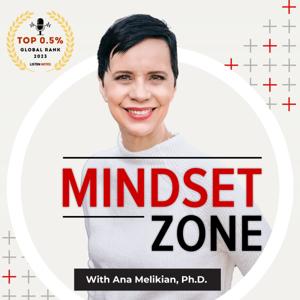
MINDSET ZONE
Download on the App Store

MINDSET ZONE episodes

  • A Conversation with Viktor Frankl’s Grandson – Alexander Vesely
    – Listen to this interview to find out how to win a copy of the documentary “Viktor & I”– Movie Trailer: Viktor & I, An Alexander Vesely In this episode, I spoke with Alexander Vesely about his grandfather, Viktor Frankl. Viktor Emil Frankl, M.D., Ph.D. (1905-1997) is considered by many as one of the greatest […]
    45 min
  • A Conversation with Viktor Frankl’s Grandson – Alexander Vesely
    – Listen to this interview to find out how to win a copy of the documentary “Viktor & I”–
    [leadplayer_vid id="5554E39D9C43F"]
    Movie Trailer: Viktor & I, An Alexander Vesely
    In this episode, I spoke with Alexander Vesely about his grandfather, Viktor Frankl.
    Viktor Emil Frankl, M.D., Ph.D. (1905-1997) is considered by many as one of the greatest thinkers of the 20th century.
    He was an Austrian neurologist and psychiatrist, as well as a Holocaust survivor.
    Frankl is known by many via his best-selling book Man's Search For Meaning.
    Alex Vesely is an Austrian-born filmmaker and trained psychotherapist.
    His movie – "Viktor & I” – is an impactful documentary about his eminent grandfather, Viktor Frankl.
    For three years, he traveled the world to bring us this insightful look at Viktor Frankl through the eyes of those closest to him.
    In our conversation we discussed:
    - How to introduce the life work of Viktor Frankl to the next generation
    - What is logotherapy
    - How logotherapy can help people on their journey of personal development
    - How Viktor Frankl spoke about despair (despair is suffering without meaning: d=s-m)
    - The core of resilience and the role of meaning
    - How Alex realized that his grandfather was the famous Viktor Frankl
    - How the experience of being Frankl’s grandson shaped him
    - How Frankl lived the maximum “The salvation of man is through love and in love” in his personal life and that of his family
    - How does one surrender judgment in order to practice forgiveness
    - How Viktor Frankl spoke about Responsibility
    4-Min Video: Frankl at a conference in Toronto
    [leadplayer_vid id="5409F8EA6F5DE"]
    Links:
    Movie "Viktor & I"
    Man’s Search for Meaning
    Related Episodes:
    007: Searching for Meaning – Are You Aiming High Enough?
    008: React or Create – Your Choice
    46 min
  • Your Body of Work (with Pam Slim)
    In this episode, you will listen to an interview with Pamela Slim, author of Escape from Cubicle Nation and the Body of Work.
    Pamela Slim is an award-winning author, speaker and business consultant who has been an entrepreneur for eighteen years. Pam is a passionate, engaging speaker with proven advice for building careers in the “New World of Work” – a world filled with economic instability, rapid change, increased demands on leadership, work-life balance pressures and 24-hour a day social media sharing.
    Our conversation focused on her last book:
    Body of Work: Finding the Thread That Ties Your Story Together.
    We discussed:
    - Body of Work - definition
    - Need for a new type of career advice
    - Finding the thread that ties your story together
    “You need to tell a story about your own body of work, in a context that will make sense for the work you want to get.” – Pam Slim
    - Ethical and effective story telling
    “More and more people, by choice or by force, don’t have a straight-line story for their work experience.” – Pam Slim
    - Mindset shift needed to succeed in our rapid changing world
    “Craft a story that explains your highest values, your strengths, and the value you can provide to the audience you care about influencing.” – Pam Slim
    - Importance of defining our roots
    - We can have more than one singular life purpose
    - Our work recipes and ingredients
    - A definition of success
    “Don't aim at success–the more you aim at it and make it a target, the more you are going to miss it. For success, like happiness, cannot be pursued; it must ensue, and it only does so as the unintended side effect of one's personal dedication to a cause greater than oneself or as the by-product of one's surrender to a person other than oneself.”― Viktor E. Frankl, Man's Search for Meaning
    More about Pam Slim at:
    http://pamelaslim.com
    31 min
  • Your Body of Work (with Pam Slim)
    In this episode, you will listen to an interview with Pamela Slim, author of Escape from Cubicle Nation and the Body of Work. Pamela Slim is an award-winning author, speaker and business consultant who has been an entrepreneur for eighteen years. Pam is a passionate, engaging speaker with proven advice for building careers in the […]
    30 min
  • Invisibilia – The Blind Can See
    Today's episode goal is to invite you to go and listen to a different podcast - really :)
    This is one of the things I love about the podcasting world.
    Like authors and professionals speakers, we know that people who read a book, listen to a speaker, or a podcast, will enjoy reading others books, listening to other speakers, and subscribing to other podcasts.
    We don’t see each other as competition.
    Cavett Robert, the founder of the National Speaker Association, said it best:
    "As speakers, we never fight over the size of our slice of the pie, we build a bigger pie."
    Since my podcast is all about expanding possibilities, I want to introduce you to Invisibilia, a NPR podcast, launched in the beginning of 2015.
    Invisibilia is a latin word that means "all the invisible things”, and this podcast explores the intangible forces that shape human behavior – ideas, beliefs, assumptions, and emotions.
    There is a particular episode of this podcast that I would love you to go and listen to. It’s titled “How to Become Batman” and was released on January 22nd, 2015.
    This episode is all about expectations, and how these expectations can limit what we can do and be.
    I have to warn you, that this hour-long Invisibilia episode can blow your mind, and really make you think about how we limit ourselves and others by accepting expectations without questioning other possibilities.
    The show starts by describing how when scientists are doing experiments with rats, if they think that a particular lab rat is dumb or clever, that affects how well that rat will perform the experiment. But this is just the beginning.
    Then, they focus their narrative on Daniel Kish, a blind person who destroys every stereotype you may have about blindness.
    Daniel Kish lost both eyes when he was a very young toddler, yet he grow up to be able to navigate is world independently, and with confidence. He developed a system that allowed him and other blind people to see - really.
    He is a blind person who guides other blind people, as well as those of us who have normal sight, to see so many new possibilities in our lives.
    When I listened to this show, I questioned so many things:
    - How expectations can limit the possibilities of people with disabilities
    - How I can limit myself with my beliefs and expectations
    - How my expectations for my daughter can limit her from achieving what she is capable of.
    This reminds me of the episode 7 of the MINDSET ZONE podcast, where I spoke about a powerful quote that Viktor Frankl mentioned in one of his lectures:
    “If we take man as he is, we make him worse, but if we take man as he should be, we make him capable of becoming what he could be."– Goethe (1749 – 1832)
    Please go ahead and listen to “How to Become Batman” from Invisibilia podcast.
    Click the player below to listen to it.
    [smart_track_player url="http://pd.npr.org/anon.npr-mp3/npr/specials/2015/01/20150122_specials_invisibiliabatman.mp3" title="How to Become Batman" artist="Invisibilia" download="false" ]
    TEDx talk by Daniel Kish
    [leadplayer_vid id="55426B1DBFDA2"]
    Love to hear your comments about this.
    If you want a weekly mindset workout, make sure you are subscribed to this podcast :)

    12 min
  • Non-Obvious: How to Think Different with Rohit Bhargava
    In this episode, I have the pleasure to interview Rohit Bhargava, author of five best selling business books including Likeonomics and his most recent one calledNon-Obvious: How to think Different, Curate Ideas and Predict the Future.
    He had me at “how to think different", because to have this skill is a wonderful way to give our mindsets a workout and open the doors to new possibilities.
    In our conversation we discussed:
    - Why it is misleading to think that industry experts are the best one to predict trends
    - How curation is the ultimate method of transforming noise into meaning
    - The Curator’s Mindset (Being Curious, Observant, Fickle, Thoughtful, Elegant)
    - How to foresee a trend that will last
    Links:
    - Non-Obvious: How to think Different, Curate Ideas and Predict the Future - Hard Cover Edition
    - Non-Obvious: How to think Different, Curate Ideas and Predict the Future - Kindle Edition
    - Likeonomics: The Unexpected Truth Behind Earning Trust, Influencing Behavior, and Inspiring Action - Hard Cover Edition
    - Likeonomics: The Unexpected Truth Behind Earning Trust, Influencing Behavior, and Inspiring Action - Kindle Edition
    - New to audible.com? You can download for free the Audio Edition of Likeonomics at http://mindset.zone/audiobooks
    - http://nonobviousbook.com - Get excerpt of Non-Obvious and a summary of all 15 trends from the 2015 Non-Obvious Trend Report
    - http://www.rohitbhargava.com/
    - http://www.rohitbhargava.com/blog
    - https://twitter.com/rohitbhargava
    27 min
  • Non-Obvious: How to Think Different with Rohit Bhargava
    In this episode, I have the pleasure to interview Rohit Bhargava, author of five best selling business books including Likeonomics and his most recent one calledNon-Obvious: How to think Different, Curate Ideas and Predict the Future. He had me at “how to think different”, because to have this skill is a wonderful way to give our […]
    25 min
  • Misattributions – Good Or Bad?
    Today, I want to focus on misattributions, that is, situations where we attribute an idea to the wrong source.
    I was listening to news recently and they were speaking about the beautiful new US stamp, produced as an homage to the life and work of Maya Angelou.
    It's wonderful and meaningful to see a poet and thinker recognized this way, yet the quote that they chose to go along with the photo of Maya Angelou is not her own quote!!!
    They misattributed the quote.
    "A bird doesn't sing because it has an answer, it sings because it has a song."
    This inspiring quote was often cited by the late poet, yet we know now that it was written by another writer Joan Walsh Anglund in 1967.
    Maya Angelou never claimed authorship for the quotation, she use it often because it’s a really powerful sentence.
    The US Post Office should have done their homework and checked in which publication that quote was printed, not waited until the stamp was published to discover their mistake.
    At least now we know about another inspiring women writer, Joan Walsh Anglund, who now has a Wikipedia entry thanks to this misattribution.
    Another Example...
    Another example of a misattribution – with a very a happy ending – regards this powerful poem:
    People are illogical, unreasonable, and self-centered.Love them anyway.If you do good, people will accuse you of selfish ulterior motives.Do good anyway.If you are successful, you win false friends and true enemies.Succeed anyway.The good you do today will be forgotten tomorrow.Do good anyway.Honesty and frankness make you vulnerable.Be honest and frank anyway.The biggest men and women with the biggest ideas can be shot down by the smallest men and women with the smallest minds.Think big anyway.People favor underdogs but follow only top dogs.Fight for a few underdogs anyway.What you spend years building may be destroyed overnight.Build anyway.People really need help but may attack you if you do help them.Help people anyway.Give the world the best you have and you'll get kicked in the teeth.Give the world the best you have anyway.
    This “Anyway" quote is often attributed to Mother Teresa because a version of this poem was written on a wall in Mother Teresa's home for children in Calcutta, yet this is a misattribution.
    These Paradoxical Commandments were originally written by Kent M. Keith in 1968 as part of a booklet for student leaders.
    Because of this misattribution, Kent M. Keith was inspired to publish a beautiful book called "Do It Anyway: The Handbook for Finding Personal Meaning and Deep Happiness in a Crazy World."
    Here is an interview with the author:[leadplayer_vid id="553342E612683"]
    So, what’s the moral of the story?
    Yes, before publishing anything writers should do their homework and check their sources. Yet, as this podcast has illustrated several times, it’s easy to make mistakes and misattributions too.
    My thinking is that when misattributions are corrected, that can be a beautiful opportunity to learn more.
    We will make mistakes, attribute ideas to the wrong sources, and hopefully someone will catch them, call our attention to them, and we will be able to correct them. The possibility of misattribution should not stop us to put our work out there into the world – do it anyway.
    LINKS:
    http://time.com/3814888/maya-angelou-stamp-us-postal-service-joan-walsh-anglund/
    http://en.wikipedia.org/wiki/Joan_Walsh_Anglund
    http://www.joanwalshanglund.com/about.htm
    http://prayerfoundation.org/mother_teresa_do_it_anyway.htm
    16 min
  • Misattributions – Good Or Bad?
    Today, I want to focus on misattributions, that is, situations where we attribute an idea to the wrong source. I was listening to news recently and they were speaking about the beautiful new US stamp, produced as an homage to the life and work of Maya Angelou. It's wonderful and meaningful to see a poet […]
    16 min

About MINDSET ZONE

From the publisher's feed

Our mindsets determine the way we see the world, as well as, the way we behave and who we are as people. It’s very easy and normal to stay stuck in fixed mindsets – limiting beliefs about our…

More shows like MINDSET ZONE

The One You Feed | Personal Growth, Emotional Resilience & Purpose by Eric Zimmer

The One You Feed | Personal Growth, Emotional Resilience & Purpose

2,590 Listeners

Happier with Gretchen Rubin by Gretchen Rubin / The Onward Project

Happier with Gretchen Rubin

12,890 Listeners

Untangle by Untangle

Untangle

828 Listeners

The Psychology Podcast by Scott Barry Kaufman

The Psychology Podcast

1,797 Listeners

The Life Coach School Podcast by Brooke Castillo

The Life Coach School Podcast

8,778 Listeners

The Terri Cole Show by Terri Cole

The Terri Cole Show

1,410 Listeners

The School of Greatness by Lewis Howes

The School of Greatness

21,054 Listeners

The Marie Forleo Podcast by Marie Forleo

The Marie Forleo Podcast

1,637 Listeners

Kwik Brain with Jim Kwik by Jim Kwik, Your Brain Coach, Founder www.KwikLearning.com

Kwik Brain with Jim Kwik

4,827 Listeners

Oprah's Super Soul by Oprah

Oprah's Super Soul

31,724 Listeners

Extraordinary Minds by Vishen Lakhiani

Extraordinary Minds

1,275 Listeners

On Purpose with Jay Shetty by Perfect Strangers

On Purpose with Jay Shetty

27,826 Listeners

Meditative Story by WaitWhat

Meditative Story

3,064 Listeners

The Daily Motivation by Lewis Howes

The Daily Motivation

914 Listeners

The Mel Robbins Podcast by Mel Robbins

The Mel Robbins Podcast

19,273 Listeners