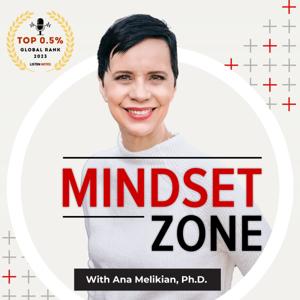
MINDSET ZONE
Download on the App Store

MINDSET ZONE episodes

  • The Second Arrow – Stories We Tell Ourselves (with Eric Zimmer)
    In this Episode, I interviewed Eric Zimmer the host of the podcast "The One You Feed.”
    "The One You Feed" podcast was named Best of 2014 by iTunes, and it's an amazing collection of open minded discussions of habits, wisdom, psychology, philosophy, and motivation.
    Eric starts his episodes with a short story that explains the title of his podcast:
    An old grandfather told his grandson:
    “My son, there is a battle between two wolves inside us all. One is evil. It is anger, jealousy, greed, and resentment. The other is good. It is joy, love, hope, humility, kindness, empathy, and bravery.”
    The boy thought about it, and asked, “Grandfather, which wolf wins?”
    The old man quietly replied, “The one you feed.”
    In this conversation Eric and I discuss:
    - One of Eric’s favorite stories, "The Second Arrow"
    - "I’ll be happy when” mindset and its alternatives
    - Fixed Mindset and Growth Mindset (Dr. Carol Dweck)
    - How can we stop the reactive cycles in our lives
    - The power of stories
    Subscribe to The One You Feed podcast at OneYouFeed.net
    If you want a weekly mindset workout, make sure you are subscribed to MINDSET ZONE podcast via iTunes, or Stitcher.
    32 min
  • The Second Arrow – Stories We Tell Ourselves (with Eric Zimmer)
    In this Episode, I interviewed Eric Zimmer the host of the podcast “The One You Feed.” “The One You Feed” podcast was named Best of 2014 by iTunes, and it's an amazing collection of open minded discussions of habits, wisdom, psychology, philosophy, and motivation. Eric starts his episodes with a short story that explains the title of […]
    32 min
  • Do You Have A Sandbox?
    For many of you, last week's episode was very conceptual with no practical application.
    I want to celebrate that :)
    It’s essential to have activities that don't seem to have practical applications, or use business language, with no tangible Return Of Investment – ROI.
    We know that children need to play to learn new skills and develop as people.
    Yet, as adults we forget that we also need to keep playing in order to better ourselves.
    I have a six year-old daughter, and I totally understand the need to contain the areas where she plays. This way, I keep some order in my house and myself sane.
    I love inventions such as sandboxes, where we can let kids have fun, knowing that the mess is somewhat contained.
    So, when I learned that in software development it’s very common to use the term "sandbox" to describe a safe place to try new software, I thought: “What a brilliant use of the term. Why not create something similar to use for our businesses and lives."
    Imagine if we could create a place where we could try things, and play with concepts, without worry about getting too messy or off track.
    For me, my podcast MINDSET ZONE, is my sandbox :)
    Here, I play with concepts, explore ideas, even invite special guests, and pick their brains around a certain topic.
    I even have playmates. People like you, who listen to this podcast and send me their comments and feedback. This way, I know what resonates with my favorite peeps.
    Playing in this MINDSET ZONE sandbox, I learn what concepts don't work, and I have to let them go. I discover what mindset workouts work better. I also play with ideas that I can use in live presentations or webinars. I can develop my speaking material, while playing in podcasting - and I love it. I can start to articulate concepts that maybe one day get organized and edited in a book - who knows!
    Even, if I don't materialize any of these ideas, I still think the time and effort to do this podcast, it's totally worth it, because I'm enjoying the process :)
    This containment gives me freedom to play - and I like it :)
    Do you have a sandbox?
    Your sandbox can be for play at a professional level or to add some enjoyment to your personal life. It can be a hobby, or whatever allows you to create that safe space where you can just play for the fun of it.
    11 min
  • Paradoxes – Give Your Mindsets a Workout
    To provide a mindset workout is my goal for every episode of my podcast.
    I want to create a space where you come to exercise your mind, such as when you go to the health club to keep yourself healthy and in shape.
    In the last episode – 26: Do People Really Change? – I went back in time 2,400 years, to Ancient Greece to illustrate the point that the question “Do People Really Change?" is not a new one.
    There I spoke about philosophers who argued that nothing really changes.
    They reasoned that everything we perceive as changes are merely illusions of our senses.
    This is a true paradox.
    If we look to the origin of the word paradox, we learn that it’s the conjunction of two Greek words:
    PARA that means "contrary to" and DOXA that means “opinions" or "to appear.”
    A concept contrary to appearance is a paradox.
    So, when we look around, we see things changing but maybe they are not changing – this interpretation is a paradox because it’s contrary to what it appears to be.
    And yes, this makes our brain twist a little.
    It creates new connections between neurons in our brain.
    It causes some confusion, and makes us question if what we think is actually true. It’s a great workout for our minds.
    In this episode, I want to describe some paradoxes created by Zeno - a student of Paramenides.
    The reason why I want to twist your mind with these paradoxes, is because they are great illustrations of how we can question deep ingrained beliefs - in this case, that things change.
    It makes us question our own perceptions.
    Stay with me.
    In Ancient Greece, Paramenides and Zeno had to convince other philosophers to trust their reasoning more than their senses.
    So Zeno devised several situations that question what we perceive as change using strong logical arguments. I’m going to speak about two paradoxes that focus on movement.
    Paradox One
    Suppose that you want to go from point A to point B.
    In order to do this, you first have to get to the half point between A and B - let us call it point C.
    Now, to go from C to B, you have to first get to the half point between C and B - let us call it point D.
    Then for going from D to B, you have to get to the half point between D and B - let us call it point E.
    Are you getting the point? (Pun intended.)
    We will run out of letters of the alphabet, and there still be a half point before we ever arrive to B.
    So logically, by following this reasoning, it is impossible to really arrive at point B.
    I know that you can walk from point A to point B, but logically we can argue that you are doing the impossible.
    I warned you that this was a brain twister.
    See video below:
    [leadplayer_vid id="5520D0E8120F6"]
    Ready to another?
    Paradox Two
    Following the same logic, suppose that you have a race between Achilles and the tortoise.
    Achilles gives the tortoise a head-start.
    By the time that Achilles reaches the place from which the tortoise started, the tortoise has already advanced to another point; when Achilles reaches that point, then the tortoise will have reached another point.
    So Achilles is getting closer and closer, but by this logic he never overtakes the tortoise.
    See video below:
    [leadplayer_vid id="5520D14A9141A"]
    And yes, you can be telling yourself, "Yes, I get the logic. If we consider that between a point an the another, there is an infinite number of points (like they teach us in math), there always be a middle point between any two points, BUT I know that people go from point A to B, and I can trust my perception."
    Maybe. Yet, I will not be so sure to trust your perception so blindly.
    Water Experiment
    Did you ever experiment with three containers of water?
    Imagine three glasses next to each other:
    The glass on the left has hot water.The glass on the right has icy water.The middle glass has room temperature water.
    Place your left index finger on the glass on the left with hot water; at the same time, place the right index finger on the glass on the right with the icy water; and after a minute, place both index fingers on the middle glass with the water at room temperature.
    What do you perceive?
    Can you trust your senses now?
    You know that the glass in the middle is room temperature, yet each index finger feels the temperature differently.
    So, can you trust your senses?
    If you never have done this experiment, do it as soon as you can.
    You are creating new connections between neurons in your brains - these are great workouts to shift your mindsets.
    21 min
  • Paradoxes – Give Your Mindsets a Workout
    To provide a mindset workout is my goal for every episode of my podcast. I want to create a space where you come to exercise your mind, such as when you go to the health club to keep yourself healthy and in shape. In the last episode – 26: Do People Really Change? – I […]
    20 min
  • Do People Really Change?
    I’m fascinated by change - if you listen regularly to this podcast you may have noticed that.
    Change has been the focus of my professional life.
    When I started as a psychotherapist, I helped people overcome problems in ways that changed how they lived their lives.
    Afterwards, as a life coach, I focused on supporting people to reach their goals and potential. This also implies change.
    Now, as a business coach, I assist service professionals to change their mindsets to become more impactful change-makers.
    Yet, once in a while, I have friends who ask “Do people really change?"
    This question is not new
    Back in Ancient Greece, many philosophers also wonder about this.
    They questioned change in general.
    In fact, there was a group of philosophers who argued that nothing really changed.
    They said that what we perceive as change is merely an illusion of our senses.
    In the fifth century BC, Parmenides argued that nothing can become anything other than it is.
    It’s a total contradiction of what we perceive - it’s a paradox.
    Yet, the logic behind it is solid and mind-boggling.
    And Paramenides' ideas had a big impact on philosophy and in the development of science.
    For me, this idea that nothing changes is very contra-intuitive. And I have the tendency to think that it will be contra-intuitive to other people too.
    Yet, when I think about expressions that people often say:
    He is what he is.”
    “He was born like that.”
    “People don’t really change.”
    “It runs in the family.”
    “It’s in their genes."
    Maybe the question “Do people really change?” is asked so often, because for some people that’s what their intuition or experience tells them.
    Going back to Ancient Greece, to the fifth century BC
    There was another group of philosophers who argued that everything flows, everything is always changing.
    The most well-known is Heraclitus.
    Even if you don’t know his name, probably you are familiar with one of his quotes:
    No man ever steps in the same river twice."
    Or the longer version:
    No man ever steps in the same river twice, for it's not the same river and he's not the same man."
    I love this quote, yet I also recognize that this idea of constant flow, constant changing, it can be felt as lack of stability, confusion, even chaos.
    For instance, think about our technological world. The pace of change is so fast that sometimes it can make us feel uneasy, and wish for more stable ground.
    If you had to decide between these two extremes - nothing can change or everything is in a constant state of change - which would you pick?
    Difficult choice. And what I love about philosophy is that it shows us that there is at least a third option, an option that transcends these opposites.
    Back to the 5th century BC, Empedocles proposed the idea that both Parmenides and Heraclitus were right.
    Yes, nothing changes AND everything changes is possible.
    If we believe that everything in nature consists of four elements - earth, air, fire, and water - and that these elements never change, yet can be mixed in various combinations.
    How is it possible that four elements to be the basis of everything we see?
    Think of a painter who has the red, yellow, and blue – and can mix these primary colors to become all other colors.
    Or think about atoms. Yes, there are more than four atoms, yet we believe that everything in nature is made of atoms.
    I love philosophers and thought leaders who help us transcend opposites.
    How to apply these ideas to how we see change in ourselves
    For instance, we can work very hard to change characteristics that are very ingrained in ourselves.
    Or we can work to accept these characteristics as a given that we can’t change.
    Yet,  now we have a third option.
    Why not use our energy to mix and match these characteristics so that we produce our desired outcomes.
    Similar to a painter who has a limited palette, by mixing and matching, we are only limited by our imagination.
    We can use our creativity to transcend our own limiting contradictions, and transform our mindsets.
    Think about the possibilities :)

    16 min
  • Learning and Change
    The topic of this episode is Learning and Change  – and how can we learn from our relapses, and missteps.
    First of all, I want to correct a mistake I did in Episode 23: Understanding Change - and Why Is So Difficult to Change, where I spoke about a specific model to explain change that was developed by a team of psychologists in the 1990s: Prochaska, Norcross, and Diclemente.
    I said that according to this model, if someone wants to change a habit or behavior, they will go through a 5-Stage Process.
    My mistake was to describe this system with only 5 stages, when the authors speak of 6 stages.
    The book that popularized this model, is titled:
    Changing for Good: A Revolutionary Six-Stage Program For Overcoming Bad Habits And Moving Your Life Positively Forward.
    When I was publishing Episode 23, I realized my mistake, and I could have postponed the release of the episode. Yet, I decided to go ahead with it, because I’m on a mission to embrace my courage to be imperfect – listen to Episode 16 to know more about this – and I knew I could do another episode to correct that misinformation.
    So, for the record, this Change Process is described as a having 6 stages:
    Stage 1: Pre-Contemplation
    If we are at this stage, we don’t see any need to change.
    Stage 2: Contemplation
    As the name suggests, we start to realize that there is something that we are better off changing.
    Stage 3: Preparation
    We start to devise a plan with concrete action steps and implementation dates.
    Stage 4: Action
    We do it.
    Stage 5: Maintenance
    We consolidate the new habits, behaviors, and patterns.
    And very important:
    Stage 6: Recycling – Learning from Relapse
    This last stage reminds us that the change is not a linear process, where you go from stage 1, to 2, then 3, then 4, and 5.
    There are ups and downs, steps backwards and forwards.
    The secret is to keep going, and learn from the relapses.
    In fact, Prochaska, Norcross, and Diclemente, speak about several lessons we can learn from this last stage.
    For instance, we know that:
    - It’s rare to change a habit on our first attempt.
    - Trial and error is not a very effective method  – instead, learn from other people who have done it, and master the change you are trying to achieve.
    - If you relapse, that means that you have done some action. Keep learning, and translating that learning into actions, and you will be able to create better habits in your life.
    How does knowing that relapse is common and even a part of the change process, help you move forward?
    For me, the lesson is to see a relapse as an opportunity to learn something new.
    Pick ourselves up again, and keep moving forward.
    This reminds me of a skill that people who achieve big things have developed.
    As I spoke in Episode 3: Failure and The Way To Success - we must build a strong failure resilience if we want success.
    And as my interview with Andrea Waltz - in Episode 22 – show clearly, the image of the fork in the road – with one road that leads to success and the other to failure – is misleading.
    Success happens if we are willing to endure failures (it’s part of the path).
    15 min
  • Stop Changing – Start Shifting (with Whitney Hutten)
    Last episode I spoke about why it’s so difficult to change, and I knew then that I had to bring Whitney Hutten to this podcast.
    Whitney believes that to stop changing and start shifting, is the best strategy to make what you want happen.
    Her mission is to help professionals to get 10 to 15 hours back every week, so they can focus on their health, relationships, and personal life – without feeling stressed, overwhelmed, or guilty.
    During this interview, you'll shift your mindset about change.
    You will learn:
    - Why you should remove the word “change” from your vocabulary
    - How-to make shifts that produce long lasting results
    - 3 Simple Steps to Start Shifting (Focus - Meaning - Plan)
    Find more about Whitney Hutten at whitneyhutten.com
    27 min
  • Stop Changing – Start Shifting (with Whitney Hutten)
    Last episode I spoke about why it’s so difficult to change, and I knew then that I had to bring Whitney Hutten to this podcast. Whitney believes that to stop changing and start shifting, is the best strategy to make what you want happen. Her mission is to help professionals to get 10 to 15 […]
    26 min

About MINDSET ZONE

From the publisher's feed

Our mindsets determine the way we see the world, as well as, the way we behave and who we are as people. It’s very easy and normal to stay stuck in fixed mindsets – limiting beliefs about our…

More shows like MINDSET ZONE

The One You Feed | Personal Growth, Emotional Resilience & Purpose by Eric Zimmer

The One You Feed | Personal Growth, Emotional Resilience & Purpose

2,590 Listeners

Happier with Gretchen Rubin by Gretchen Rubin / The Onward Project

Happier with Gretchen Rubin

12,890 Listeners

Untangle by Untangle

Untangle

828 Listeners

The Psychology Podcast by Scott Barry Kaufman

The Psychology Podcast

1,797 Listeners

The Life Coach School Podcast by Brooke Castillo

The Life Coach School Podcast

8,778 Listeners

The Terri Cole Show by Terri Cole

The Terri Cole Show

1,410 Listeners

The School of Greatness by Lewis Howes

The School of Greatness

21,054 Listeners

The Marie Forleo Podcast by Marie Forleo

The Marie Forleo Podcast

1,637 Listeners

Kwik Brain with Jim Kwik by Jim Kwik, Your Brain Coach, Founder www.KwikLearning.com

Kwik Brain with Jim Kwik

4,827 Listeners

Oprah's Super Soul by Oprah

Oprah's Super Soul

31,724 Listeners

Extraordinary Minds by Vishen Lakhiani

Extraordinary Minds

1,275 Listeners

On Purpose with Jay Shetty by Perfect Strangers

On Purpose with Jay Shetty

27,826 Listeners

Meditative Story by WaitWhat

Meditative Story

3,064 Listeners

The Daily Motivation by Lewis Howes

The Daily Motivation

914 Listeners

The Mel Robbins Podcast by Mel Robbins

The Mel Robbins Podcast

19,273 Listeners