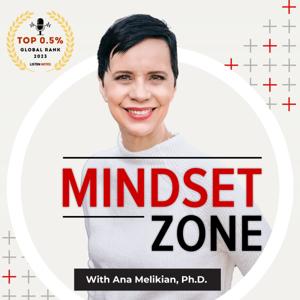
MINDSET ZONE
Download on the App Store

MINDSET ZONE episodes

  • The Four Agreements – It’s Not About You
    On the last episode, I focused on the the first agreement from the book: The Four Agreements by Don Miguel Ruiz. I spoke about “Be impeccable with your word” and reflected on the Power of Words. I even shared some insights from recent psychological research that can help us take this concept to next level, […]
    22 min
  • The Four Agreements – Words Are Powerful
    On the last episode I spoke about the book:
    The Four Agreements by Don Miguel Ruiz.
    I explored what Ruiz calls Self-Limiting Beliefs.
    I call them Mindset Blind-Spots because we are not aware that we hold them, and yet we filter our experiences through them.
    I even started a 7-day Awareness Challenge for myself. Just to become aware of some of my self-limiting beliefs, and to try to articulate them. The reality is that we all have many of these Mindset Blind-Spots.
    Don Miguel Ruiz suggests to replace these Self-Limiting Beliefs by The Four Agreements:
    1. Be impeccable with your word
    2. Don't take anything personally
    3. Don't make assumptions
    4. Always do your best
    Today, I want to focus on the first agreement “Be impeccable with your word," and reflect on the power of words.
    Ruiz defines this First Agreement - Be impeccable with your word - as:
    Speak with integritySay only what you meanAvoid using the word to speak against yourself or to gossip about othersUse the power of your word in the direction of truth and love
    We often use expressions such as:
    "Those are just words."
    “Too much talking and no action."
    "Sticks and stones will break my bones but names will never hurt me."
    And so forth.
    All these expressions view words as powerless.
    Yet, if that was true, why do we get so hurt by words, why do we keep remembering words that someone said to us.
    Having the capacity of using words is something distinctly human, and we should recognize that words are powerful.
    Don Miguel Ruiz emphasies the power of words.
    He writes:
    "The word is not just a sound or a written symbol. The word is a force; it is the power you have to express and communicate, to think, and thereby to create the events in your life. You can speak. What other animal on the planet can speak? The word is the most powerful tool you have as a human; it is the tool of magic. But like a sword with two edges, your word can create the most beautiful dream, or your word can destroy everything around you. ... Depending upon how it is used, the word can set you free, or it can enslave you even more than you know."
    Let me give another example from another book.
    Dr. Carol Dweck, in her book Mindset, writes about the power of negative labels. She even refers to research studies that show that to check a box to indicate your race or gender can evoke a stereotype and lower test scores. It seems that this happens at a subconscious level.
    Words, their meaning and associations are very powerful.
    Yet, it’s not enough to replace negative words by positive words.
    It’s not enough to replace negative labels by positive labels.
    For instance, do you know that praising kids for their intelligence can be counterproductive?
    See the video below that summarizes some of this research.
    [leadplayer_vid id="54C1190A5CCA1"]
    We can learn a lot from these type of studies. We can learn to avoid “The Inverse Power of Praise”, and focus our positive words to praise other peoples effort in a specific and concrete way.
    And, very importantly to apply these principles in our self-talk too.
    For instance, if you are frequently praised for being a good speaker, a natural on stage, that can create a self-image “I’m a great speaker."
    And, who want to challenge such a great self-image?
    It’s tempting to do everything in our power to preserve it.
    So we can stop taking risks, because potentially we could fail and ruin our self-image.
    It’s safer to play small.
    Think about the implications of all this.
    Did you ever fall into this type of vicious cycle?
    This dynamic can stop us from developing our full potential.
    Love to learn about your experiences.
    21 min
  • The Four Agreements and Mindset Blind-Spots
    At the beginning of the year, I like to re-read books that impacted me in the past.
    This year, I decided to read again The Four Agreements by Don Miguel Ruiz.
    It’s a beautifully written short book that calls our attention to the many self-limiting beliefs we hold in our lives.
    The author, Don Miguel Ruiz, calls these beliefs agreements.
    I like to call them Mindset Blind-Spots, because we are not aware that we hold them, yet we filter our experiences through them.
    According to Don Miguel Ruiz, if we learn to replace these self-limiting beliefs by The Four Agreements proposed in his book, we can change our lives for the better.
    These Four Agreements are:
    1. Be impeccable with your word
    2. Don't take anything personally
    3. Don't make assumptions
    4. Always do your best
    In the next episodes of this podcast, I will focus on these agreements.
    Today, I want to explore the concept of agreement as a self-limiting belief which we hold without awareness.
    This is why I consider these self-limiting beliefs as Mindset Blind-Spots.
    Yet, unlike the visual blind spot I described in Episode 6: Blind Spots - We All Have Them, we are not born with Mindset Blind-Spots - we learn them.
    Don Miguel Ruiz calls this learning process the domestication of humans.
    It’s how we typically learn how to live and how to dream.
    This often happens at a subconscious level.
    We start to believe in certain rules as truisms that we don't even consider to challenge.
    These can be rules like saying “Thank You" when someone gives us as a gift.
    To take as fact that if someone says we are “dumb”, “ugly”, “bad” that also must be true.
    I see this process of domestication as part of being human, living in an organized society. Yet, I like the idea of living in a society where I have some say about the rules that govern it.
    Luckily enough, I lived all my live in countries ruled by democratic regimes, where theoretically, we have some say on the rules.
    Yet there are so many implicit and subtle rules that are not written, but are as strong or even stronger that the written ones.
    I want to have a say on these rules too. Even if it's to agree that I want to keep following that rule.
    This is vital, because often these are the rules that govern our personal lives.
    I know that I cannot be in a state of constant analysis – that would lead to analysis paralysis. I would be so overwhelmed that would prevent me to do any meaningful action.
    Yet, I like to create spaces where I become aware of these unwritten rules. This helps me to become aware of my own Mindset Blind-Spots.
    I see this as a three-step ABC process:
    Step 1: Awareness – Become aware that we have many self-limiting beliefs that make us react in a certain way
    Step 2: Breath Out – Remind myself that I have the power to press the pause button. I don’t have to react, I can choose how to respond
    Step 3: Create My Response (following my own agreements)
    I speak about this on Episode 8: React or Create–Your Choice.
    Love the quote that Stephen R. Covey attributes to Viktor Frankl:
    “Between stimulus and response there is a space.In that space is our power to choose our response.In our response lies our growth and our freedom.”
    I love this quote because, we usually see a stimulus as something that activates a response almost automatically.
    There – between stimulus and response – Frankl sees a space.
    A brief space where we have the power to choose our response.
    A brief space where we can learn to be creators of our lives and not just be reactors.
    This is very powerful and transformational.
    My challenge for the my next 7 days is to focus on awareness - Step 1 of the ABC process described.
    The goal is to become more aware.
    Whenever possible, I will write down my awareness or feelings about the situation.
    What are the rules am I following?How do I feel about them?Do I feel I need to do this, I have to do this, or I must do this?Do I want to do this?
    Want to join me in this 7-day Awareness Challenge?
    Love to hear your comments and learn about your experiences.
    16 min
  • The Four Agreements and Mindset Blind-Spots
    At the beginning of the year, I like to re-read books that impacted me in the past. This year, I decided to read again The Four Agreements by Don Miguel Ruiz. It’s a beautifully written short book that calls our attention to the many self-limiting beliefs we hold in our lives. The author, Don Miguel […]
    15 min
  • Courage To Be Imperfect
    Perfection - I strive for perfection.
    I always did, and I still do.
    I like to do things as well as possible. I'm always looking for ways to improve.
    I know that perfection is an illusion.
    It's impossible to produce something totally flawless, but why not to try to create something as good as possible.
    In preparation to produce this Podcast,  I invested the time and money to learn from the Podcast Answer Man, Cliff Ravenscraft.
    To launch this podcast, I invested the time and money to learn from John Lee Dumas of Entrepreneurs On Fire.
    I decided to do this podcast – MINDSET ZONE – because I know that I can create experiences that will help my listeners to expand their possibilities about what they can do and be.
    Most of the episodes have been solo, and I only bring guests for interviews, when I think that adds significant value to the overall experience to my listener.
    I'm also aware that when we do a podcast interview, we increase the reach of our message to a wider audience. We are potentially speaking to our own peeps and well as the people who already follow our guest.
    Thus, to bring the Best-Selling Author Michael Port, to the last week's episode was a very important event at both levels (to create an incredible experience and increase the reach of the Mindset Zone to new listeners).
    I wanted this interview to be as to be perfect as possible.
    I Did The Prep Work
    I had prepared the topic and questions I wanted to cover with Michael well ahead of time. I thought I had planned equally well the environment here in my home office to be ready for this event.
    This happened during my 5 year-old daughter's school winter break, thus I asked my husband to take her out of the house during the interview.
    There was a miscommunication about timing, and they returned home during the recording.
    There I was, trying not to panic, and trying to manage everything in order not to ruin my perfect interview.
    If you are a home based solo-preneur, you probably get this scenario.
    Not surprisingly my daughter interrupted the interview by saying hello in the mic (she loves mics!).
    Again, trying not to panic and bring all my professional skills into play, I utilized the situation to illustrate how we have to be able to deal with situations that are not perfect and yet keep putting our work out there.
    Courage To Be Imperfect
    Still, the truth is, it took me a week to gather the courage to listen to the recording and decide if I was going to use it or not.
    I had worked hard to produce this interview.
    It was the right timing.
    My show was trending high in the New & Noteworthy lists in iTunes. I was showing in the main feature chart.
    I rated:
    Number 1 in Education>Training and Health>Self-Help Categories.Number 2 in the Business>Management & Marketing category, in both the New & Noteworthy list, as well as, the Top Podcast list.
    Finally, I was reaching more people, and I knew I had the opportunity to give them an experience that could determine if they will keep following my show (or not).
    I had to decide to publish (or not to publish) the interview.
    What would people think?
    What kind of professional image am I going to project?
    Agonizing with these issues, I thought of possible solutions.
    Maybe, I could edit that part out (but, there was solid content that I would have had to cut as well).
    Maybe, I could ask Michael to re-record the interview, (however, that would delay the release of that episode at least for a couple of weeks).
    I gathered my courage (and pressured by the deadline to make a decision,) and hit play.
    The interview sounded better than expected.
    The Reality...
    The reality is that doing a good interview with Michael Port is not difficult. If we have a good enough first question, we just have to keep out of his way and he will produce a great show, full of useful and powerful content.
    Yes, I can see my nervousness by counting the amount of “uhmms."
    I know I could have done a better job in facilitating the flow of the interview.
    Yet, the content was solid, and the message of thinking big is a very important one. Michael dealt so graciously with my daughter’s interruption that it produced a sweet and fun moment.
    The interview was really a good one, and it was published last week. It's the more popular episode so far.
    So why did I made such a drama about it?
    The turmoil of this process made me face my own gremlins about perfection.
    Let Go of Perfection
    I decided to read the book,"The Gifts of Imperfection.”
    This book is written by the best-selling author Brené Brown who is also a researcher and amazing speaker I admire a lot..
    In her book, Brown give us 10 guideposts in order to live a wholehearted life.
    Guidepost #2 is "Cultivating Self-Compassion: Letting Go Of Perfectionism."
    Easier Said Than Done
    I had to recognize that I strive for perfection, but often not for the right reasons.
    As Michael Port says in the last episode interview, we should be aware if we are doing something for approval or for results.
    Reading Brené Brown’s book helped me to understand and become aware that:
    Perfectionism is not the same as striving to be our bestPerfectionism is different than self-improvement
    I'm all about both striving to be our best, and self-improvement.
    Yet, if we decide to be on the spotlight in order to reach more people, we have to let go of perfectionism.
    We have to have the courage to be imperfect. To be vulnerable. To dare greatly.
    Inspiration:
    It is not the critic who counts;not the man who points out how the strong man stumbles,or where the doer of deeds could have done them better.The credit belongs to the man who is actually in the arena,whose face is marred by dust and sweat and blood;who strives valiantly;who errs, who comes short again and again, because there is no effort without error and shortcoming;but who does actually strive to do the deeds;who knows great enthusiasms, the great devotions;who spends himself in a worthy cause;who at the best knows in the end the triumph of high achievement, andwho at the worst, if he fails, at least fails while daring greatly,so that his place shall never be with those cold and timid souls who neither know victory nor defeat.Excerpt from the speech "Citizenship In A Republic"delivered by Theodore Roosevelt at the Sorbonne, in Paris, France on 23 April, 1910
    [See Brené Brown's video where she recites this quote at 7mn 3sec, and much more :)]
    [leadplayer_vid id="54AEB32373360"]
    [Also click here for more info about the book Daring Greatly.]
    This is my story of my own struggle with perfection and imperfection.
    How About YOU!
    Do you resonate with this struggle?
    Do you fight with perfectionism too?
    Are you your worst critic?
    Love to hear your experiences.
    It's so easy to let perfectionism stop us from making a difference and play small instead of playing big.

    26 min
  • Think BIG MindSet (with Michael Port)
    During this episode, I interviewed my mentor Michael Port about the Think BIG MindSet.
    Michael Port has been called an "uncommonly honest author" by the Boston Globe, and a "marketing guru" by The Wall Street Journal. He has written 5 bestselling books including Book Yourself Solid, Beyond Booked Solid, The Contrarian Effect, the New York Times Bestseller, The Think Big Manifesto, and Book Yourself Solid Illustrated Edition.
    He is also known as “The guy to call when you are tired of thinking small."
    In fact, everything he does is inspired by thinking big about who you are and what you offer the world. Thus Michael is the ideal person to speak about this topic.
    In this interview we speak about:
    How to become aware if we are thinking small or thinking big, and if we are going for approval or resultsNon-geeky approaches to Social Media and MarketingTypes of balance that go beyond life and workHow to make the Mindset shift to start to play bigThe concept that all the world is a stageHow to claim who we want to becomeDifferent roles we play in our livesPerfectionismHow to plan the New Year
    Links referred to:
    http://heroicpublicspeaking.com/live
    http://michaelport.com
    Please rate and especially write a review in iTunes.
    44 min
  • Think BIG MindSet (with Michael Port)
    During this episode, I interviewed my mentor Michael Port about the Think BIG MindSet. Michael Port has been called an “uncommonly honest author” by the Boston Globe, and a “marketing guru” by The Wall Street Journal. He has written 5 bestselling books including Book Yourself Solid, Beyond Booked Solid, The Contrarian Effect, the New York […]
    43 min
  • The Power of YET – A Growth Mindset Secret
    The idea behind this podcast is that our mindsets determine the way we see the world. And, because it’s so easy to stay stuck in Fixed Mindsets, that prevents us from learning new things, it’s vital to intentionally cultivate Growth Mindsets.
    These concepts of Fixed and Growth Mindsets are based on the work of Carol Dweck, a Stanford University psychologist.
    In her book–Mindset: The New Psychology of Success–she describes decades of research about why people succeed or fail, and how the Fixed and Growth Mindsets play a role in this process.
    Dr. Dweck's 10-minute TED Talk, “The Power Of Believing That You Can Improve”, gives a powerful introduction to these concepts.
    One of my favorite golden nuggets from her presentation is how she explains the Power of YET.
    She begins by describing research studies about how 10-year-old children coped with learning challenges.
    In her own words:
    So I gave 10-year-olds problems that were slightly too hard for them. Some of them reacted in a shockingly positive way. They said things like, "I love a challenge," or, "You know, I was hoping this would be informative." They understood that their abilities could be developed. They had what I call a growth mindset. But other students felt it was tragic, catastrophic. From their more fixed mindset perspective, their intelligence had been up for judgment and they failed. Instead of luxuriating in the power of yet, they were gripped in the tyranny of now."
    So what do they do next? I'll tell you what they do next. In one study, they told us they would probably cheat the next time instead of studying more if they failed a test. In another study, after a failure, they looked for someone who did worse than they did so they could feel really good about themselves. And in study after study, they have run from difficulty. Scientists measured the electrical activity from the brain as students confronted an error. On the left, you see the fixed mindset students. There's hardly any activity. They run from the error. They don't engage with it. But on the right, you have the students with the growth mindset, the idea that abilities can be developed. They engage deeply. Their brain is on fire with yet. They engage deeply. They process the error. They learn from it and they correct it."
    Let’s think about these studies for a moment. Research shows us that when a child has a Fixed Mindset as regards their skills and abilities they run away from challenges, they even go as far as to cheat, and compare themselves with children who do worse than they do. If they have a Growth Mindset, they see difficulties as a challenge to overcome, to learn from. Their brain fires up, and they engage.
    These same principles apply to adults as well.
    Think about the implications of these principles for our personal and professional lives.
    If we are locked into a Fixed Mindset, we are gripped in the tyranny of now.
    If we challenge ourselves with a Growth Mindset, we can luxuriate in the Power of YET.
    So, how can we cultivate a Growth Mindset in our lives?
    Here are some clues from Dr. Dweck:
    First of all, we can praise wisely, not praising intelligence or talent. That has failed. Don't do that anymore. But praising the process that kids engage in: their effort, their strategies, their focus, their perseverance, their improvement. This process praise creates kids who are hardy and resilient.
    There are other ways to reward yet. We recently teamed up with game scientists from the University of Washington to create a new online math game that rewarded yet. In this game, students were rewarded for effort, strategy and progress. The usual math game rewards you for getting answers right right now, but this game rewarded process. And we got more effort, more strategies, more engagement over longer periods of time, and more perseverance when they hit really, really hard problems.
    Just the words "yet" or "not yet," we're finding, give kids greater confidence, give them a path into the future that creates greater persistence. And we can actually change students' mindsets. In one study, we taught them that every time they push out of their comfort zone to learn something new and difficult, the neurons in their brain can form new, stronger connections, and over time they can get smarter.”
    How can we apply this to ourselves?
    For instance, as a service provider, I can focus on developing my resilience to failure.
    [Listen to episode 3 of this podcast series to learn more about "Failure and The Way to Success".]
    When I face a challenge, or even a failure, I can tell myself that “I have not learn how to do this YET."
    Think about the possibilities.
    Every time you hear a voice saying “You are not______." Add YET: “I am not ______ YET."
    Feel the Power of YET and see the possibilities that open in front of you when you cultivate a Growth Mindset.
    Love to hear your comments and learn about your experiences.
    Dr. Dweck TED Talk:
    [leadplayer_vid id="549B108726017"]
    18 min
  • How to Overcome the Fear of Running Out of Money (with Sarah Thompson)
    I had a thought provoking conversation with Sarah Thompson, a financial expert, on how to overcome the fear of running out of money.
    I invited Sarah, because she has a well of experiences, from working on the corporate world, to her own personal struggles with debt, finances, and success.
    Now she brings it all together in her own coaching and consulting business - MoreMoneyMentoring.com.
    Love to hear your comments about this conversation.
    Others links:
    Mindset.Zone/8 - Episode 008: React or Create – Your Choice
    Mindset.Zone/6 - Episode 006: Blind Spots – We All Have Them
    Mindset.Zone/4 - Episode 004: Growth Mindset – Yes, We Can Learn It
    Thank you for the iTunes Reviews!
    Food4BonesEmpowered PurposeRamona V.Vered K.DrddlDenice WhiteleyHolly CrumpJoshco0752John Murphy (Ireland)TBSolutionsDonDBook Yourself Solid Jason (Canada)KarrenGarrityPoetinprogressWatcha33The Healthy EntrepreneurMalaMonkeyHeather*02Matt McWilliamsLifeForce SolutionsAdrienne Olso
    Your reviews encourage us and help others find this podcast!
    Please rate and especially write a review for us in iTunes.
    41 min

About MINDSET ZONE

From the publisher's feed

Our mindsets determine the way we see the world, as well as, the way we behave and who we are as people. It’s very easy and normal to stay stuck in fixed mindsets – limiting beliefs about our…

More shows like MINDSET ZONE

The One You Feed | Personal Growth, Emotional Resilience & Purpose by Eric Zimmer

The One You Feed | Personal Growth, Emotional Resilience & Purpose

2,590 Listeners

Happier with Gretchen Rubin by Gretchen Rubin / The Onward Project

Happier with Gretchen Rubin

12,890 Listeners

Untangle by Untangle

Untangle

828 Listeners

The Psychology Podcast by Scott Barry Kaufman

The Psychology Podcast

1,797 Listeners

The Life Coach School Podcast by Brooke Castillo

The Life Coach School Podcast

8,778 Listeners

The Terri Cole Show by Terri Cole

The Terri Cole Show

1,410 Listeners

The School of Greatness by Lewis Howes

The School of Greatness

21,054 Listeners

The Marie Forleo Podcast by Marie Forleo

The Marie Forleo Podcast

1,637 Listeners

Kwik Brain with Jim Kwik by Jim Kwik, Your Brain Coach, Founder www.KwikLearning.com

Kwik Brain with Jim Kwik

4,827 Listeners

Oprah's Super Soul by Oprah

Oprah's Super Soul

31,724 Listeners

Extraordinary Minds by Vishen Lakhiani

Extraordinary Minds

1,275 Listeners

On Purpose with Jay Shetty by Perfect Strangers

On Purpose with Jay Shetty

27,826 Listeners

Meditative Story by WaitWhat

Meditative Story

3,064 Listeners

The Daily Motivation by Lewis Howes

The Daily Motivation

914 Listeners

The Mel Robbins Podcast by Mel Robbins

The Mel Robbins Podcast

19,273 Listeners